
You are currently browsing the monthly archive for March 2018.
I’m reassured with the knowledge that a small legion of smart people are actively planning the demise of civilization and the majority of human life here on Earth. I’m thinking that these people need to be called the Fermi Corps because they are actively trying to prove Fermi’s Paradox and associated theory theory to be correct. Rajan Menon writes on Tom’s Dispatch on how our governments are attempting to normalize and rationalize nuclear solutions that spell the end of our world.
What is scary (on top of the base amount of scary) is how insular this report (NPR) seems to be.
“Instead, [the Nuclear Posture Review] it makes an elaborate case for a massive expansion and “modernization” of what’s already the world’s second largest nuclear arsenal (6,800 warheads versus 7,000 for Russia) so that an American commander-in-chief has a “diverse set of nuclear capabilities that provide… flexibility to tailor the approach to deterring one or more potential adversaries in different circumstances.”
The NPR insists that future presidents must have advanced “low-yield” or “useable” nuclear weapons to wield for limited, selective strikes. The stated goal: to convince adversaries of the foolishness of threatening or, for that matter, launching their own limited strikes against the American nuclear arsenal in hopes of extracting “concessions” from us. This is where Strangelovian logic and nuclear absurdity take over. What state in its right mind would launch such an attack, leaving the bulk of the U.S. strategic nuclear force, some 1,550 deployed warheads, intact? On that, the NPR offers no enlightenment.
You don’t have to be an acolyte of the Prussian military theorist Carl von Clausewitz or have heard about his concept of “friction” to know that even the best-laid plans in wartime are regularly shredded. Concepts like limited nuclear war and nuclear blackmail may be fun to kick around in war-college seminars. Trying them out in the real world, though, could produce disaster. This ought to be self-evident, but to the authors of the NPR it’s not. They portray Russia and China as wild-eyed gamblers with an unbounded affinity for risk-taking.
The document gets even loopier. It seeks to provide the commander-in-chief with nuclear options for repelling non-nuclear attacks against the United States, or even its allies. Presidents, insists the document, require “a range of flexible nuclear capabilities,” so that adversaries will never doubt that “we will defeat non-nuclear attacks.” Here’s the problem, though: were Washington to cross that nuclear Rubicon and launch a “limited” strike during a conventional war, it would enter a true terra incognita. The United States did, of course, drop two nuclear bombs on Japanese cities in August 1945, but that country lacked the means to respond in kind.
However, Russia and China, the principal adversaries the NPR has in mind (though North Korea gets mentioned as well), do have just those means at hand to strike back. So when it comes to using nuclear weapons selectively, its authors quickly find themselves splashing about in a sea of bizarre speculation. They blithely assume that other countries will behave precisely as American military strategists (or an American president) might ideally expect them to and so will interpret the nuclear “message” of a limited strike (and its thousands of casualties) exactly as intended. Even with the aid of game theory, war games, and scenario building — tools beloved by war planners — there’s no way to know where the road marked “nuclear flexibility” actually leads. We’ve never been on it before. There isn’t a map. All that exists are untested assumptions that already look shaky.”
Our demise as a species is being laid out, piecemeal, by people who should know better. Realistically the only ‘nuclear button’ needed by the the ‘great powers’ is one that is labelled “The End of All Civilization” because there are no winners in a nuclear exchange.
It might even be better just to have a button that incinerates one’s own country and civilian population, as a quick (relatively quick-ish) nuclear conflagration seems to be a more humanitarian endpoint than the slow starvation and decent into chaos that is promised with nuclear winter.
Sounds a bit macabre, I realize, but I’m pretty sure I wouldn’t prefer the nuclear winter option, as my mad blogging skillz and boff0 teaching portfolio have no utility in any sort of post apocalyptic scenario.
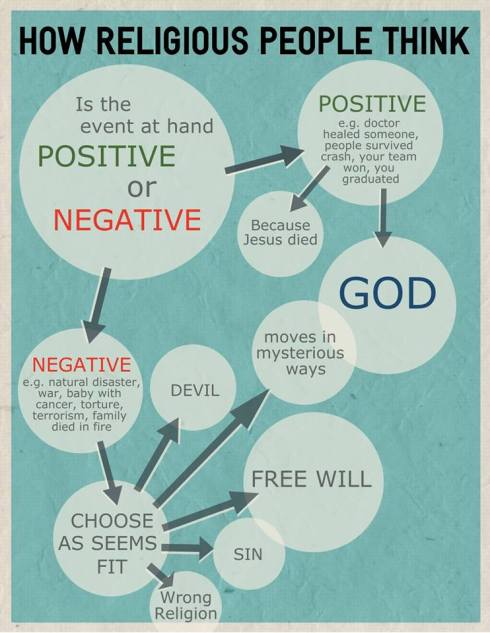
Your handy-dandy guide to religious reasoning…
We’ve had a few pieces on the disconnect between the public and the political process. This essay by Richard D. Wolff looks to answering the question why, despite there being two different political parties in the US, that the overall arc of the US body politic maintains the same general direction.
“In short, “democracy” has been applied to societies whose political/residential sphere was at least formally democratic but whose economic sphere was decidedly not.
The ideological rigidity of most brands of anti-statism across US history served nicely to keep the focus forever on state/public versus individual/private in thinking and acting about social change. Democracy was redefined in practical terms as the liberty of the individual/private from the intrusion of the state/public. The democratic quality of the individual/private enterprise – the central structure of the economy – was exempted from analysis or even from view in terms of its structural incompatibility with democracy. Legalistic equations of capitalist corporations with individual personhood also helped to distract attention away from the undemocratic structure of the corporation. Likewise, the US government’s commitment to a “democratic foreign policy” fostered the reproduction elsewhere of the same undemocratic economic structure that characterized the US.
The right wing of US politics has long understood and responded to social movements for equality and democracy as threats to capitalism. Its leaders built their coalitions by working to mobilize public opinion against those movements as threats to the “American way of life.” It built its ideology on the notion that democracy meant a state kept from intruding on the lives and activities of persons and enterprises rendered as equivalently “individuals.” Equality to them meant equality of opportunity, not outcomes: and then only if opportunity was strictly disconnected from the wealth, income and social position each individual was born into.
The left wing of US politics has always tried hard to sustain the notion that capitalism was not only compatible with egalitarianism and democracy. It would also be strengthened, not threatened, by moving capitalist society closer to equality and democracy. In practical terms it contested against the right wing by insisting that the mass of people – the workers in capitalist enterprises – would become disaffected from and disloyal to capitalism if it indulged its anti-egalitarian and anti-democratic tendencies. Capitalism, it argued and argues, will be strengthened not threatened by less inequality and more democracy.
Both left and right – and their expressions in the leaderships of the Republican and Democratic Parties – live in fear, conscious or otherwise, that the mass of people, the working class, will become disaffected from capitalism. “Populist” is the currently popular epithet that expresses this fear. Both parties contest for the support of the leaders of capitalism – major shareholders and the corporate boards of directors they select – by offering their alternative strategies for avoiding, controlling, or safely channeling mass disaffection with capitalism.”
Want to know moar, citizen? Check out Manufacturing Consent by Noam Chomsky.
Women’s Day has come around again. Let’s focus on the material conditions that inhibit the flourishing of women. A huge thank you to those women who have stepped up and are being seen in society thus providing the path for others to follow. Concomitantly, thanks to those who have chosen to take paths the patriarchy denies light to, but are vitally contributing to the well being of society and future generations.
I am a big fan of raunchel’s musings. Her writing is adroit, prescient, and incisive. A small sample highlights teh awesome:
“Because if there is one thing that a woman isn’t allowed to be in our society, it’s different. We aren’t allowed to be individuals, we only are part of a group. And we need this group, we have to be with others, to have a measure of safety. Alone, we’re vulnerable. Of course, in a group, with others, we’re still vulnerable, but less so. This means that it is vital to be part of a group. And to be part of a group, we have to be like the others.
Unfortunately, we live in a world where there are many pressures on women. All of society has expectations for us, and every deviation thereof means that we have to be punished. This punishment often is exclusion. We are expected to be silent, to be meek, to be a thousand things. But none of those things are being strong, being ambitious, or just being yourself.
This is why women often refuse to take the centre stage. Not only have we been taught since they were little girls that they should be silent, but they also know that if they do, they are excluded. They basically become un-persons, and even associating with them brings the same social punishment.
The reason why this is so strongly enforced is very simple. Nothing is as undermining to patriarchy as a woman who actually achieves something.”
–
Finite area but infinite perimeter? What magic is this?
In case you were unfamiliar. :)











 bleatmop
 Mystro
 The Arbourist


 Dead Wild Roses
Your opinions…