
You are currently browsing the monthly archive for June 2018.

Whelp, now you know. :)
A deliciously wriggling can of worms this topic is. I lean toward the answer being yes, but having rights in our society isn’t a guarantee of justice or fairness. I would hope that by the time sentient AI becomes a thing, we have our own house in order so we can be a good example to our AI children.
Well, another week of firsts folks. My first foray into Karaoke was with Paul Simon and late in the evening. Funny how the difficulty goes up when you happen to be responsible for the rhythmical and lyrical production. A few stumbles, but I managed to stay in time and in tune. ;)
I was lying In my bed I couldn’t of been no more Than one or two
I remember there’s a radio Comin’ from the room next door And my mother laughed The way some ladies do
When it’s late in the evening And the music s seeping through
The next thing I remember I am walking down the street I’m feeling all right I’m with my boys I’m with my troops, yeah
And down along the avenue Some guys were shootin pool And I heard the sound Of a cappella groups, yeah
Singing late in the evening And all the girls out on the stoops, yeah
Then I learned to play some lead guitar I was underage In this funky bar And I stepped outside to smoke myself a “J”
And when I came back to the room Everybody just seemed to move And I turned my amp up loud and I began to play
And it was late in the evening And I blew that room away
The first thing I remember When you came into my life I said I’m gonna get that girl No matter what I do
Well I guess I’d been in love before And once or twice I been on the floor
But I never loved no one The way that I loved you
And it was late in the evening And all the music seeping through
Patriarchy is the air we breathe, the taxes we pay, the norms we consciously and unconsciously follow. This post is long, but details exactly what the female representation of a dragon *should* be like. Not the patriarchally approved one that has appeared on the poster.
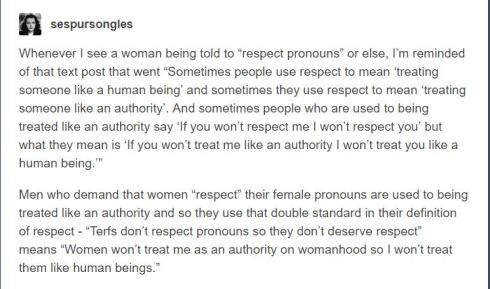
The strain of male entitlement runs through most of transactivism. The pronoun debacle, is no exception.
A corollary to this notion of respect is the ‘don’t be a jerk’ angle. What’s the harm in playing along with someone’s wishes? Why offend them when it’s just a simple linguistic modification.
I’m a big fan of being polite. It makes society and civilization possible. Where is the limit though? Joining people in their respective delusions, whether it be gender or religion or rallying on about ‘big phrama’ should not be considered to be an extension of ‘politeness’. I am (nor is anyone else) not obliged to be a part of the desultory grand stage that another person is setting.
Men have had the privilege of defining society and reality as they see fit since its inception – this tendency does not go away with the application of nail polish and a pair of cute shoes.
As a Physicalist, I can get behind some of what Rachlin says. I think I’ll have to read some more regarding his thoughts on pain though, because I’m finding it hard to take out the direct connection our nervous system has with the world out there and replace it with the notion that it is simply an interaction over time.
Interesting article none the less, and of course the three questions that get you thinking about what Teleological Behaviourism is reproduced here:
“As far as I am concerned, our minds are not mysterious entities in our brains but rather equivalent to the long-term patterns in our overt behaviour. This view stems from Aristotle’s philosophy of teleology, in which the end, not the means, is the most important part. For a psychologist, the viewpoint is known as teleological behaviourism, and that’s where I fall.
The concept might be difficult to accept at first, but give it a chance. Following are three questions and answers that are hard to resist; they might not convince you to become a teleological behaviourist, but they should demonstrate that teleological behaviourism is not as crazy as it might seem at first:
QUESTION: It is the far-distant future. Knowledge of the brain has progressed to the point where our brains can be removed from our bodies and stored safely in a room while communicating wirelessly with our bodies; such disembodied brains can control our movements as they do now in situ. American football teams use this brain-separation technique to protect themselves from concussions. Yet there are still broken arms and legs, and players writhing on the ground. Where is the pain?
ANSWER: The pain is in the players’ behaviour. The brains in the locker room contain the pain mechanisms, but pain itself is not an internal mechanism; it is an interaction over time between a person’s overt behaviour and the environment. It is the player writhing on the field, not his or her brain, that needs assistance; pain can function as a signal for that. For the hurt football player, as for us all, the pain of the moment exists in the context of a wider relationship over time between harmful stimuli (such as a hot stove) and overt and generally functional behaviour (such as pulling your hand away).
QUESTION: Again, it is the far-distant future. Suppose you lived then and married a wonderful person and had a great life together with perhaps children and grandchildren. After 50 years of marriage, on his/her deathbed, he/she tells you that he/she is a robot, manufactured rather than normally born. Would you be disappointed?
ANSWER: I would not be disappointed. If anything (say, a non-physical soul or some neural circuit in her brain) had been left out of my wife’s composition, that thing would have been entirely irrelevant to me. If her behaviour after all these years was that of a normal human being, her consciousness must have been that of a normal human being, by definition. Otherwise, consciousness would be a truly trivial thing. Consciousness evolved as did our less-extended behavioural patterns. The separation of consciousness from long-term behavioural patterns allows you to say that a normally behaving person, normal in every way (perhaps, over the long run, a better behaving person than you are), is ‘really’ inferior to you because his or her in-principle non-detectible consciousness is faulty or non-existent. Such a notion is not just wrong but destructive, and can underlie racism and prejudice of every kind.
QUESTION: Two people in a room are asked to imagine a lion. One closes her eyes and says: ‘Yes, now I see it; it’s walking around; I see the mane and the tail.’ The other person runs screaming from the room. Which one is imagining a lion?
ANSWER: Clearly the person running out of the room is imagining a lion. The other is imagining a movie of a lion. There are no sense organs in our brains; if there were, we would see nerves and not lions. To imagine something is to behave in the absence of that thing as you would normally do in its presence – as you would do if you perceived that thing. Thus, as Aristotle said, imagination depends on perception. Actors on the stage are performing acts of imagination. Good acting is not a consequence of good imagination but is itself good imagination.”











 bleatmop
 Mystro


 Dead Wild Roses
Your opinions…