
You are currently browsing the monthly archive for December 2019.
It would be nice if our current government would start taking responsibility for the mess that they are creating. Blaming the “Anti-Alberta Conspiracy” for the lacklustre economic performance of the economy reeks of desperation and deceit. Alberta’s Premier is busily talking out of both sides of his mouth when it comes to Moody’s Investor Service.
“When Moody’s Investors Service downgraded Alberta’s credit rating this week, Premier Jason Kenney reacted swiftly and decisively — to attack the messenger.He took aim at Moody’s for daring to include environmental risk in its report card. As Moody’s pointed out: “Alberta’s oil and gas sector is carbon intensive and Alberta’s greenhouse gas emissions are the highest among provinces. Alberta is also susceptible to natural disasters including wildfires and floods which could lead to significant mitigation costs by the province.”
Moody’s conclusion was understandable. In a time of climate change, credit rating agencies are taking environmental risk into account.
But Kenney refuses to accept that.
For him, this is just one more example of an anti-Alberta conspiracy. According to Kenney, financial institutions, including Moody’s, “are buying into the political agenda emanating from Europe, which is trying to stigmatize development of hydrocarbon energy. And I just think they are completely factually wrong.”
Kenney all but accused Moody’s of being part of the foreign-funded conspiracy he claims is out to landlock Alberta’s oil.”
Wait for it…
“The UCP, while in opposition, was happy to accept the conclusions of agencies, including Moody’s, whenever they downgraded the NDP government’s credit rating.
Consider this quote from UCP MLA Jason Nixon back in December of 2017 after the NDP government-of-the-day suffered yet another credit downgrade: “We have a government that is showing no signs of controlling their spending and clearly the credit agencies don’t trust them right now.”
However, as former-premier Ralph Klein was fond of saying, that was then, this is now.
According to the UCP back then, Moody’s was a purveyor of the truth.
According to the UCP now, Moody’s is “completely factually wrong.”
The Moody’s report, of course, put the UCP government in an awkward spot. This is a government that promised to turn the Alberta economy around with jobs and pipelines. Even though the Trans Mountain pipeline expansion is forging ahead, significant job creation is stuck in neutral.”
Yeah. The bullshit is that thick here in Alberta. It would be nice, for once, to let the facts speak for themselves without the partisan glaze that has become the norm. The UCP has demonstrated a distinct lack of leadership when it comes to the promises made on the campaign trail – job losses, negative economic growth, and more taxes (user fees) for the people of Alberta. Nothing like ‘making Alberta open for business, and getting people back to work’.
Lessig speaks to the notion that the media divide in American culture lies near the root of many of the countries problems when it comes to their democratic process.
“What is the role of education in a democracy? Must the electorate be informed? What happens when we are operating with a different view of reality?
Obviously it’s incredibly important that people understand their democracy. They understand the facts about what’s going on in the world and they begin to use their values in light of the facts to press for one set of policies over another. So we need some level of education. But we have moved from a world where much of a public education about matters of public import was provided by broadcasting and into a world where we can’t rely on that anymore. People are going to be less reliably aware of important issues––at least in a way which is grounded on a common set of understandings or a common set of facts. So it’s going to be harder for us as a people to resolve certain questions when those questions require common judgment.
For example: the question of impeaching the president. If the Congress goes through with the impeachment, and the Senate goes through with trying the President, there will be a very significant proportion of Americans who cannot believe the results, and a significant proportion of Americans who take the results as completely obvious. And that’s true regardless of what the result is. And that’s because we built this world where people live in these separate tribal bubbles and they don’t have an understanding of facts held in common. That’s a product of the media environment.
We’re not going to solve that, in the sense that we’re going to get to a place where we all know the same stuff. We need to think about solving it without trying to get everybody to the right place. We need alternatives to everyone being in the right place. That’s why I talked about things like the civic juries that can help people decide issues. That would enable reflective and informed judgments of the people, as opposed to unreflective judgments of the people. Regularizing that dynamic would be a critical part of what we need to do.
Will the result of the Impeachment hearings also illustrate something about whether our democracy is representative?
The reality of today is that any impeachment is going to be conducted in an environment where politicians can see the people and the people can see the politicians––but the people don’t see a common set of facts that the politicians are supposed to be viewed against. That’s because a significant chunk of the people are going to view the facts through the lens of MSNBC and another are going to view the facts through Fox News, and those two realities are going to conflict. They don’t agree; they don’t see the world in the same way. So that conflict is really debilitating, because it’s going to lead to one side believing something deeply unjust has occurred. That kind of recognition or belief is really invidious, poisonous to democracy. It’s something we should recognize as new. When we’ve had impeachments before, either the public was invisible, like with Andrew Johnson, or the public came to a similar judgment, or was driven to a similar judgment, like in the context of Nixon. So this change is very significant.”
This scares me. Not sharing a common set of facts is essential to functioning society. What’s worse is that the same phenomena is happening in Canada. I hazard to guess that the majority of my fellow residents of Alberta do not take the time to reach outside their media bubble and sample the waters of the ‘other’ side. I hear it in the online debates and talking with my fellow citizens, a decided lack of common ground and lack of agreement on shared facts when it comes to the governance of the province of Alberta.
Talking across the divide is very difficult and often ends in insults and more pertinently no forward movement toward a nuanced understanding of the issues at hand. And as Lessig says, the lack of common reference, is toxic for democratic societies.
Jane Clare Jones is a philosopher with a formidable intellect and a determined defender of women and their rights. This exchange cuts through the usual emotional appeals/name calling to get to the heart of the case for defending female rights and boundaries.


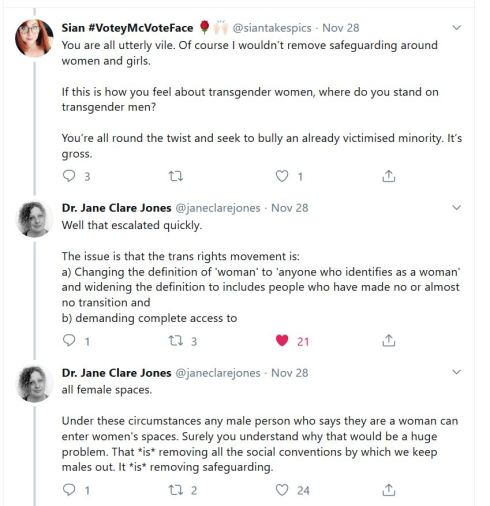

Amazing clarity of argument. Thank you Dr.Jones.












 bleatmop
 Mystro
 The Arbourist


 Dead Wild Roses
Your opinions…