
You are currently browsing the monthly archive for April 2025.
The DEI (Diversity, Equity, and Inclusion) requirements for the Library Technician position at BC Cancer in Vancouver appear to be more of a political purity test than a set of skills directly relevant to the job. The qualifications demand a deep understanding of systemic racism, Indigenous Peoples’ health contexts, and familiarity with specific legislative documents like the Truth & Reconciliation Commission’s Calls to Action and the Declaration on the Rights of Indigenous Peoples Act. While these are important societal issues, they are not inherently tied to the core duties of a library technician, such as organizing materials, assisting patrons, or managing databases. This focus on ideological alignment risks prioritizing political correctness over practical expertise, potentially alienating candidates who excel in the technical and operational aspects of the role but may not meet these specific ideological benchmarks.
Moreover, these requirements could deter highly qualified candidates who lack the specified DEI knowledge but possess exceptional skills in library management, customer service, or technical proficiency. For instance, a candidate with years of experience in library systems, a knack for efficient cataloging, and strong interpersonal skills might be overlooked if they haven’t engaged deeply with Indigenous-specific anti-racism education or settler-colonial history. By emphasizing these DEI criteria, the hiring process may inadvertently filter out individuals who could otherwise excel in the role, replacing merit-based selection with a test of ideological conformity. This approach undermines the goal of hiring the best candidate for the job, as it prioritizes social justice credentials over the practical abilities needed to perform the role effectively.
Ultimately, while fostering diversity and inclusion is a noble goal, the DEI requirements for this position create an unnecessary barrier to entry that may compromise the quality of the hire. The library technician role demands skills like alphanumeric filing, communication, and equipment operation, as outlined in the job description, yet the DEI expectations overshadow these core competencies. By focusing on political and cultural knowledge that is tangential to the job’s day-to-day responsibilities, BC Cancer risks missing out on candidates who could bring efficiency, innovation, and excellence to the role, thus hindering the organization’s ability to serve its patrons effectively.

https://jobs.phsa.ca/job/vancouver/library-technician-bc-cancer-vancouver/909/79784591232
The comparison of gender ideology to a Gnostic religious belief hinges on framing it as a worldview with metaphysical claims about identity, reality, and liberation. Here are five examples illustrating this perspective:
- Dualism of Body and Soul: Gnosticism often posits a split between the material body (flawed) and the spiritual soul (true self). Gender ideology can be seen as analogous when it suggests a person’s true gender identity resides in their internal sense of self, distinct from or in conflict with their physical body, which may be viewed as an obstacle to authenticity.
- Secret Knowledge of the Self: Gnosticism emphasizes esoteric knowledge (gnosis) as the path to salvation. Gender ideology sometimes frames self-discovery of one’s gender identity as a profound, personal truth that transcends societal norms or biological reality, accessible only through introspection or affirmation by others.
- Rejection of Material Reality: In Gnostic thought, the material world is illusory or corrupt. Critics argue gender ideology parallels this by prioritizing subjective feelings over objective biological markers (e.g., chromosomes, anatomy), treating physical sex as malleable or irrelevant to one’s true identity.
- Liberation Through Transformation: Gnosticism often seeks liberation from the material world through spiritual awakening. Gender ideology can be interpreted as promoting liberation from societal or biological constraints via social transition, medical interventions, or redefinition of language and norms to align with one’s identity.
- Moral Hierarchy of Believers: Gnostic communities sometimes distinguished between those enlightened by gnosis and outsiders. Gender ideology can create a similar dynamic, where those who affirm certain beliefs about gender are seen as morally superior, while dissenters are labeled as ignorant or harmful, fostering an in-group/out-group divide.
Gender ideology’s proponents might argue it’s grounded in psychological, social, or medical realities rather than metaphysical claims. Still, the Gnostic lens highlights perceived similarities in structure and worldview.
Critical Social Constructivism (CSC) underpins the ideology known as “woke,” as explained by James Lindsay on his New Discourses website. Lindsay (2025) describes CSC, or Critical Constructivism, as a framework where knowledge and reality are entirely socially constructed, devoid of any objective foundation beyond human perception and agreement. Within woke ideology, this perspective views social concepts like race, gender, and justice as products of narratives and power dynamics rather than universal truths. Woke activism uses this foundation to prioritize marginalized groups’ narratives, aiming to reshape societal truths to align with ideological goals. By rejecting objective reality, CSC enables woke activists to redefine reality based on who controls the dominant discourse.
Woke activists often avoid debate due to CSC’s logic, which Lindsay (2025) argues fosters a totalitarian power dynamic. Since CSC denies an objective reality accessible through reason or evidence, truth depends on social consensus shaped by power rather than rational dialogue. For woke activists, debating risks validating opposing views, which conflicts with their belief that truth emerges from enforcing the “correct” narrative. Instead of engaging in discussion, they employ social coercion through tactics like shaming, cancellation, or institutional pressure to silence dissent and ensure conformity. Lindsay emphasizes that this approach stems from viewing power as the ultimate determinant of accepted truth.
This reliance on coercion reflects a core CSC tenet: whoever holds power to enforce a narrative defines what is “true.” Lindsay (2025) notes that CSC’s rejection of objective reality implies truth is not discovered but created, and those controlling institutions, media, or cultural norms shape reality. In woke ideology, this translates to a relentless push to dominate discourse, equating narrative enforcement with truth establishment. By prioritizing power over reason, woke activists favor control over debate, using social force to validate their constructed realities and ensure their version of truth prevails.
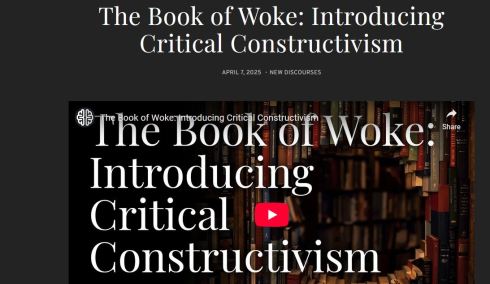
Reference
- Lindsay, J. (2025). The Book of Woke: Introducing Critical Constructivism. Retrieved from https://newdiscourses.com/2025/04/the-book-of-woke-introducing-critical-constructivism

Social constructivism, a theory positing that reality is constructed through social processes and interactions rather than being an objective truth, lies at the core of what is commonly referred to as “woke” ideology. This perspective asserts that knowledge, identity, and societal norms—such as gender, race, and morality—are not rooted in any inherent or natural order but are instead products of human agreement and power dynamics. In the woke framework, this translates into a belief that all structures and hierarchies are arbitrary and must be relentlessly questioned or dismantled, particularly those perceived as oppressive. The emphasis on subjective experience and collective narrative over empirical evidence or universal principles defines woke ideology as a direct descendant of social constructivism, where truth becomes malleable and contingent upon the dominant social discourse.
This worldview inherently encourages coercive attitudes because it rejects the possibility of a shared, objective reality that can be appealed to in resolving disputes. If reality is socially constructed, then those who control the narrative wield ultimate power, and dissent becomes not just a disagreement but a threat to the constructed order. Woke adherents often demand conformity to their reimagined norms—such as language policing, mandatory ideological training, or the silencing of opposing views—under the guise of protecting marginalized groups or advancing justice. This coercion stems from the belief that alternative perspectives perpetuate harmful constructs, leaving no room for dialogue or compromise. The result is a moral absolutism that justifies silencing or punishing those who deviate from the prescribed narrative, as their very existence challenges the fragile consensus of the constructed reality.
The totalitarian tendencies of this approach emerge from its insistence on universal adherence to a singular interpretive framework. Social constructivism, as embraced by woke ideology, does not tolerate competing claims to truth; it seeks to monopolize the social construction process itself. Institutions—be they educational, corporate, or governmental—are repurposed as tools to enforce this orthodoxy, often through mechanisms like cancel culture, deplatforming, or the rewriting of history to align with the approved narrative. Dissenters are not merely wrong but dangerous, necessitating their exclusion or reeducation. This mirrors historical totalitarian regimes, where control over perception and belief was paramount, except here it is cloaked in the language of progress and equity rather than overt authoritarianism.
Fundamentally, social constructivism within woke ideology constitutes an anti-real ontology—an explicit rejection of an independent, knowable reality. By denying that there are facts or truths outside human interpretation, it undermines the foundations of science, reason, and even basic human experience. For instance, biological realities like sex differences are reframed as oppressive constructs to be transcended, while historical events are judged not by evidence but by their alignment with contemporary moral sensibilities. This anti-real stance dismisses the possibility of a world that exists beyond our perceptions, reducing everything to a power struggle over who gets to define the “truth.” In doing so, it sacrifices the pursuit of understanding for the imposition of ideology, leaving no anchor for objective inquiry or mutual coexistence.
In conclusion, social constructivism serves as the intellectual bedrock of woke ideology, driving its coercive and totalitarian impulses while cementing its status as an anti-real ontology. It transforms society into a battleground of competing narratives where power, not truth, determines legitimacy. The resulting culture of enforced conformity stifles dissent and erodes the possibility of a shared reality, replacing it with a fragmented, subjective landscape that demands constant vigilance and control. Far from liberating, this framework traps individuals in a cycle of perpetual reconstruction, where no truth is final and no freedom is secure. Ultimately, it reveals a paradox: a philosophy claiming to deconstruct oppression constructs its own rigid, unyielding system in its place.
“Sommarpsalm,” also known as “En vänlig grönskas rika dräkt,” is a beloved Swedish hymn written in 1889 by Carl David af Wirsén, with music composed by Waldemar Åhlén. Originally penned as a summer psalm, it celebrates the beauty of nature and divine creation, capturing the essence of Sweden’s lush landscapes and serene summers. Its simple yet evocative lyrics have made it a cultural cornerstone, often sung at school graduations, church services, and national celebrations, symbolizing renewal and gratitude. The hymn’s enduring popularity reflects its deep resonance with Swedish identity, connecting generations through shared appreciation of the natural world.
En vänlig grönskas rika dräkt
Hav klätt de fält och ängar.
Nu smyckar solens gyllne prakt
Den värld, som Gud bebänger.
Det susar lätt i furuskog,
Det porlar svagt i källans vatten;
All jorden är en lovsångsrog
Till honom, som den skapat.
Med blomsterkrans om tufsig knut
Är lunden skönt behängd.
Var stig är lagd med mjuk sammet,
Som Herren har tillängd.
O Herre, du som jorden klätt
Med grönska, ljus och fägring,
Vår själ i tacksam glädje sätt,
Att lova dig med fröjdefägring!
A friendly verdure’s rich attire
Has clothed the meadows far and wide,
And summer’s sun with golden fire
Awakes the world in joyful pride.
The brooks in gentle murmurs sing,
The forests hum with life’s sweet spring,
And all the earth in gladness rings
With praises to the Lord on high.
The fields with blossoms soft are spread,
The trees with verdant leaves are crowned,
And every path where mortals tread
Is touched with beauty all around.
O God, who made the earth so fair,
We lift our hearts in grateful prayer,
Thy love and grace are everywhere,
Thy glory shines in summer’s day.
 A few houses down, there’s this neighbour who’s basically declared his yard a no-maintenance zone, and it’s got the whole block groaning. Every winter, we’re all out shoveling to keep the sidewalks clear, but his place? A snow-drift disaster that forces people to shuffle into the street. Come summer, his lawn’s a chaotic sprawl of overgrown grass and invasive weeds that look ready to invade the rest of the neighborhood. Like, come on—how hard is it to just run a mower over your lawn once a week-ish? It’s not like we’re begging for a botanical masterpiece, just some basic effort.
From where I’m at, I don’t have to deal with his mess directly, but you can’t miss it strolling by—it’s like a black hole sucking the charm out of the street. It’s not just about curb appeal; those weeds don’t respect property lines, creeping into other yards, and the unshoveled snow makes life harder for kids or anyone passing through. Keeping your yard decent shows you’re in it with the rest of us, not thumbing your nose at the neighborhood. A quick mow, a bit of edging, or a few minutes with a shovel isn’t a huge ask—it’s like saying, “Hey, I care about this place too.”
I don’t know what’s up with the guy—maybe he’s got bigger fish to fry—but letting your yard turn into the block’s eyesore feels like a choice. Nobody’s expecting him to sculpt topiaries or build a snow fort; just do the minimum so we’re not all dealing with the fallout. We’re all pitching in to keep the street looking like a community, not a free-for-all. A little sweat with a mower or a weed-puller goes a long way to keeping things neighborly.
An antidote :) –











 bleatmop
 Mystro
 The Arbourist


 Dead Wild Roses
Your opinions…