
Public arguments about biological sex often become tangled because several different questions are treated as though they were the same. Chromosomes, hormones, genital development, secondary sexual characteristics, and identity are placed into one conceptual pile, and the resulting complexity is then offered as evidence that sex itself must be a spectrum.
In his 2025 commentary, “Why There Are Exactly Two Sexes,” Colin Wright argues that this confuses the definition of sex with the mechanisms that determine it and the traits that ordinarily develop from it.
His central claim is straightforward: in anisogamous species, including human beings, sex refers to one of two reproductive functions. Male organisms are organized around the production of small gametes, or sperm; female organisms are organized around the production of large gametes, or ova. There is no third gamete type and, therefore, no third reproductive sex.
The qualification concerning biological function matters. Children, elderly people, infertile adults, and people with developmental conditions do not become sexless because they are not presently producing gametes. They belong to the reproductive class their bodies developed toward, even when that reproductive system is immature, impaired, or nonfunctional.
Five Sources of Confusion
Wright addresses five arguments commonly used to deny that sex is binary.
First, some fungi and slime moulds are said to possess hundreds or thousands of sexes. Wright explains that these organisms have numerous mating types: compatibility categories determining which organisms can reproduce with one another. Mating types are not sexes because they are not organized around the production of sperm and ova.
Second, variations such as XXY, X0, XX males, and XY females are offered as evidence that chromosomes create more than two sexes. This confuses how sex is determined with what sex is. Different species use chromosomes, temperature, environmental signals, or other mechanisms to direct sexual development. These mechanisms vary enormously, while the two reproductive functions remain the same.
Third, differences or disorders of sex development are presented as positions along a sexual continuum. These conditions demonstrate that sexual development is complicated and can produce ambiguous outcomes. They do not, however, produce a third kind of gamete or reproductive system. Difficulty classifying a rare individual does not create another reproductive class.
Fourth, sex is sometimes described as a cluster of chromosomes, hormones, anatomy, neurological features, and secondary characteristics. Since these traits vary, the argument goes, sex must also vary along a spectrum.
Wright’s answer is that these traits are causes, indicators, or consequences of sex, not its definition. A trait can only be described as male-typical or female-typical because males and females have already been identified by some independent standard. Remove the reproductive distinction, and the labels “male-typical” and “female-typical” lose their biological reference point.
Finally, multilevel models speak of chromosomal sex, hormonal sex, anatomical sex, behavioural sex, and sometimes gender identity as though each were a separate component of an individual’s sex. Such models may help physicians describe a patient’s particular biology, but description should not be confused with definition. A medically useful inventory of sex-related traits does not establish the existence of additional sexes.
Variation Does Not Abolish the Categories
The most useful distinction in Wright’s paper is between variation in sex-related characteristics and variation in the number of sexes.
Hormone levels vary. Bodies vary. Secondary sexual characteristics overlap. Sexual development can proceed atypically, and a small number of people may be difficult to classify unambiguously. None of this is denied by the reproductive definition.
A category can contain substantial variation without becoming a spectrum of categories. Human beings vary enormously in height, strength, appearance, fertility, and hormone levels, but this variation occurs within and between the two reproductive classes. Complexity at the level of traits does not generate additional reproductive functions.
A competing commentary by Brian Earp, Morgan Carpenter, and Sebastian Porsdam Mann accepts the existence of two gamete-based reproductive plans, but argues that “sex” can have additional, context-dependent meanings when classifying actual bodies in medicine or public policy. That is a serious practical consideration: a physician may need more information than a male-or-female box can provide.
It does not, however, refute Wright’s biological argument. Medical forms may require detailed information about anatomy, hormones, medications, pregnancy capacity, or surgical history. Recording those facts improves patient care without turning each combination of traits into another sex.
What the Paper Does — and Does Not — Establish
Wright’s paper is a scholarly commentary synthesizing evolutionary and developmental biology, not a new experiment or dataset. It provides a clear biological definition and tests several prominent objections against it.
Its argument is directly relevant when someone claims that chromosome variations, intersex conditions, overlapping characteristics, or numerous fungal mating types prove that human beings have more than two sexes. They do not.
The paper does not, by itself, settle every dispute involving transgender people. Biological description and public policy are related but separate questions. How society should handle identity, medical treatment, legal documentation, privacy, or sex-separated spaces requires additional evidence and moral reasoning.
That boundary strengthens rather than weakens the argument. Human dignity does not depend upon pretending that biological categories are unreal, and biological categories do not spaces requires additional evidence determine how every person must be treated in every circumstance.
There are two sexes because sexual reproduction in human beings is organized around two gametes and two corresponding reproductive functions. Developmental variation is real, sometimes medically significant, and deserving of humane treatment. It does not supply the missing third gamete required to create a third sex.
Complexity should improve our descriptions. It should not be used to erase the biological distinction that makes those descriptions intelligible in the first place.
Evidence note: Wright’s article was published as a commentary in Archives of Sexual Behavior. He is a salaried employee of the Manhattan Institute and has provided paid expert testimony on related issues; both are disclosed in the paper. The article is open access and can be read in full here.











 bleatmop
 Mystro
 The Arbourist


 Dead Wild Roses
1 comment
Comments feed for this article
August 15, 2026 at 5:51 am
Steve Ruis
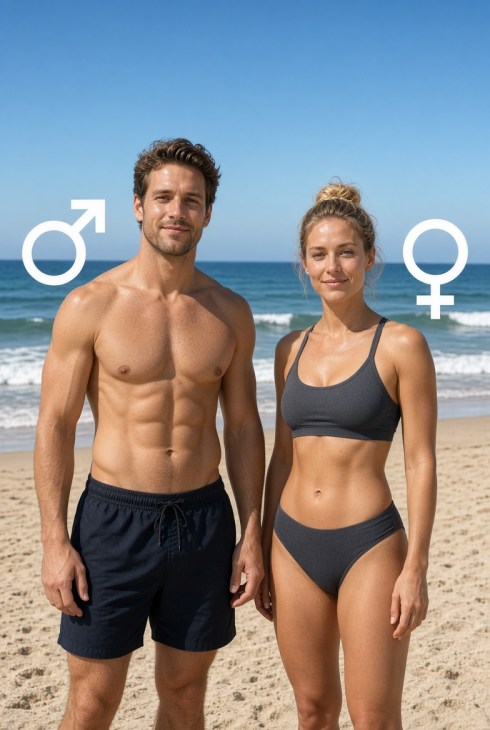
It’s not fair! Re the photo. Why do those two gorgeous creatures get to look like that and we look like what we do? Another example of the range of human “traits.”
LikeLike