
You are currently browsing The Arbourist’s articles.
:)

I’m fairly new on Twitter but have already had the displeasure of witnessing the fury of faux-progressive backlash against feminism and feminists attempting to speak their mind in public places… in Canada. Canada?? The easy going, live and let live notions we like to believe in the more sensible regions of Canada seem to dissipate in our larger cities. Queer rights activists and trans activists have mounted a vigorous assault not on the arguments of gender critical feminists, but rather their character, the venues that host said feminists, and a rather hyperbolic set of straw assertions/mantras that serve as conversational dead ends/thought terminating cliches.
This is not the left that I grew up with, nor do I intend to ever associate with. These individuals seem to believe that their individualistic solutions to systemic social problems will somehow win the day. Not gonna happen.
The comparison between the regressive left and religious is worthy of examination. James Bloodworth makes the comparison in his essay on Unherd.
“But politics as religion invariably comes with a cost. There is, naturally, a constant hunt for heretics. Public denunciations followed by ‘cancellations’ are de rigueur. Rigid adherence to doctrine is celebrated, while those who err are pompously told that they are on the “wrong side of history”. Political spats focus on the moral character of a person rather than the content of their arguments. Public arguments in which, as Swift phrases it, “identity leftists spend a great deal of time expending venom… at fellow leftists with whom they have some minor disagreements” are ubiquitous on Twitter and other social media.
All of this takes the Left further into the echo chamber, away from the people it is supposed to represent. Attitudes which are held by the vast majority of Britons — that there should be some upper limit on immigration, that sex differences exist, that gender isn’t entirely a social construct — are enough to get a person ‘cancelled’ by today’s hobbyist Left. Moreover, the slippery equation of words — or even thoughts — with violence creates a censorious climate where activists feel justified in hounding people from public life completely.”
See the transactivists haranguing women and trying to disrupt two public (in Toronto and Vancouver respectively) gatherings that featured Meghan Murphy and other feminist speakers was solid proof for me of the parallel.
The armament industries have lead the way in the conquest and modernization of the world. One of the key policies of British Empire was to keep manufacturing technology out of the hands of her far flung colonial conquests while denaturing and appropriating any of the native craftsmanship/technology solely for the benefit of the empire. Priya Satia writes about a historical technological divergence that happened around the 1800’s and how that manufactured divide laid the ground work for much of the present economic system and associated cleavages, we have today.
“Bengal, Mysore and Maratha are just three of many places in the Indian subcontinent where Britain at great expense and effort restricted, curtailed or closed down knowledge and capacity for arms manufacturing in India. The near parity between India and Britain in small arms made British conquest of the subcontinent slow, costly and difficult, and made the crushing of indigenous arms manufacture essential.
Perhaps many polities had the potential for industrial growth, but imperial ambition, generating military commitments requiring mass levels of supply, ensured that Britain became the site of industrial take-off – and a global arms depot. In addition to its geological and geographical advantages, Britain had coercive colonial policies enabling jealous control of know-how. Eighteenth-century Britons believed in the government’s right and obligation to use its might to promote industrial prosperity at home and strangle it abroad. We too must recognise the way that war shaped the entwined industrial fates of Britain and its colonies, and the way that power always shapes knowledge-sharing.”
The rest of Satia’s essay is quite heavy on historical specifics, but worth the read if you have the time.
This is the talk that the transactivists don’t want you hear. They protested, they shouted, they tried to intimidate the Library and women organizing the event. Share this widely folks, do not let the woke totalitarians win.


Listening to the news on the way to work this morning the last story was about the smog problem in New Delhi. The amount of particulate matter in the air was something like ten times the recommended levels for good health.
“Part of the problem stems from residents who burn small fires to keep warm when temperatures drop. Combined with crop burning, vehicle exhaust, industrial emissions from coal-fired plants, dust from building sites and smoke from the burning of waste, air quality is frequently unhealthy for residents. The AQI tends to spike when there is a lack of wind to clear out the particulate matter.
“India’s smog problem is due, in part, to the cooler temperatures recently, the lack of big weather systems to move air pollutants around and an ongoing drought across much of the country,” said weather.com meteorologist Jonathan Belles. ”
It looks pretty bad there:

They have been dealing with their smog problem for quite a while. Devising on the ground solutions to the particulate matter difficulties:

But this current bout with pollution has been the attributed primarily to the actions of farmers in the surrounding regions:
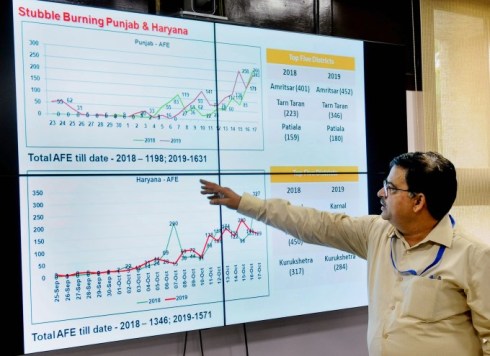
Poor farmers lack the modern tools to clear their fields after harvest. The traditional solution is to burn the stubble to the ground. Hence the annual spike in pollution in the city of New Delhi.
These sorts of problems are calling out for a communal based solution. The people in the city need to help the people in the poorer rural areas acquire the proper technology (tractors) to help them efficiently clear the fields. With the fields not being burnt, the air quality in New Delhi would improve, or at least not be exacerbated by the annual crop stubble clearing.
Wouldn’t be nice if we could get away from the capitalistic neoliberal model and focus on working on the problems that we face together? The world is just too small to continue to ‘f-you, I’ve got mine mentality’.











 bleatmop
 Mystro


 Dead Wild Roses
Your opinions…