
You are currently browsing The Arbourist’s articles.
Haydn’s chief biographer, H. C. Robbins Landon, has written that this mass “is arguably Haydn’s greatest single composition”.[1] Written in 1798, it is one of the six late masses by Haydn for the Esterhazy family composed after taking a short hiatus, during which elaborate church music was inhibited by the Josephinian reforms of the 1780s. The late sacred works of Haydn are masterworks, influenced by the experience of his London symphonies. They highlight the soloists and chorus while allowing the orchestra to play a prominent role.[2]
Owing to the political and financial instability of this period in European history, Haydn’s patron Nikolaus II dismissed the Feldharmonie, or wind band octet, shortly before Haydn wrote the Missa in Angustiis for the Princess’s name day.[2] Haydn, therefore, was left with a “dark” orchestra composed of strings, trumpets, timpani, and organ.[3] Later editors and arrangers added what they perceived to be missing woodwind parts, but the original scoring has again become the accepted choice for modern performances.
Though Haydn’s reputation was at its peak in 1798, when he wrote this mass, his world was in turmoil. Napoleon had won four major battles with Austria in less than a year. The previous year, in early 1797, his armies had crossed the Alps and threatened Vienna itself. In May 1798, Napoleon invaded Egypt to destroy Britain’s trade routes to the East.
The summer of 1798 was therefore a terrifying time for Austria, and when Haydn finished this mass, his own title, in the catalogue of his works, was Missa in Angustiis (Mass for troubled times). What Haydn did not know when he wrote the mass, but what he and his audience heard (perhaps on September 15, the day of the very first performance), was that on 1 August, Napoleon had been dealt a stunning defeat in the Battle of the Nile by British forces led by Admiral Horatio Nelson. Because of this coincidence, the mass gradually acquired the nickname Lord Nelson Mass. The title became indelible when, in 1800, Lord Nelson himself visited the Palais Esterházy, accompanied by his British mistress, Lady Hamilton, and may have heard the mass performed.[4]
Haydn’s original title may also have come from illness and exhaustion at this time, which followed his supervision of the first performances of The Creation, completed a few months earlier. More simply, it may have sprung from the challenge of composing without the desired instrumentation.[5] The solo parts for two of the vocal quartet are virtuosic: the bass line was perhaps written for the accomplished Christian Specht, and the soprano line, even more demanding, could have been written for Barbara Pilhofer or Therese Gassmann. The piece was premiered 23 September 1798 at the Stadtpfarr church, a last minute venue change from the Bergkirche in Eisenstadt.
Otherwise you get this:
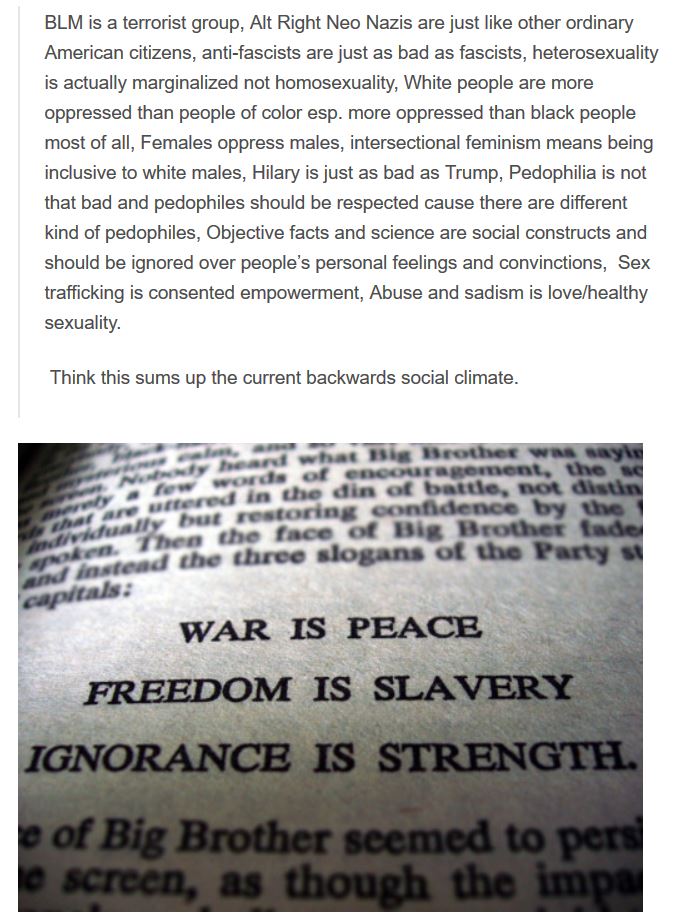
Auntie Wanda discusses the super-sekrit radfem position on gender and biology. :)
http://auntiewanda.tumblr.com/post/155279602721/wow-what-a-headache-that-was-to-read-its-not
“The vagina centric theme of the *woman’s marches* was entirely offensive…”
Heaven fracking forbid that women are able to identify with the material reality of their oppression.
No no, let’s not offend the men-folk…*that* should be the priority.
 The idea that feminism is the movement to liberate women from patriarchy (a notion lost to much of the befuddled third-wave) is finally beginning to (re)gain some traction as more women see what the unctuous morass of neo-liberal identity politics inflicts upon their mass movement.
“It saddens me to see the inclusive liberal feminism I grew up with reduced to a grab-bag of competing victimhood narratives and rival community-based but essentially individualist identities jostling for most-oppressed status. We need a better reaction to the election of a man who cynically responded to the center-left’s fragmentation by celebrating his own angry populist’s definition of white identity. Can’t we rise above the sniping about “privilege,” “white feminism,” “intersectionality,” and hierarchies of grievance in the face of Trump and the dangers he poses to the American and international liberal world order and women everywhere?
Such an approach doesn’t mean ignoring the differing experiences of women, or the history of racism between women, but confronting them empirically and resisting blaming each other for systemic disadvantage. Despite rampant inequality in the U.S., the word “class” doesn’t get a mention in the ‘Guiding vision and definition of principles’ of the march. Yet trans women/youth/migrants receive six references.
Cursory attention is given to the structural inequalities that limit all American women, regardless of their race, religion, sexual or other identities. American women across the board face huge barriers to labor force participation and achieving work-family balance compared to their sisters in Europe and other comparable developed countries. The vision document doesn’t even call expressly for nationally mandated paid maternity leave of at least three months — it describes “family leave” vaguely as a “benefit” rather than a right, in contrast to LGBTQIA human rights.”
It is almost like Ms.Symons is getting annoyed by the fact that the issues that are directly affecting women aren’t being centred in the march by and for women.
Fancy that.
Let’s see some transactivism in action shall we? Elizabeth Harrington, reporting in the Washington Free Beacon writes:
“Transgender activists are upset that the women’s march over the weekend was not inclusive to biological men who identify as women, as the protest presented an “oppressive message” that having a “vagina is essential to womanhood.”
Saturday’s event to oppose the inauguration of Donald Trump was largely a “white cis women march,” with too many pictures of female reproductive organs and pink hats, according to trans women and “nonbinary” individuals interviewed by Mic.com.”
Wow! Are you seeing the benefits of inclusivity? (I most certainly am!) I mean, the feelings of men at a woman’s march should definitely be prioritized as their gender-feels are profoundly more important than the onslaught women and their rights are being subjected to as a class.
“The women’s march had an over-reliance on slogans and posters depicting gender norms, like using pink to represent women and girls, said some transgender activists who boycotted the march.
“The main reason I decided not to go was because of the pussy hats,” said one transwoman from California. “I get that they’re a response to the ‘grab them by the pussy’ thing, but I think some people fixated on it the wrong way.”
“I believe there’s a lot of inequality that has to do with genitals—that’s not something you can separate from the feminist movement,” the transwoman added. “But I feel like I’ve tried to get involved in feminism and there’s always been a blockade there for trans women.”
The ‘blockade’ being that effective feminism is about he liberation of females from patriarchy. If you aren’t female, then this particular movement just isn’t about you. If you would like to show support for, and be an ally and reinforce the Feminist movement – that would be great – but have the common decency to not co-opt the feminist movement for your own agenda.
“Signs that said “Pussy grabs back,” “Resistance is Fertile,” and “Pussy Power” sent a “clear and oppressive message to trans women, especially: having a vagina is essential to womanhood.”
The article explained that transwomen are weary of “trans-exclusionary radical feminists.” “TERFs” are people who “equate womanhood with having a vagina” or feminists who “argue trans women are actually men in disguise trying to infiltrate their spaces.”
I’m guessing that women (and by that term I mean adult human female) are quite weary of having men (for centuries) try to define their reality for them.
Clearly, acknowledging sex-based oppression -in a feminist movement – is quite beyond the pale. Reflecting on the quote above, if one cannot distinguish between the notion of women being nothing but vaginas versus the notion that women have vaginas, then one probably shouldn’t be speaking about woman’s issues in the first place.
Finally, hopefully we can see what the transactivist movement brings to the table –

So ya, it is time for transactivists to acknowledge the fact that feminism is for females (this should not be controversial) and work in solidarity with Feminists toward feminist goals – or start your own movement that centres your own particular goals.
**UPDATE** – Trans solidarity with women? F*ck that noise. Further evidence of the need for a strong cleavage between feminists and transactivists.
http://tehbewilderness.tumblr.com/post/156776500409/did-the-national-womens-march-call-for-pussy











 bleatmop
 Mystro
 The Arbourist


 Dead Wild Roses
Your opinions…