
You are currently browsing The Arbourist’s articles.
Western public culture has no trouble speaking in the language of conquest, so long as the conqueror is European. We can list the crimes of empire in a catechism: invasion, extraction, settlement, forced conversion, slavery, and the slow grinding down of local institutions. We teach it. We ritualize it. We build moral identity around denouncing it.
But history did not outsource conquest to Europe.
From the 7th century onward, Muslim-ruled polities participated in a major, long-running arc of territorial expansion: the early Arab conquests across the Levant, Egypt, North Africa, and Persia; the push into Iberia; later Turkic and Ottoman expansion through Anatolia and into the Balkans; and, further east, Muslim dynasties consolidating power across parts of South Asia. This was not a tea party with trade agreements. It was war, regime change, tribute systems, and durable social hierarchies that reordered whole regions for centuries.
Even where rule was comparatively tolerant by the standards of its time, it was still rule. Non-Muslim populations were commonly governed as dhimmi, protected yes, but subordinate. They often paid special taxes, faced legal asymmetries, and lived under conversion pressures that, in some contexts, ranged from overt coercion to the long, quiet incentives of status and security. The story differs by place and century. The pattern does not disappear.
Then there is slavery, another topic where our moral accounting often becomes selective. The trans-Saharan, Red Sea, and Indian Ocean systems ran for many centuries and involved very large numbers, though estimates vary widely. They fed household servitude, military slavery, and sex slavery. In the Mediterranean, North African corsairing and “Barbary piracy” produced European captives well into the early modern era. Some historians argue for totals in the low millions across those centuries, though the higher figures are disputed and other scholars propose substantially lower estimates. Either way, the phenomenon is real, and it is rarely integrated into the default Western “slavery story,” which typically means plantations, the Atlantic triangle, and racial chattel bondage. The Ottoman system also included practices like devshirme, the levy of Christian boys for state service, and imperial governance across religious communities was often managed by layered legal categories. Stability was purchased with inequality.
None of this is a claim that Muslim-majority societies are uniquely violent. They are not. It is a claim that they were human societies with power, ambition, and the usual imperial toolkit. Sometimes it was tempered by pragmatism. Sometimes it was sharpened by ideology. It was always shaped by the incentives of rule.
So why does so much Western academic and activist discourse treat “colonialism” as if it is a European invention, or at minimum reserve the hottest moral language for European cases?
You can see the asymmetry in ordinary cultural output. A student can finish a humanities degree with a fluent vocabulary for “settler-colonialism,” “whiteness,” and “decolonization,” and still never be asked to apply the same conceptual machinery to the Islamization of North Africa, the Turkification of Anatolia, or the Ottoman imperial management of the Balkans. The knowledge exists. The integration often does not.
A few mechanisms are doing the work:
First: the moral map is drawn around modern Western guilt. Universities and NGOs in the West operate inside a story where the primary purpose of historical consciousness is to discipline our civilization. That can be valuable. Self-critique is healthier than propaganda. But it also creates a spotlight effect. If the goal is penance, you do not look for other sinners. You look for mirrors.
Second: postcolonial theory often frames power in a one-directional way. “Colonizer” and “colonized” become fixed identities rather than recurring historical roles. Once the roles harden into moral identities, describing conquest by non-Western empires becomes conceptually awkward. It scrambles the script.
Third: fear of misuse leads to silence. Many scholars and activists worry, often reasonably, that frank discussion of Islamic conquest will be weaponized by bigots. But the answer to bad faith is not selective amnesia. When institutions pre-censor reality to prevent “the wrong people” from citing it, they teach the public a fatal lesson. The gatekeepers do not trust the truth.
Fourth: selective “harm literacy” is now a career incentive. Some topics are safe, rewarded, and legible within current moral fashion. Others are professionally risky, easily smeared, or administratively discouraged. This does not require a conspiracy. It is simply an ecosystem where the costs and benefits are asymmetrical.
The result is not denial, exactly. It is a pattern of omission. Certain conquests are treated as the central moral lesson of history. Others are treated as context, complication, or footnote, no matter how long they lasted, how many people they reordered, or how durable their legal hierarchies proved.
If “colonization” is a real category, and if it means conquest, extraction, tribute, settlement, cultural subordination, and the restructuring of life under new rulers, then it has to apply wherever the pattern appears. Otherwise it is not analysis. It is choreography. 🎭

So here is the question Western institutions should be willing to answer plainly: Why is one empire’s violence treated as the moral template, while another empire’s violence is handled like a reputational hazard, especially when the same victims, religious minorities, conquered peoples, and enslaved captives, are supposed to matter in our universalist ethics?
Because the cost of selective memory is not merely academic. It trains citizens to distrust the referees. When respectable institutions signal, through omissions and asymmetrical moral urgency, that certain truths are too dangerous to say out loud, audiences will go looking for people who will say them. Often crudely. Often with their own distortions. And the gatekeepers will have manufactured the very problem they feared.
If “process legitimacy” is the immune system of pluralist democracy, then institutional behaviour on gender policy is a stress test. The question isn’t whether an organization “supports trans kids.” Most Canadians want distressed kids treated with compassion. The real question is whether a major institution preserves the rules that let citizens disagree without declaring each other enemies: transparent standards, viewpoint tolerance, due process, and consistent safeguarding norms.
On gender issues in Alberta schools, the Alberta Teachers’ Association (ATA) has repeatedly positioned itself against provincial policies that increase parental consent/notification requirements (for under-16 name/pronoun changes) and opt-in consent for certain explicit instruction around gender identity and sexuality. (Reuters) (Those positions are not obscure; they are central to ATA’s public posture around the province’s direction of travel.)
More important than the slogans is the procedural stance that shows up in teacher guidance: ATA-affiliated materials have explicitly cautioned educators against disclosing a student’s sexual orientation or gender identity to parents or colleagues without the student’s consent. (Office of Population Affairs) That is a high-stakes choice about where authority sits—between child, family, and school. You can argue for it. You can argue against it. But you can’t pretend it’s neutral. It quietly rewrites safeguarding defaults: the family becomes, at minimum, a conditional partner rather than the presumption.
Now add the evidence environment. Over the last two years the confidence level around pediatric medical interventions has become more openly disputed—not only in Europe but in the Anglosphere generally. A major American federal review published under HHS/OPA in late 2025 frames the evidence base for pediatric gender-dysphoria treatments as weak/low-certainty and calls for greater caution and higher standards of evidence. (Office of Population Affairs) Separately, a 2025 systematic review and meta-analysis focused on puberty blockers for youth with gender dysphoria rated the certainty of evidence as very low for many outcomes and called for higher-quality studies. (PMC)
None of that automatically tells Alberta what to do. But it does tell you what institutions shouldn’t do: treat a contested landscape as settled; treat caution as moral failure; treat parental involvement as presumptive danger; or treat dissent as “misinformation” rather than as disagreement about evidence thresholds and child-protection tradeoffs.
Because once an institution behaves that way, it teaches a poisonous lesson: the process is legitimate only when it produces the “right” outcomes. That’s outcome legitimacy wearing a procedural costume. And it’s exactly how you get an arms race in which every faction concludes it must “capture” the institution before the other faction does.
To be clear: there are serious researchers and clinicians who report short-term mental-health improvements in cohorts receiving gender-affirming medical interventions, and there are studies reporting low regret among youth who accessed puberty blockers/hormones in particular samples. (PubMed) That’s precisely why process legitimacy matters: when evidence is mixed, partial, or uncertain, the only adult stance is procedural humility—clear standards, honest uncertainty, room for argument, and policies that can survive being applied by your opponents next year.
Verdict (process-first, not tribe-first)
If an institution wants to avoid the “friend/enemy” trap on this file, it should stop acting like moral certainty is a substitute for good procedure. In practice that means:
- publish the evidence threshold being used (and why),
- separate student support from ideological doctrine,
- adopt viewpoint-neutral professional norms (no loyalty tests),
- and set safeguarding rules that can be defended symmetrically—not only when your side holds the pen.
That’s how you reduce ideological capture risk without replacing it with counter-capture. 🧯

Glossary 📌
Process legitimacy — Accepting an institution’s decision as binding even when you dislike the outcome, because rules were lawful, fair, transparent, and consistently applied.
Outcome legitimacy — Treating a process as legitimate mainly when it produces your preferred outcome.
Ideological capture — A condition where a contested worldview becomes so dominant in an institution’s norms and incentives that dissent is chilled and policy becomes insulated from evidence contestation and pluralism. (Best treated as an inference from mechanisms, not a slogan.)
Safeguarding — Child-protection norms and practices: role clarity, duty of care, appropriate parental involvement, documentation, escalation pathways, and risk management.
Low certainty evidence — A systematic-review judgment (often using GRADE) indicating limited confidence that an observed effect is real and durable; future studies may change the conclusion materially.
Puberty blockers (in this context) — Medications used to pause pubertal development; the debate concerns indications, outcomes, and risk–benefit in youth with gender dysphoria.
Citations 🧾
ATA / Alberta schooling context
- ATA-affiliated guidance on confidentiality around students’ sexual orientation/gender identity (GSA/QSA guide). (Office of Population Affairs)
American evidence review
- HHS/OPA report PDF: Treatment for Pediatric Gender Dysphoria: Review of Evidence and Best Practices (Nov 19, 2025). (Office of Population Affairs)
- HHS press release summarizing the report (Nov 19, 2025). (HHS.gov)
- Scholarly critique/response to the HHS report (J Adolesc Health, 2025). (JAH Online)
Systematic review on puberty blockers
- Miroshnychenko et al. 2025 systematic review/meta-analysis (PubMed + full text). (PubMed)
Evidence suggesting benefit / satisfaction in some cohorts (for balance and accuracy)
- Tordoff et al. 2022 (JAMA Network Open): association with lower depression/suicidality over 12 months. (JAMA Network)
- Olson et al. 2024 (JAMA Pediatrics): satisfaction/regret findings in youth accessing blockers/hormones (regret rare in that sample). (JAMA Network)
This essay is not an argument against transgender adults living freely and being treated decently. It is an argument about a specific set of claims—metaphysical, political, and clinical—that tends to generate persistent institutional conflict because it lacks a shared stopping rule. By “stopping rule,” I mean a principled boundary that both sides can recognize as legitimate: a line where accommodation ends and coercion begins, or where uncertainty requires caution. When subjective identity claims are treated as authoritative and dissent is treated as harm, disputes recur across domains—speech norms, public policy, and pediatric medicine—because there is no common adjudicator capable of resolving the underlying disagreement.
1) Thesis and scope: what is being argued, and what is not
The claim here is procedural. Whatever one’s moral intuitions, systems built to enforce contested metaphysics predictably produce friction that neither side can permanently “win.” A pluralist society can enforce civility and prohibit harassment. It cannot, without escalating conflict, require citizens and institutions to treat an internally felt identity as the final authority over publicly legible categories—especially when those categories structure law, safety, and fairness.
2) Metaphysical claim: identity as authoritative reality
The metaphysical claim, stated minimally, is: when sex and self-declared gender conflict, identity is treated as the authoritative reality for how others must speak and for how institutions must categorize. In a liberal society, people routinely request courtesy; the tension begins when courtesy becomes a duty enforced by institutional sanctions, because that converts disagreements about contested concepts into compliance problems.
The mechanism is structural rather than psychological. If a proposition is treated as morally obligatory yet largely unverifiable, enforcement shifts from evidence to norms, and from norms to penalties. This does not require attributing motives; it is a predictable consequence of asking public systems to operationalize contested metaphysics. The cost is an expansion of “speech governance,” where ordinary interpersonal mistakes or dissenting beliefs are treated as policy violations rather than social disputes. The verdict: making subjective identity authoritative at the level of public rulemaking tends to destabilize shared norms, because the principle contains no internal boundary that can settle recurring disputes.
3) Political claim: institutions forced to referee contested categories
The political claim extends the metaphysical one: public institutions must treat identity as authoritative in classification and access. The “no stopping rule” problem becomes concrete when policy must decide eligibility, categories, and competing rights. Sport is not the whole controversy, but it is a clear case study because sex-segregated categories exist to preserve fairness under stable biological differences.
World Athletics’ 2023 regulations excluding transgender women who have experienced male puberty from elite female competition were an explicit attempt to draw a boundary grounded in performance-relevant biology rather than identity.(worldathletics.org) This example does not “prove” the broader thesis; it illustrates the governing dilemma: once identity is treated as determinative, any sex-based boundary becomes contestable on the same logic, and institutions are pulled into continuous adjudication. The cost is not only policy churn but legitimacy loss, as significant segments of the public come to see institutions as enforcing contested beliefs rather than administering neutral rules. The verdict: when institutions are made to referee contested metaphysical claims, policy disputes harden into identity conflicts and become difficult to resolve through ordinary pluralist compromise.
4) Clinical claim: minors, uncertainty, and the need for evidentiary brakes
The clinical claim is narrower and higher-stakes: affirmation-first protocols are often presented as the evidence-based default for minors, despite ongoing disputes about evidence quality, long-term outcomes, and appropriate thresholds for irreversible interventions.
The mechanism is again about stopping rules. In pediatrics, where patients may have limited capacity to grasp lifelong tradeoffs and where interventions can be difficult to reverse, uncertainty normally triggers caution: structured assessment, conservative pathways, and high evidentiary standards. In England, the Cass Review’s recommendations prompted major service redesign, and NHS England’s implementation document outlines steps already taken and planned in response to those recommendations.(england.nhs.uk) The UK government also announced that emergency restrictions on the private sale and supply of puberty blockers would be made indefinite following advice from the Commission on Human Medicines, citing safety concerns; the DHSC explainer situates this within a broader shift toward research frameworks.(gov.uk)
The point is not that UK policy settles the science. The point is procedural: a major public health system treated evidentiary uncertainty as a reason to tighten pathways and emphasize research structures. The cost of overstating certainty is predictable—trust erosion among families, clinicians, and the public when policy appears to run ahead of evidence. The verdict: for minors, uncertainty should operate as a brake; when it does not, clinical decision-making becomes vulnerable to political and ideological pressure.
5) Steelman, with a credibility caveat: what proponents argue, and why WPATH cannot be treated as neutral authority
A fair steelman starts with the humane premise: some young people experience profound distress; social rejection correlates with worse mental health; supportive environments may reduce suffering; and for adults, liberal societies generally presume wide autonomy over body and presentation. Observational research has reported short-term associations between receiving puberty blockers or hormones and lower reported depression or suicidality among transgender and nonbinary youth, while still facing the usual limitations of nonrandomized designs (selection effects, confounding, short follow-up).(jamanetwork.com)
Advocates often cite WPATH’s Standards of Care (SOC8) as a professional consensus reference point. A publishable essay, however, has to include a procedural caveat: SOC8 is now contested as an uncontested authority, particularly for minors, due to public disputes about guideline-development process and evidentiary representation. The “WPATH Files” publication by Environmental Progress alleges internal discussions inconsistent with the public posture of evidentiary confidence.(environmentalprogress.org) Separately, an HHS report alleged that during SOC8 development, WPATH suppressed certain systematic reviews considered potentially undermining to preferred protocols.(opa.hhs.gov) WPATH and USPATH responded by disputing key characterizations and criticizing the HHS report, framing it as misrepresenting evidence, and noting constraints around ongoing litigation and related processes.(wpath.org)
The responsible conclusion is limited but important: SOC8 may still be used to describe the best-case articulation of the pro-affirmation position, but it cannot function as a neutral “settled science” stamp—especially in a pediatric domain where evidentiary confidence must be demonstrable rather than asserted. The verdict: steelman the humane intent and the reported short-term associations; do not outsource epistemic certainty to a guideline whose development and representation are under active public dispute.
6) Synthesis: stopping rules as the governance solution
The practical question is governance, not moral panic: can a pluralistic society accommodate people without compelling metaphysical assent, and can pediatric medicine proceed without overstating certainty? The answer is unglamorous: stopping rules.
In institutions, stopping rules mean enforcing civil treatment and anti-harassment norms while refusing to treat metaphysical agreement as a condition of participation in public life. In medicine, stopping rules mean evidence thresholds, transparent review, and heightened caution for minors where long-term outcomes remain contested. If stopping rules are refused, conflict tends to migrate: from clinics to courts, from policy to punishment, from persuasion to compulsion. The cost is durable polarization and degraded trust in institutions. The verdict: if the goal is social peace and clinical integrity, the burden is on advocates and opponents alike to articulate boundaries that are evidence-responsive, rights-consistent, and enforceable without demanding ideological conformity.

Glossary
Affirmation-first: A clinical approach that treats a person’s stated gender identity as true and prioritizes support for it; critics argue it may reduce exploratory assessment, especially for minors.
Cass Review: Independent review commissioned by NHS England into child and adolescent gender services; its recommendations prompted service redesign and tighter evidence standards.(england.nhs.uk)
Observational study: Research that observes outcomes without random assignment; can show association but generally cannot prove causation.(pubmed.ncbi.nlm.nih.gov)
Puberty blockers (GnRHa): Medications that suppress pubertal development; debated in youth gender medicine due to evidence-quality and risk/benefit uncertainty.(gov.uk)
SOC8: WPATH Standards of Care, version 8 (2022), widely cited in gender medicine; currently disputed as neutral authority in some public controversies.(environmentalprogress.org)
Stopping rule: A principled boundary that can settle recurring disputes (e.g., evidence thresholds for minors; category rules in sport).
WPATH Files: A publication of alleged internal WPATH materials by Environmental Progress; relevant here because it is part of an ongoing credibility dispute about guideline development.(environmentalprogress.org)
References
- NHS England, Implementing the Cass Review recommendations (PDF). https://www.england.nhs.uk/wp-content/uploads/2024/08/PRN01451-implementing-the-cass-review-recommendations.pdf
- NHS England, Children and young people’s gender services: implementing the Cass Review recommendations (long read). https://www.england.nhs.uk/long-read/children-and-young-peoples-gender-services-implementing-the-cass-review-recommendations/
- UK Department of Health and Social Care, “Ban on puberty blockers to be made indefinite on experts’ advice” (11 Dec 2024). https://www.gov.uk/government/news/ban-on-puberty-blockers-to-be-made-indefinite-on-experts-advice
- DHSC Media Blog, “Puberty blockers: what you need to know.” https://healthmedia.blog.gov.uk/2024/12/11/puberty-blockers-what-you-need-to-know/
- World Athletics press release (Mar 2023) on female eligibility. https://worldathletics.org/news/press-releases/council-meeting-march-2023-russia-belarus-female-eligibility
- World Athletics eligibility regulations PDF. https://worldathletics.org/download/download?filename=c50f2178-3759-4d1c-8fbc-370f6aef4370.pdf&urlslug=C3.5A%20%E2%80%93%20Eligibility%20Regulations%20Transgender%20Athletes%20%E2%80%93%20effective%2031%20March%202023
- Tordoff et al., JAMA Network Open (2022). https://jamanetwork.com/journals/jamanetworkopen/fullarticle/2789423
- Environmental Progress, “The WPATH Files.” https://environmentalprogress.org/big-news/wpath-files
- HHS, Treatment for Pediatric Gender Dysphoria (Nov 2025). https://opa.hhs.gov/sites/default/files/2025-11/gender-dysphoria-report.pdf
- WPATH/USPATH response (May 2025). https://wpath.org/wp-content/uploads/2025/05/WPATH-USPATH-Response-to-HHS-Report-02May2025-3.pdf
“Trans kids didn’t exist until we created them” is blunt phrasing, but the mechanism underneath it is real: kids don’t merely reveal identities; they adopt the identity-models a culture supplies and rewards. Adolescence is a meaning-factory. Pain looks for an explanation. Alienation looks for a tribe. If adults and institutions elevate one interpretive story for distress and then attach moral prestige, protection-from-questioning, and instant community to that story we should expect more kids to step into it. Not because every child is “lying,” but because this is how social scripts spread: they simplify suffering, convert it into status, and offer belonging on demand.
Proponents will tell a cleaner story. They claim “trans kids have always existed” and we’re simply seeing higher visibility in a less stigmatizing age. They claim affirmation is harm reduction. They claim the clinical pathway is cautious, selective, and evidence-informed. And they claim the “social contagion” frame is just a pretext to dismiss real dysphoria. That’s the best version of their public narrative: visibility + safety + compassion + careful medicine. The problem is that this narrative asks society to treat disputed assumptions as settled truth and then to treat moral confidence as a substitute for evidence – precisely in the domain where evidence must be strongest: irreversible interventions for minors.
That’s where the ideology runs aground. The evidence base for pediatric medical transition—especially puberty suppression—has repeatedly been assessed as weak and low-certainty. The York-led systematic review published in Archives of Disease in Childhood concluded there is a lack of high-quality research on puberty suppression in adolescents with gender dysphoria/incongruence, and that no firm conclusions can be drawn about impacts on dysphoria or mental/psychosocial outcomes. A 2025 systematic review in the same journal similarly characterized the best available evidence on puberty blockers’ effects as mostly very low certainty. This isn’t a minor academic quibble. It’s the difference between “we have strong reasons to believe this helps, on balance” and “we cannot be confident what this does to developing bodies and minds.” When the confidence level is that low, the ethical default is not acceleration; it’s restraint.
And restraint is exactly what some public health systems have moved toward—because the claims didn’t cash out in robust evidence. In the UK, the NHS stopped routine prescribing of puberty blockers for under-18s and restricted them to research context, and the government moved to make restrictions indefinite after expert advice citing insufficient evidence of safety. NHS England’s Cass implementation materials also frame puberty blockers as part of a research program with long-term follow-up, alongside evaluation of psychosocial interventions. That is not what “settled science” looks like. That is what a field looks like when it is finally admitting—late—that it has been making high-stakes moves on thin ice.
Now zoom out from the clinic to the culture, because this is the part people keep refusing to say out loud: the social environment is not neutral. Once schools, media, and professional bodies moralize one framework (“affirmation is care”) and stigmatize alternatives (“questioning is harm”), you get a one-way ratchet. A child declares an identity; the adults are trained that the declaration must be treated as authoritative; “exploration” becomes suspect if it doesn’t begin with affirmation; and any friction is rebranded as abuse. That moral framing isn’t compassion—it’s epistemic closure. And epistemic closure is exactly how you end up routing heterogeneous adolescent distress into a single explanatory funnel.
Because the presenting population isn’t one thing. It’s a mix: anxiety, depression, trauma, obsessive traits, social contagion dynamics, autism-spectrum features, sexual discomfort, body dysmorphia, internalized homophobia, loneliness, and the general misery of puberty in a screen-soaked status economy. Give that mix one glamorous story with institutional backing, and you will pull more children into it. You will also make it harder for them to exit, because the identity becomes socially defended and medically reinforced. Once irreversible steps begin, doubt becomes expensive. Regret becomes unspeakable. The “care model” becomes self-protecting: the deeper you go, the harder it is to admit the initial certainty was misplaced.
This is why I don’t treat “gender-affirming care” as a neutral phrase. It’s marketing language for a clinical posture that—too often—front-loads conclusion and back-loads caution. Real care for minors under uncertainty looks boring: slow assessment, serious differential diagnosis, treatment of comorbidities, family stability, and time. Real care doesn’t require anyone to be cruel. It requires adults to resist the temptation to turn a child’s distress into an adult moral performance. It requires institutions to stop rewarding certainty and punishing skepticism. It requires the basic humility to say: “We might not know what’s going on yet, and that means we don’t get to make irreversible bets with children.”
If we don’t change course, the end state is predictable. More kids will be swept into an identity pipeline that confers instant meaning but demands escalating commitment. More parents will be coerced by policy and stigma rather than persuaded by evidence. More clinicians will practice defensively in a moralized climate. And the backlash won’t stay polite or surgical; it will arrive as a blunt instrument, because careful critics were dismissed as hateful for too long. That’s the social damage: not merely the trend itself, but the institutional refusal to admit uncertainty until the human costs become impossible to ignore.

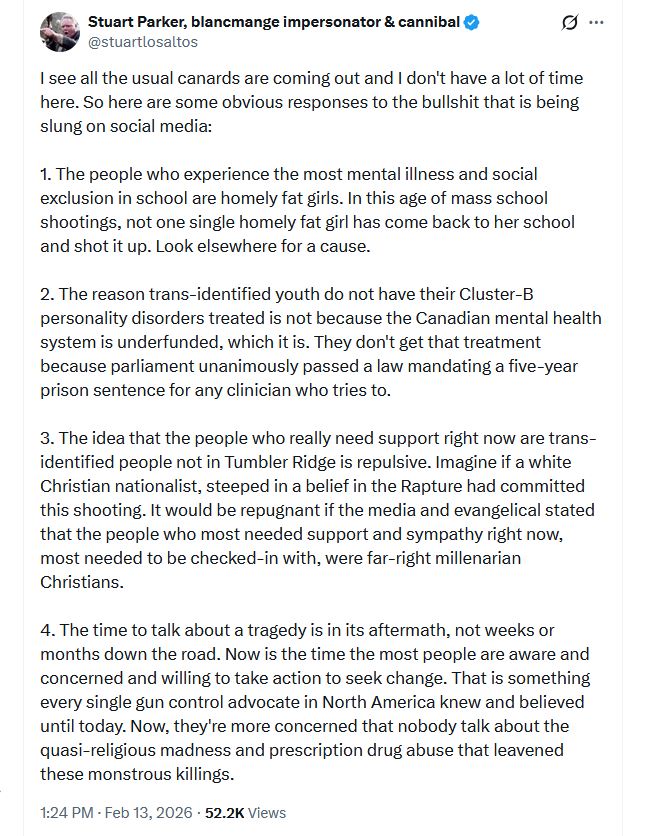
The first duty of public journalism after a massacre is simple: name the dead, establish the sequence, and tell the truth about what is known and what is not. That is media hygiene. That is how a public learns. That is how systems get fixed.
Instead, we got a firewall.
In the immediate wake of the Tumbler Ridge killings—home first, then school; five students dead, an education assistant dead; the perpetrator dead by suicide—the national conversation was quickly steered away from forensic clarity and toward reputational triage. In at least one major network segment, the frame was explicit: the story was “anti-trans disinformation” after the shooting. Not the chain of events. Not the failure points. Not the institutional blind spots. The message was prophylactic: watch what you say; the real danger is how people might talk about it.
This is not merely tone-deaf. It’s a form of complicity.
Not complicity in the act, obviously—complicity in what follows: the slow, predictable replacement of accountability with moral theatre. When a newsroom’s first instinct is to manage narrative risk, it begins to treat facts as flammable materials—things to handle with gloves, filter through approved experts, and keep away from ordinary citizens who might draw the “wrong” conclusions.
That is how gatekeepers lose legitimacy. And it is how tragedies become recurring.
The mechanism: switch the object of fear
Watch the pivot closely and it’s always the same move.
- A real event happens in the world—blood, bodies, families blown open.
- The newsroom identifies a second-order risk: public anger, political fallout, reputational damage to a protected consensus.
- The coverage shifts from “What happened?” to “What must we prevent?”
- Prevention is defined as protecting a narrative, not repairing a system.
The object of fear changes. Instead of fearing the next killing, the institutions fear the next argument.
So they tell you the problem is “misinformation.” They tell you the danger is “conflation.” They tell you this is a moment for “community support” and “protecting vulnerable people.” And those may all be decent impulses—in their proper place, at their proper time. But as a lead story? As the framing lens? As the moral of the segment?
That’s not reporting. That’s crisis communications.
“Don’t conflate” becomes a solvent
One line in particular functions like a solvent in the modern media ecosystem:
Don’t conflate an identity with violence.
Fine. True in the general case. But after a massacre, deployed as the first moral reflex, it does more than discourage scapegoating. It quietly discourages inquiry.
Because inquiry is not a vibe. Inquiry is a chain:
- What was the timeline?
- What were the warning signs?
- Who saw what?
- What interventions were tried?
- Where did they fail?
- What policies shaped those failures?
- What is going to change next week because children are dead?
A solvent doesn’t “refute” those questions. It dissolves the social permission to ask them. It turns scrutiny into contamination.
That is why it feels so out of touch to grieving parents: it is journalism behaving as if the central public hazard is discussion rather than risk.
Media complicity looks like this
Complicity, in this context, is not about malice. It’s about habit.
It’s the habitual choice to protect institutions from accountability by rerouting attention:
- From the scene to the discourse.
- From the victims to the community statement.
- From the timeline to the think-piece.
- From “what failed?” to “what mustn’t be said?”
A professional newsroom used to be allergic to this. The old standards—imperfect, often biased, frequently arrogant—still had a core ethic: facts first, advocacy last. If advocacy entered the frame, it was labeled as such. If uncertainty existed, it was named. If a claim couldn’t be verified, it didn’t get aired as settled truth.
Today, too often, we get advocacy laundering: press-release moralizing presented as news, with the added twist that dissent is treated as a moral defect rather than a factual dispute.
That is not neutrality. That is narrative commitment wearing a blazer.
What “media hygiene” used to mean (and must mean again)
A return to old standards isn’t nostalgia. It’s practical survival. Here’s what media hygiene looks like when it’s done properly—especially after mass violence:
1) Victims first.
Name the dead. Describe the community. Make the loss real before you make it useful.
2) Sequence before interpretation.
Timeline, confirmed facts, and clearly separated unknowns. No moral “lesson” until the basic chain is established.
3) Mechanisms over slogans.
If firearms were involved, the mechanism is access and storage—specific failures, not national clichés. If mental health is part of the background, the mechanism is escalation thresholds and follow-up—specific gaps, not hashtags.
4) No prophylactic framing.
Do not lead with “misinformation,” “backlash,” or “what this might fuel.” Those are downstream effects. They are not the event.
5) Don’t pre-label inquiry as bigotry.
Scapegoating is wrong. So is shutting down investigation by treating questions as dangerous.
6) Separation of church and newsroom.
Advocacy voices may be relevant. They must not become the controlling lens. Journalists should interrogate them the way they interrogate police, politicians, and corporations.
7) Corrections that cost you pride.
If you get something wrong, correct it prominently, not performatively. Trust is built when gatekeepers admit error without theatrics.
None of this requires “hating” anyone. It requires doing the job.

The consequence of failing the job
When media behaves like a narrative defense force, the public does not become more compassionate. It becomes more suspicious. It begins to assume that every tragedy will be translated into a pre-approved moral. It begins to look elsewhere for facts—often to sources far less responsible, far more conspiratorial, and far more cynical.
That is the boomerang effect of the firewall: the attempt to prevent “bad interpretations” produces a credibility vacuum, and the vacuum fills with poison.
If journalists want to stop that cycle, they can’t do it by lecturing the public into compliance. They can only do it by earning trust the old way: through sequence, clarity, restraint, and the disciplined refusal to turn atrocity into messaging.
Because if the first move after a massacre is to protect a narrative, the system will not learn.
And if the system does not learn, it will repeat. 🕯️











 bleatmop
 Mystro


 Dead Wild Roses
Your opinions…