
You are currently browsing The Arbourist’s articles.
In 2018, after fifteen years together and six years of marriage, my wife told me that our relationship was no longer working for her and that she wanted to separate. I was left trying to decide what hurt more: the loss of the relationship itself or what felt like the betrayal of the vows we had made. In sickness and in health, for better or worse, until death parted us. Those promises had described the future as I understood it. Suddenly, they did not.
I spent many hours talking with my mother and friends, returning to some version of the same question: How could she do this to me, and how could she do it to us? It was partly a search for an explanation, but it was also an argument with reality. I believed our shared history, the difficult years we had already survived and the commitment we had made to our later years ought to count for more than they apparently did.
She told me that she no longer felt the kind of romantic and physical connection she needed from a marriage. For her, companionship, shared history and the other parts of our covenant could not compensate for what was missing. I did not share her conclusion, but I came to understand it even while experiencing her decision as a betrayal of our vows.
Marriage requires two people to sustain it, but only one to withdraw. I made the case for the life we had built and the future I believed remained possible. A covenant may carry moral obligations, yet it cannot be preserved by one person alone. Eventually, there was nothing left to negotiate except the conditions of the ending.
By 2019, I had lost twenty pounds from stress. The house was sold, and I moved in with my mother to serve as her caretaker. The divorce was amicable in conduct, even when its consequences were devastating. I have seen divorces animated by cruelty, revenge and the deliberate destruction of whatever survives after the marriage has failed. Ours was not like that, and I remain thankful for it. Suffering is not a tournament, however, and perspective does not make an experience painless.
Fiona, our white cat, came with me. She became the finest snuggle companion and love cat a temporarily broken man could have asked for. She offered warmth, routine and uncomplicated affection when all three were badly needed. Fiona died in 2025 and still holds a dear place in my heart. She helped carry me through one loss before I had to grieve hers.

Fiona, who came with me in 2019 and remained a beloved companion until 2025
Divorce is not the same as death, but it breaks many of the same bonds. A familiar person disappears from the role she occupied in my life, taking with her not only the present relationship but an imagined future. The difference is that she remains alive somewhere beyond the boundary of that shared world. The grief therefore carries an additional question: this person did not simply vanish; she chose to leave.
In the final portion of his conversation on TRIGGERnometry, Arthur Brooks presents falling in love as the ultimate example of prudent risk-taking. The phrase initially sounds too calm for the experience it describes. Love exposes us to rejection, grief and the possibility that another person will change in ways we cannot control. Even the happiest relationship eventually exposes someone to loss. Yet the sensible response cannot be to eliminate the risk by refusing to love. A life shielded from every wound would also be cut off from much of what makes life worth living.
This is the difficult territory left after defining happiness and identifying its false substitutes. A happy life is not one in which nothing terrible happens, nor is pain evidence that we have failed to construct one correctly. The more serious question is what pain becomes after it arrives. It can harden into permanent accusation, turn inward as self-punishment or gradually become part of a more honest understanding of ourselves and other people.
Brooks offers a compact formula for the distinction: suffering equals pain multiplied by resistance. It is better read as a heuristic than a clinical equation. Pain is the wound itself; resistance is the mind’s continuing insistence that reality must not be what it already is. One of the hosts describes noise in his home that he could not eliminate. Once he stopped fighting its existence and arranged his life around it, the noise remained but much of his suffering receded.
The stakes of divorce are considerably higher than irritating noise, but I recognized the mechanism. “How could she do this?” was a legitimate moral question, particularly while I was trying to understand what our vows had meant to each of us. Repeating it indefinitely could not restore the marriage. In time, the question stopped uncovering information and became another way of refusing an answer I had already received.
Non-resistance does not mean passivity, and acceptance is not a moral pardon. Some causes of pain can and should be changed. Illness should be treated, injustice opposed and a failing relationship confronted while both people remain willing to repair it. Wisdom lies partly in recognizing which lever is still available. I could ask for honesty and examine my conduct. I could not make another person want the same future.
This raises an apparent tension in Brooks’s account: he speaks of suffering as sacred and part of being fully alive, but also argues that we can reduce it by relinquishing resistance to unavoidable pain. I would put the first claim more cautiously. I did not want my divorce or, years later, Fiona’s death. Pain does not become valuable merely because we survive it, nor does an injury become virtuous through severity. A life fully alive does not go looking for wounds. It accepts vulnerability as the cost of loving others and pursuing goods that can be lost.
The divorce taught me, but it did not teach automatically. Whatever wisdom I gained emerged through conversations, reflection and decisions made after the initial crisis had passed. That process helped me move from blaming her to blaming myself and finally toward a more complicated account of us. It did not divide responsibility into mathematically equal shares. It allowed me to examine the part of the marriage that was mine to understand.
Looking back, I came to see how often I had confused being nice with being kind. Niceness, as I had practised it, tried to preserve the immediate calm. It avoided the difficult conversation, softened the unwelcome observation and plastered over cracks in the foundation in the hope that they would repair themselves. Kindness proved more demanding. It required accepting the discomfort of telling the truth before silence turned a manageable problem into structural damage.
Hard honesty begins with ourselves. We can believe we are being considerate while quietly withholding information another person needs in order to know us. Assumptions fill the resulting gaps, and because they are rarely tested, they can resemble mutual understanding for years. The surface remains pleasant until it can no longer bear the weight placed upon it.
Better communication cannot save every relationship because honest people sometimes want incompatible things. Truth guarantees nothing, but it clarifies the risk they are taking together and replaces unspoken expectations with something less comfortable but more solid.
Gratitude arrived much later. For a long time, acknowledging that the marriage contained real happiness felt dangerously close to excusing the way it ended. Yet the fifteen years were not all bad. Most of them were pretty good. The ending did not retroactively poison every shared meal, private joke, difficult season survived or ordinary day of companionship. Those experiences were real even though the permanence I attached to them was not.
I still qualify that gratitude. The betrayal continues to irk me in the way a scar does not quite feel like the surrounding skin. A scar is not an open wound, but neither is it evidence that nothing happened. Gratitude does not require us to falsify the texture of memory. It is not a final acquittal delivered upon the past; it is the gradual recovery of what was worth having from the pain of how it was lost.
Fiona taught the same truth in a gentler register. Knowing now that I would lose her does not make me wish she had not come with me. Grief should not have exclusive ownership of the memories that preceded it. The pain belongs to the story, but it does not get to claim the entire story as its own.
By 2020, I was ready to try again, though “ready” may grant the process more tidiness than it possessed. I made one commitment to myself: I would be honest about who I was, what I wanted and what I brought to the table. I had no interest in selling someone a polished version of myself and hoping reality would arrive too gradually to cause trouble.
Six years into my current relationship, it is about as good as relationships get. There are still problems and irritations because two imperfect people have not discovered a loophole in the human condition. Marriage may be on the horizon. Would it be a slam dunk? I know better than to claim that. People and their desires change over time, and vows cannot remove the freedom that gives them meaning.
What we can do is communicate, listen and try to understand what the person beside us is feeling before the cracks disappear beneath another coat of plaster. We can tell the truth early enough for kindness to remain possible. None of this guarantees permanence. It creates better conditions for trust and gives both people a fairer understanding of the life they are choosing.
This is what makes love a prudent risk rather than blind optimism. Prudence does not eliminate uncertainty; it asks whether the good being pursued is worthy of the exposure it requires. I entered this relationship without believing I had made myself invulnerable to another loss. I knew more clearly what love asks of me and what avoidance had once allowed me not to say.
A fully alive person is not someone who has learned to enjoy suffering. There is no moral achievement in remaining inside preventable misery, and no virtue in refusing help when pain becomes unmanageable. The choice is not between worshipping suffering and fleeing every discomfort. It is between treating pain as one part of life and allowing the fear of pain to determine the boundaries of living.
Enjoyment, satisfaction and meaning do not form a protective wall around a life lived properly. Faith, family, friendship and meaningful work matter partly because they draw us beyond the small territory we could keep perfectly controlled.
I would not choose the divorce again merely to preserve its lessons. I would not choose Fiona’s death to prove that her companionship mattered. Yet I remain grateful for what was good in my marriage, for the white cat who helped a temporarily broken man find warmth again, and for the relationship that later asked me to risk an uncertain future with greater honesty.
Happiness does not require a painless life. It requires enough openness to keep loving what can be lost, enough judgment to change what can still be changed, and enough humility to carry what cannot. The scar remains different from the surrounding skin, but it belongs to a living body.

Private voice lessons can expose a peculiar conflict between learning and approval. I enter wanting to please my coach by doing everything correctly, yet that desire can produce the tension that prevents me from singing well. I anticipate correction, imagine the expected standard and begin consciously supervising every part of the instrument. Breath, placement, phrasing, resonance and tone become a laundry list of instructions rather than an integrated act.
Finding the vocal sweet spot requires something more difficult. I must remain mindfully aware of the instrument while trusting the process learned through practice. The technique does not disappear but recedes far enough into the background for singing to begin. Each lesson involves some combination of learning and unlearning: accepting correction without receiving it as proof that I do not belong there.
“The difficulty begins when correction stops being information about the singing and starts feeling like information about the singer.”
Comparison is often called the thief of joy, but in a demanding art form it can also be the steward of earned progress. Recordings, professional singers and a vocal coach provide standards against which improvement becomes audible. Used diagnostically, comparison reveals the next piece of work. Used as a measure of personal worth, it can make genuine progress feel fraudulent.
The larger trajectory becomes visible when I step back. The time required to find that vocal state has decreased, even if it has not reached zero. My coach’s instruction has moved from broad corrections toward increasingly precise details. Plateaus and regressions remain, along with missed practice sessions and the accompanying self-reproach, but finer criticism may be evidence that I have become capable of working at a finer level.
The difficulty begins when correction stops being information about the singing and starts feeling like information about the singer.
Imposter syndrome often occupies the space between those judgments. External evidence of competence accumulates—successful performances, praise, increasingly demanding repertoire—without producing a corresponding sense of security. Each challenge reopens the question of whether the previous success was deserved. The achievements are real, yet their reassurance cannot last because they were expected to prove personal worth.
This is one form of a larger mistake Arthur Brooks explored during his appearance on the TRIGGERnometry podcast. Drawing on Thomas Aquinas, Brooks described four goods that readily become idols: money, power, pleasure and fame or honour. Achievement and social validation fit most naturally under honour, especially when accomplishment becomes a way of earning admiration from the people whose judgment matters to us.
The word idol can sound needlessly theological when applied to ordinary ambition or pleasure. Brooks’s point is more useful than a catalogue of forbidden desires. An idol is a limited good expected to perform unlimited work—something capable of improving part of a life that we begin asking to explain the value of the whole.
What’s my idol?
Brooks does not simply ask his students to choose their favourite from money, power, pleasure and fame. Direct questions invite flattering answers. Few people want to identify themselves as greedy, controlling, hedonistic or vain, and the crudest version of each idol may bear little resemblance to the form it takes in a respectable life.
Instead, he proceeds by elimination. Imagine possessing only an ordinary amount of each good. Which could you surrender most easily? Which would make being average feel intolerable? Continue until one remains.
The categories broaden as the game unfolds. Money includes wealth, possessions and access to resources. Power means influence over people and events. Pleasure encompasses comfort, security and relief from disturbance as well as sensual indulgence. Fame includes honour, prestige and the desire to be highly regarded by a particular audience.
For someone struggling to secure food, shelter or safety, money’s urgency should not be mistaken for idolatry. Material necessity is not a moral failure.
The podcast’s hosts initially struggled to recognize themselves inside those definitions. One spoke about needing money to obtain the life he wanted, but the life he described was defined by peace, comfort and freedom from inconvenience. Money was the instrument; security was the promise. The other recognized his vulnerability to immediate pleasures used for mood management. His carefully constructed guardrails—including avoiding alcohol, meditating and structuring his days—showed that the pleasure idol need not resemble carefree indulgence. It can appear as the temptation to self-administer relief whenever difficult feelings arrive.
Fame wears an equally convincing disguise. A professor may have no desire for celebrity while longing to enter an academic conference and be recognized as the author of an important paper. A singer may feel no attraction to a mass audience while caring intensely about the judgment of a conductor, vocal coach or accomplished musician. The desired audience can be extremely small. Its authority matters more than its size.
Power also appears in respectable forms: the desire to control outcomes, prevent dependence or arrange a life in which no one possesses the ability to unsettle us. Money may become valuable because it purchases insulation; status because it commands deference; competence because it reduces the occasions on which we must ask for help.
The game therefore looks beneath the object to the promise attached to it. Do I want money, or protection from uncertainty? Influence, or freedom from vulnerability? Pleasure, or escape from an emotional state I cannot tolerate? Recognition, or evidence that someone whose judgment matters believes I am worthy?
My own answer is not indiscriminate applause. It is the more respectable desire to be regarded as capable by people whose judgment I trust. That desire can support serious work. It can also turn a lesson into an audition I am trying to pass, shifting my attention from discovering what the voice can do toward demonstrating that I already know.
The idol is revealed less by what we possess than by what we expect the possession to prove.
Groundhog Day dramatizes what happens when the promise attached to achievement is love. Phil Connors uses the repeating day to study Rita’s preferences, memorize the correct responses and construct the version of himself he believes she will approve. Even learning the piano becomes part of the strategy. The skill is real, but its value lies in making him appear accomplished and worthy of admiration.
The film turns as Phil’s actions cease to function primarily as transactions. Rita does not owe him affection because he has accumulated enough good deeds. His transformation makes love possible because he stops treating goodness as currency and Rita as a prize. He becomes willing to be known rather than merely approved.
Human doings
The film magnifies a quieter pattern. Imposter syndrome describes the failure of achievement to settle an inner doubt; the “human doing” responds by producing still more achievement. We observe what attracts approval, reproduce it and hope repeated success will eventually provide security.
Brooks sees this pattern among high-achieving students who believe money is their principal motivation. Many are more deeply attached to honour. They may have learned early that excellence attracted attention, and attention felt enough like love for the two to become difficult to distinguish. Grades become promotions, publications, performances, salaries or professional recognition. Yesterday’s evidence must continually be replaced because its reassurance has already begun to fade.
Brooks describes such strivers as “human doings” rather than human beings. They do not merely enjoy accomplishment or take proper pride in competence. Productivity supplies evidence that they are worthy of attention, belonging or love.
Modern social validation makes the transaction unusually visible. Views, likes, applause, reviews and rankings can tell us that something connected with an audience. They cannot establish that the audience values the person apart from the performance. The singer’s applause and the writer’s readership are real feedback; trouble enters when success must also answer whether the performer deserved to be there.
There are two questions hidden inside the fear that we are not enough.
Am I good enough for this task? Preparation, evidence and honest criticism can answer that. A singer may not yet be ready for the solo. An essay may require another draft. A missed week of practice can produce an audible result. Reassurance cannot substitute for work, and inherent dignity does not make every performance equally competent.
Am I accomplished enough to deserve dignity, friendship or love? No performance can answer that question. Every measurable achievement permits another increment: a larger audience, a better performance, a more prestigious position or the approval of one more respected person. The scoreboard can record progress, but it contains no square marked enough.
The false idol of achievement collapses the two questions: I was not good enough for this task; therefore, I am not enough. The first judgment may be accurate and useful. The second does not follow from it. Criticism can identify inadequate preparation, technical weakness or poor judgment; it cannot calculate the total worth of the person being criticized.
Character and conduct still matter. Loyalty, honesty, sacrifice and care make healthy intimacy possible, while cruelty, betrayal and neglect can destroy it. Inherent worth does not excuse wrongdoing or require anyone to remain in a harmful relationship.
Love nevertheless cannot be converted into wages paid for sufficient achievement. Recognition can be earned. Intimacy must also be freely given and received.
We do not become enough as people by crossing an achievement threshold. We begin from the premise that people possess worth, then spend our lives becoming more capable, responsible and generous without mistaking that unfinished work for an audition to qualify as human.

Putting good things back in their place
Recognizing an idol does not require rejecting the good concealed inside it. Money can provide security, power can protect the vulnerable, pleasure can deepen rest and celebration, recognition can honour worthy work, and achievement can develop capacities through which we contribute to the world.
The question is what these goods serve. Directed toward purposes beyond themselves, they can support a life; made responsible for identity, their loss begins to feel like the loss of self.
Brooks contrasts the idols with faith, family, friendship and meaningful work. The distinction is not absolute: work can consume a person, families can be unhealthy, and religious identity can become another source of status. At their best, however, these goods ask us to give, receive and participate rather than accumulate evidence of our importance.
They also resist complete control. A friendship cannot be optimized like a résumé. A family cannot be reduced to an audience. Meaningful work requires competence, but its meaning depends upon whom or what the competence serves. Faith, where it is genuinely practised, begins with the humbling possibility that value is received before it is achieved.
Brooks grounds that worth in grace; a secular account may ground it in equal human dignity. Either way, worth must precede performance, because performance cannot establish it.
The vocal lesson still requires preparation. The correction may be accurate, and the missed practice repetitions remain mine to own. But the coach is evaluating the singing, not conducting an audition for my humanity.
There is freedom in allowing that distinction to stand. Achievement can return to being achievement: difficult, rewarding and worth pursuing. Criticism can become information rather than condemnation. Love can be received without immediately asking what performance will be required to keep it.
We do not need to become less ambitious. We need to stop asking ambition to tell us when we are enough.
By the time we performed Mozart’s Missa brevis in F major, K. 192, most of the work had already been done. Learning the Mass required hours devoted to rhythm, phrasing and tone, active listening, regular rehearsals, instructions pencilled into the score, and conversations with the conductor about difficult passages. It became a nearly totalizing choral experience.
During the performance, much of that technical work receded into the background. I could remain present, engaged with the music and responsive to the conductor, because the necessary decisions had been practised into me. After living and breathing a work for long enough, one is no longer merely singing the correct notes, but producing art that can speak to and move another person.
Calling the experience happiness leaves important details unexplained. The preparation included repetition, frustration and the knowledge that an exposed mistake could affect more than my own performance. Removing those difficulties would not have improved it. The work made possible a degree of competence, attention and participation that would otherwise have remained closed to me.

In a recent conversation on the TRIGGERnometry podcast, Arthur Brooks argued that our pursuit of happiness often goes wrong because we begin with a faulty definition. We imagine happiness as a sustained condition of cheerfulness or freedom from distress, and then treat sadness, anxiety or frustration as evidence that something has gone wrong.
But human emotional life was never designed to provide uninterrupted pleasure. Fear alerts us to danger, sadness registers loss, and anxiety prepares us for uncertainty. These emotions can become excessive or disordered, but their presence does not prove that happiness has abandoned us. A life without pain, fear or sadness would not necessarily be happy; it might simply be impossible.
Brooks instead describes happiness as a combination of enjoyment, satisfaction and meaning. He calls them its “macronutrients.” The metaphor is a useful heuristic, not a scientific anatomy of the good life. Happiness is not one sensation that must be continuously maintained, but something that emerges when several human needs are met in reasonable proportion.
Enjoyment is more than pleasure
The first distinction Brooks makes is between pleasure and enjoyment. Food, alcohol, gambling, sex, comfort and attention can all produce pleasure. None is necessarily bad, but the sensation is immediate and temporary. Once it fades, it must either be accepted as complete or pursued again.
Enjoyment asks more of us. Brooks argues that pleasure becomes enjoyment when we add people and memory. Gambling alone at four in the morning is not the same experience as prudently playing cards with friends, just as stress-eating alone is different from sharing a meal and conversation with people whose company we value.
“Pleasure asks how we can feel good right now. Enjoyment asks whether this good thing is enlarging our experience or merely administering another sensation.”
People and memory capture much of the distinction, though reading, gardening, listening to music or walking alone can also be deeply enjoyable. What matters is whether we are present to the experience or merely using a sensation to alter our mood. A favourite piece can become background noise, just as a good meal can be consumed while scrolling without our having properly tasted it. We receive the stimulus, but scarcely inhabit the experience.
Pleasure asks how we can feel good right now. Enjoyment asks whether this good thing is enlarging our experience or merely administering another sensation. The Mozart offered something more substantial than the pleasure of singing beautiful music because I was participating in a shared undertaking, responding to the conductor and other singers, and contributing my voice to something none of us could have produced alone.
Yet its depth depended upon everything that came before it: the difficult passages, corrections in the score and gradual acquisition of competence. To understand that part, we need Brooks’s second element of happiness: satisfaction.
Satisfaction needs resistance
Satisfaction contains a paradox: experiences that ultimately satisfy us may require us to tolerate frustration, defer gratification and continue working without immediate reward. Brooks calls it the joy of an accomplishment joined to struggle. A student who cheats on an examination may receive an A, but cannot experience the satisfaction of mastering the material. The outward evidence remains while the process that would have made it real has been bypassed.
More importantly, the work changes the person doing it. Learning demanding music develops attention, discipline, judgment and the ability to respond to other performers. Those capacities cannot be transferred with the sheet music or acquired through a shortcut. Preparation does more than delay the reward; it makes a deeper experience of the music possible.
The professional support singers in our community choir reveal a subtler version of the same principle. They sight-read fluently, model accurate rhythm and intonation, and sing with a clarity and control that can raise the standard of an entire section. Yet the singer standing nearby can use that excellence in two very different ways.
One can simply sing behind the professional, allowing the stronger voice to determine every entrance, rhythm and phrase. The immediate performance may improve, but the amateur is chiefly practising how to follow. Alternatively, one can listen actively: noticing the placement of a consonant, comparing intonation, understanding how a difficult rhythm fits the phrase, and gradually learning to share responsibility for leading the section.
In the first case, professional support substitutes for musicianship; in the second, it becomes a model through which musicianship develops. Help does not cheapen an accomplishment when it enables us to do the necessary work. It becomes a shortcut when we use it to avoid developing the capacity ourselves.
Worthwhile struggle derives its value from what it serves: learning, creation, responsibility, love or some other intelligible good. A task gains nothing merely from being unpleasant, and needless suffering does not ennoble us. Still, worthwhile goals often ask something from us before they give something back.
“A singer does not invent the score, tradition, text, ensemble or disciplines required to participate. He enters an inheritance that precedes him, develops a voice within it, and helps carry it forward.”
Brooks illustrates this through a child who snacks continuously and arrives at dinner without an appetite. Anticipation and hunger allow the eventual meal to satisfy. I recognize a musical version of that anticipation in preparing for Haydn’s Missa Cellensis, a work considerably longer and more complex than the Mozart. Although I have not yet received the score, two months of listening have taught me its shape and left me eager to discover what the tenor line will demand. The pleasure is already present, along with appetite and expectation.
Modern life encourages the opposite approach: obtain more of what we want while reducing the effort required. This works well when the object is convenience, but less reliably when the goal is competence, character, intimacy or art. Efficiency can deliver a product; it cannot always reproduce the development involved in making or earning it.
Success brings another limit. Brooks calls our expectation of lasting fulfilment the “arrival fallacy”: the promotion becomes our job, the new possession becomes familiar, and the completed performance becomes a memory.
His informal equation describes satisfaction as what we have divided by what we want. We usually try to improve the result by increasing what we have, while neglecting the possibility of governing what we want. This does not require abandoning ambition. I can take pride in the Mozart while anticipating the harder Haydn. Satisfaction becomes possible when the next goal does not invalidate the accomplishment that preceded it.
A person can therefore become extremely competent and accumulate impressive achievements without asking what they are for. Effort can make an accomplishment satisfying; it cannot, by itself, make it meaningful.
Meaning asks what the work is for
A chorister can learn every entrance, reproduce the correct rhythm and sing with an attractive tone while remaining concerned principally with his own performance. Those are real accomplishments. But even a technically successful performance can feel hollow if the singer never lifts his eyes from his own score to consider what the music communicates or what his voice contributes to the whole.
Brooks breaks meaning into three related questions. Coherence asks how the pieces of life fit together. Purpose asks why we are doing what we are doing. Significance asks why our lives and actions matter.
These questions operate naturally inside music. Learning the architecture of a Mass gives coherence to what might initially appear to be a long sequence of notes and unfamiliar Latin. Purpose asks whether I am singing merely to demonstrate competence or helping an ensemble create something none of us could produce alone. Significance reaches further: a performance can create beauty, preserve a musical inheritance, express grief or joy, and move someone who may never know the names of the people singing.
The choir also reveals meaning as something we often receive rather than construct privately. A singer does not invent the score, tradition, text, ensemble or disciplines required to participate. He enters an inheritance that precedes him, develops a voice within it, and helps carry it forward. Meaning can be encountered, inhabited and shared.
This is especially apparent in sacred music, where the singer enters both a composition and a religious inheritance. Brooks argues that religious practice offers an especially comprehensive source of meaning because it answers all three questions within one account of reality. Within that account, coherence comes from understanding the world as proceeding from the mind of God; purpose comes from orienting one’s life toward the divine will; and significance rests upon each person possessing a relationship to the divine that cannot be reduced to status, utility or achievement.
Importantly, he distinguishes religious identity from religious practice. Calling oneself Catholic, Anglican or Jewish does not automatically provide a meaningful life. A tradition supplies coherence, purpose and significance only when it is taken seriously enough to shape how a person understands and lives.
Religion is not the only place people encounter meaning. A parent caring for a child, a teacher helping a student, or a volunteer sustaining a local institution may endure considerable frustration while understanding exactly whom the work serves. Family, friendship, vocation, service, philosophy, art and moral responsibility can all connect a person to goods beyond immediate self-interest.
Brooks’s larger point survives that qualification: meaning requires more than keeping busy or feeling intensely. It requires some account of why our actions matter and what they ultimately serve. A choir becomes capable of producing something beautiful when each singer develops a voice strong enough to contribute and disciplined enough to remain part of the whole.
Happiness is found inside the work
Brooks’s model is most persuasive when enjoyment, satisfaction and meaning are not treated as separate compartments. In the Mozart, enjoyment came from participating attentively in something beautiful and shared. Satisfaction rested upon preparation, correction and growing competence. Meaning emerged through contributing to the choir, the music and the people listening.
Happiness extended beyond the few moments of performance. It was distributed across the undertaking: hearing the music take shape, wrestling with difficult passages, learning from the conductor and section leads, rehearsing, and finally bringing the work before an audience.
Not every moment felt good, nor did it need to. Frustration meant something remained to be learned; anxiety reflected the fact that the performance mattered. Pain alone would not have accomplished this, but a life arranged to avoid every difficulty would have made the accomplishment impossible.
This may be why happiness is so difficult to pursue directly. If we chase the feeling itself, effort appears as an impediment, discomfort as failure and other people as instruments of gratification. But if we learn to enjoy what deserves our attention, accept the work required to become capable, and direct that competence toward purposes we did not invent entirely for ourselves, happiness may arrive without becoming the object of every action.
Happiness may be less like the applause at the end of a performance than the music itself: something that emerges when disciplined voices listen, answer and contribute to a whole that none could create alone.
References
- TRIGGERnometry, “Why Crazy Activism Is Taking Over the West — Harvard Professor Arthur Brooks,” July 10, 2026. See also the official episode page.
- Wolfgang Amadeus Mozart, Missa brevis in F major, K. 192, Carus-Verlag.
- Joseph Haydn, Missa Cellensis (St. Cecilia Mass), Hob. XXII:5, Carus-Verlag.
Culture wars are easy to dismiss when your side is winning one.
The phrase suggests an artificial conflict manufactured by activists who cannot leave ordinary life alone. Yet every society teaches its members what is admirable, shameful, natural and just. The dispute begins when we ask who is doing the teaching—and what vision of society their institutions are working to produce.
Ideas hostile to the classical liberal principles upon which Western societies were founded have gained commanding influence across many of the institutions that produce and transmit culture. Schools, universities, publishers, arts organizations, media outlets and professional associations increasingly interpret society through categories of power, identity, oppression and liberation, while individual responsibility, equality before the law and freedom of conscience are treated with suspicion.
This did not happen because a secret committee issued instructions from a hidden room. Cultural change rarely works that neatly. People enter institutions carrying particular assumptions, hire and promote others who share them, reward work that conforms to the emerging consensus and gradually redefine what respectable people are permitted to believe. The framework also offers something many post-religious institutions lack: moral purpose, a vocabulary of sin and redemption, and a hierarchy of virtue in which conformity can be experienced as courage.
Over time, ideology becomes professional common sense.
To understand how this occurred, we need to return to a problem that confronted Marxists in the early twentieth century. Classical Marxism predicted that the working class in advanced capitalist societies would eventually rise against the bourgeois order. That revolution did not materialize in the industrial democracies of the West, where workers frequently remained attached to their countries, churches, families and inherited ways of life.
Antonio Gramsci, an Italian Marxist writing from a Fascist prison, attempted to explain why.
Gramsci argued that Western societies were not maintained by economic coercion or state violence alone. Their stability also depended upon what he called cultural hegemony: the network of institutions, customs and moral assumptions through which people came to regard the existing order as legitimate. Government possessed force, but civil society produced consent.
Churches, schools, universities, newspapers, unions, voluntary associations and intellectual institutions all helped form the common sense of the population. Together they created a protective structure around the political order, making a direct revolutionary assault far more difficult than Marxist theory had anticipated.
Gramsci did not leave behind a five-point infiltration manual. What he provided was more important: an explanation of why political revolution in the West required a prior struggle over culture. Before a movement could capture the state, it would have to establish intellectual and moral authority within civil society by cultivating its own educators, organizers, artists and “organic intellectuals.”
Gramsci called this prolonged cultural contest a “war of position.” Decades later, Rudi Dutschke gave a related strategy its memorable name: the “long march through the institutions.” The phrase was Dutschke’s, and direct intellectual transmission from Gramsci is disputed, but both recognized the same strategic reality: durable political transformation required sustained work within the institutions that formed public consciousness.
That contest has travelled a considerable distance. The economic categories of classical Marxism did not disappear, but they were joined by cultural categories drawn from race, sex, sexuality and identity. Society was increasingly interpreted as a struggle between oppressors and oppressed, while inherited norms and institutions were treated as mechanisms through which dominant groups preserved their power.
This is what I mean by cultural Marxism. Critics object that this is not orthodox Marxism, and they are correct in the narrow sense. It is Marxism adapted to a cultural register, retaining the moral architecture of oppressor and oppressed while changing the principal categories through which that conflict is understood.
This does not require an omnipotent conspiracy in which every progressive activist takes orders from a central authority. It describes the migration of Marxist habits of thought into the wider culture: the elevation of group identity over individual responsibility, the reduction of social relationships to power, the assumption that unequal outcomes demonstrate oppression and the belief that liberation requires the transformation of inherited institutions.
The institutional consequences are no longer theoretical. The Canada Council for the Arts explicitly applies equity principles across its funding programs and provides targeted support to designated priority groups. Its stated purpose is to correct persistent barriers, not to advance Marxism, but the policy illustrates how cultural resources are increasingly allocated through group-based concepts of equity rather than formally equal treatment. The Council describes that policy in its own terms.
Universities provide another measure of the emerging consensus. In a 2024 survey by the Foundation for Individual Rights and Expression, more than half of conservative faculty respondents reported at least occasionally concealing their political beliefs from colleagues to protect their careers. That does not prove that every campus has become ideologically uniform, but it does show that institutional culture can impose professional costs without requiring formal censorship. FIRE’s faculty report documents the wider pattern.
Politics lies downstream of this cultural formation. People arrive at elections with moral intuitions already shaped by the stories they have encountered, the history they have been taught and the institutions they have learned to trust. If children encounter Western civilization primarily through slavery, colonialism, racism and exclusion, they should not surprise us by concluding that their inheritance is uniquely shameful.
Those failures belong in the historical record and must not be concealed. Progressives can reasonably argue that many institutional changes corrected genuine exclusions, and they are right. Western societies did not always honour their own principles, while appeals to tradition sometimes protected injustice.
The dividing line is not whether institutions may change. It is whether reform extends liberal principles to people previously denied them or replaces those principles with group entitlement, inherited guilt and political tests. A civilization taught only through its crimes does not produce citizens equipped to improve it; it produces citizens emotionally prepared to repudiate it.
Classical liberals and conservatives have too often responded downstream. They pour money into elections, policy organizations, advertising and social media campaigns while giving comparatively little attention to the institutions that form political instincts before a campaign begins. They criticize ideological films without supporting better filmmakers, mock politicized novels without helping dissenting writers reach readers and complain about educational capture without cultivating teachers capable of presenting a richer account of Western history.
They are searching beneath the political streetlamp because that is where the light is better, even though the cultural keys were lost somewhere else.
Winning a culture war therefore requires more than defeating a candidate or exposing the latest ideological absurdity. Writers, filmmakers, musicians, teachers, publishers and artists who value freedom need patrons, professional networks, durable institutions and routes to an audience. Expecting every dissenting creator to finance, market and distribute his own work while established institutions subsidize the prevailing orthodoxy is not a serious cultural strategy.
This does not mean manufacturing classical liberal propaganda. Ideological art remains ideological art regardless of which side produces it, while characters who exist only to recite correct opinions are no more compelling when those opinions happen to be ours. The alternative culture must succeed as culture: truthful about human nature, alive to tragedy, unafraid of beauty and capable of showing why freedom is both valuable and demanding.
It must also teach Western history honestly enough to acknowledge cruelty and failure while explaining the development of individual rights, constitutional government, scientific inquiry, religious toleration and equality before the law. Positive cultural confidence does not require collective innocence, because a mature society can admit what its ancestors got wrong without pretending they built nothing worth inheriting.
Nor does national pride require hostility toward other peoples. It means recognizing that a country and civilization can possess a distinctive inheritance worthy of gratitude, stewardship and improvement. We can criticize our institutions while remaining committed to them, correct injustice without abandoning individual responsibility and reform society without teaching people to hate it.
The alternative offered by revolutionary politics is not merely reform at a faster pace. A movement that treats individual rights, procedural neutrality and freedom of conscience as instruments of oppression cannot be trusted to preserve those protections after acquiring power. Activists who regard institutions principally as weapons against their enemies may discover that revolutionary institutions have little tolerance for activists once the revolution is complete.

The proper response is not to imitate that illiberalism from the Right, but to contest the culture while remaining faithful to the classical liberal order we are trying to defend. That requires recovering the confidence to say that Western civilization, although imperfect, has produced achievements worth preserving; that freedom is more than camouflage for power; and that individuals cannot be reduced to racial, sexual or economic categories.
Politics still matters, but it cannot permanently defend principles that the culture has taught people to despise. If we want different political outcomes, we must begin further upstream, in the institutions and stories that teach each generation what is true, what is admirable and what kind of society deserves to survive.
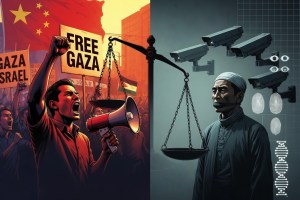 Governments and institutions that claim to speak for the Muslim world regularly invoke the ummah—the global Muslim community—as a source of political and moral authority. They demand solidarity across borders when Muslims suffer in Palestine, Kashmir or Myanmar.
When China constructed a police state around the Uyghurs, however, many of those governments did more than remain quiet. They defended Beijing, repeated its language and helped prevent international scrutiny.
That is the disparity worth examining. The charge is not that Muslims as a population have ignored the Uyghurs. Uyghur activists, dissidents and sympathetic Muslim organizations have worked for years to expose what is happening. The indictment belongs to the governments and institutions possessing the influence, diplomatic machinery and declared religious authority to act, but which chose accommodation with China instead.
The Muslims China decided to remake
In the Xinjiang Uyghur Autonomous Region, China has subjected Uyghurs and other predominantly Muslim peoples to mass surveillance, arbitrary detention, political indoctrination, coercive labour programs and severe restrictions on religious and cultural life.
The Office of the United Nations High Commissioner for Human Rights found credible allegations of torture, forced medical treatment, sexual violence and family separation. It concluded that China’s arbitrary and discriminatory detention of Uyghurs may constitute international crimes, particularly crimes against humanity. Beijing rejects those findings and describes the detention system as a counterterrorism and vocational-education program.
The repression extends beyond prisons and camps. Religious observance has been treated as evidence of extremism; families have been divided; children have been separated from parents; mosques, shrines and cemeteries have been altered or destroyed. Hundreds of Uyghur village names containing religious or historical references have reportedly been replaced with language reflecting Communist Party ideology and national unity. (Associated Press)
China is not negotiating how Islam should be accommodated in public life. It is deciding which portions of Uyghur identity may survive, and in what form.
The institutions that chose Beijing
The Organisation of Islamic Cooperation describes itself as the collective voice of the Muslim world. Yet in 2019, rather than confront China over Xinjiang, the OIC praised Beijing for “providing care to its Muslim citizens.” It accepted the language China used to describe political re-education and mass detention as social development and counter-extremism. (Organisation of Islamic Cooperation)
Individual governments made similar choices. Saudi Arabia, Pakistan, Egypt, the United Arab Emirates and Algeria were among the Muslim-majority states that supported statements commending China’s Xinjiang policies and its supposed achievements in counterterrorism and deradicalization. Qatar initially joined that defence before later withdrawing its support. (United Nations Human Rights Council)
The failure became even clearer after the UN human-rights office released its assessment in 2022. The Human Rights Council was asked only to hold a debate on the findings. The proposal failed by 19 votes to 17, with 11 abstentions. Pakistan, Indonesia, Qatar and the UAE voted against discussion, while Somalia was the rare Muslim-majority state that supported scrutiny. (Axios)
These governments were not working from rumours or social-media fragments. They had embassies, intelligence services, diplomatic missions and direct access to the UN report. Some of them claimed a special responsibility to defend Muslim interests while helping Beijing avoid even a formal debate about possible crimes against humanity.
Their conduct was not uniform, and it should not be treated as such. Somalia acted differently. Qatar withdrew from the earlier letter. Uyghur advocates have found allies in parts of the Muslim world.
The pattern among several of its most powerful governments remains unmistakable: when strategic and economic interests collided with proclaimed Muslim solidarity, solidarity gave way.
In some cases, the cooperation went further than diplomatic support. Researchers have documented Uyghurs being detained or returned from Arab states, including Egypt, Morocco, Saudi Arabia, Syria and the UAE, despite the danger of imprisonment upon return to China. (TIME)
The ummah, it seems, has boundaries set not only by faith but by Chinese investment, security relationships and diplomatic convenience.
Why Palestine mobilizes and Xinjiang does not
The contrast with Palestine-related activism is obvious, but it cannot be explained by hypocrisy alone.
Gaza is an active war covered daily through graphic footage, international reporting and social media. The Palestinian cause has decades of established institutions, political language, donor networks and diaspora organization behind it. Protesters can respond to events almost as they happen, and the adversaries they confront—Israel, Canada, the United States and European governments—are visible and accessible.
Xinjiang is a closed system. China restricts independent access, controls information and intimidates witnesses. Uyghurs abroad must consider whether public criticism will bring retaliation against relatives still inside China. The diaspora is smaller, its institutional reach is weaker, and the repression produces fewer fresh images capable of driving an attention economy built around immediacy.
Those differences matter. They help explain why one cause can mobilize vast numbers while another struggles for sustained attention.
China’s power matters even more. Beijing can threaten trade, investment and diplomatic relationships. It can pressure foreign governments to detain or repatriate Uyghurs, and it has demonstrated that criticism may carry consequences beyond the person speaking.
Liberal democracies are easier to confront because they tolerate confrontation. Activists can accuse Western governments of racism, colonialism or complicity without disappearing into a re-education system. China makes dissent expensive.
That is a real explanation for the disparity, but it is not an excuse for governments and institutions that claim leadership of the Muslim world. They possess resources individual dissidents do not. They do not need viral footage to understand a UN report, and they cannot plausibly invoke universal solidarity only when the political cost is manageable.
A principle proves very little when following it requires nothing.
The wrong kind of Muslim victim
The Uyghurs present an ideological inconvenience because their persecutor does not fit the political narratives that dominate much international activism.
China is not Israel, a Western democracy or a former European colonial power. It presents itself as an opponent of Western dominance, invests heavily across Muslim-majority countries and offers authoritarian governments a model of economic partnership without demands for democratic reform.
The victims therefore receive less political value. Their suffering cannot easily be attached to Western guilt, anti-colonial mythology or opposition to Israel. Beijing is remote, resistant to protest and willing to punish anyone who interferes.
This does not mean that Palestine activism exists only because Israel is Jewish, nor does it diminish the suffering of Palestinians. It does reveal an institutional hierarchy in which some Muslim victims become central symbols while others are subordinated to alliances, investments and ideological convenience.
The problem is not that Gaza receives too much concern. It is that governments claiming to represent global Muslim interests defended China while it suppressed Muslim life.
The Uyghur test
A serious commitment to Muslim solidarity would require the OIC to repudiate its praise of Beijing and demand independent access to Xinjiang. Muslim-majority governments would stop returning Uyghurs to Chinese custody, support international investigation and use their economic relationships with China as leverage rather than treating those relationships as reasons for silence.
Islamic institutions and advocacy networks in the West could place Xinjiang on their agendas without abandoning Palestine. They could campaign against forced-labour supply chains, support Uyghur refugees and organize sustained pressure outside Chinese diplomatic missions. Medical organizations could demand verifiable proof that organs transplanted in China come from genuinely consenting donors.
China’s secrecy explains why evidence emerges slowly. Its economic and political power explains why governments hesitate. Neither absolves institutions that claim moral authority precisely on the basis of a borderless Muslim community.
Solidarity that flourishes against accessible adversaries but recedes when Beijing threatens consequences is not a universal moral commitment. It is foreign policy and political fashion wearing the language of religious principle.
The Uyghurs have made that distinction impossible to ignore.
Before a government can persecute large numbers of people, it has to solve a political problem.
It must persuade everyone else that the victims are not quite ordinary citizens—that their suffering is acceptable, deserved or simply too dangerous to oppose.
Maoist China developed a brutally effective method for doing this. Society was divided into politically approved and politically contaminated identities.
The favoured populations belonged to the Red Categories: workers, poor peasants, revolutionary soldiers, Party cadres and the families of revolutionary martyrs. Landlords, rich peasants, counter-revolutionaries, “bad elements” and rightists belonged to the Black Categories.
Red meant politically reliable; black meant politically suspect.
These categories were not merely descriptions of class or occupation. They distributed safety, status and opportunity. Being recognized as red could open doors, while being classified as black could close them—sometimes for an entire family.
More importantly, the system told every Chinese citizen how to behave toward the people the Party had marked.
Friendship with the wrong person could become evidence of disloyalty. Defending a black-category neighbour might endanger a career. Denunciation could demonstrate revolutionary commitment. Silence was safer than sympathy, while visible hostility could be rewarded.
The Party did not need everyone to become a committed revolutionary. It needed ordinary self-interest to reinforce the political category.
That is the process at the centre of this essay. The state identifies a troublesome population, assigns it a contaminated identity, isolates its members from ordinary society and removes the protections attached to citizenship. Once that work is complete, exploitation becomes easier—and resistance becomes more costly.
The original Black Categories belonged to Mao’s political campaigns. The labels have changed, but the method remains visible in the treatment of Falun Gong practitioners and Uyghurs.
The category is the weapon
In a system based on individual responsibility, the state begins with an act. It gathers evidence, identifies the person responsible and attempts to prove guilt.
Political classification reverses that order.
The state begins with a kind of person. Membership in the category becomes evidence of danger before any particular wrongdoing has been established.
A landlord was presumed exploitative because he belonged to the landlord class. A rightist was presumed hostile because the Party had named him a rightist. The label did not merely summarize an accusation; it reduced the need to prove one.
Once imposed, black status could follow a person long after the original circumstances had disappeared. Land had been confiscated, businesses nationalized and social relationships transformed, yet the former landlord or rich peasant remained politically stained.
Children could inherit the consequences of identities assigned to their parents. Education, employment, political participation, friendships and marriage prospects could all be affected by family background.
The supposed class category had become a moral caste.
Its power depended upon incentives. People wanted to be recognized as red because red status brought security and belonging. They avoided black-category families because association carried risk.
This transformed political persecution into social coercion. The state imposed the label, but neighbours, colleagues, teachers and relatives helped enforce it. By the time the police arrived, the condemned person could already be isolated.
Redemption through surrender
The black-category system did not always require physical destruction. Often, it demanded ideological submission.
The accused could confess, undergo self-criticism, denounce former beliefs and demonstrate that Party education had corrected the defective self.
This offered the appearance of a way out, but the price was significant. The person had to accept the state’s description of him.
A man classified as a class enemy was expected to acknowledge his guilt. A religious believer had to recognize faith as superstition or political manipulation. A dissident had to admit that disagreement revealed hostility rather than judgment.
The state converted an identity into an offence, assigned collective guilt and then demanded gratitude for providing the cure.
Refusal carried its own penalty. If someone would not confess, the Party could treat that resistance as proof that the person remained dangerous, stubborn or insufficiently transformed.
Disagreement therefore became self-confirming: submission proved that re-education had been necessary, while resistance proved that more coercion was required.
Falun Gong becomes a suspect population
The campaign against Falun Gong shows how readily this method could be transferred to a population that had nothing to do with Mao’s original class structure.
Falun Gong spread rapidly during the 1990s as a decentralized spiritual discipline involving meditation, physical exercises and moral teachings. The Chinese Communist Party banned it in 1999 and began a national campaign to eradicate the practice.
The Party did not limit its response to prosecuting people who had committed identifiable crimes. It classified Falun Gong itself as an “evil cult” and treated continued adherence as evidence of danger, irrationality or political disloyalty.
That designation compressed millions of individuals into a single suspect identity.
Practising publicly, possessing literature, distributing information or refusing to renounce the movement could expose a person to detention and coercive re-education. Human Rights Watch documented the use of labour camps and “transformation” facilities where practitioners were pressured to abandon their beliefs. Officials established transformation targets, while former detainees described physical and psychological abuse intended to produce recantation.
The Party first identified a population it could not fully control, then assigned it a category that carried its own accusation. Ordinary citizens were taught to regard practitioners as dangerous or deluded, while employers, schools, families and neighbourhood authorities were drawn into enforcing the distinction.
A practitioner could recover a measure of safety, but only by accepting the Party’s judgment and repudiating the identity that had made him suspect.
Falun Gong practitioners were never formally added to Mao’s Five Black Categories. They did not need to be.
They had been placed in the same political position: outside the circle of people whose conscience, liberty and bodily integrity commanded ordinary protection.
Uyghur identity becomes evidence
The Party has used a related process against Uyghurs and other predominantly Muslim peoples in Xinjiang.
China has faced real acts of separatist and terrorist violence. The state has a legitimate responsibility to investigate attacks and prosecute the individuals who organize or commit them.
The abuse begins when suspicion moves from perpetrators to a population.
Under the campaign against religious extremism, ordinary conduct has been treated as evidence that someone requires surveillance, detention or ideological correction. The UN human-rights assessment of Xinjiang found that people could be referred to so-called vocational education and training centres for reasons including wearing a veil or beard, applying for a passport, possessing certain communications software, maintaining foreign contacts or having more children than state policy permitted.
These are not findings that a particular individual planned an attack. They are identity markers.
Religious practice, family life, cultural difference and contact with the outside world become entries in a political risk profile. Once Uyghur identity is associated with extremism, officials no longer need to demonstrate that each person poses a threat. The classification supplies the suspicion.
Former detainees described being required to confess, repent and accept political instruction even when they did not understand what offence they had committed. The centres combined language and vocational programs with ideological “transformation,” while operating outside the ordinary safeguards of criminal justice.
The terminology is modern and technocratic, but the logic is older. The Party defines the acceptable identity, identifies deviations from it and offers restoration through surrender.
The Han-nationalist reversal
There is a particular irony in the treatment of Uyghurs.
Maoist doctrine officially condemned Han chauvinism. The Communist Party presented itself as the guardian of a multinational revolutionary state, not an instrument of ethnic domination by the Han majority.
That promise was never consistently honoured. Minority religion and culture were attacked during Maoist campaigns whenever they conflicted with revolutionary conformity.
Even so, the Party formally treated Han chauvinism as a political danger.
Today, Uyghur religious, linguistic and cultural difference is increasingly subordinated to a standardized national identity built around Party loyalty, Mandarin and cultural norms drawn largely from the Han majority.
The Party that once denounced Han chauvinism now pressures minorities to demonstrate their legitimacy by becoming less distinct from the Han-centred national mainstream.
The preferred identity has changed—from revolutionary class identity to national and civilizational unity—but the coercive authority remains the same. The Party still decides which identities are politically healthy and which require transformation.
From political unperson to biological inventory
This process helps explain how the conditions necessary for forced organ harvesting could be created.
Political classification does not prove that every person placed inside a suspect category will be killed for organs. Most people targeted by Maoist categories were not executed, and not every Falun Gong practitioner or Uyghur detainee has been subjected to the same treatment.
The category serves a broader purpose. It removes the expectation that each person must be treated as an individual citizen whose detention, injury or disappearance requires explanation.
A forced-organ procurement system would need more than corrupt surgeons and wealthy recipients. It would need captive populations that could be medically examined without meaningful consent, records hidden from public inspection, families unable to demand answers and officials confident that the disappearance of a politically contaminated person would not provoke the same response as the disappearance of someone considered respectable.
That infrastructure begins outside the hospital.
The process starts by identifying a problem group and assigning it a category associated with danger, sickness or moral contamination. Society is encouraged to withdraw sympathy—and to punish those who refuse—until the categorized population can be deprived of freedom, legal protection and bodily autonomy with little political cost.
Once that has been accomplished, human beings can be handled as state resources. Labour can be extracted from them. Confessions can be extracted from them. In the most extreme form of the system, organs can be extracted from them.
The hospital is the final stage, not the first.
Who dies?
The question is not answered simply by asking who has committed the most serious offence.
In a system governed by political categories, those most at risk are the people whom the state has successfully moved outside the moral community.
Mao’s Black Categories taught Chinese society that some identities carried guilt before an act had been proved. They gave citizens strong incentives to distance themselves from the condemned and stronger incentives to display loyalty to the favoured red identity.
Falun Gong practitioners and Uyghurs are not interchangeable with Maoist landlords or rightists. Their beliefs, histories and circumstances differ.
The continuity lies with the Party, which still identifies populations that resist or complicate complete political control, compresses individuals into suspect identities and demands confession, transformation and submission as the price of restored acceptance.
Most importantly, it still uses political classification to determine whose suffering can be ignored.
Before bodies can be farmed for organs, the people inside them must first be made into political unpeople.
The Black Categories provided the method.
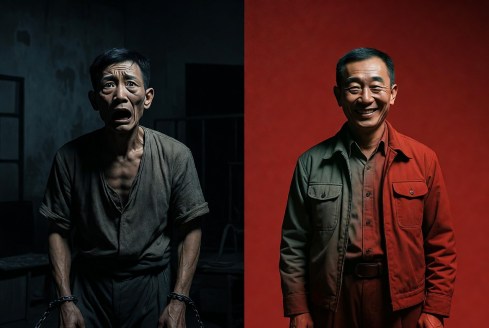
“Divided by Category: Red (favored, content) and Black (suspect, under duress) — the Maoist tool that made persecution socially acceptable.”
References and Further Reading
Maoist classifications and the Cultural Revolution
Guo Jian, Song Yongyi and Yuan Zhou, Historical Dictionary of the Chinese Cultural Revolution, Scarecrow Press, 2006.
A scholarly reference work covering the Five Black Categories, the favoured Red Categories, political campaigns, struggle sessions and other institutions of the Cultural Revolution.
https://books.google.com/books?id=T5-4zOdHKOIC&q=Five+Black+Categories
Song Yongyi, “Chronology of Mass Killings During the Chinese Cultural Revolution (1966–1976),” Sciences Po Mass Violence and Resistance Research Network, August 25, 2011.
An academic chronology of Cultural Revolution violence. It describes the Five Black Categories—landlords, rich peasants, counter-revolutionaries, bad elements and rightists—and documents how political classifications exposed individuals and their families to confiscation, expulsion, persecution and killing.
https://www.sciencespo.fr/mass-violence-war-massacre-resistance/en/document/chronology-mass-killings-during-chinese-cultural-revolution-1966-1976
Evan Osnos, “Born Red,” The New Yorker, March 30, 2015.
A profile of Xi Jinping that also describes the status attached to revolutionary family background during the Cultural Revolution. It includes the “born red” culture, inherited political prestige and the stigma imposed upon children of people classified as reactionaries.
https://www.newyorker.com/magazine/2015/04/06/born-red
Mao on ethnicity and Han chauvinism
Mao Zedong, “On the Ten Major Relationships,” April 25, 1956.
English text of Mao’s speech addressing relations between the Han majority and China’s minority nationalities. Mao formally identified Han chauvinism as a danger and argued that the Party should oppose discrimination by the Han majority.
https://www.marxists.org/reference/archive/mao/selected-works/volume-5/mswv5_51.htm
Falun Gong persecution and “transformation”
Human Rights Watch, “Falungong in Custody: Competing Accounts,” in Dangerous Meditation: China’s Campaign Against Falungong, January 2002.
Human Rights Watch’s examination of detention, re-education through labour, extrajudicial transformation centres and coercive attempts to force practitioners to renounce their beliefs. The report also discusses the difficulty of verifying claims because China prevented independent monitoring of prisons and labour camps.
The report documents official transformation targets and evidence of severe physical and psychological pressure, including torture and extreme pressure to recant.
https://www.hrw.org/reports/2002/china/China0102-04.htm
Uyghurs and the Xinjiang detention system
Office of the United Nations High Commissioner for Human Rights, Assessment of Human Rights Concerns in the Xinjiang Uyghur Autonomous Region, People’s Republic of China, August 31, 2022.
The principal UN assessment of China’s counter-extremism policies, methods for identifying “at risk” people, detention in vocational education and training centres, treatment in custody and restrictions upon religious, linguistic and cultural identity.
Permanent Mission of the People’s Republic of China to the United Nations Office at Geneva, “Response to the OHCHR Assessment,” August 2022.
China’s formal rebuttal to the UN assessment. The government rejects the allegations, describes the centres as lawful counterterrorism and vocational programs, and argues that the UN assessment relied upon politicized or unreliable sources.
https://www.ohchr.org/sites/default/files/documents/countries/2022-08-31/ANNEX_A.pdf
Organ profiling and the connection to the first essay
United Nations Office of the High Commissioner for Human Rights, “China: UN Human Rights Experts Alarmed by ‘Organ Harvesting’ Allegations,” June 14, 2021.
A statement by UN human-rights experts concerning reports that detained Falun Gong practitioners, Uyghurs, Tibetans, Muslims and Christians were subjected to blood tests and examinations of the heart, liver, kidneys and other organs without informed consent.
“Handle with Care” has the loose warmth of friends making music together, but beneath its easy rhythm is a song about bruised trust and stubborn hope.
George Harrison carries the verses with quiet weariness, while Roy Orbison’s soaring bridge opens the song into something almost operatic. Bob Dylan, Tom Petty and Jeff Lynne add texture without crowding it, giving the performance the feeling of five distinct voices serving one generous, unshowy whole.
It is a song about being disappointed without becoming closed off—about asking, after everything, to be treated with a little care.











 bleatmop
 Mystro


 Dead Wild Roses
Your opinions…