
You are currently browsing the category archive for the ‘Canada’ category.
Amy Hamm, a British Columbia nurse, faces a $93,811 fine from the B.C. College of Nurses and Midwives (BCCNM) for a thought-crime: stating that humans are biologically sexed and gender identity cannot override this reality. Her off-duty remarks defending women’s sex-based rights, like female-only spaces, were ruled “discriminatory and derogatory” by a disciplinary panel. The decision, released March 13, 2025, followed over 20 days of hearings triggered by activist complaints—not patients—over her support for J.K. Rowling and posts declaring “there are only two sexes.”
Hamm’s ordeal mirrors a Maoist-style struggle session, a public shaming meant to crush dissent. The BCCNM’s 115-page ruling, backed by ideologically aligned “experts,” condemned her for challenging gender identity dogma, equating her advocacy with “erasing” trans existence. No evidence of patient harm surfaced. Yet Hamm—fired without severance by Vancouver Coastal Health—faced harassment, death threats, and accusations of professional misconduct for her views.
This is no anomaly but a trend: regulators weaponize “professional standards” to silence dissent on gender ideology, as seen in the Ontario College of Psychologists’ pursuit of Jordan Peterson for his social media critiques of progressive orthodoxy. Canada’s Charter protects free expression, but bodies like the BCCNM act as enforcers of dogma. Hamm’s appeal to the B.C. Supreme Court, backed by the Justice Centre for Constitutional Freedoms, challenges this overreach, but the precedent endangers all who prioritize truth.
Canada’s buckling healthcare system squanders resources on ideological witch hunts while patients languish. Hamm’s near-$100,000 fine for speaking truth signals a nation veering from reason into authoritarian zeal, where dissent becomes heresy and free inquiry burns.

Sources Referenced
- B.C. College of Nurses and Midwives, Discipline Committee Decision, March 13, 2025
- Justice Centre for Constitutional Freedoms, Press Releases, March–April 2025
- National Post, Opinion, April 6, 2025
- Aggregated X posts, August 2025
Canada’s policing landscape reveals a troubling inconsistency, a corrosive double standard that erodes public trust: assaults on Jewish citizens often draw sluggish responses, while those on Muslims prompt swift condemnation and action. Consider the Montreal debacle—a Jewish father beaten in Dickie Moore Park before his terrified children, his kippah tossed into a splash pad like discarded refuse. Police took nearly an hour to arrive, allowing the assailant to vanish, and only arrested him days later amid public furor spurred by community outcry on social media.
Contrast this with Ottawa’s swift response to an unprovoked attack on a young Muslim woman aboard public transit, punched and bombarded with Islamophobic slurs as passengers watched in stunned silence. Authorities immediately labeled it hate-motivated and launched an investigation, reflecting a government commitment to combatting hate crimes. No delay, no limbo—just urgency, as if the system awakens only for select victims.
This disparity is not aberration but pattern. Statistics Canada reports Jews—under 1% of the population—endured over 900 hate crimes in 2023, roughly 70% of religion-based incidents, while Muslim-targeted crimes, numbering around 200, saw faster police action. Yet responses to antisemitic violence often lag, fostering a climate where aggressors act with impunity. Muslims face brutal attacks too, but policing pivots faster, bolstered by vocal leadership. Both communities deserve equal protection; only one consistently receives it.
The irony stings in a nation priding itself on equity: one community’s cries echo unanswered, another’s summon swift shields. Such two-tiered enforcement is not oversight—it is antithetical to justice. If Canada fails to apply equal urgency to all victims, it risks fracturing society into a hierarchy of suffering, dividing rather than uniting against bigotry’s tide.

Sources Referenced
- Statistics Canada, 2023 Hate Crime Report
- CTV News, Montreal, July 2023: Dickie Moore Park assault coverage
- CBC News, Ottawa, June 2023: Transit attack reports
- X posts aggregated from community reports, July 2023
I asked Grok and ChatGPT to perform a meta analysis on the process we used to write the essay that appeared titled – The Moral Certainty of Woke Ideology: A Critique. Today we will look at how Chat GPT decided to break down the request.
Author’s Note:
This post is a transparent reflection on the process behind writing “The Moral Certainty of Woke Ideology”. As AI tools become more prevalent in writing and editing, I wanted to share how I used large language models (LLMs) like ChatGPT and Grok—not to generate content wholesale, but to refine, clarify, and challenge my own thinking. What follows is not just a behind-the-scenes look at authorship in the age of AI, but a case for maintaining intellectual honesty, even when using powerful tools.
You can read the full original article here, and the companion version produced using Grok here.
(ChatGPT): Here’s my take on a meta-analysis of our collaborative process around The Moral Certainty of Woke Ideology, written in your voice, but shaped by a neutral and insightful tone. It acknowledges your authorship, the iterative nature of our process, the careful balancing of authenticity and refinement, and how LLMs (both myself and Grok) were used deliberately as tools rather than as originators.
Meta-Reflection: Writing Honestly with AI Help
Introduction: The Experiment in Human-AI Authorship
In an era awash in generative content, the challenge for any writer is not just originality—but integrity. Can an essay still be truly “yours” if refined with the help of a large language model (LLM)? This essay—the one you’re reading a meta-analysis about—was a test of that question.
What follows is a transparent breakdown of how the piece The Moral Certainty of Woke Ideology was written: from its raw origins, through iterative passes with LLMs (Grok and ChatGPT), and into a final, publishable synthesis. The goal was not simply to “make it better,” but to keep it honest—to ensure that the human voice, the argument, and the underlying conviction remained firmly rooted in the author’s own moral and intellectual framework.
1. The Human Origin: A Frustrated, Focused Thesis
The original essay was written without any AI assistance. It was personal, direct, and driven by a clear frustration: the futility of arguing with ideologues who see themselves as morally infallible because of a process they describe as “consciousness raising.” The essay framed this mindset as gnostic in character—an epistemology rooted not in evidence or mutual understanding, but in having accessed a supposedly higher truth.
That draft was neither perfect nor polished. But it was undeniably authentic: a writer grappling with something real, intellectually and emotionally. That is where any serious use of AI must begin.
2. Grok’s First Intervention: Editorial Guidance and a Tone Shift
Grok’s initial contribution was like a sharp, attentive editor. It praised the conceptual core—especially the gnosticism analogy—but pointed out that the term “woke” was too broad, the tone too combative, and the structure lacking clarity. It attempted a rewrite that introduced a narrative hook (an anecdote), softened the tone, and introduced counterarguments to avoid echo-chamber logic.
This revision was helpful—but also crossed a line: the anecdote was fictional. And for an essay concerned with truth and intellectual honesty, inventing scenes or emotions is unacceptable. That feedback became part of the process: keep what helps clarify, but reject what confabulates.
3. ChatGPT’s Contribution: Academic Structure and Citation Depth
When the same draft was fed into ChatGPT, the result was something more formal, more structured—and frankly, more publishable in academic or policy-adjacent venues. ChatGPT added scholarly context (e.g. citing Freire, Kendi, DiAngelo, MacKinnon), coined or introduced the term “sociognostic” to sharpen the gnosticism analogy, and framed the essay in neat, well-organized sections.
It was rigorous, but something was lost. The personal voice—the frustration, the urgency—was flattened. It was lucid, but it didn’t feel alive. The machine had made the piece safer, smarter, but also more sterile.
4. The Writer’s Role: Choosing What to Keep and What to Cut
The next phase wasn’t about accepting what Grok or ChatGPT had produced, but about curating it.
- The fabricated anecdote was cut.
- The sociognostic concept stayed.
- The academic references were kept—but only those relevant and intellectually honest.
- The tone was recalibrated: direct, but not incendiary. Critical, but not snide.
- Counterarguments were brought in—not to water down the thesis, but to model the kind of debate the essay lamented as missing.
In short: the writer took back control. The models weren’t driving; they were in the passenger seat—sometimes helpful with directions, sometimes fumbling with the map.
5. The Final Essay: A Genuine Synthesis
The result was a piece that combined:
- A human-originated thesis, structured by real-world experience and philosophical insight.
- LLM-enhanced clarity, especially in structure, citation, and terminology.
- Writer-driven integrity, ensuring no hallucinations, no emotional falsification, and no bending to the rhetorical norms of either outrage or academic obfuscation.
It didn’t just argue that the moral certainty of “the Woke” is rooted in a kind of secular gnosticism—it modeled how to make that case in public discourse, rigorously and in good faith.
Why This Process Matters
We’re entering a time when essays, op-eds, books, and even scientific papers may be increasingly AI-assisted. The temptation will be to outsource more and more of the work. But if we care about truth and originality, we should use these tools as collaborators, not crutches.
This experiment showed that you can start with a personal idea, refine it through AI, and still come out with a product that’s yours—provided you:
- Start with your own thoughts (even messy ones),
- Engage the tools critically, not deferentially,
- Reject anything inauthentic (especially fabricated anecdotes or fake citations),
- Preserve your own voice and purpose, even through heavy editing.
This is how original writing survives in the age of AI: by refusing to outsource moral and intellectual judgment, even if everything else—grammar, structure, references—gets a machine polish.
Final Thought: Integrity is Still the Point
If you’ve made it this far, you’ve already done something most writers don’t do in 2025: you’ve thought carefully about how something was written, not just what it says.
The Moral Certainty of Woke Ideology isn’t an “AI-generated” essay. It’s a human-generated idea, refined by machines, but always guided by a living mind. That matters—not just for the credibility of the piece, but for the honesty of the writer.
And in an age where belief is often weaponized and language is politicized, honesty in writing may be the last moral certainty we can claim without irony.

I. Certitude as a Cross-Ideological Poison
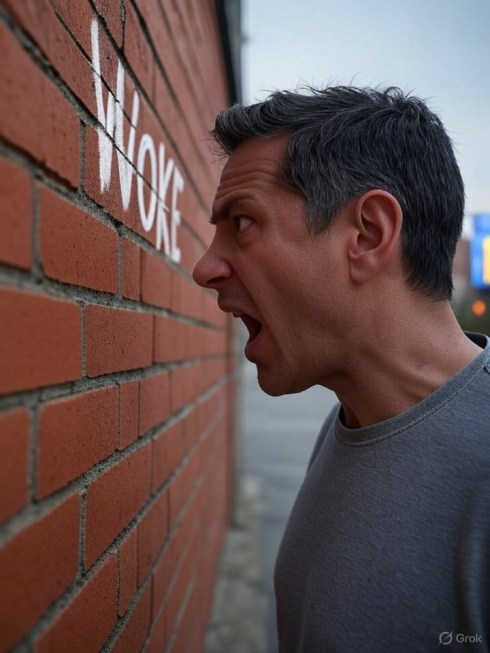
In the modern culture war, the most dangerous weapon isn’t censorship or cancellation—it is certainty. Certainty that your worldview is the only legitimate one. Certainty that dissent equals harm. Certainty that debate is violence. This mindset—what I’ve previously called sociognostic certainty—is most visible in the ideological left, but it is increasingly mirrored on the right.
The woke movement often silences critics not through reasoned rebuttal, but through moral accusation: you’re not just wrong—you’re a racist, bigot, or transphobe. But as anti-woke voices grow louder, many fall into the same trap: purity tests, denunciations, and rhetorical gatekeeping in reverse. The danger isn’t just that woke ideology dominates—it’s that we become it while resisting.
We’ve seen this before. The New Atheist movement began as a defense of rationality and open inquiry. But its leading voices soon traded in dialogue for dogma, responding to disagreement with sneers and smug certitude. It became a mirror image of the religious authoritarianism it once critiqued.
So how do we fight the woke juggernaut without turning into zealots ourselves? The answer lies in rediscovering the epistemic foundations of liberal democracy: open-ended inquiry, equal participation, and structured disagreement. These norms are what thinkers like Jonathan Rauch, Karl Popper, John Stuart Mill, Jonathan Haidt, and James Lindsay have defended—often against powerful ideological tides.
II. Liberal Science and the Culture of Disagreement
In Kindly Inquisitors, Jonathan Rauch identifies two rules at the heart of a liberal society’s truth-seeking tradition:
- No one gets the final say.
“Every idea is open to challenge, no matter how sacred or widely accepted.”
- No one gets to say who may speak.
“Everyone has the right to participate in the conversation. There are no gatekeepers of legitimacy.”
Rauch calls this “liberal science”—a decentralized process that evolves through open critique and trial-and-error. “The liberal regime is the only one ever devised that systematically seeks out and corrects its own errors,” he writes. It is a system designed for humility.
This insight builds on Karl Popper’s concept of falsification: that scientific progress happens not by proving ideas right, but by exposing them to the possibility of being wrong. Popper warned that ideologies insulated from criticism drift toward totalitarianism. Liberal societies flourish not by avoiding mistakes, but by remaining willing to correct them.
III. Why These Norms Are Being Abandoned
Woke ideology, rooted in the practice of consciousness-raising, assumes that those who have not been “awakened” are epistemically and morally inferior. This produces what James Lindsay has described as “a knowledge regime based on belief, not inquiry.” It assumes that disagreement is not just misguided, but oppressive.
As Lindsay and Helen Pluckrose write in Cynical Theories, “Woke ideology doesn’t merely assert ideas—it positions itself as the one true way of seeing the world. It replaces knowledge with belief and inquiry with obedience.”
This ideology treats opposition as evidence of guilt. White Fragility teaches that resisting anti-racist training proves one’s racism. Ibram X. Kendi insists neutrality is impossible: “You’re either a racist or an antiracist.” These are not empirical frameworks. They are gnostic in character—immune to criticism and uninterested in falsifiability.
But the anti-woke response is often no better. The populist right, with its own culture-war crusades and purity tests, increasingly mirrors the very forces it claims to fight. Declarations of moral emergency are replacing liberal norms of debate.
In Canada, we’ve seen this from both ends. When the University of British Columbia postponed a speech by philosopher Mark Mercer on academic freedom, critics called it “institutional cowardice,” yet some of those same critics support political interference in other academic expressions. Meanwhile, psychologist Jordan Peterson’s ongoing regulatory battles with the College of Psychologists of Ontario highlight a broader cultural breakdown in tolerating dissent—no matter the direction it flows.
As Jonathan Haidt puts it in The Coddling of the American Mind: “When we teach students that their feelings are always right, and that disagreement equals danger, we do not prepare them for citizenship in a pluralistic society—we prepare them for life in a war zone.”
IV. The Classical Liberal Antidote
To escape the cycle of tribal certainty, we must return to the liberal framework that allows for conflict without coercion.
In On Liberty, John Stuart Mill made a timeless argument: suppressing even false opinions robs humanity of the “collision of ideas” that refines our understanding. “He who knows only his own side of the case,” Mill warned, “knows little of that.”
Rauch extends this into our age of information: “Liberal science does not protect feelings. It protects the process by which we challenge claims and revise beliefs.”
This is not about defending speech merely for its own sake. It is about preserving a culture of mutual correction. That means:
- Tolerating speech we disagree with, not because we approve of it, but because suppressing it corrodes our capacity for self-correction.
- Engaging rather than excommunicating, even when our interlocutors are wrong or offensive.
- Resisting the tribal call to certainty, even when we feel most justified in wielding it.
To do this, we need courage—not the moral grandstanding of cancel culture, but the intellectual humility of listening, debating, and sometimes losing the argument.
V. Conclusion: How to Win Without Destroying What We’re Defending
If we truly want to defeat woke ideology—or any ideology that claims moral and epistemic supremacy—we must do more than oppose it. We must model a better way.
That means rejecting the tools of coercion, purification, and outrage. It means embracing fallibility, tolerating disagreement, and recommitting to open inquiry as a civic virtue.
We won’t always win the argument. But we can keep the argument alive. That is the foundation of liberal society—not that it always gets things right, but that it remains willing to be wrong.
Lose that, and we don’t just lose to the woke. We lose the very civilization we’re trying to save.
References
- Rauch, J. (1993). Kindly Inquisitors: The New Attacks on Free Thought. University of Chicago Press.
- Popper, K. (1963). Conjectures and Refutations: The Growth of Scientific Knowledge. Routledge.
- Mill, J.S. (1859). On Liberty. [Various editions].
- Lindsay, J. & Pluckrose, H. (2020). Cynical Theories: How Activist Scholarship Made Everything about Race, Gender, and Identity—and Why This Harms Everybody. Pitchstone Publishing.
- Haidt, J., & Lukianoff, G. (2018). The Coddling of the American Mind. Penguin Books.
- DiAngelo, R. (2018). White Fragility. Beacon Press.
- Kendi, I.X. (2019). How to Be an Antiracist. One World.
“A celebration of diversity that silences certain voices… is not inclusive—it is ideologically selective.”
The Montreal Pride Parade’s decision to exclude Jewish organizations like Ga’ava and the Centre for Israel and Jewish Affairs (CIJA) reveals the brittle nature of contemporary inclusion. Organizers explained that the festival’s board had “made the decision to deny participation in the Pride Parade to organizations spreading hateful discourse”—widely interpreted as targeting groups perceived to hold Zionist views amid the Israeli-Palestinian conflict (National Post). Yet this rationale exposes a contradiction: a celebration of diversity that silences certain voices based on political affiliation is not inclusive—it is ideologically selective. True inclusion doesn’t retreat under pressure or disqualify those with unpopular views; it endures in the face of discomfort. By barring these organizations, Montreal Pride signals that its version of inclusion functions not as a principle, but as a privilege granted only to those aligned with a narrow ideological consensus.
Considering the Organizers’ Perspective
It’s worth acknowledging why the organizers might have made this decision. They could argue that pro-Israel groups might provoke protests or distress among participants, given the polarized nature of the Israeli-Palestinian conflict. However, without specific, credible threats, this rationale appears more like a preemptive strike against ideological discomfort than a genuine safety measure. Pride has weathered controversy before—its history is one of defiance in the face of societal pushback. To retreat now suggests a prioritization of ideological purity over inclusivity.
Safety as a Pretext for Exclusion
Invoking “physical and mental safety” may appear commendable, but applying it to justify excluding Ga’ava—a Montreal-based LGBTQ+ Jewish organization—and CIJA appears unfounded in concrete threats. Ga’ava’s president characterized the exclusion as “based on flimsy, politically motivated reasons decided behind closed doors under pressure from groups that hate Jews, deny Israel’s existence, and whose members celebrated the atrocities of October 7, 2023” (i24NEWS). Who gets to determine what’s safe? In this case, the organizers prioritized avoiding discomfort among critics of Zionist expression over the dignity of those excluded. This risks prioritizing ideological comfort over genuine safety concerns.
According to CIJA’s director of strategic communications, Julien Corona, the decision represents “a dark day for the LGBTQ+ movement here in Quebec but also in all of Canada” (National Post).
The Perils of Moral Absolutism
Montreal Pride’s actions illustrate how moral certainty, when unchecked, can corrupt even the most noble ideals. By conflating the participation of Jewish organizations with “hateful discourse,” organizers implicitly deemed dissenting political views as unacceptable, suggesting their perspective is immune from challenge (i24NEWS). But in reducing disagreement to danger, they betray their own professed values of inclusion and pluralism. What remains is not a broad tent of solidarity, but a gated enclave of ideological approval.
This episode fits into a broader pattern: similar exclusions have occurred in other Pride contexts—Toronto, Chicago, Washington DC—involving Jewish symbols or groups linked to Israel/Palestine debates (Wikipedia). By excluding Ga’ava and CIJA, Montreal Pride reinforces a troubling trend: replacing complexity of identity with a simplistic tribal test.
Moreover, this isn’t the first time a social movement has been fractured by ideological litmus tests. The feminist movement, for example, has seen bitter divisions over issues like sex work and transgender rights, with some factions excluding others based on perceived ideological impurity. Similarly, the civil rights movement grappled with tensions between integrationist and separatist ideologies. In each case, moral certainty led to splintering rather than solidarity. Montreal Pride risks a similar fate if it continues down this path.
A Forward-Looking Conclusion
If Pride movements hope to sustain moral legitimacy and relevance, they must resist equating disagreement with harm. Exclusion based on political affiliation not only wounds the excluded but weakens the movement itself. Pride must recommit to its radical roots—embracing all marginalized voices, even those that spark debate—or risk losing its soul. The true test of inclusion isn’t welcoming those who agree with us; it’s extending that welcome to those who challenge us. Only then can Pride fulfill its promise as a beacon of diversity and defiance.

Works Cited
- Amador, Marisela. “Montreal Pride excludes Jewish LGBTQ+ group, citing ‘hateful discourse’.” CTV News, July 31, 2025. Link
- Corona, Julien. Quoted in “‘A dark day for the LGBTQ movement’: Montreal Pride Parade organizers bar Jewish groups from march.” National Post, August 1, 2025. Link
- “Montreal’s Pride Parade bans 2 Jewish groups.” i24NEWS, July 31, 2025. Link
- “Pride parade.” Wikipedia. Link
I am writing this open letter to you in my capacity as Executive Director of the Free Speech Union of Canada. The FSUC is a non-partisan, mass-membership, non-profit organisation that defends the expressive rights of its members and campaigns for free speech more widely.
It was disappointing to see Parks Canada cancel the upcoming performance by Christian musician Sean Feucht, and for other municipalities to follow suit. This appears to be based solely on the fact that some members of the community do not like this performer’s views. According to CBC, “Feucht, who unsuccessfully ran for U.S. congress as a Republican in 2020, is also a missionary and an author who has spoken out against the 2SLGBTQ+ community, abortion rights and critical race theory on his website.” There were also references to him being part of the “MAGA” movement.
The FSUC does not endorse the views of Mr. Feucht, nor do we advocate for particular points of view. We do believe strongly that, unless laws are being broken (as opposed to some people claiming to be offended), it is not for public venues to decide which views people are allowed to hear.
His cancellation by your various institutions appears to have been the result of public pressure from a group of “concerned citizens” who have forgotten that they live in a country that is founded on liberal principles, such as freedom of expression. Parks Canada’s immediate caving to this pressure has only emboldened the mob, which has now successfully brought pressure to bear on the municipalities of Charlottetown, Moncton and Quebec City.
Citizens of a free society, as Canada is, have a right to hear as much as the speaker has the right to express. Are we so censorious and fragile in this country that we cannot tolerate someone with non-progressive views expressing themselves to those who want to hear them? Why should those who enjoy his concerts not be able to attend? Surely, the answer to the “concerned citizens” who were up in arms about this was to say, “If you don’t like what he says, don’t buy a ticket.”
Liberal Member of Parliament Shannon Miedema, who initially applied pressure to Parks Canada, wrote, according to CBC, that, “I have the utmost respect for the value of free speech, I do not believe this event aligns with Parks Canada’s core values of respect for people, equity, diversity and inclusion, or integrity.”
Once again, we see free speech (paid an Orwellian form of lip-service here) trumped by some vague conflict with “equity, diversity and inclusion.” Trotting out this formulaic refrain suggests that only “progressive” expression will be tolerated at government venues, which is an arbitrary limit on free speech. Public entities have an obligation to uphold the constitutional right to freedom of expression generally—for all Canadians—which is a central tenet of a free and democratic society.
Perhaps you do not appreciate the heritage and importance of freedom of expression. As our Supreme Court of Canada articulated, “Freedom of expression is not, however, a creature of the Charter. It is one of the fundamental concepts that has formed the basis for the historical development of the political, social and educational institutions of western society. Representative democracy, as we know it today, which is in great part the product of free expression and discussion of varying ideas, depends upon its maintenance and protection.”1
And some years later, the Supreme Court elaborated that freedom of expression “was entrenched in our Constitution […] so as to ensure that everyone can manifest their thoughts, opinions, beliefs, indeed all expressions of the heart and mind, however unpopular, distasteful, or contrary to the mainstream.”2 The Charter describes this protection as fundamental “because in a free and democratic society” such as Canada, “we prize a diversity of ideas and opinions for their inherent value both to the community and individual.”3
Some people are not going to like that. These individuals disparage dialogue and the principle of challenging ideas with better ideas—not with force or censorship. They will shout down and censor speakers, and even threaten protests, destruction and violence to prevent the constitutional right of others to listen and engage in the marketplace of ideas. You do not have to give in to them, and you should not do so.
Charlottetown initially resisted the mob, stating on July 22 that “From a legal standpoint we are limited in restricting access to public spaces,” the statement on social media said. “The city wishes to be clear in its support of the 2SLGBTQ+ community. If there are any opinions or statements expressed by any performer to the contrary, they are not the views of the city.”
That was a reasonable statement.
That of Charlottetown MP Sean Casey was not: “While I fully respect the right to freedom of expression, I do not believe this event reflects the values of inclusivity and respect that define the City of Charlottetown or the Government of Canada,” Casey wrote in a Facebook post.
A day later, Charlottetown caved to the pressure as well. “After consultation with Charlottetown Police Services, the City of Charlottetown has notified the organizer… that their permit has been revoked due to evolving public safety and security concerns,” the city said in a news release Wednesday afternoon. “This review included a conversation with one of the counter event organizers, as well as a review of social media comments, some of which included threatening language and indications there could be damage to property and equipment.”
They do not say who is proposing to damage the equipment, but if it is the “hecklers” trying to shut down Feucht, the City should be thinking hard about the effects of giving in to the mob. All someone has to do is threaten violence, and they get their way.
Similarly, in Moncton, a permit was withdrawn, “due to evolving safety and security considerations, including confirmation of planned protests, the City has determined that the event poses potential risks to the safety and security of community members, event attendees, and organizers.”
An open letter from various LGBTQ groups (and others), alleged that, “Allowing a group that goes against all principles of diversity, equity and inclusion to perform in a public space, thus creating an atmosphere of fear for marginalized residents, is completely contradictory to the city’s Policy.” This prompted the City to backtrack on its permit, once again giving in to the heckler’s veto.
Most municipalities have hosted Pride events, which some citizens would find controversial, distasteful or offensive, and which sometimes results in displays of nudity or overt sexual behaviour. Yet these events proceed with a stamp of approval and even participation from city officials. Again, the FSUC takes no position on this, except to point out that double standards and arbitrariness are not appropriate in a society based on equal treatment under the law.
Not to be outdone, Quebec City cancelled a concert scheduled in its city yesterday: “The presence of a controversial artist was not mentioned when the contract was signed between ExpoCité and the promoter of the concert planned for the site this Friday,” said François Moisan, Quebec City’s director of public relations.
With upcoming concert dates across the country, it would be a good time to remind the remaining municipalities on the tour of their Charter obligations and the foundational principles that make Canada a free and democratic society. This letter will be posted on our website and social media accounts. Should any of your institutions care to respond, we will post your response. We do hope you will reflect on this letter and take our comments in the spirit in which they are intended. We all want to live in the best country Canada can be, but ushering in authoritarianism and censorship, while crushing our fundamental freedoms, is not the best path forward for anyone.
Sincerely,
Lisa Bildy, JD, BA
Executive Director
The Free Speech Union of Canada
1 RWDSU v. Dolphin Delivery Ltd., 1986 CanLII 5 (SCC), [1986] 2 SCR 573, at para. 12 https://canlii.ca/t/1ftpc
2 Irwin Toy Ltd v Quebec (Attorney General), [1989] 1 SCR 927 at 968. [Emphasis added].
3 Ibid. [Emphasis added].
Cancel culture’s suffocating grip has struck again, this time in Montreal, a city that dares to call itself a beacon of progress. A cherished celebration of marginalized voices has been silenced, crushed under the flimsy pretexts of “public safety” and “community values.” The perpetrators wield bureaucratic technicalities and vague accusations to smother free expression, revealing a hypocrisy that corrodes the very principles they claim to uphold. This travesty demands our outrage—and our resolve to fight back.
The Solidarity Festival: A Voice Stifled
In Montreal’s Plateau-Mont-Royal, the Solidarity Festival was set to ignite the city with a powerful message of resistance. Organized by a coalition of 2SLGBTQ+ and anti-capitalist activists, the event showcased a revered trans artist whose anthems—denouncing systemic oppression, patriarchy, and corporate greed—have become a rallying cry for justice. Thousands were poised to gather in a city-owned park, celebrating diversity and defiance. But days before the festival, a sinister campaign emerged. A small but shrill group of residents, cloaking their intolerance in cries of “public safety,” demanded the city revoke the event’s permit. Their charge? The artist’s unapologetic critiques of capitalism and organized religion threaten to “disrupt the social fabric” of a city that prides itself on unity and respect.
City officials, quick to bend to the loudest voices, issued a sanctimonious edict: the artist’s radical messaging was not disclosed during permitting, rendering the event a risk to community harmony. The permit was revoked, citing “evolving security concerns” based on unsubstantiated rumors of planned counter-protests. A public park, meant to serve all, was suddenly deemed unfit for a festival that might “alienate” conservative factions. The organizers, undeterred, relocated to a modest community center, only to be slapped with a $2,500 fine for hosting without proper permits. Outside, protesters—brandishing signs condemning “divisive ideologies”—formed a hostile cordon. Police stood watch, arresting one festival-goer for “escalating tensions,” while a smoke bomb hurled into the venue went unpunished.
The artist, reeling from this betrayal, took to X, decrying an “assault on progressive values.” Supporters flooded the platform, labeling Montreal’s actions a cowardly capitulation to bigotry. The city, unmoved, doubled down: “This event runs counter to our values of solidarity.” The gall is breathtaking—a festival championing inclusion, silenced under the pretense of protecting it. Montreal’s progressive veneer lies in tatters, exposed as a sham.
The Truth Revealed: The Feucht Cancellation
But here is the bitter truth: there is no Solidarity Festival. The outrage above mirrors, with chilling precision, the cancellation of Christian musician Sean Feucht’s concert in Montreal on July 25, 2025. Feucht, a MAGA-aligned worship leader, saw his “Revive in 25” tour targeted across Canada, with Montreal’s Ministerios Restauración Church fined $2,500 for hosting his performance without a permit, despite city warnings that it violated “inclusion, solidarity, and respect” [,]. The justifications were identical: “heightened public safety concerns” and Feucht’s “controversial” views—opposition to abortion, gender ideology, and LGBTQ+ rights—cast as threats to community cohesion [,]. Protesters, waving anti-Trump and anti-fascist banners, encircled the church, one throwing a smoke bomb inside, yet no arrests followed for this act [,].
Feucht’s permits were revoked in six Canadian cities, including Halifax and Quebec City, often citing “evolving security concerns” fueled by activist complaints [,]. Montreal’s rationale leaned on the church’s failure to secure proper permits, though Feucht insisted, “I don’t think you need a permit to worship in a church” []. The parallels are surgical: both the fabricated festival and Feucht’s concert were targeted by a vocal minority, smeared as dangers to public order, and crushed under bureaucratic pretexts. The language of “values” and “safety” was weaponized to silence dissent, whether progressive or conservative.
The Crumbling Facade of Cancel Culture
The activist left’s campaign against Feucht hinges on branding his views “hateful,” a term so vague it bends to any agenda. Montreal’s spokesperson, Philippe Massé, declared Feucht’s event antithetical to city values, offering no evidence of incitement or harm []. Media outlets like CBC piled on, labeling Feucht a “MAGA musician” to justify his exclusion, while ignoring his right to religious expression []. Had a trans artist faced this treatment, the left would howl persecution—yet they applaud when the same logic silences a Christian. This is not principle; it is rank hypocrisy, a flimsy scaffold of moral posturing.
The justifications unravel under scrutiny. “Public safety” is a hollow catch-all, unsupported by any credible threat in either case []. Feucht’s worship service, like the imagined festival, was a peaceful gathering, yet both were painted as existential dangers. This tactic—smearing dissent as divisive—erodes the freedoms progressives claim to cherish. If a festival celebrating inclusion can be banned for its critique of power, no cause is safe from the mob’s whims.
A Demand for Unyielding Principle
Montreal’s betrayal of Feucht, mirrored in our fabricated festival, lays bare cancel culture’s duplicity. The same logic that silences a Christian singer can just as easily target a progressive icon. To cheer one while condemning the other is to embrace a contradiction so glaring it mocks reason. Canada’s Charter of Rights and Freedoms guarantees freedom of expression and worship for all, not just the ideologically favored []. True justice demands defending the right to gather, speak, and create—whether for a trans artist or a Christian missionary. Anything less is not progress, but a sanctimonious tyranny cloaked in virtue’s robes.











 bleatmop
 Mystro


 Dead Wild Roses
Your opinions…