
You are currently browsing the category archive for the ‘Debate’ category.
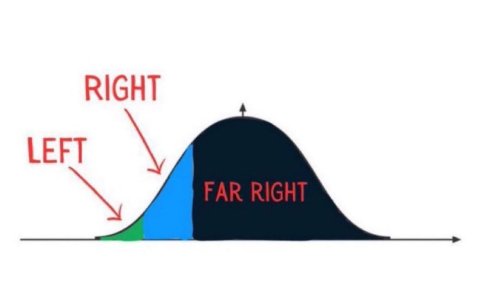
One of the most corrosive habits in current political discourse is the way plain factual claims get assigned a partisan label. Not arguments. Not policies. Facts. Or, more precisely, statements that point back to material reality, institutional limits, or ordinary human constraints. In theory, facts are supposed to discipline ideology. In practice, they are often treated as ideological aggression when they obstruct a preferred moral script.
That is what people are reaching for when they say facts are now treated as right-wing. The phrase is blunt, but it points to something real. In a growing number of disputes, especially around sex, gender, speech, and institutional policy, a person can say something materially true and be treated not as a participant in debate but as a moral suspect. The point is not answered on its merits. It is recoded as a signal of contamination. The speaker is no longer heard as describing reality. He is heard as choosing a tribe.
That shift matters because it changes the structure of argument. Once a factual claim is socially coded as “right-wing,” the burden quietly moves. The question is no longer whether the claim is true. The question becomes why you said it, what kind of person says such things, and who might feel endangered by hearing it. Motive replaces mechanism. Stigma replaces rebuttal. The claim is not refuted so much as quarantined.
You can see this clearly in disputes over sex and pronouns. For many people, saying that sex is real, binary in the ordinary human sense, and not altered by self-declaration is not an act of hostility. It is a claim about reality and a claim about language. “He” and “she” historically track male and female persons. Refusing to detach those words from sex is not, on its face, a partisan performance. It is an attempt to keep public language tethered to the material world rather than to inward identity claims.
“The disagreement is not mainly about politeness. It is about which reality gets public authority.”
That is exactly why the issue generates so much heat. The disagreement is not mainly about politeness. It is about which reality gets public authority. Does language track bodies, or does it track self-declared identity? Does a school treat sex as a stable feature of the world, or does it treat identity assertion as the governing fact? Those are not small etiquette disputes inflated by the internet. They are conflicts about ontology, law, and institutional power.
Canada now offers several live examples. Alberta’s Education Amendment Act requires parental notification when a student requests a gender identity-related preferred name or pronouns, and parental consent for students under 16 before staff may use them. The province says these changes are part of supporting families and setting clear school rules, with the remaining education amendments anticipated to take effect on September 1, 2025. Then, in late 2025, Alberta escalated further. Bill 9 invoked the notwithstanding clause to shield not only this school policy but other contested sex-and-gender measures from being struck down by the courts. That bundling matters. It shows this is no longer being treated as a narrow administrative disagreement, but as a foundational conflict over parental authority, child development, and the public meaning of sex.
Quebec presents the same fracture from the opposite direction, and it is ongoing now. Current reporting says a Montreal teacher is challenging the provincial policy that allows students 14 and older to change the name and pronouns used at school without parental consent. The teacher alleges she was required to use male pronouns at school while using female pronouns with the student’s parents. A preliminary hearing on anonymity and confidentiality was held on March 6, 2026, with the broader merits challenge still to come. Strip away the activist packaging and the conflict becomes plain: can institutional professionals be required to maintain two vocabularies of reality depending on the audience, and if they object, are they making an ethical argument or committing a moral offense?
The Barry Neufeld case in British Columbia shows the institutional end point of this logic. On February 18, 2026, the B.C. Human Rights Tribunal issued its decision and ordered substantial damages after finding that multiple publications were discriminatory, while some crossed the threshold into hate speech. That does not prove that every factual objection to gender ideology is punishable. It does show how readily dissent can be processed through systems that move from moral condemnation to formal classification. Once that line is crossed, everyone watching understands the lesson. The risk is no longer simply that you will be called wrong. The risk is that you will be treated as a public contaminant.
This is why the familiar “both sides are just choosing different facts” formula goes soft in exactly the wrong place. The conflict is not symmetrical. One side is generally making claims about bodies, language, legal authority, and institutional procedure. The other is often demanding that those things yield to identity-based recognition norms. Dignity is real and relevant. But dignity does not erase biological category, dissolve observable sex, or transmute factual disagreement into literal violence.
So when people say facts are treated as right-wing, the point is not that truth literally belongs to one side of the spectrum. The point is that in a culture saturated with moral performance, inconvenient facts are often recoded as partisan because it is easier to stigmatize them than to answer them. A factual claim that disrupts the script is no longer processed as description. It is processed as dissent. And dissent, under current conditions, is increasingly treated as a character defect.
Facts do not have a party. But when facts obstruct an ideological narrative, that narrative will often brand them right-wing and move straight to motive-policing. That is not a sign that the facts have changed. It is a sign that too much of public discourse has become allergic to reality when reality refuses to flatter the creed.
References
Government of Alberta. “Supporting Alberta students and families.”
https://www.alberta.ca/supporting-alberta-students-and-families
Government of Alberta. “Protecting youth, supporting parents, and safeguarding female sport.”
https://www.alberta.ca/protecting-youth-supporting-parents-and-safeguarding-female-sport
Global News. “Montreal teacher challenges policy for trans students to hide identity from parents.” March 6, 2026.
https://globalnews.ca/news/11719392/montreal-teacher-trans-students-challenge/
British Columbia Human Rights Tribunal. Chilliwack Teachers’ Association v. Neufeld (No. 10), 2026 BCHRT 49. February 18, 2026.
https://www.bctf.ca/docs/default-source/for-news-and-stories/49_chilliwack_teachers-_association_v_neufeld_no_10_2026_bchrt_49.pdf?sfvrsn=2d847803_1
Online discourse is exhausting for a simple reason: certain words are used not to describe reality, but to end the conversation. The label does the work. The argument never has to.
“Fascist” is one of those words.
In current usage, it often functions as a moral airhorn: you’re beyond the pale; you’re dangerous; you’re not worth debating. It gets tossed at people over ordinary ideological disputes about sex and gender, about speech norms, about state power, about immigration, about education. Sometimes it’s malice. Sometimes it’s a sincere attempt to name something authoritarian using the most nuclear term available. Either way, the practical effect is the same: “fascist” becomes a conversation-stopper rather than a description.
That’s why definitions matter. Not because language never evolves (it does), but because political language has consequences. When a term carries a freight of historical evil, using it casually is not “rhetorical adaptation.” It’s moral inflation. Moral inflation does not stay rhetorical for long.
Fascism isn’t just “authoritarian”
Start with what fascism is not.
Fascism is not merely “oppressive, dictatorial control.” That’s too broad. Plenty of regimes are oppressive. Plenty of dictators are brutal. If “fascist” just means “authoritarian,” it becomes a synonym for “bad,” and then it means nothing at all.
Fascism is a historically specific modern political project. A workable definition, tight enough to guide usage and broad enough to cover the main cases, looks like this:
Fascism is an authoritarian mass movement aimed at national rebirth, organized around the leader principle, hostile to liberal constraints (pluralism, due process, free speech), willing to use intimidation or violence against opponents, and committed to subordinating institutions to a single national story.
Notice the “mass movement” piece. Fascism is not only what the state does; it’s what a mobilized public is trained to do for the regime. It does not merely punish dissent. It cultivates a moral atmosphere in which dissent feels like treason, contamination, sabotage.
Economically, fascist systems often preserve nominal private ownership while subordinating markets, labour, and industry to regime goals through state direction and corporatist control. That’s not the essence, but it’s part of the recognizable package: the economy exists for the national project, not the other way around.
History: what it looked like when it was real
Words should cash out in the world.
Historically, fascism is anchored in early 20th-century Europe, most centrally Mussolini’s Italy and Hitler’s Germany. They differed in important ways, but the family resemblance is clear: politics becomes a spiritual drama of national humiliation and promised restoration; the leader becomes the embodiment of the nation; opposition becomes illegitimate by definition; and coercion becomes normalized as “necessary” for unity and renewal.
The methods are recognizably modern: propaganda, spectacle, the disciplining of media and education, the weaponization of law, the tolerated use of street-level intimidation, and the steady narrowing of permissible speech and association. It’s not merely “the government is strong.” It’s the fusion of power with myth, enforced socially and legally.
A practical threshold: not one trait, a cluster
If you want to use “fascist” responsibly, you need a threshold. Not a single feature, a cluster.
The label starts to become warranted only when several of these are present together:
- Leader principle: politics organized around a singular figure or party claiming a unique right to rule.
- Myth of national rebirth: humiliation plus promised restoration demanding unity and purification.
- Anti-pluralism: opponents treated as enemies, not fellow citizens.
- Suppression of dissent: legal, institutional, or social narrowing of speech and association.
- Propaganda and spectacle: mass emotional mobilization replacing open contest.
- Normalization of intimidation: harassment, threats, “consequences,” or violence used as political tools.
- Institutional capture: courts, schools, media, and professions bent into ideological instruments.
This is also how you keep your head when the internet offers you cheap clarity. If someone is merely wrong, stubborn, rude, or convinced, that is not fascism. If someone wants stronger regulation, that is not fascism. If someone defends free speech, or argues about sex and gender, that is certainly not fascism by definition. Those are disputes inside ordinary politics, however heated.
A concrete misuse: the pattern in miniature
Here’s the move you see constantly:
A person says, “I think compelled speech policies in workplaces and schools are a mistake.”
The reply is not, “I disagree, because…”
The reply is, “Fascist.”
What did the label accomplish? It converted a claim about policy into an accusation about moral essence. It implied the speaker is not merely mistaken but dangerous; not merely wrong but disqualifying. Once you have categorized someone as a “fascist,” the next steps feel justified: deplatforming, professional punishment, social exile, denial of hearing.
Maybe the labeler was “just venting.” Maybe it was “good-faith hyperbole.” But hyperbole has downstream effects. It trains the audience to treat coercion as civic hygiene.
Symmetry: this is not a left-only sin
And yes: the right does its own version. “Marxist” becomes a synonym for “liberal.” “Communist” becomes “anyone who wants a program.” “Groomer” becomes a sloppy club for any disagreement about education. “Traitor” becomes shorthand for “opponent who won.” Same mechanism, different tribe: labels as argument-substitutes and permission structures.
If we’re going to complain about language used as a weapon, we don’t get to only notice it when it hits our side.
Why this matters beyond the internet
The problem isn’t just vibes on social media. Label inflation spills into institutions.
When terms like “fascist” become casual descriptors, workplaces and professional bodies begin treating contested political disagreement as a safety issue. Media narratives start pre-sorting dissent as extremism. Politicians learn to substitute moral denunciation for persuasion. The public learns to fear argument and love punishment.
The final irony is that this habit corrodes the liberal norms that make pluralistic society possible: the expectation of disagreement, the discipline of evidence, and the moral restraint of not treating opponents as vermin.

A better standard
Here’s the rule I’m adopting: I’ll reserve “fascist” for cases where I can point to the cluster. Leader principle, anti-pluralism, suppression, intimidation, institutional capture, mythic rebirth. Not merely the heat of the dispute.
When I mean “authoritarian,” I’ll say authoritarian. When I mean “illiberal,” I’ll say illiberal. When I mean “coercive,” I’ll say coercive.
Definitions aren’t pedantry. They are the line between argument and excommunication, a public safety measure for language. “Fascist” should be a diagnosis you can defend, not a mood you can perform. If we flatten every disagreement into fascism, we train ourselves to crave punishment instead of persuasion, and we teach institutions to treat dissent as contamination. That habit does not protect democracy. It rots the muscles that make democracy possible, and it turns politics into a brawl we will eventually call governance.
A lot of arguments don’t end because someone “lost.” They end because someone drops a category word: harmful, hateful, unsafe. The conversation gets reclassified as an emergency, and suddenly you are no longer debating a claim. You are defending your right to be in the room.
If you’ve felt this happening more often lately, you’re not imagining it. The move is simple: treat disagreement as injury, then treat your refusal to retract as more injury. It’s a neat little loop. You can’t disprove it, because your attempt to disprove it is counted as part of the harm.
So the goal here isn’t to “win” every exchange. The goal is to stay clear, stay calm, and avoid being dragged into fog.
Three rules help.
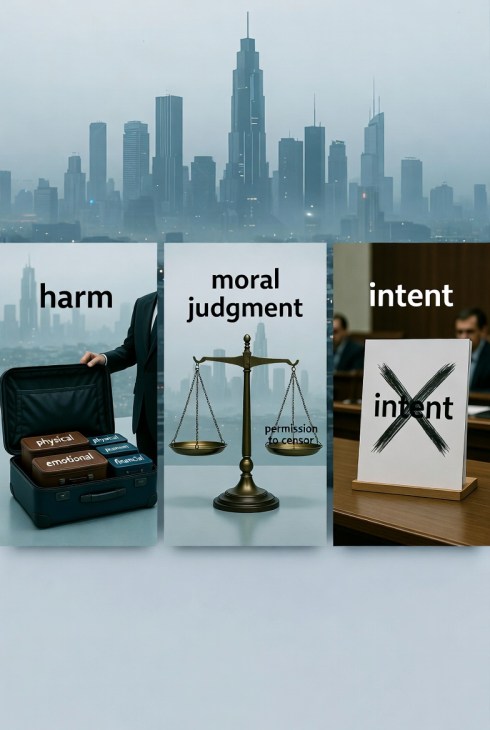
1) Ask what the harm is, mechanically
“Harm” is a suitcase word. People pack a dozen meanings into it, then wheel it around as if it’s one thing.
Don’t fight the suitcase. Open it.
Try:
-
“What kind of harm do you mean: emotional distress, social exclusion, incitement, discrimination, or something else?”
-
“What’s the actual path from my claim to the harm you’re naming?”
-
“Is the harm that you dislike the idea, or that you think it leads to a specific outcome?”
This isn’t a gotcha. It’s basic hygiene. If a person can’t tell you what they mean, you cannot respond intelligently. You’re shadowboxing.
A good rule of thumb: if they can’t name a mechanism, they aren’t making an argument. They’re placing a stop sign on the table and acting like the sign is evidence.
And notice the comfort “harm” provides. It allows someone to skip the hard part, the part where they explain why your claim is false, or why it leads to a concrete bad result. They can just announce: “That’s harmful,” and then expect you to retreat on cue.
Make them do the work. Not as punishment, but because without that work you are not in a debate. You are in a moral weather report.
2) Separate moral judgment from permission to censor
Even if a statement is rude, wrong, or ignorant, it does not automatically follow that it should be suppressed or punished.
That leap is the whole game.
You’ll notice how quickly some conversations smuggle in this assumption: if it’s harmful, it must be disallowed. But that premise is not neutral. It’s political. It’s also the premise that makes “harm” such a powerful word, because it offers a shortcut from “I condemn that” to “you don’t get to say that.”
Break the spell with a calm distinction:
-
“You’re free to think I’m wrong. That doesn’t mean you’re entitled to make me silent.”
Or softer:
-
“We can disagree strongly and still protect the right to say it.”
This forces a choice. Are they arguing that you are mistaken, or are they arguing that mistaken speech is illegitimate?
In a plural society, we tolerate a lot of speech precisely because we do not trust any faction, left or right, religious or secular, activist or corporate, to define “harm” without expanding it until it covers whatever irritates them this week.
Also: don’t let “consequences” do lazy work. Yes, speech can have consequences. So can silence. So can mandatory agreement. So can the habit of treating adults like fragile glassware.
You can live in a world where people criticize each other sharply. That’s normal. What you cannot do, without slowly breaking civic life, is turn moral condemnation into a veto.
Criticism is fair game. Coercion is not.
3) Don’t get trapped in intent court
When someone says “That’s hateful,” they often mean: “Your intent must be hateful.”
Now you’re in a trial about your inner motives, which is the safest place for them. It’s unfalsifiable. You can’t prove you don’t hate. They can’t prove you do. But they can keep you stuck there forever while the original claim remains untouched.
So: state your intent once, briefly, then return to the claim.
A template that works:
-
“My intent isn’t to attack anyone. The claim is X. If X is wrong, show me where.”
That’s it. One sentence of intent, then substance.
If they refuse and keep circling back to your hidden motives, set a boundary:
-
“If your position is that disagreement equals hate by definition, then there isn’t a debate to have.”
This is not escalation. It’s diagnosis. Because at that point the argument is no longer about facts, reasons, or tradeoffs. It’s about social control: the category word has been used to declare you out of bounds, and your only permitted move is submission.
The point of the exercise
The goal isn’t to dunk on people. It’s to keep the conversation from being hijacked by fog words and moral shortcuts.
So:
-
Define the harm (mechanism, not mood).
-
Separate judgment from censorship (criticism isn’t a veto).
-
Refuse the intent trap (claims, not soul-reading).
If they can engage those terms, you might actually have a discussion. If they can’t, you’ve learned something useful. You learned it without flailing, apologizing for existing, or agreeing to a vocabulary designed to make debate impossible.
And that, in 2026, is already a small victory.
This is a common activist argument. It often arrives pre-loaded with moral certainty, as if the analogy itself settles the question. That should set off your spider-senses immediately: when moral certitude and ideological correctness are doing the work, argumentative rigour usually is not.
The claim is familiar. Left-handedness once looked rare because it was stigmatized and suppressed; stigma eased, reported rates rose. Therefore, the rise in transgender identification among youth should be read the same way.
The analogy is rhetorically useful. It is also weak.
It forces two different kinds of phenomena into one moral script. Left-handedness is a motor preference: early-emerging, directly observable, and generally stable across the life course. Childhood transgender identification is not that. It involves self-interpretation, language, social meaning, and developmental concepts that mature unevenly. Whatever one’s broader politics, these are not the same kind of thing. Treating them as equivalent does not clarify the issue. It pre-loads the conclusion.
The first failure is developmental. Handedness does not require a child to grasp an abstract social category. A child reaches for a spoon, a crayon, a ball. The preference is visible in action. Gender identity claims are different. They depend on how a child understands sex categories, role expectations, persistence over time, and what it means to “be” a boy or girl beyond clothing, imitation, or preference. That is a heavier cognitive task. Piaget and Kohlberg do not settle today’s policy disputes, but they do establish a relevant caution: young children often reason concretely, and stable identity concepts develop in stages. A child can show a hand preference before the child can fully articulate an abstract identity claim in a mature sense.
That difference changes what counts as evidence. Handedness does not need interpretive reinforcement to remain legible. It persists without adults affirming a narrative about the child’s inner state. Childhood gender self-description does not operate that way. It unfolds inside a social field: family language, peer dynamics, institutional scripts, online models, and adult interpretation. Saying that does not make every case shallow or insincere. It does mean the left-handedness analogy smuggles in false simplicity by equating a physical preference with a socially mediated self-concept.
The second failure is pattern. The rise in reported left-handedness is commonly explained, in large part, by declining suppression and changing norms around forcing children to write with the right hand. The increase was broad and gradual. It was not driven by intense peer clustering in narrow demographic bands. Recent increases in transgender identification among youth have shown a different profile, including marked concentration in particular age and sex cohorts in some settings. That pattern is harder to explain by destigmatization alone. At minimum, it supports a mixed account in which social influence, peer effects, and online environments may contribute in some cases. That is not proof of a single-cause “contagion” model for every child. It is enough to show that the left-handedness analogy is doing more moral work than explanatory work.
The third failure is stability. Handedness, once established, is typically stable and does not initiate a pathway of medical intervention. Childhood gender distress is more variable. Longitudinal studies from earlier clinic-referred cohorts often found that many children presenting with gender dysphoria did not continue to identify as transgender in adulthood, especially after puberty. Those findings need careful handling. They come from older cohorts, older diagnostic frameworks, and a literature now heavily contested on definitions and generalizability. Even with those caveats, the central point remains: childhood gender distress has historically shown developmental fluidity in a way handedness does not. That alone should make the analogy suspect.
The practical asymmetry is harder to ignore. If society was wrong to suppress left-handedness, the correction was simple: stop forcing children to switch hands. No endocrine pathway. No fertility implications. No irreversible surgeries. No high-stakes clinical decisions under uncertainty. Pediatric gender care is not identical in stakes or consequences. That does not answer every clinical question. It does mean “this is just like left-handedness” is not an argument. It is a reassurance strategy.
A more honest framing is available. Stigma can affect disclosure and prevalence reporting without making every rise in identification analogous to left-handedness. Some young people experience deep and persistent gender distress. Childhood identity development is also shaped by cognition, peers, institutions, and timing. Those claims can coexist. Compassion does not require category collapse.
The left-handedness comparison survives because it is emotionally efficient. It offers a ready-made progress narrative and casts skeptics as yesterday’s moral failures. Efficient is not the same thing as accurate. If the aim is responsible care for vulnerable young people, the first obligation is conceptual hygiene: use comparisons that illuminate developmental reality, not analogies that flatten it.

References
- Kohlberg, L. (1966). A cognitive-developmental analysis of children’s sex-role concepts and attitudes. In E. E. Maccoby (Ed.), The Development of Sex Differences. Stanford University Press.
- Gilbert, A. N., & Wysocki, C. J. (1992). Hand preference and age in the United States. Neuropsychologia, 30(7), 601–608.
- Steensma, T. D., Biemond, R., de Boer, F., & Cohen-Kettenis, P. T. (2011). Desisting and persisting gender dysphoria after childhood: A qualitative follow-up study. Clinical Child Psychology and Psychiatry, 16(4), 499–516.
- Singh, D., Bradley, S. J., & Zucker, K. J. (2021). A follow-up study of boys with gender identity disorder. Frontiers in Psychiatry, 12, 632784.
- Cass, H. (2024). Independent Review of Gender Identity Services for Children and Young People (Final Report).
Modern North American politics is increasingly conducted as if the other side is not an opponent but a threat. Not “wrong,” but illegitimate. Not “mistaken,” but dangerous. Once that framing takes hold, everything downstream gets harder: legislating, compromising, trusting institutions, even sharing a country.
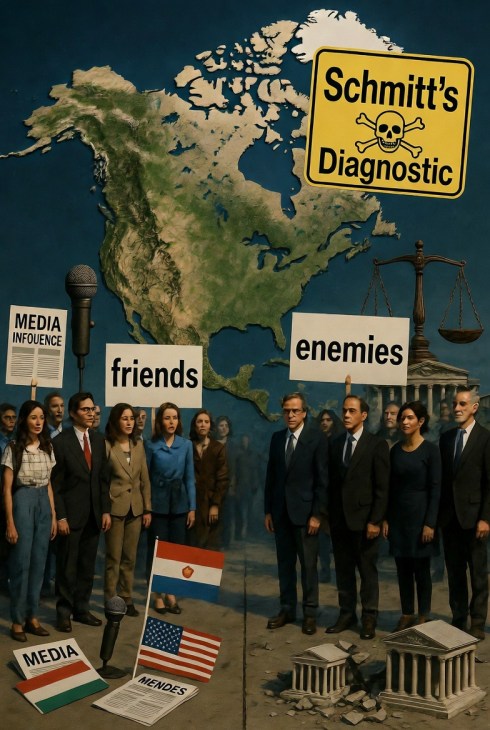
There’s a name for this move, and it’s older than social media: the friend–enemy distinction associated with the German jurist Carl Schmitt. Use it carefully. Attribute it correctly. Treat it as a warning label, not a blueprint.
The Schmitt paragraph (correct attribution without laundering)
In The Concept of the Political (first as an essay in 1927; expanded as a book in 1932), Carl Schmitt argued that what is distinctively political is not morality, economics, or aesthetics, but the capacity to sort human beings into friends and enemies—public groupings that can reach the highest intensity and, in the extreme case, make violence thinkable. (Stanford Encyclopedia of Philosophy) Schmitt is a morally compromised figure: he joined the Nazi Party in 1933 and wrote in support of the regime, which makes him “radioactive” as an authority. (Wikipedia) That’s precisely why the concept should be handled as a diagnostic for a recurring political pattern—not as an endorsement of Schmitt’s politics, and not as a permission slip to treat fellow citizens as foes.
That’s the frame. Now the point: you can reject Schmitt’s politics and still find his definition useful for recognizing when a society is sliding from politics-as-bargaining into politics-as-threat-management.
1) What the friend–enemy distinction is (and isn’t)
Schmitt’s core claim is often quoted badly. The clean version is this:
- It’s public, not personal. “Enemy” is not your private dislike. It’s a public adversary, a category applied at the level of groups. (Stanford Encyclopedia of Philosophy)
- It’s about intensity and stakes. The distinction becomes political when disagreement is framed as a contest over a community’s existence or way of life—when coercion becomes not just imaginable but morally narratable. (Stanford Encyclopedia of Philosophy)
- It’s not reducible to morality. In Schmitt’s framing, you can judge an enemy morally good and still treat them as an enemy; the political is not the same thing as ethics. (Stanford Encyclopedia of Philosophy)
So the friend–enemy distinction is less a philosophy lesson than a switch. When it flips on, political disagreement stops being about what we should do and becomes about who is allowed to be “us.”
2) The observable move: how to spot it in the wild
You’re watching friend–enemy politics when rhetoric shifts from:
- “Their plan won’t work” → “They cannot be permitted to govern.”
- “We’ll reverse this policy later” → “If they win, the country is finished.”
- “We can bargain on X” → “Any compromise is betrayal.”
- “Institutions are imperfect” → “Institutions are legitimate only when they deliver our outcomes.”
Here’s the part that matters: this is not just “heated language.” It’s a legitimacy test. The argument isn’t “our side has better ideas.” It’s “the other side is outside the moral community.”
What it sounds like now (no special villains required)
Over the last decade, ordinary campaign language has absorbed a new register: catastrophe certainty. You hear it when routine electoral competition is narrated as a point of no return not “we’ll reverse their policy,” but “if they win, the country is over.” You hear it when every institution that fails to deliver your preferred outcome becomes not merely flawed but captured—courts, schools, public health bodies, legacy media, election administration. Once those are recast as enemy infrastructure, the next step is predictable: treating compromise as collaboration.
That’s the Schmittian escalator: it turns normal democratic rivalry into a kind of internal cold war.
3) Why this maps onto polarization in the U.S. (with verifiable anchors)
American public opinion data increasingly fits the emotional profile you would expect in a friend–enemy environment: high frustration, high anger, low confidence, and pervasive negativity toward the opposing party.
Pew Research Center (survey fielded Sept. 22–28, 2025) reports that roughly half of U.S. adults say each party makes them feel angry (Democratic Party 50%, Republican Party 49%), and large majorities say each makes them feel frustrated (Democratic Party 75%, Republican Party 64%). (Pew Research Center) Pew also reports that majorities view both parties as too extreme (GOP 61%, Democrats 57%). (Pew Research Center)
That doesn’t “prove Schmitt.” It shows a climate where it’s easy for elites and activists to plausibly say: “The other side isn’t just wrong; they’re dangerous.”
Political science has a name for the emotional side of this: affective polarization which is the tendency for partisans to dislike and distrust the out-party as a social group. Iyengar, Sood, and Lelkes argue that affect increasingly operates through social identity dynamics rather than ideological distance alone. (Political Communication Lab)
Affective polarization supplies the fuel. Friend–enemy rhetoric supplies the spark.
4) Why Canada is not “the same,” but not immune
Canada has its own stresses: regional tensions, institutional distrust, culture-war imports, and an online ecosystem shared with the U.S. but it is still a mistake to claim Canada is simply America north.
A careful comparative point looks like this: research summarized by UBC Magazine reports Canadians show moderate affective polarization and lower levels of deeper hostility (political sectarianism) than Americans; divisions exist, but they are less intense, and fewer people treat the other side as morally beyond the pale. (UBC Alumni Magazine)
A note on insulation (not immunity) 🧯
Canada also has some built-in insulation: parliamentary governance can make politics feel less like a single, winner-take-all presidency; multi-party dynamics can prevent a total two-tribe monopoly; party discipline can concentrate bargaining inside caucuses rather than turning every vote into a public loyalty test. None of that makes Canada immune especially in a shared online ecosystem with American media incentives but it helps explain why Canadian polarization can be real without being identical.
5) Why identity politics dovetails so easily (even when it starts as justice) 🧩
“Identity politics” is a term that gets used as a slur, so define it cleanly. The Stanford Encyclopedia of Philosophy describes identity politics as political activity and theorizing rooted in shared experiences of injustice among members of particular social groups, often aiming to secure political freedom for a marginalized constituency. (Stanford Encyclopedia of Philosophy)
That definition is not inherently friend–enemy. You can organize around group experiences without treating dissenters as enemies.
So why the dovetail?
Because identity politics—left and right—naturally foregrounds group boundaries: who counts, who belongs, who’s harmed, who threatens, who is owed what. Schmitt’s point is that any distinction ethnic, cultural, religious, linguistic, and ideological can become politically decisive if it becomes a marker of collective identity with enough intensity. (Stanford Encyclopedia of Philosophy)
Now add moralization. Finkel and colleagues define political sectarianism as “the tendency to adopt a moralized identification with one political group and against another.” (Political Communication Lab) Once politics is moralized at the identity level, compromise starts to look like apostasy: you don’t bargain with evil; you resist it.
Here’s the dovetail in one line:
Identity makes the boundary salient; moralization makes it sacred; friend–enemy logic makes it coercive.
The accelerant: attention economics
The friend–enemy move also fits the modern information economy. Outrage travels; nuance doesn’t. Platforms and partisan media ecosystems reward content that converts complexity into moral clarity so we get villains, victims, emergencies, and betrayal. That incentive structure doesn’t invent the friend–enemy distinction, but it mass-produces it, because existential framing is the most reliable way to keep attention and discipline the in-group.
6) The cost: why friend–enemy politics jams the machinery of governance
When politics is friend–enemy:
- Compromise becomes betrayal.
Not merely “a bad deal,” but disloyalty to the tribe. - Institutions become contested terrain.
Courts, legislatures, bureaucracies, and media are judged not by process but by whether they serve “us.” Legitimacy becomes outcome-dependent. - Policy friction skyrockets.
Even mutually beneficial reforms become hard because the other side’s win is treated as loss of status or existential risk. - Moderation gets punished.
The moderate’s basic civic move—“I’ll grant you partial legitimacy and bargain” gets rebranded as weakness or collaboration.
The social cost (quiet, cumulative, real)
The damage isn’t confined to legislatures. Friend–enemy framing erodes social trust: people self-censor at work, avoid neighbours, and retreat into curated friend-only spaces. Institutions become identity badges your media, your university, your charities, your professional associations until public life resembles a network of gated communities with competing moral jurisdictions.
7) The steelman (and the answer)
Steelman: sometimes the other side really is dangerous. Sometimes a movement is openly anti-democratic, violent, or committed to permanent domination. In those cases, “enemy” language can feel like moral clarity.
Answer: danger exists. But friend–enemy framing is cheap to claim and expensive to live under. The burden of proof has to be high, because once you normalize existential threat talk, you train citizens to treat routine democratic alternation as intolerable. You also incentivize mirroring: nobody wants to be the only player insisting it’s “just politics” while being branded a threat.
Friend–enemy politics is a ratchet. It rarely turns only one way.
8) A short field guide: “know it when you see it”
You’re in friend–enemy territory when you hear:
- “They’re illegitimate.”
- “If they win, the country is over.”
- “Neutrality is complicity.”
- “Compromise is betrayal.”
- “The system is rigged—unless we win.”
- “Your neighbour’s vote is violence / treason / conquest.”
And you’re watching it spread when those claims expand outward to tag neutral institutions and ordinary citizens: not just the party but anyone who isn’t for us is with them.
9) The exit ramp: moderation without naïveté
This is not a call for civility theatre. It’s a call for civic hygiene.
A workable politics of moderation has one core rule:
Treat opponents as lawful rivals unless and until they clearly demonstrate otherwise and even then, be precise.
Practically, that means:
- Argue policy in terms of tradeoffs, constraints, second-order effects (the language of governing, not excommunication).
- Reserve “enemy” language for genuinely exceptional cases, and specify evidence and predictions that could, in principle, be falsified.
- Defend institutional legitimacy as a process, not a scoreboard.
If you can’t do that, you don’t just intensify conflict you corrode the shared premise that makes democratic disagreement possible: that losing an election is not losing the country.
Closing: the consequence if we don’t name it
Schmitt’s concept is dangerous partly because it’s accurate as a description of how politics can harden. Once a society trains itself to see politics as friend versus enemy, it will eventually demand enemy-handling tools: purges, blacklists, emergency powers, legitimacy tests, permanent distrust. The policy state becomes brittle; the civic culture becomes suspicious; moderation becomes a vice.
The friend–enemy distinction is not merely an idea. It’s a habit of mind. And habits, unlike ideologies, don’t require formal assent. They spread by imitation.
The minimum defensive act is to recognize the move when it’s being done to you, and when you’re tempted to do it back. 🧭
Glossary
Affective polarization — Dislike, distrust, and social hostility toward supporters of the opposing party, treated as a group identity rather than merely a set of policy positions. (Political Communication Lab)
Catastrophe register / no-return framing — A rhetorical mode that describes ordinary electoral competition as an existential point of no return (“if they win, the country is over”).
Friend–enemy distinction (Schmitt) — The claim that the political is defined by the capacity to distinguish friend from enemy in a public sense, with sufficient intensity that coercion or violence becomes thinkable in extreme cases. (Stanford Encyclopedia of Philosophy)
Identity politics — Political activity and theorizing grounded in shared experiences of injustice among members of particular social groups, typically aimed at securing political freedom for a marginalized constituency. (Stanford Encyclopedia of Philosophy)
Legitimacy denial — Treating the opposing side as outside the set of lawful rivals who may govern; shifting from “they’re wrong” to “they must not rule.”
Political sectarianism — “The tendency to adopt a moralized identification with one political group and against another,” borrowing the metaphor of religious sects rather than mere teams. (Political Communication Lab)
Process legitimacy — The idea that institutions are legitimate because procedures are lawful, stable, and fairly applied—not because they produce outcomes you like.
Citations (Sources)
- Carl Schmitt (Stanford Encyclopedia of Philosophy), overview of Schmitt and the friend–enemy distinction. (Stanford Encyclopedia of Philosophy)
- Background note on The Concept of the Political and Schmitt’s Nazi Party membership (reference context). (Wikipedia)
- Pew Research Center (Oct 30, 2025), party feelings: anger/frustration measures. (Pew Research Center)
- Pew Research Center (Oct 30, 2025), views of both parties: “too extreme” findings. (Pew Research Center)
- UBC Magazine (Dec 2, 2025), summary of Canadian polarization research and comparative claims. (UBC Alumni Magazine)
- Iyengar, Sood, & Lelkes (2012), “Affect, Not Ideology,” on affective polarization as social identity. (Political Communication Lab)
- Finkel et al. (Science, 2020), “Political sectarianism in America,” definition and framework. (Political Communication Lab)
- Identity Politics (Stanford Encyclopedia of Philosophy), definition and scope. (Stanford Encyclopedia of Philosophy)

A meme slid past my feed this week that’s basically a whole comment section compressed into one sentence:
“If you’re real quiet about Renée Good and Alex Pretti, but were really loud about Charlie Kirk—I see you. We all see you.”
You can feel what it’s trying to do. It’s not asking a question. It’s issuing a verdict — and inviting the crowd to clap. 👀
Before we get moral about it (or defensive about it), it helps to name what’s happening. This kind of meme is a conversational device. It’s a way of sorting people into “clean” and “suspect” without having to do the slow work of inquiry.
This post isn’t about denying hypocrisy exists. Selective empathy is real. It’s ugly. It’s also common — across every tribe that’s ever existed. The point here is narrower:
When we treat silence as proof of motive, we stop talking about what’s true and start talking about who’s safe.
And once the conversation becomes “who’s safe,” facts arrive late and leave early.
What the meme is actually doing
That one sentence performs four moves:
- An observable claim: “Some people were loud about X and quiet about Y.”
- A measurement dodge: “Loud” and “quiet” are undefined (posts? news coverage? your feed? my feed?).
- A motive leap: The difference is taken as evidence of moral defect.
- A social threat: “I see you. We all see you.” = reputational enforcement.
In other words: it skips the checkable part (#1) and jumps straight to the morally satisfying part (#3), backed by a crowd (#4).
If you want conversation instead of sorting, you reverse the order: connect → define → test → then (carefully) infer.
The best one-sentence reply is not a rebuttal
Before you ask any questions, you lower the temperature:
“All political violence and unjust killing is wrong. If selective empathy is happening, I agree it’s worth confronting.”
That sentence does two things: it refuses the tribal frame, and it makes your questions sound like inquiry rather than evasion.
Make the meme’s claim testable
Here are the three questions that turn heat into light:
- “When you say loud vs quiet, what counts as loud/quiet?”
- “Do you mean the same individuals, or the general vibe of your feed?”
- “On a 0–10, how sure are you it’s the same people — and what gets you to that number?”
If the conversation can’t answer those, it isn’t actually about truth. It’s about loyalty.
“Real conversations” in action (composites)
What follows are composites — not quotes — written to sound like the kinds of exchanges that reliably show up under posts like this. The point is not to win. The point is to keep two minds in the same room long enough to examine certainty.
Conversation A: The public comment (low bandwidth, high heat)
Them: “If you were loud about Kirk but quiet now, you’re telling on yourself.”
You: “I hear the frustration. Selective empathy is real, and it’s corrosive.”
Them: “Exactly. People only care about their team.”
You: “Can I ask one clarifying question — when you say ‘quiet’ and ‘loud,’ do you mean the same individuals, or the general vibe of your feed?”
Them: “Same individuals.”
You: “On a 0–10, how sure are you it’s the same individuals?”
Them: “Nine.”
You: “What gets you to 9?”
Them: “I saw them post about Kirk immediately.”
You: “Okay. What would move you to an 8? Would it matter if some of them simply never saw the other story, or didn’t know enough yet to comment?”
Them: “Maybe, but come on.”
You: “Fair. I’m not denying hypocrisy exists. I’m trying to separate ‘didn’t see / didn’t know’ from ‘doesn’t care.’ If we’re going to accuse motives, I want it to land on something we can actually verify.”
Notice the move: you don’t “defend the quiet.” You ask whether the accusation is evidence-based or feed-based.
Conversation B: The DM (relationship context)
Friend: “I’m sick of fake empathy.”
You: “I get that. Can I ask what you want to happen with a post like this — reflection, apology, pressure, unfriending?”
Friend: “I want people to admit they’re biased.”
You: “Okay. On a 0–10, how sure are you it’s bias rather than attention/algorithm/people being afraid to say the wrong thing?”
Friend: “Nine.”
You: “What’s the strongest thing that puts it at 9?”
Friend: “They posted about Kirk instantly.”
You: “That’s a real data point. Would you be willing to test one person you mean? If they genuinely didn’t see the other story, would you want to know that before concluding motive?”
Friend: “…Yeah.”
You: “That’s all I’m guarding: one small door for ‘maybe there’s another explanation’ before we turn silence into a moral indictment.”
This is the “impossible conversations” pivot: from verdict to conditions for revising certainty.
Conversation C: The trap (“You were loud about Kirk”)
Them: “Funny you’re talking now. You were loud about Kirk.”
You: “Fair question. What are you inferring from that?”
Them: “That your empathy is tribal.”
You: “I don’t want that to be true. My honest answer is: the Kirk story saturated my feed, so I reacted fast. I saw the other story later.”
Them: “Convenient.”
You: “Maybe. So let’s test it. If you saw me condemn violence consistently across cases, would that move your certainty down even one point?”
Them: “Possibly.”
You: “Then we’re not stuck. And I’ll take the lesson too: I should be slower to mind-read others, because I don’t want it done to me.”
You decline the moral cage match and offer a falsifiable check: consistency over time.
The hidden leap: silence equals motive
The meme’s real power comes from a hidden assumption: silence proves character.
Sometimes silence is cowardice. Sometimes it’s indifference. Sometimes it’s ignorance. Sometimes it’s grief in private. Sometimes it’s uncertainty. Sometimes it’s algorithmic — people genuinely did not see what you saw.
If you want to accuse motives, you can. But if you want to persuade people who don’t already agree with you, you need to do the hard part first: define what you’re measuring, and test whether your inference survives alternative explanations.
A few clarifications before the comments do what comments do
- “So you’re saying hypocrisy isn’t real?” No. I’m saying hypocrisy accusations land harder when they’re grounded rather than assumed.
- “So you’re saying violence isn’t political?” No. I’m saying political interpretation isn’t a substitute for checking claims.
- “So you’re tone-policing?” No. I’m trying to keep inquiry alive when the conversation is about to be sealed shut.
- “So this is manipulation?” Only if you use it to stall forever. The point is mutual standards and one testable claim. If we can’t do that, we exit.
Suggested reading
- How to Have Impossible Conversations — the toolkit behind the “connection → certainty → one claim” pattern
- The Righteous Mind — why moral intuitions lead and reasoning follows
- Mistakes Were Made (But Not by Me) — why doubling down feels like integrity
- Never Split the Difference — practical emotional-safety tactics
- How Minds Change — what actually shifts belief over time
I’ve watched conversations snap shut the moment a label lands. “Authoritarian.” “Racist.” “Groomer.” “Commie.” “Fascist.” Sometimes it’s shouted; sometimes it’s delivered with a calm that’s worse. Either way, the label does the same job: it turns dialogue into sorting.
If you care about persuasion—or even just about staying human with people you disagree with—this is the moment that matters. Because once someone is convinced you are morally radioactive, your facts don’t enter the room. And once you decide they’re unreachable, you stop trying to reach them. The relationship becomes a trench. 🕳️
I’m writing about a specific conversational pattern—fast moral labeling that turns disagreement into contamination, and makes inquiry feel like betrayal. This post is about how to keep a relationship intact long enough to examine the certainty behind that label.
It draws heavily on the “impossible conversations” approach: connection first, then a mutual audit of certainty, then one claim we can actually test. Not a conversion campaign. Not a dunk. Not more fuel.
My claim is simple:
If you want a real conversation with someone who reaches for moral labels quickly, start by making a real connection—then invite a shared audit of certainty, not a duel of conclusions.
Lens A: From inside the moral-alarm posture
From the inside, this posture often doesn’t feel like ideology. It feels like moral eyesight. You can see harms other people don’t see—or don’t want to see—and the world keeps asking you to speak softly about it, to “debate,” to “be civil,” to wait your turn while people get hurt.
In that frame, neutrality isn’t neutral. A demand for “open inquiry” can sound like a demand to treat someone’s dignity as a hypothesis. So when I hear a policy proposal, a joke, a statistic, even a question—my mind scans for the pattern: Who gets harmed? Who gets protected? Who gets erased?
That’s why labels arrive quickly. Often, “fascist” isn’t meant as a careful historical claim. It’s shorthand for: this is authoritarian; it threatens vulnerable people; it belongs in the moral quarantine. The label is a gate. It keeps the moral community safe.
And to be fair: sometimes the alarm is justified. There are real authoritarian impulses in politics and institutions. The question isn’t whether harm exists. The question is whether a particular claim about harm is being held in a way that stays connected to evidence—and stays connected to other people.
So what keeps me in the conversation?
- You don’t start by correcting my language. You start by understanding what harm I think I’m preventing.
- You don’t perform neutrality. You show you have values too—especially values I recognize: dignity, fairness, reducing cruelty.
- You lower the temperature by reducing threat: to my identity, my group, my moral standing.
What makes me leave immediately?
- “You’re brainwashed.”
- “You’re evil.”
- “You’re hysterical.”
- Any vibe of: I need you to be stupid for me to be confident.
If you need me to feel small so you can feel right, I’m gone.
Lens B: Where I am now, and what I’m trying to do
I’m wary of ideological capture. I care about fairness and free inquiry, and I’m suspicious of moral language used as a weapon to shut down reasoning. I also know this: you don’t talk someone out of certainty by attacking it head-on. You often strengthen it. Certainty is frequently doing work: protecting identity, status, belonging, safety.
So my aim isn’t “defeat your conclusion.” It’s two-fold:
- Make enough connection that you feel safe staying in the room.
- Shift the conversation from “What do you believe?” to “How sure are you, and why?”
Beliefs can be tribal. But certainty is often a crack where curiosity can enter. 🌱
The approach: connection → certainty → one claim we can actually test
1) Connection before correction
Connection isn’t flattery. It isn’t surrender. It’s reducing the sense that this conversation is a status fight or a moral trial.
Concrete moves:
- Name a shared value.
“I think we both want fewer people harmed.”
“I’m with you on dignity; I’m unsure about the mechanism.” - Name your intent.
“I’m not trying to score points. I want to understand how you’re seeing this.” - Steelman one piece before touching the claim.
“If those outcomes are real, I can see why you’re alarmed.”
None of this concedes the label. It makes it possible to talk about what the label is trying to protect.
2) The certainty questions
Once connection is real—not perfect, just real—you invite a mutual audit. This is where the conversation becomes “impossible” in the good way: you’re not arguing conclusions; you’re exploring how the conclusion is held.
The simplest sequence I know:
- “On a scale from 0–10, how certain are you that [assertion]?”
- “What gets you to that number?”
- “What would move you down one point?”
- “What evidence would you expect to see if you were wrong?”
That last question is the tell. If nothing could change it, you’re not in a disagreement—you’re in a boundary ritual.
Guardrail: this isn’t meant to be an endless epistemology loop. If you’re auditing certainty forever and never testing a claim, you may be stalling—or being stalled.
3) Only then: test one claim together
Most fights fail because we try to litigate an entire worldview. Don’t. Pick one claim. Keep it local. Make it about outcomes and standards, not about moral status.
Rules that help:
- One topic. One example.
- Ask what counts as good evidence for both sides.
- Keep it falsifiable-ish. If it can’t be wrong, don’t wrestle it.
A short dialogue when “fascist” shows up
Here’s the kind of exchange I mean. It’s deliberately plain.
Them: “That’s basically fascist.”
Me: “When you say ‘fascist’ here, do you mean historically fascist, or more like authoritarian and harmful?”
Them: “Authoritarian. It targets marginalized people.”
Me: “Okay. On a 0–10 scale, how certain are you it leads to that harm?”
Them: “A 9.”
Me: “What gets you to 9?”
Them: “The pattern. It always goes this way.”
Me: “If we found out the outcomes didn’t increase harm to that group—say they were neutral or improved—would your certainty drop at all?”
Them: “Maybe.”
Me: “What evidence would you need to see for that ‘maybe’ to feel real?”
Notice what happened. I didn’t accept the label. I didn’t attack it either. I moved from label → claim → certainty → conditions for revision. That’s the move.
And I try to hold myself to the same standard. If I ask what would change your mind, I should be able to answer what would change mine. Symmetry is disarming. ⚖️
The “three doors” rule
When things get hot, offer choices so the other person doesn’t feel trapped:
“Do you want to do one of these?”
- Clarify terms (what do we mean?)
- Check certainty (how sure, and why?)
- Test one claim (what evidence would move us?)
If they refuse all three, I stop—not in anger, but in conservation mode:
“It sounds like we’re not in a place for a real exchange right now. I’m here if you want to try again later.”
When not to use this approach
Connection is not a duty in every context. If the exchange is coercive, humiliating, or unsafe—or if someone demands you accept a moral confession just to keep talking—leave. If concrete harm is immediate, address the harm first. Certainty-audits are not a substitute for accountability.
What success looks like
Success is not conversion. It’s not winning. It’s smaller—and because it’s smaller, it’s more real:
- “I still disagree, but I understand why you think that.”
- “Here’s what might change my mind.”
- “I don’t need to call you evil to keep my beliefs intact.”
If we can’t talk about certainty—ours or theirs—we will keep outsourcing moral judgment to labels. Labels are efficient. They are also corrosive. They turn disagreement into contamination. ☣️
The culture war runs on that corrosion. It doesn’t need more fuel.
If you want to reach someone deep in moral certainty, connection is the price of admission. Once you’re in, don’t aim for the headline. Aim for the one honest question that makes certainty visible—then sit there together long enough for reality to have a chance.

A few clarifications before the comments do what comments do
- “So you’re saying fascism isn’t real?” No. I’m saying labels are often used as conversation-stoppers, and I’m interested in testing the underlying claim together rather than trading moral verdicts.
- “So you’re saying just be nice to bigots?” No. Boundaries still matter. This is about how to talk when you choose to talk, and how to exit cleanly when you shouldn’t.
- “So you’re tone-policing people who are alarmed?” No. I’m describing a pattern where moral alarm hardens into moral certainty—and how to make certainty discussable without contempt.
- “So this is manipulation?” Only if you use it to stall forever. The point is mutual standards and one testable claim—if we can’t do that, the conversation ends.
Suggested reading
- How to Have Impossible Conversations — The core toolkit: rapport, questions, and clean exits.
- The Righteous Mind — Moral intuition first, reasoning second; helps explain threat dynamics.
- **Mistakes Were Made (But Not by Me) — Cognitive dissonance and why doubling down feels like integrity.
- Never Split the Difference — Emotional-safety techniques that pair well with “connection first.”
- How Minds Change — A modern synthesis on belief change and identity.











 bleatmop
 Mystro


 Dead Wild Roses
Your opinions…