
You are currently browsing the category archive for the ‘Education’ category.
Suicidal empathy is a term Dr. Gad Saad uses to describe a specific failure mode of compassion: empathy that gets detached from boundaries, reciprocity, and cost-accounting—until it starts producing outcomes that harm the very people and institutions doing the empathizing.
Read it less as a diagnosis and more as a warning label. Empathy is normally a pro-social tool. It helps humans cooperate, care for dependents, and build trust. But like any tool, it can be misapplied. When empathy becomes an unconditional rule (“the compassionate option must always win”), it stops asking the questions that keep compassion functional: Who pays? Who benefits? What incentives are we creating? What happens if this scales?
That’s the central mechanism. Unbounded empathy deactivates trade-offs. It treats limits as moral failure, and it treats enforcement as cruelty. In public life, that often looks like policies designed around the needs of the claimant while steadily eroding the duties owed to the steward—the taxpayer, the law-abiding neighbor, the already-vulnerable person living downstream of disorder. It isn’t that compassion is wrong; it’s that compassion without accounting becomes a transfer of risk onto the conscientious.
If you want this concept to be useful—rather than partisan—you need a clean heuristic. Here’s one:
The Suicidal Empathy Test (a quick diagnostic)
When you see a “compassion-first” policy, norm, or movement, ask:
-
Where does the cost land?
Is the cost paid by decision-makers, or exported onto people with less voice? -
What happens at scale?
Would this still work if adopted widely, or is it only viable as a boutique exception? -
What incentives does it create?
Does it reward responsibility and reciprocity—or does it reward manipulation, noncompliance, or repeat harm? -
Are boundaries being treated as immoral by definition?
If the only “good” option is the one that refuses limits, you’re not doing ethics—you’re doing sentiment. -
Does it erode the conditions that make generosity possible?
High-trust societies can afford softness because they still enforce norms. If the proposal weakens trust, safety, or shared obligation, it may be burning the fuel empathy runs on.
You don’t need cynicism to apply this test. You just need the willingness to treat compassion as something that must be paired with responsibility. The point isn’t to feel less—it’s to see more: the second-order effects, the incentives, the people who silently pay. If empathy can’t survive contact with those questions, it isn’t moral courage. It’s moral vanity with a body count.

References
Suicidal Empathy (publisher page – HarperCollins / Broadside Books)
https://www.harpercollins.com/products/suicidal-empathy-gad-saad
Gad Saad – Concordia University faculty profile
https://www.concordia.ca/faculty/gad-saad.html
The Parasitic Mind (publisher page – Simon & Schuster)
https://www.simonandschuster.com/books/The-Parasitic-Mind/Gad-Saad/9781621579939
Gad Saad – Psychology Today contributor page
https://www.psychologytoday.com/ca/contributors/gad-saad-phd
Suicidal Empathy (Audible Canada listing – includes release date/details)
https://www.audible.ca/pd/Suicidal-Empathy-Audiobook/B0FZ6JMVFQ
In a revealing glimpse behind the curtain, commentator Andrew Doyle recently highlighted how certain narratives are tightly controlled within major media organizations. According to Doyle, the BBC has an “LGBT desk” that effectively acts as a gatekeeper, making sure all stories related to sexuality or gender must align with a particular viewpoint before they get the green light.
This revelation sheds light on how media outlets can become ideologically captured, turning into echo chambers rather than platforms for open dialogue. While there are undoubtedly excellent journalists at the BBC, Doyle’s insight reveals a systemic issue: when certain desks have the power of veto over stories, it raises questions about whose voices are being heard and whose are being filtered out.
In a time when free speech and diverse perspectives are more important than ever, understanding how these behind-the-scenes dynamics work is crucial. After all, a truly free press should aim to present a range of viewpoints rather than enforcing a single narrative.
If you missed what I’m talking about please look at the post from this Sunday’s The DWR Sunday Religious Disservice – Why Classical Islam and Western Liberalism Face Deep Tensions.

1) “You’re Confusing Islam with Islamism. The Problem Is Politics, Not the Religion.”
Steelman: Islamism is a modern political project. The ugly stuff is authoritarianism in religious costume. Islam as faith is diverse and reformable. Reformers exist. So don’t blame the religion for the politics.
My answer: The distinction is real. It just doesn’t rescue the claim.
Modern Islamism didn’t invent the collision with liberalism. It accelerated it. The collision is older, because it sits inside a legal tradition that treats divine law as public law, not private devotion.
Start with the liberal baseline: your right to change your beliefs without state punishment. The ICCPR treats freedom of thought, conscience, and religion as including the freedom “to have or to adopt” a religion of one’s choice, and bars coercion that impairs that freedom.[1] Yet apostasy laws still exist as state law in a chunk of the world. Pew counted apostasy laws in 22 countries in 2019.[2] That’s not “Islamism only.” That’s a standing fact about legal systems and what they’re willing to criminalize.
Then there are the asymmetries that aren’t modern inventions at all. The Qur’an’s inheritance rule that the male share is “twice that of the female” is explicit.[3] So is the debt-contract witness standard that requires one man and two women in that context.[4] You can contextualize these. You can argue for limited scope. You can try to reinterpret. But you can’t pretend the hard edges arrived in the 20th century.
So yes: reform is possible. But the obstacle is not merely “bad regimes.” It’s the weight of inherited jurisprudence plus institutions that treat that inheritance as binding.
If you want a clean test, use this: Is conscience sovereign? Including the right to leave the faith without legal penalty. Where the answer is no, liberalism exists on permission, not principle.
2) “Western Civilization Has Its Own History of Religious Violence and Oppression.”
Steelman: Christianity did crusades, inquisitions, heresy executions, and legal oppression. Liberalism took centuries. So singling out Islam is selective and hypocritical. Islam may simply be earlier in the same process.
My answer: Fair comparison. Now use it properly.
The West didn’t become liberal because Christians became nicer. It became liberal because religious authority was structurally pushed out of sovereignty over law and conscience. That’s the real lesson.
If “Islam can modernize” is your claim, then define modernization. It means a public order in which equal citizenship is non-negotiable and the right to belief and exit is protected in law.[1] You don’t get there by vibes. You get there by institutions.
Tunisia’s 2014 constitution is a useful example precisely because it shows the tension in plain language. It says the state is “guardian of religion,” while also guaranteeing “freedom of conscience and belief.”[5] That’s the struggle in one paragraph: which sovereignty rules when the two conflict?
Morocco’s family-law reforms are another example of the same dynamic. Over time, reforms have expanded women’s rights in areas like guardianship and divorce.[6] But even current reform proposals acknowledge a hard limit: inheritance rules grounded in Islamic law remain, with workarounds proposed through gifts and wills rather than direct replacement.[7] Again, that’s not a moral condemnation. It’s the mechanism. Reform runs into inherited authority.
So yes: the Western analogy shows change is possible. It also shows change is not automatic. It is conflict, choices, and enforcement.
3) “You’re Ignoring Diversity in the Muslim World and Overgeneralizing.”
Steelman: Nearly two billion adherents across many cultures and legal systems. Outcomes vary widely. Some Muslim-majority societies are relatively pluralistic. Sweeping statements are unfair.
My answer: Diversity is real. It just doesn’t settle the core question.
Different outcomes prove the future isn’t predetermined. They don’t prove the underlying tension disappears. In practice, “moderation” usually correlates with one thing: how far the state limits religious jurisdiction over public law.
Indonesia is the standard example. Its founding philosophy, Pancasila, is explicitly framed as a unifying civic ideology with principles including belief in one God, deliberative democracy, and social justice.[8] That civic framing matters. It can restrain sectarian rule. But it doesn’t end the conflict.
Indonesia’s newer criminal code debates show how quickly “public morality” and “religious insult” can become tools against liberty. Reuters’ explainer on the code flagged concerns over provisions related to blasphemy and other speech constraints.[9] Human Rights Watch argued the updated code expanded blasphemy provisions and warned about harms to rights, including religious freedom.[10] Reuters has also reported concrete blasphemy prosecutions, including a comedian jailed for jokes about the name Muhammad.[11]
So yes: diversity exists. Outcomes differ. But the recurring fault line remains: whether the state treats conscience and equal citizenship as the top rule, or treats religious law as a superior jurisdiction that liberalism must negotiate with.
Closing
The best objections don’t erase the problem. They refine it.
The conflict is not “Muslims are bad.” That’s a cheap and stupid sentence. The conflict is structural: a comprehensive religious-legal tradition claiming public authority collides with a political order grounded in sovereignty of individual conscience.[1]
You don’t solve that conflict by saying “it’s just politics.” You don’t solve it by reciting Western sins as a deflection. You don’t solve it by pointing to diversity and declaring victory.
A liberal society survives by enforcing liberal public order: one civil law for all, equal rights as the baseline, and no religious veto over belief, speech, or exit.[1] If you refuse to name that clearly, you don’t get “coexistence.” You get drift. And drift always has a direction.
References (URLs)
[1] OHCHR — International Covenant on Civil and Political Rights (ICCPR), Article 18
https://www.ohchr.org/en/instruments-mechanisms/instruments/international-covenant-civil-and-political-rights
[2] Pew Research Center — Four in ten countries… had blasphemy laws in 2019 (includes apostasy law count) (Jan 25, 2022)
https://www.pewresearch.org/short-reads/2022/01/25/four-in-ten-countries-and-territories-worldwide-had-blasphemy-laws-in-2019-2/
[3] Qur’an 4:11 (inheritance shares) — Quran.com
https://quran.com/en/an-nisa/11-14
[4] Qur’an 2:282 (witness standard in debt contracts) — Quran.com
https://quran.com/en/al-baqarah/282
[5] Tunisia 2014 Constitution, Article 6 — Constitute Project
https://www.constituteproject.org/constitution/Tunisia_2014
[6] Carnegie Endowment — Morocco Family Law (Moudawana) Reform: Governance in the Kingdom (Jul 28, 2025)
https://carnegieendowment.org/posts/2025/07/morocco-family-law-moudawana-reform-governance?lang=en
[7] Reuters — Morocco proposes family law reforms to improve women’s rights (Dec 24, 2024)
https://www.reuters.com/world/africa/morocco-proposes-family-law-reforms-improve-womens-rights-2024-12-24/
[8] Encyclopaedia Britannica — Pancasila
https://www.britannica.com/topic/Pancasila
[9] Reuters — Explainer: Why is Indonesia’s new criminal code so controversial? (Dec 6, 2022)
https://www.reuters.com/world/asia-pacific/why-is-indonesias-new-criminal-code-so-controversial-2022-12-06/
[10] Human Rights Watch — Indonesia: New Criminal Code Disastrous for Rights (Dec 8, 2022)
https://www.hrw.org/news/2022/12/08/indonesia-new-criminal-code-disastrous-rights
[11] Reuters — Indonesian court jails comedian for joking about the name Muhammad (Jun 11, 2024)
https://www.reuters.com/world/asia-pacific/indonesian-court-jails-comedian-joking-about-name-muhammad-2024-06-11/
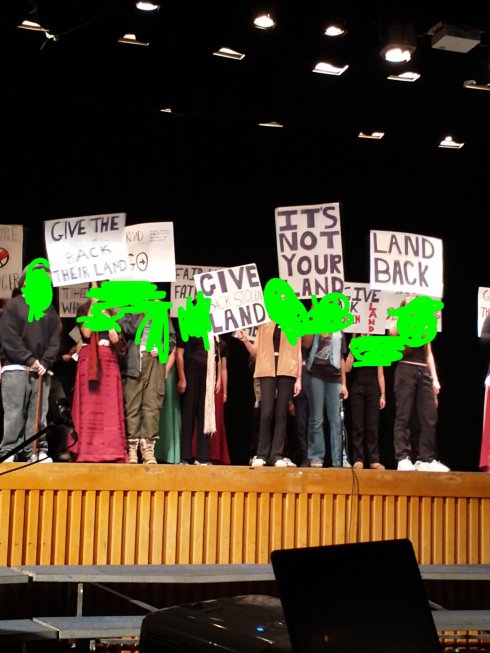
In recent years, Canadian public schools have increasingly incorporated political themes into extracurricular events, including winter concerts. A widely discussed example occurred at Karen Kain School of the Arts in Toronto, where Grade 8 students performed a skit during a December “winter concert” featuring protest‑style signs such as “Give Back Stolen Land” and “Land Back.” The performance replaced traditional seasonal programming with messaging aligned with the contemporary “Land Back” movement. While the intent may have been to highlight Indigenous history, the choice of format and venue raises important questions about the appropriate boundaries between education and activism in publicly funded schools.
To evaluate this incident fairly, it is essential to distinguish between curricular education—which is mandated, necessary, and valuable—and extracurricular political advocacy, which carries different expectations and responsibilities.
Ontario’s curriculum explicitly requires students to learn about Indigenous histories, treaties, residential schools, and the Truth and Reconciliation Commission’s Calls to Action. These topics are not optional; they are embedded in the Social Studies and History curriculum for Grades 1–8. Teaching them is not activism—it is education grounded in historical fact and national responsibility. When taught in the classroom, these subjects can be explored with nuance, context, and opportunities for critical thinking.
The issue at Karen Kain is not the subject matter itself, but the format and framing. A winter concert is traditionally a community‑building event: inclusive, celebratory, and accessible to families of all backgrounds. Parents attend expecting music, dance, or drama that reflects seasonal themes or showcases student creativity. Transforming such an event into a protest‑style performance shifts the purpose from celebration to advocacy. It also removes the pedagogical safeguards—balanced discussion, guided inquiry, and contextual explanation—that exist in the classroom.
The “Land Back” movement, while rooted in legitimate discussions about Indigenous rights and historical treaties, is also a politically contested movement with a wide range of interpretations and significant implications for land ownership, governance, and public policy. Presenting it through slogans and protest imagery, without space for analysis or alternative perspectives, risks conveying a single ideological stance rather than fostering informed understanding. For 13‑ and 14‑year‑old students, who are still developing the ability to evaluate complex political claims, this can blur the line between learning about a movement and being encouraged to endorse it.
This concern is not hypothetical. Surveys consistently show that many Canadian parents prefer schools to avoid pushing students toward political activism, even on causes they personally support. Parents generally want schools to prioritize academic learning, critical thinking, and balanced instruction rather than advocacy. When extracurricular events adopt activist framing, it can erode trust by making families feel blindsided or excluded from decisions about what messages their children are asked to perform publicly.
None of this means schools should avoid difficult topics or silence discussions of Indigenous rights. On the contrary, these subjects deserve thoughtful, rigorous treatment. But context matters. A winter concert is not the venue for dramatizing contested political movements. Doing so risks reducing complex issues to slogans, bypassing critical engagement, and placing students in the role of political actors rather than learners.
A healthier approach would preserve the distinction between education and advocacy. Teach Indigenous history thoroughly in the classroom, as the curriculum requires. Encourage students to analyze movements like Land Back with intellectual seriousness. But keep extracurricular performances focused on inclusive, community‑oriented themes that unite rather than divide.
By maintaining this boundary, schools can honour both their educational mission and their responsibility to provide neutral, welcoming environments for all families—ensuring that learning remains grounded in inquiry, not activism, and that public events remain spaces of shared celebration rather than ideological theatre.
References
Original Incident and Reporting
Pfahl, Chanel (@ChanLPfa). “A parent at the Toronto District School Board sent me these pictures from the ‘Winter Concert’…” X (formerly Twitter), 18 Dec. 2025. https://x.com/ChanLPfa/status/2001719861723173203
“Toronto Grade 8 students stage ‘Land Back’ protest at school ‘winter concert’.” Juno News, 19 Dec. 2025. https://www.junonews.com/p/toronto-grade-8-students-stage-land
Ontario Curriculum Requirements
Ontario Ministry of Education. “Indigenous Education in Ontario.” Government of Ontario, updated 2 Sept. 2025. https://www.ontario.ca/page/indigenous-education-ontario
“Indigenous history, culture now mandatory part of Ontario curriculum.” CBC News, 8 Nov. 2017. https://www.cbc.ca/news/indigenous/indigenous-history-culture-mandatory-ontario-curriculum-1.4393527
Context on the “Land Back” Movement
“The Indigenous ‘Land Back’ Movement: A Land Mine for Canadians.” C2C Journal, 28 Oct. 2024. https://c2cjournal.ca/2024/10/the-indigenous-land-back-movement-a-land-mine-for-canadians/
Parental Attitudes Toward Activism in Schools
Zwaagstra, Michael, and Alex MacPherson. “Canadian parents don’t want schools to push students into political activism.” Fraser Institute, 2024. https://www.fraserinstitute.org/commentary/canadian-parents-dont-want-schools-to-push-students-into-political-activism
For Canadians observing American politics from across the border, the U.S. conservative movement can look unusually volatile—especially after Donald Trump’s 2024 victory reinforced his influence over the Republican Party. If the Canadian Conservative Party is a “big tent,” the GOP is a sprawling, louder, and more internally divided version of the same idea. Its factions share broad goals but clash over identity, strategy, and the future of the movement.
In a recent public commentary, writer James Lindsay outlined five distinct factions competing for influence on the American right. His taxonomy is one interpretation among many, but it captures real ideological and generational tensions. For Canadians trying to understand how these divisions might shape U.S. policy, it’s a useful map.
1. Establishment Republicans: The Institutional Conservatives
These are the traditional, business-oriented conservatives—what Lindsay calls the “stodgy suit-wearing” wing. They emphasize:
• limited government
• free trade
• predictable governance
• strong national defense
For Canadians, this group resembles the Mulroney-era blue Tories: polished, institutionally minded, and cautious about populist disruption.
2. “RINO” Moderates: The Centrist Republicans
“RINO” (Republican In Name Only) is a pejorative label used by hardliners to describe moderates they see as too conciliatory or ideologically soft. Think of figures who prioritize bipartisan cooperation or resist populist rhetoric.
The Canadian parallel would be how some conservatives dismiss “Red Tories” as insufficiently committed to conservative principles. The term reflects internal policing rather than a neutral category, but it marks a real divide between ideological purists and pragmatic centrists.
3. Middle MAGA: The Populist-Pragmatic Core
Lindsay identifies Middle MAGA as the current center of gravity within the GOP. This faction emphasizes:
• patriotism
• common-sense governance
• America First policies
• civic engagement
• skepticism of foreign wars
It is largely Gen X–led and blends populist energy with practical governance. For Canadians, the closest analogue is Pierre Poilievre’s populist-but-practical conservatism: anti-elite, affordability-focused, and oriented toward achievable reforms rather than sweeping ideological overhauls.
4. The Woke Right / Post-Liberal Radicals
This faction—also described as post-liberal, paleoconservative, or national conservative—rejects classical liberalism’s emphasis on individual rights and free markets. Instead, they advocate:
• a more interventionist state
• protectionist economics
• government enforcement of cultural or religious norms
• a strong national identity
Lindsay criticizes this group for adopting tactics he associates with left-wing activism, such as purity tests and identity-based rhetoric. For Canadians, this resembles fringe nationalist or sovereigntist currents—loud, ideological, and disruptive, but not representative of mainstream conservative policy.
5. Pragmatic Neo-Establishment Republicans (e.g., DeSantis-aligned)
This faction overlaps with Middle MAGA but is distinct in its technocratic, results-oriented approach. These conservatives:
• embrace populist themes
• maintain classical liberal commitments
• prioritize policy execution and administrative competence
Lindsay uses Ron DeSantis as an example of this style: populist in tone, managerial in practice. For Canadians, this resembles the Harper-era blend of populist messaging with disciplined governance.
Where the Movement Is Heading
Lindsay predicts that the most likely future for the American right is a fusion between Middle MAGA (3) and the pragmatic neo-establishment (5). This coalition would combine populist energy with administrative competence, pulling many traditional establishment conservatives (1) along with it.
By contrast, he expects the RINO moderates (2) and the Woke Right/post-liberal radicals (4) to resist this consolidation—“kicking and screaming,” as he puts it—and potentially causing disruption from the fringes.
Why This Matters for Canada
These internal American debates have direct implications for Canadians. U.S. conservative politics influence:
• trade policy and tariffs
• energy infrastructure, including pipelines and cross-border projects
• border security and immigration coordination
• NATO and continental defense
As Trump’s second term unfolds, the balance of power among these five factions could shape everything from tariff structures to foreign aid priorities. For Canada, understanding these divisions is essential. Our closest ally and largest trading partner is navigating a period of ideological realignment—one that echoes our own debates, but on a larger, louder, and more consequential scale.


In a captivating episode 0f Wired & Watched 101: EdTech, host Missy Carwowski sits down with Dr. Jared Cooney Horvath, a neuroscientist, former teacher, and leading expert on the science of learning. For two decades, Horvath has studied how humans truly learn—focusing on memory, attention, and brain function—and his findings deliver a sobering message: despite billions spent and endless promises, education technology (laptops, tablets, one-to-one devices, and now AI) is not transforming learning for the better.
In many cases, it is actively harming it. Far from making children smarter, the explosion of screens in classrooms is contributing to the first measured cognitive declines in generations, leaving parents and educators searching for answers.Horvath traces the problem to three fundamental ways technology clashes with how the human brain learns.
First, screens destroy focused attention through constant multitasking—something the brain cannot actually do. Students now spend over 2,500 hours a year switching between tabs, messages, and videos, training them to task-switch rather than concentrate. Second, learning relies heavily on empathy—the biological synchrony that happens when humans interact face-to-face—which machines simply cannot provide. Without that human connection, students lack the motivation to push through difficulty and often quit at the first sign of struggle. Third, “transfer” fails: knowledge learned on screens in an easy, narrow context rarely moves to the varied, complex real world, because computers remove the very effort and contextual cues that make learning stick.
The evidence is stark and growing. Gen Z and Gen Alpha are the first generations to show declines in memory, attention, and general intelligence compared to their parents—the reversal of the Flynn effect that had been climbing for a century. Raw scores on international tests like PISA and the SAT have been dropping 15–30 points per decade, hidden only by constant renorming and grade inflation. Meanwhile, handwriting boosts memory through spatial context and forces deeper processing, while typing often produces shallow, verbatim notes that students barely remember. Even binge-watching studies (which helped shape Netflix’s release strategy) show that spaced practice beats massed screen exposure for both understanding and enjoyment.
Horvath dismantles the common defenses of edtech with clarity. Claims of “potential” admit that promised benefits aren’t happening yet—hardly a reason to double down. Arguments that children must master today’s tools to be “work-ready” ignore the fact that K–12 education has always been about teaching adaptable thinking, not specific software that will soon be obsolete. And the excuse that teachers or students are simply “using it wrong” falls flat: real-world use, not inventors’ intentions, determines a tool’s impact. After sixty years of waiting for the edtech revolution, the data remains underwhelming at best and damaging at worst.
So what should classrooms look like? Horvath envisions a return to pre-2000 norms: computer labs used intentionally for specific lessons, not ubiquitous devices in every hand. Teachers and parents should demand true opt-out policies, forcing schools to maintain analog alternatives. When educators must prepare both digital and paper versions of assignments, most quickly discover that analog methods produce deeper understanding with greater flexibility. Above all, Horvath reminds us that learning has always happened best through human relationships—between teachers and students, students and students—not through screens. As cell-phone bans spread across schools, the next frontier is reclaiming classrooms from compulsory edtech, giving children back the focused, empathetic, effortful environment their brains need to thrive.

References for “The Digital Delusion: Why EdTech Is Failing Our Children”
- M forl Academy podcast episode with Dr. Jared Cooney Horvath (full transcript basis for the essay):
https://www.mforlacademy.com/ (specific episode featuring Dr. Horvath on education technology – check recent releases or search “Jared Cooney Horvath”) - Dr. Jared Cooney Horvath’s upcoming book:
Horvath, Jared Cooney. The Digital Delusion: How Technology Is Failing Our Children and What We Can Do About It. (Expected release December 7, 2025) - Horvath’s website and research hub:
https://www.lmeglobal.net/ - Jared Cooney Horvath YouTube channel (features breakdowns of learning science and edtech research):
https://www.youtube.com/@JaredCooneyHorvath - OECD PISA reports (raw score declines and renorming examples):
https://www.oecd.org/pisa/ (see technical reports on score equating and trends since 2000) - Flynn effect reversal studies (cognitive declines in Western countries):
Bratsberg, Bernt & Rogeberg, Ole (2018). “Flynn effect and its reversal are both environmentally caused.” PNAS. https://doi.org/10.1073/pnas.1718793115
Additional meta-analysis: Wongupparaj et al. (2023) on Gen Z/Alpha declines. - Handwriting vs. typing note-taking research (Mueller & Oppenheimer, 2014 – foundational study):
Mueller, P. A., & Oppenheimer, D. M. (2014). “The Pen Is Mightier Than the Keyboard.” Psychological Science. https://doi.org/10.1177/0956797614524581











 bleatmop
 Mystro


 Dead Wild Roses
Your opinions…