
You are currently browsing the category archive for the ‘Education’ category.
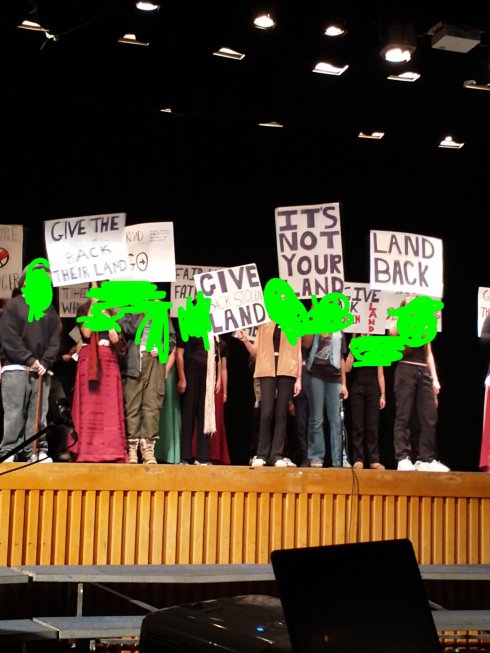
In recent years, Canadian public schools have increasingly incorporated political themes into extracurricular events, including winter concerts. A widely discussed example occurred at Karen Kain School of the Arts in Toronto, where Grade 8 students performed a skit during a December “winter concert” featuring protest‑style signs such as “Give Back Stolen Land” and “Land Back.” The performance replaced traditional seasonal programming with messaging aligned with the contemporary “Land Back” movement. While the intent may have been to highlight Indigenous history, the choice of format and venue raises important questions about the appropriate boundaries between education and activism in publicly funded schools.
To evaluate this incident fairly, it is essential to distinguish between curricular education—which is mandated, necessary, and valuable—and extracurricular political advocacy, which carries different expectations and responsibilities.
Ontario’s curriculum explicitly requires students to learn about Indigenous histories, treaties, residential schools, and the Truth and Reconciliation Commission’s Calls to Action. These topics are not optional; they are embedded in the Social Studies and History curriculum for Grades 1–8. Teaching them is not activism—it is education grounded in historical fact and national responsibility. When taught in the classroom, these subjects can be explored with nuance, context, and opportunities for critical thinking.
The issue at Karen Kain is not the subject matter itself, but the format and framing. A winter concert is traditionally a community‑building event: inclusive, celebratory, and accessible to families of all backgrounds. Parents attend expecting music, dance, or drama that reflects seasonal themes or showcases student creativity. Transforming such an event into a protest‑style performance shifts the purpose from celebration to advocacy. It also removes the pedagogical safeguards—balanced discussion, guided inquiry, and contextual explanation—that exist in the classroom.
The “Land Back” movement, while rooted in legitimate discussions about Indigenous rights and historical treaties, is also a politically contested movement with a wide range of interpretations and significant implications for land ownership, governance, and public policy. Presenting it through slogans and protest imagery, without space for analysis or alternative perspectives, risks conveying a single ideological stance rather than fostering informed understanding. For 13‑ and 14‑year‑old students, who are still developing the ability to evaluate complex political claims, this can blur the line between learning about a movement and being encouraged to endorse it.
This concern is not hypothetical. Surveys consistently show that many Canadian parents prefer schools to avoid pushing students toward political activism, even on causes they personally support. Parents generally want schools to prioritize academic learning, critical thinking, and balanced instruction rather than advocacy. When extracurricular events adopt activist framing, it can erode trust by making families feel blindsided or excluded from decisions about what messages their children are asked to perform publicly.
None of this means schools should avoid difficult topics or silence discussions of Indigenous rights. On the contrary, these subjects deserve thoughtful, rigorous treatment. But context matters. A winter concert is not the venue for dramatizing contested political movements. Doing so risks reducing complex issues to slogans, bypassing critical engagement, and placing students in the role of political actors rather than learners.
A healthier approach would preserve the distinction between education and advocacy. Teach Indigenous history thoroughly in the classroom, as the curriculum requires. Encourage students to analyze movements like Land Back with intellectual seriousness. But keep extracurricular performances focused on inclusive, community‑oriented themes that unite rather than divide.
By maintaining this boundary, schools can honour both their educational mission and their responsibility to provide neutral, welcoming environments for all families—ensuring that learning remains grounded in inquiry, not activism, and that public events remain spaces of shared celebration rather than ideological theatre.
References
Original Incident and Reporting
Pfahl, Chanel (@ChanLPfa). “A parent at the Toronto District School Board sent me these pictures from the ‘Winter Concert’…” X (formerly Twitter), 18 Dec. 2025. https://x.com/ChanLPfa/status/2001719861723173203
“Toronto Grade 8 students stage ‘Land Back’ protest at school ‘winter concert’.” Juno News, 19 Dec. 2025. https://www.junonews.com/p/toronto-grade-8-students-stage-land
Ontario Curriculum Requirements
Ontario Ministry of Education. “Indigenous Education in Ontario.” Government of Ontario, updated 2 Sept. 2025. https://www.ontario.ca/page/indigenous-education-ontario
“Indigenous history, culture now mandatory part of Ontario curriculum.” CBC News, 8 Nov. 2017. https://www.cbc.ca/news/indigenous/indigenous-history-culture-mandatory-ontario-curriculum-1.4393527
Context on the “Land Back” Movement
“The Indigenous ‘Land Back’ Movement: A Land Mine for Canadians.” C2C Journal, 28 Oct. 2024. https://c2cjournal.ca/2024/10/the-indigenous-land-back-movement-a-land-mine-for-canadians/
Parental Attitudes Toward Activism in Schools
Zwaagstra, Michael, and Alex MacPherson. “Canadian parents don’t want schools to push students into political activism.” Fraser Institute, 2024. https://www.fraserinstitute.org/commentary/canadian-parents-dont-want-schools-to-push-students-into-political-activism
For Canadians observing American politics from across the border, the U.S. conservative movement can look unusually volatile—especially after Donald Trump’s 2024 victory reinforced his influence over the Republican Party. If the Canadian Conservative Party is a “big tent,” the GOP is a sprawling, louder, and more internally divided version of the same idea. Its factions share broad goals but clash over identity, strategy, and the future of the movement.
In a recent public commentary, writer James Lindsay outlined five distinct factions competing for influence on the American right. His taxonomy is one interpretation among many, but it captures real ideological and generational tensions. For Canadians trying to understand how these divisions might shape U.S. policy, it’s a useful map.
1. Establishment Republicans: The Institutional Conservatives
These are the traditional, business-oriented conservatives—what Lindsay calls the “stodgy suit-wearing” wing. They emphasize:
• limited government
• free trade
• predictable governance
• strong national defense
For Canadians, this group resembles the Mulroney-era blue Tories: polished, institutionally minded, and cautious about populist disruption.
2. “RINO” Moderates: The Centrist Republicans
“RINO” (Republican In Name Only) is a pejorative label used by hardliners to describe moderates they see as too conciliatory or ideologically soft. Think of figures who prioritize bipartisan cooperation or resist populist rhetoric.
The Canadian parallel would be how some conservatives dismiss “Red Tories” as insufficiently committed to conservative principles. The term reflects internal policing rather than a neutral category, but it marks a real divide between ideological purists and pragmatic centrists.
3. Middle MAGA: The Populist-Pragmatic Core
Lindsay identifies Middle MAGA as the current center of gravity within the GOP. This faction emphasizes:
• patriotism
• common-sense governance
• America First policies
• civic engagement
• skepticism of foreign wars
It is largely Gen X–led and blends populist energy with practical governance. For Canadians, the closest analogue is Pierre Poilievre’s populist-but-practical conservatism: anti-elite, affordability-focused, and oriented toward achievable reforms rather than sweeping ideological overhauls.
4. The Woke Right / Post-Liberal Radicals
This faction—also described as post-liberal, paleoconservative, or national conservative—rejects classical liberalism’s emphasis on individual rights and free markets. Instead, they advocate:
• a more interventionist state
• protectionist economics
• government enforcement of cultural or religious norms
• a strong national identity
Lindsay criticizes this group for adopting tactics he associates with left-wing activism, such as purity tests and identity-based rhetoric. For Canadians, this resembles fringe nationalist or sovereigntist currents—loud, ideological, and disruptive, but not representative of mainstream conservative policy.
5. Pragmatic Neo-Establishment Republicans (e.g., DeSantis-aligned)
This faction overlaps with Middle MAGA but is distinct in its technocratic, results-oriented approach. These conservatives:
• embrace populist themes
• maintain classical liberal commitments
• prioritize policy execution and administrative competence
Lindsay uses Ron DeSantis as an example of this style: populist in tone, managerial in practice. For Canadians, this resembles the Harper-era blend of populist messaging with disciplined governance.
Where the Movement Is Heading
Lindsay predicts that the most likely future for the American right is a fusion between Middle MAGA (3) and the pragmatic neo-establishment (5). This coalition would combine populist energy with administrative competence, pulling many traditional establishment conservatives (1) along with it.
By contrast, he expects the RINO moderates (2) and the Woke Right/post-liberal radicals (4) to resist this consolidation—“kicking and screaming,” as he puts it—and potentially causing disruption from the fringes.
Why This Matters for Canada
These internal American debates have direct implications for Canadians. U.S. conservative politics influence:
• trade policy and tariffs
• energy infrastructure, including pipelines and cross-border projects
• border security and immigration coordination
• NATO and continental defense
As Trump’s second term unfolds, the balance of power among these five factions could shape everything from tariff structures to foreign aid priorities. For Canada, understanding these divisions is essential. Our closest ally and largest trading partner is navigating a period of ideological realignment—one that echoes our own debates, but on a larger, louder, and more consequential scale.


In a captivating episode 0f Wired & Watched 101: EdTech, host Missy Carwowski sits down with Dr. Jared Cooney Horvath, a neuroscientist, former teacher, and leading expert on the science of learning. For two decades, Horvath has studied how humans truly learn—focusing on memory, attention, and brain function—and his findings deliver a sobering message: despite billions spent and endless promises, education technology (laptops, tablets, one-to-one devices, and now AI) is not transforming learning for the better.
In many cases, it is actively harming it. Far from making children smarter, the explosion of screens in classrooms is contributing to the first measured cognitive declines in generations, leaving parents and educators searching for answers.Horvath traces the problem to three fundamental ways technology clashes with how the human brain learns.
First, screens destroy focused attention through constant multitasking—something the brain cannot actually do. Students now spend over 2,500 hours a year switching between tabs, messages, and videos, training them to task-switch rather than concentrate. Second, learning relies heavily on empathy—the biological synchrony that happens when humans interact face-to-face—which machines simply cannot provide. Without that human connection, students lack the motivation to push through difficulty and often quit at the first sign of struggle. Third, “transfer” fails: knowledge learned on screens in an easy, narrow context rarely moves to the varied, complex real world, because computers remove the very effort and contextual cues that make learning stick.
The evidence is stark and growing. Gen Z and Gen Alpha are the first generations to show declines in memory, attention, and general intelligence compared to their parents—the reversal of the Flynn effect that had been climbing for a century. Raw scores on international tests like PISA and the SAT have been dropping 15–30 points per decade, hidden only by constant renorming and grade inflation. Meanwhile, handwriting boosts memory through spatial context and forces deeper processing, while typing often produces shallow, verbatim notes that students barely remember. Even binge-watching studies (which helped shape Netflix’s release strategy) show that spaced practice beats massed screen exposure for both understanding and enjoyment.
Horvath dismantles the common defenses of edtech with clarity. Claims of “potential” admit that promised benefits aren’t happening yet—hardly a reason to double down. Arguments that children must master today’s tools to be “work-ready” ignore the fact that K–12 education has always been about teaching adaptable thinking, not specific software that will soon be obsolete. And the excuse that teachers or students are simply “using it wrong” falls flat: real-world use, not inventors’ intentions, determines a tool’s impact. After sixty years of waiting for the edtech revolution, the data remains underwhelming at best and damaging at worst.
So what should classrooms look like? Horvath envisions a return to pre-2000 norms: computer labs used intentionally for specific lessons, not ubiquitous devices in every hand. Teachers and parents should demand true opt-out policies, forcing schools to maintain analog alternatives. When educators must prepare both digital and paper versions of assignments, most quickly discover that analog methods produce deeper understanding with greater flexibility. Above all, Horvath reminds us that learning has always happened best through human relationships—between teachers and students, students and students—not through screens. As cell-phone bans spread across schools, the next frontier is reclaiming classrooms from compulsory edtech, giving children back the focused, empathetic, effortful environment their brains need to thrive.

References for “The Digital Delusion: Why EdTech Is Failing Our Children”
- M forl Academy podcast episode with Dr. Jared Cooney Horvath (full transcript basis for the essay):
https://www.mforlacademy.com/ (specific episode featuring Dr. Horvath on education technology – check recent releases or search “Jared Cooney Horvath”) - Dr. Jared Cooney Horvath’s upcoming book:
Horvath, Jared Cooney. The Digital Delusion: How Technology Is Failing Our Children and What We Can Do About It. (Expected release December 7, 2025) - Horvath’s website and research hub:
https://www.lmeglobal.net/ - Jared Cooney Horvath YouTube channel (features breakdowns of learning science and edtech research):
https://www.youtube.com/@JaredCooneyHorvath - OECD PISA reports (raw score declines and renorming examples):
https://www.oecd.org/pisa/ (see technical reports on score equating and trends since 2000) - Flynn effect reversal studies (cognitive declines in Western countries):
Bratsberg, Bernt & Rogeberg, Ole (2018). “Flynn effect and its reversal are both environmentally caused.” PNAS. https://doi.org/10.1073/pnas.1718793115
Additional meta-analysis: Wongupparaj et al. (2023) on Gen Z/Alpha declines. - Handwriting vs. typing note-taking research (Mueller & Oppenheimer, 2014 – foundational study):
Mueller, P. A., & Oppenheimer, D. M. (2014). “The Pen Is Mightier Than the Keyboard.” Psychological Science. https://doi.org/10.1177/0956797614524581
Critical theory, as articulated by James Lindsay and rooted in the Frankfurt School’s intellectual project, forms the corrosive core of contemporary “woke” ideology. At its heart, it is not a constructive framework for social improvement but a methodological commitment to negation. Its aim is not to diagnose specific problems and propose reforms, but to discredit existing social arrangements by measuring them against an imagined standard of perfection that its own architects say cannot be positively described.
This orientation traces back to Max Horkheimer’s 1937 essay Traditional and Critical Theory. Traditional theory, he argued—drawing from the natural sciences and classical philosophies—engages with observable reality and grapples with the inevitable trade-offs embedded in human life. Critical theory rejects this approach. It evaluates the real world not against empirical evidence or feasible alternatives, but against a speculative ideal that can never be fully articulated, let alone realized. In 1969, Horkheimer reaffirmed this openly: because the ideal society cannot be conceptualized in existing terms, the only available activity is relentless critique of whatever exists. In effect, the real world is condemned for being real.
This negative idealism weaponizes the gap between the actual and the imaginary. Real societies, by necessity, require trade-offs: freedom of speech permits offensive speech; environmental protection imposes economic and temporal costs; social order requires rules, hierarchies of competence, and constraints on behavior. Critical theory interprets these trade-offs not as inherent features of human life but as intolerable flaws. It provides no functional replacement for what it seeks to dismantle. Instead, it declares that racism, class division, penal systems, borders, gender norms, or any designated “problematic” ought not to exist in the ideal world. Everything short of that unreachable ideal becomes proof of systemic oppression.
By measuring the real against an impossible standard, critical theory does not reform institutions—it erodes their legitimacy. It fosters perpetual grievance while strategically withholding any concrete alternative that could be scrutinized, tested, or judged by the same standards it applies to the world.
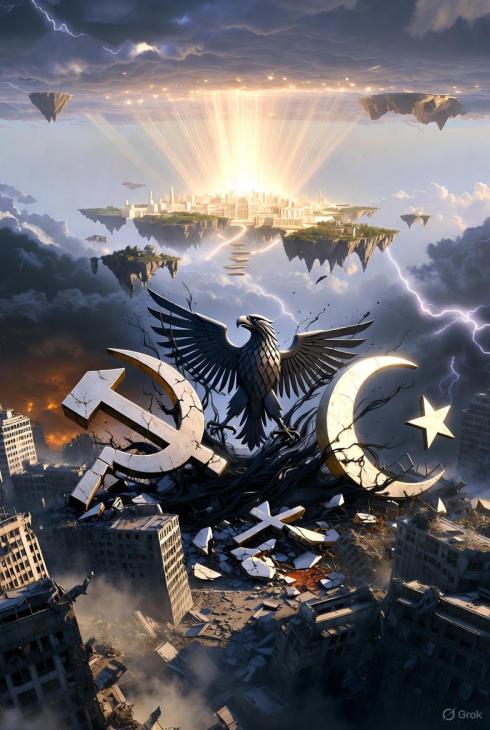
James Lindsay identifies three major historical ideologies that employ this same pattern of negative utopianism: communism, fascism, and political Islam. The claim is not that these movements are identical, but that they exhibit the same critical-theoretical structure:
- Communism imagines a stateless, classless society populated by “socialist man,” a type of human being who does not yet exist. Until such a person emerges, every tradition, institution, and authority is condemned as perpetuating exploitation.¹
- Fascism posits a perfectly ordered national or racial hierarchy unified around the mythic volk. Anything cosmopolitan, liberal, or “degenerate” is denounced as a betrayal of that utopian unity.²
- Political Islam (in its revolutionary form) imagines global submission to divine law. The present age is delegitimized as jahiliyyah—ignorance—and therefore unworthy of loyalty until the ideal community is imposed.³
In each case, the ideal is defined primarily by what it negates: capitalism, decadence, unbelief. And in each case, the historical results were catastrophic: gulags, war, genocide, theocratic oppression. The ideal was literally u-topian—“no place.”
Critical theory operates on precisely the same logic. Its power lies in inflaming resentment, undermining trust in existing institutions, and inducing a permanent revolutionary consciousness. It teaches adherents to view every tradition, norm, and hierarchy as illegitimate simply because it exists. It replaces trade-offs with absolutist moral demands, and flaws with indictments. It offers no blueprint for construction—only a sophisticated toolkit for deconstruction.
This is why contemporary “woke” politics behaves as it does. The endless denunciations of “systems,” “structures,” and “hegemonies”; the refusal to offer workable solutions; the moral absolutism; the perpetual expansion of grievance categories; the inability to articulate what a healthy society would look like—all reflect the same methodological negation that Horkheimer enshrined. It is criticism without end, and without responsibility.
Critical theory, in this sense, is not a path to reform but a program of societal disintegration. By demanding the impossible and attacking the real for failing to produce perfection, it generates only dissatisfaction, conflict, and institutional decay. The historical record is unambiguous: no system built on a negative utopia has ever produced anything but rubble.
To embrace critical theory is to wage war on reality under the banner of a perfection that cannot exist. That is why it must be understood clearly—and rejected root and branch.
Citations
Primary Critical Theory Sources
- Max Horkheimer, Traditional and Critical Theory (1937).
- Max Horkheimer, Critical Theory: Selected Essays (1969).
- Herbert Marcuse, One-Dimensional Man (1964).
- Jürgen Habermas, Knowledge and Human Interests (1968).
- Theodor W. Adorno, Negative Dialectics (1966).
Historical Ideology Sources
6. Karl Marx & Friedrich Engels, The German Ideology (1846); Critique of the Gotha Program (1875).
7. Benito Mussolini & Giovanni Gentile, The Doctrine of Fascism (1932).
8. Sayyid Qutb, Milestones (1964) — foundational for modern political Islam.
9. Ruhollah Khomeini, Islamic Government (1970).
Secondary Sources / Contemporary Analysis
10. James Lindsay, Cynical Theories (with Helen Pluckrose, 2020).
11. James Lindsay, The Marxification of Education (2023).
12. Roger Scruton, Fools, Frauds and Firebrands (2015).
13. Paul Gottfried, The Strange Death of Marxism (2005).
14. Mark Lilla, The Reckless Mind (2016).
15. John Gray, Black Mass: Apocalyptic Religion and the Death of Utopia (2007).
Glossary of Key Terms
Critical Theory – An ideological project originating with the Frankfurt School that critiques society against an impossible ideal rather than proposing practicable reforms.
Negative Idealism – Measuring reality against a utopia that cannot be articulated or realized.
Utopia – Literally “no place”; an imagined perfect society used as a moral weapon against the real world.
Hegemony – Antonio Gramsci’s concept of cultural dominance; used by CT to claim that norms and values are tools of oppression.
Structural Oppression – The assertion that unjust outcomes are produced by hidden systems rather than individual actions.
Standpoint Epistemology – The belief that knowledge is tied to identity; “lived experience” is epistemically privileged.
Praxis – Activism embedded into theory; in CT, the idea that theory must produce political action.
Reification – A Marxist term meaning the naturalization of social constructs; used to claim that institutions disguise power.
Signs You Are Encountering Critical Theory in Real Life
Here are the typical markers:
1. The language of systems and structures
Phrases like:
- “systemic oppression”
- “institutional racism”
- “hegemonic norms”
- “structures of privilege”
These shift blame from individuals to invisible systems.
2. Demands for perfect equity, not equality
If disparities alone are treated as dispositive evidence of injustice, CT is operating.
3. Appeals to lived experience as decisive evidence
Personal narrative is elevated above data or argument.
4. Moral asymmetry between groups
Some identities are framed as inherently oppressive; others as inherently oppressed.
5. Critique without end, without alternatives
If someone deconstructs everything but proposes nothing testable or concrete, it’s CT.
6. Rebranding ordinary conflict as oppression
If disagreement is treated as harm, and harm as violence, CT is at work.
7. The “if it exists, it’s oppressive” rule
Traditions, norms, meritocracy, law, biology—all treated as power structures.
How to Deal With Critical Theory in an Argument
Critical Theory arguments do not operate on normal rules of evidence or rational debate. Here’s how to engage effectively, calmly, and persuasively.
1. Reintroduce Trade-Offs
CT denies trade-offs. Bring them back.
“Every policy choice has costs—what trade-offs are you proposing in exchange for your solution?”
This forces concreteness.
2. Ask for Positive Alternatives
CT collapses when it must define what it wants.
“If the current system is oppressive, what specific system would you replace it with? How would it work in practice?”
Make them articulate the utopia in concrete terms. They rarely can.
3. Reject Claims Based Solely on Disparity
Demand causal reasoning.
“A disparity doesn’t automatically indicate discrimination. What evidence shows a causal link?”
This moves the debate from ideology to empiricism.
4. Expose Moral Asymmetry
Ask:
“Why are only some groups moralized? Do individuals still have agency?”
This undermines the oppressor/oppressed binary.
5. Clarify Definitions
CT thrives on shifting definitions.
Ask:
- “What do you mean by racism?”
- “How are you defining harm?”
- “What counts as violence?”
Pinning down definitions prevents concept-hopping.
6. Refuse Standpoint Epistemology
Challenge the epistemic claim:
“Lived experience matters, but it’s not a substitute for evidence. How can we verify your claim?”
This resets the terms of rational inquiry.
7. Separate Compassion From Ideology
Many people adopt CT-infused ideas because they want to be good.
Tell them:
“Your moral concern is admirable. CT is not the only—or even the best—way to address injustice.”
This opens space for alternatives and lowers defensiveness.
See Jonathan Kay’s X thread on the queering of outdoor education.
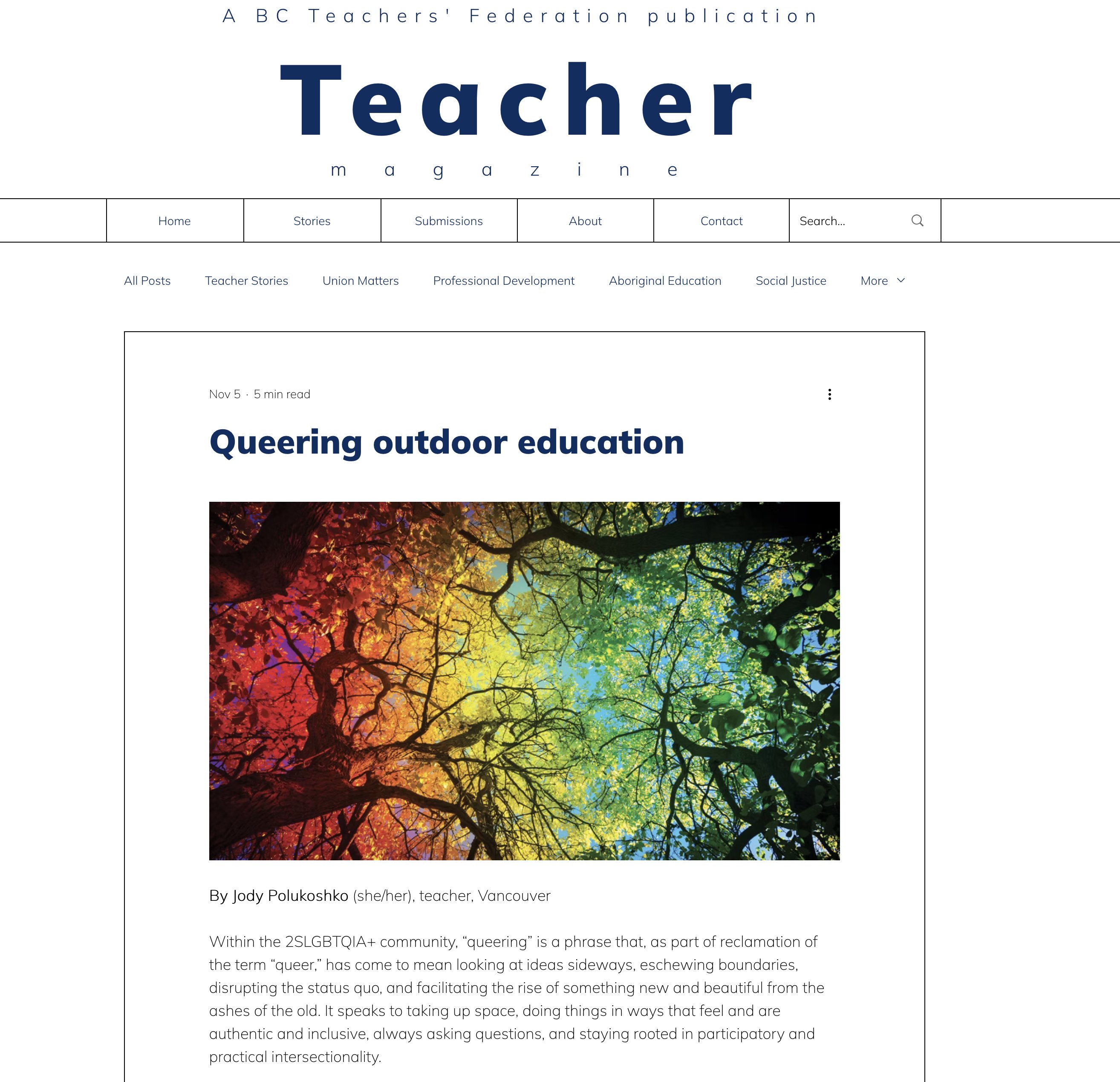
The British Columbia Teachers’ Federation (BCTF) has introduced a framework termed “Queering Outdoor Education,” which integrates queer theory, drag pedagogy, and decolonial approaches into environmental learning. This curriculum comprises lessons that encourage students to interpret natural phenomena through the lens of fluid identities, anti-normative critique, and social justice. While the framework is promoted as fostering inclusivity and challenging colonial and heteronormative assumptions, it raises substantive concerns regarding developmental appropriateness, educational clarity, and the potential for early ideological enculturation.
Metaphor and Conceptual Instability
The initial lessons employ metaphor as a primary pedagogical tool. Students are encouraged to draw analogies between natural elements—such as clouds, logs, or plants—and human identities, emphasizing fluidity and anti-essentialist perspectives. While metaphor can be valuable in education, these lessons risk overextending conceptual abstraction, replacing concrete environmental observation with ideological instruction. For children, particularly in early or middle childhood, excessive abstraction can hinder cognitive development by conflating empirical phenomena with normative social and political constructs.
Additionally, the curriculum critiques conventional linguistic frames, including metaphors like “birds and the bees,” positioning them as instruments of colonial and heteronormative power. Such framing may introduce complex sociopolitical interpretations into contexts traditionally reserved for foundational biological and ecological learning, potentially overwhelming young learners.
Moralizing Nature and Identity
Subsequent lessons extend these metaphorical frameworks into moral and social instruction. Students are asked to emulate the perceived allyship of natural objects and to conceptualize human identities in terms of ecological hierarchies, categorizing queer identities as “native” and others as “invasive.” While intended to promote reflection on inclusion and belonging, these exercises risk essentializing human worth according to ideologically charged criteria, substituting experiential learning with prescriptive social norms. By conflating ecological systems with social hierarchies, the curriculum may foster confusion rather than ethical understanding, undermining both environmental literacy and social cohesion.
Sexualization and Performative Instruction
The later lessons introduce overtly sexualized and performative elements, including the celebration of non-reproductive animal behaviors and the incorporation of drag-based exercises into outdoor activities. While drag pedagogy emphasizes self-invention and challenges normative binaries, its application to children’s environmental education raises questions of age-appropriateness. Embedding explicit discussions of sexuality and performative gender in contexts intended to cultivate observation, curiosity, and engagement with nature may distract from core learning objectives and impose adult conceptual frameworks onto immature cognitive and moral development.
Implications for Pedagogy
The queering of outdoor education exemplifies a broader pedagogical tension between radical inclusivity and the developmental needs of children. Integrating complex adult theoretical frameworks into early environmental education risks destabilizing students’ conceptual understanding, substituting guided inquiry with ideological instruction. While well-intentioned, such approaches may inadvertently limit children’s capacity for independent exploration, critical reasoning, and unmediated interaction with the natural world. Educational practice promote the idea of equality, not equity, along with the preservation of developmental appropriateness and cognitive accessibility.
Glossary
- Queer Pedagogy: An educational approach that incorporates queer theory to challenge traditional assumptions about gender, sexuality, and identity.
- Drag Pedagogy: A subset of queer pedagogy emphasizing performance, self-invention, and the destabilization of normative social roles.
- Decolonial Education: Curriculum frameworks aimed at addressing and countering the legacies of colonialism, often by centering Indigenous perspectives.
- Anti-Normative Critique: A critical approach that questions conventional social, cultural, or gender norms.
- Cognitive Development: The mental growth and acquisition of knowledge, reasoning, and understanding in children.
- Ideological Enculturation: The process of instilling a particular worldview or set of political beliefs, often through education.
References
- British Columbia Teachers’ Federation. Queering Outdoor Education Newsletter. 2025.
- Lacandona, Gaia. Drag Pedagogy: Performance and Learning. 2018.
- Polukoshko, Jody. Queer and Decolonial Approaches to Outdoor Learning. BCTF publication, 2024.
- Sumara, Dennis. Alternative Pedagogies and Cognitive Development: A Critical Review. 2017.
Suggested Readings Critiquing Queer Pedagogy
- Lindsay, James & McEwen, Bob. Critical Pedagogy and the Limits of Ideological Education. 2021.
- Wood, Peter. The Manipulation of Youth: How Ideology Enters the Classroom. 2019.
- Scholes, Robert. Childhood, Ideology, and the Limits of Social Theory. 2018.
- Davies, Belinda. Rethinking Radical Curricula: Balancing Innovation with Developmental Appropriateness. 2020.
(TL;DR) – Burke’s Reflections on the Revolution in France warned that abstract ideals, once severed from tradition, devour the civilization that birthed them. Against the arrogance of rationalist utopia, Burke offers a philosophy of gratitude: reform through inheritance, freedom through reverence, and wisdom through time.
Edmund Burke (1729–1797), the Irish-born British statesman and philosopher, published Reflections on the Revolution in France in November 1790 as an open letter to a young Frenchman. Written before the Revolution’s worst excesses, the work is less a history than a prophetic warning against uprooting inherited institutions in the name of abstract rights.
At a time when Enlightenment rationalists sought to rebuild society from first principles, Burke defended the British constitution not as perfect but as the tested fruit of centuries of moral and political experience. Against the revolutionary attempt to remake society on metaphysical blueprints, he argued that true political wisdom rests in “prescription” (inheritance), “prejudice” (habitual virtue), and the moral imagination that clothes authority in reverence and restraint. Reflections thus became the founding text of modern conservatism, grounding politics in humility before the slow wisdom of civilization (Burke 1790, 29–55).
1. The Organic Constitution versus the Mechanical State
Burke likens a healthy commonwealth to a living organism whose parts grow together over time. The British settlement of 1688, which balanced liberty and order, exemplified reform through continuity—“a deliberate election of light and reason,” not a clean slate.
The French revolutionaries, by contrast, treated the state as a machine to be disassembled and reassembled according to geometric principles. They dissolved the nobility, confiscated Church lands, and issued assignats—paper money backed only by revolutionary will. Burke foresaw that such rationalist tinkering would require force to maintain: “The age of chivalry is gone. That of sophisters, economists, and calculators has succeeded.” The predictable end, he warned, would be military dictatorship—the logic of abstraction enforced by bayonets (Burke 1790, 56–92).
2. The Danger of Metaphysical Politics
The Revolution’s fatal error, Burke argued, was to govern by “the rights of man” divorced from the concrete rights of Englishmen, Frenchmen, or any particular people. These universal abstractions ignore circumstance, manners, and the “latent wisdom” embedded in custom.
When the revolutionaries dragged Queen Marie Antoinette from Versailles to Paris in October 1789, Burke saw not merely a political humiliation but a civilizational collapse: “I thought ten thousand swords must have leaped from their scabbards to avenge even a look that threatened her with insult.” The queen, for him, symbolized a moral order that elevated society above brute appetite. Once such symbols are desecrated, civilization itself is imperiled (Burke 1790, 93–127).
3. Prescription, Prejudice, and the Moral Imagination
For Burke, rationality in politics is not the isolated reasoning of philosophers but the accumulated judgment of generations. “Prescription” gives legal and moral title to long possession; to overturn it is theft from the dead. “Prejudice,” far from being ignorance, is the pre-reflective moral instinct that makes virtue habitual—“rendering a man’s virtue his habit,” Burke wrote, “and not a series of unconnected acts.”
In his famous image of the “wardrobe of a moral imagination,” Burke insists that society requires splendid illusions—chivalry, ceremony, religion—to clothe power in dignity and soften human passions. Strip away these garments and you are left with naked force and the “swinish multitude.” Culture, in his view, is not ornament but armor for civilization (Burke 1790, 128–171).
4. Prophecy Fulfilled and the Path of Prudence
Events soon vindicated Burke’s warnings: the Reign of Terror, Napoleon’s rise, and the wars that consumed Europe. Yet Reflections is not an “I told you so” but a manual for political health. Burke accepts reform as necessary but insists that it must proceed “for the sake of preservation.” The statesman’s duty is to repair the vessel of society while it still sails, not to smash it in search of utopia.
Reverence for the past and distrust of untried theory are not cowardice but prudence—the recognition that civilization is a fragile inheritance, easily destroyed and seldom rebuilt (Burke 1790, 172–280).
5. Burke’s Enduring Lesson
Burke’s insight extends far beyond the French Revolution. His critique applies wherever abstract moralism seeks to erase inherited forms—whether through revolutionary ideology, technocratic social engineering, or the cultural purism of modern movements that prize purity over continuity. The temptation to rebuild society from scratch persists, but Burke reminds us that order is not manufactured; it is cultivated.
In an age still haunted by ideological utopias, Burke’s prudence is an act of intellectual piety: to love what we have inherited enough to reform it carefully, and to mistrust those who promise perfection by destruction.

References
Burke, Edmund. 1790. Reflections on the Revolution in France, and on the Proceedings in Certain Societies in London Relative to that Event. London: J. Dodsley.
Glossary of Key Terms
Assignats – Revolutionary paper currency secured on confiscated Church property; rapid depreciation fueled inflation.
Latent wisdom – Practical knowledge embedded in customs and institutions, inaccessible to abstract reason.
Moral imagination – The faculty that clothes abstract power in elevating symbols and sentiments.
Prejudice – Pre-reflective judgment formed by habit and tradition; for Burke, a source of social cohesion.
Prescription – Legal and moral title acquired through uninterrupted possession over time.
Swinish multitude – Derisive term for the populace once traditional restraints are removed.











 bleatmop
 Mystro


 Dead Wild Roses
Your opinions…