
You are currently browsing the category archive for the ‘Education’ category.
When the extremes meet, the center collapses. (TL;DR)
When the Horseshoe Hangs from the Scales explains why the far left and far right increasingly resemble each other—not in ideas, but in methods. Drawing on the metaphors of the scale and the horseshoe, this essay argues that both totalitarian idealism and populist reaction stem from the same metaphysical error: the rejection of objective reality. Only realism—humility before truth—can keep Western society from closing into a circle of coercion.
Political language often obscures more than it reveals. The familiar left–right spectrum suggests linear opposition—progressives facing conservatives across a straight divide. Yet history and experience show something stranger: as ideologies radicalize, their behavior begins to mirror one another. The further the extremes move from reality, the closer they become in method, rhetoric, and moral psychology.
In The Scales of Society (published yesterday), realism anchored the crossbar, and idealism dragged the pans downward into totalitarianism. The horseshoe adds a complementary image. Viewed from above, the scale’s pans curve toward each other like the ends of a bent spectrum. The metaphysical collapse becomes social convergence. Both metaphors describe a single process: when realism breaks, the poles of idealism meet in coercive symmetry.
The Geometry of Political Collapse
The horseshoe theory proposes that the political spectrum bends upon itself, bringing the far left and far right into proximity. Communism and fascism, though ideologically opposed, resemble one another in practice: one abolishes private property, the other subordinates it to the state; both demand absolute obedience. Each claims to redeem humanity through purity—of class or of nation—and each regards dissent as treason.
The scale explains why this happens: both extremes spring from idealism detached from reality. The horseshoe shows how it manifests: through behavioral and institutional mimicry. One describes the metaphysical axis, the other the social. Together they form a complete model of ideological deformation. The vertical collapse of realism generates the horizontal convergence of fanaticism.
From Difference to Sameness
Political polarization masquerades as difference, but when stripped of surface content, the ends often converge in identical impulses:
- Moral totalism. Each side claims moral monopoly—an absolute vision of justice or order that sanctifies any means.
- Friend–enemy logic. Politics becomes warfare. Dialogue is betrayal; neutrality, complicity.
- Collectivist ethics. The individual dissolves into the movement, valuable only as a vehicle for ideological ends.
- Epistemic closure. Truth is no longer discovered but declared; narrative replaces verification.
Arendt observed that totalitarian movements, regardless of ideology, replace empirical reality with “a fictitious world” sustained by propaganda. Popper saw the same pattern: the closed society begins when ideas become sacred and unfalsifiable. Whether draped in red flags or eagles, the architecture is the same.
What begins as opposition ends as resemblance. The revolutionary who abolishes hierarchy and the reactionary who enforces it both deny human limitation. Each demands transformation rather than reform, purity rather than compromise. The further they stray from realism, the more they mirror one another’s methods—purges, censorship, mythmaking, and ritual denunciation.
Convergence in the Contemporary West
The horseshoe is no relic of the twentieth century; its shape defines the present. In the West, the rhetoric of liberation and the rhetoric of restoration increasingly share an authoritarian grammar.
Cultural absolutism. On the progressive extreme, morality is redefined as the enforcement of inclusivity. Dissenting speech becomes “harm,” and linguistic deviation, “violence.” On the reactionary extreme, purity is national or moral rather than social, but the logic is the same: deviation equals corruption. Each side builds orthodoxy around identity.
Information control. The progressive insists on regulating “disinformation,” policing language for moral safety. The populist right responds with its own echo chambers, treating factual correction as conspiracy. Both distrust open discourse, substituting propaganda for persuasion. Truth is no longer common ground but a weapon.
Purity politics. Cancel culture and culture-war purges are functional twins. One excommunicates for heresy against equality, the other for heresy against tradition. Each side frames punishment as virtue, enforcing conformity by shame or exclusion. In both cases, moral capital accrues not from good deeds but from the public destruction of sinners.
The psychological mechanism is identical: belonging through denunciation. The horseshoe’s curve tightens as participants draw moral comfort from collective outrage. When opposing extremisms adopt the same tactics, the distance between them is illusion.
The Horseshoe Meets the Scale
The two metaphors illuminate one another. The scale shows the metaphysical error: idealism’s detachment from realism. The horseshoe shows the social consequence: the return of opposites through behavioral convergence. The result is not diversity of belief but monoculture of method.
Imagine the scales viewed from above: the crossbar of realism forms the straight backbone, but as the pans descend into idealism, they bend toward one another, forming the curve of the horseshoe. The more society abandons truth, the closer its extremes approach in both temperament and technique.
When realism—objective verification, moral humility, and factual accountability—fails, politics becomes a contest of myths. The question is no longer “what is true?” but “whose truth will rule?” In that struggle, the difference between revolutionary and reactionary becomes decorative. Both invoke moral crisis to justify compulsion; both see coercion as salvation.
Why the Center Cannot Hold Without Realism
Critics often lament the “vanishing center,” as if centrism itself could rescue political sanity. But moderation is not a position; it is a discipline—an adherence to external reality over internal fervor. The true counterweight to the horseshoe’s closure is not neutrality but realism.
Realism anchors discourse in verifiable truth: data, evidence, experience, and the acknowledgment of limits. It permits disagreement without dehumanization because it recognizes a shared world beyond ideology. Realism turns enemies into interlocutors by subjecting both to the same facts.
Idealism, by contrast, makes conflict existential. When truth depends on belief, contradiction becomes evil. The desire to perfect the world leads to the compulsion to perfect others, and the moral imagination becomes the tool of tyranny. Only realism—accepting that the world corrects us—keeps the curve of politics open rather than collapsing into a circle of extremism.
The Moral Psychology of the Horseshoe
The convergence of extremes is not merely institutional; it is psychological. Both sides attract personalities drawn to certainty, purity, and moral theater.
The late political theorist Eric Voegelin described this as “gnostic revolt”—the refusal to accept human limitation and the longing to recreate the world in one’s own image. Arendt called it “world alienation.” Each formulation captures the same impulse: the substitution of idea for reality. The horseshoe is the social geometry of that spiritual rebellion.
When entire populations internalize this mindset, societies lose the ability to distinguish moral conviction from metaphysical arrogance. Activists and autocrats alike begin to speak in the same register—of awakening, purity, and necessary sacrifice. The vocabulary of utopia is universal; only its symbols differ.
The Path Back to Reality
Escaping the horseshoe requires reattaching it to the scales—recovering realism as the crossbar that holds political difference in balance. This means restoring institutions that mediate between belief and fact: open science, free inquiry, due process, and honest journalism. It means accepting that error, not heresy, is the normal state of human reason.
Humility, not ideology, is the civic virtue realism demands. The realist admits uncertainty, revises judgment, and learns from failure. Such modesty is not weakness but strength—the discipline that prevents conviction from hardening into cruelty.
Conclusion: The Shape of Sanity
The geometry of political life reflects our metaphysics. When truth stands above us, the scales stay level and the horseshoe remains open. When truth becomes a tool of power, the scales tilt, and the horseshoe closes into a circle—opposites united in coercion.
The West’s present turbulence is not a clash of left and right but a crisis of realism. Both sides, in their extremes, are tempted by the same illusion: that belief can replace being, that will can dictate truth.
If freedom is to endure, it will not be because one ideology triumphs but because reality reasserts itself—quietly, stubbornly, as the only ground capable of bearing the weight of difference.

References
- Arendt, Hannah. The Origins of Totalitarianism. New York: Harcourt Brace, 1951.
- Burke, Edmund. Reflections on the Revolution in France. London: J. Dodsley, 1790.
- Haidt, Jonathan. The Righteous Mind: Why Good People Are Divided by Politics and Religion. New York: Vintage, 2012.
- Lukianoff, Greg & Haidt, Jonathan. The Coddling of the American Mind. New York: Penguin, 2018.
- Popper, Karl. The Open Society and Its Enemies. London: Routledge, 1945.
- Voegelin, Eric. The New Science of Politics. Chicago: University of Chicago Press, 1952.
- Ortega y Gasset, José. The Revolt of the Masses. New York: W.W. Norton, 1932.
Why do societies slide toward tyranny when they pursue utopia? (TL;DR)
The Scales of Society argues that the real divide in politics isn’t left versus right, but realism versus idealism. When truth yields to belief, coercion follows. From communism and fascism to modern moral crusades, history warns that abandoning objective reality tips civilization toward totalitarianism. The balance must be restored—anchored in realism, humility, and truth.
In the landscape of political philosophy, metaphors serve as intellectual scaffolding—structures that help us grasp dynamics too intricate for direct depiction. The familiar political compass, with its left–right and liberty–authority axes, sketches ideological positions but fails to reveal the deeper fracture driving modern polarization. A more illuminating image is that of a balance scale. Its crossbar represents philosophical realism—the recognition of an objective reality—while the suspended pans embody the idealist extremes of communism and fascism. This model captures not just polarization but the gravitational descent into totalitarianism that occurs when societies abandon reality for utopia.
The Core Divide: Realism vs. Idealism
Realism begins with the premise that reality exists independently of human will or perception. The wall remains whether one believes in it or not, and collision has consequences indifferent to ideology. This external order imposes limits: progress requires trade-offs, and perfection is impossible. The realist accepts these constraints, submitting theories to verification through evidence, reason, law, and experience. Responsibility and competence—not vision or zeal—earn authority.
Idealism inverts this relationship. It treats reality as a projection of consciousness, imperfect but malleable. If perception shapes the world, then changing minds can remake existence. Truth becomes what society collectively affirms. This impulse, when politicized, leads toward social constructivism and, inevitably, coercion: those who refuse to affirm the “truth” must be re-educated or silenced. A contemporary example can be seen in gender ideology, where subjective identity claims are enforced as social fact through compelled speech and institutional conformity. The point is not about gender per se but about the pattern: belief overriding biology through social pressure rather than persuasion.
The Platonic ideal—perfect, transcendent, and abstract—becomes the new absolute. The imperfect, tangible world must be reshaped until it conforms. Once utopia is imagined as possible, coercion becomes inevitable, for someone must ensure that all comply with the ideal.
The Scale and Its Balance
The realist crossbar allows for movement and balance. One may lean left toward egalitarianism, right toward hierarchy and tradition, or find equilibrium between the two. Disputes are adjudicated by verifiable standards: evidence, empirical data, or, for the religious, revelation interpreted through disciplined exegesis. Justice is blind, authority is earned, and failure prompts responsibility rather than revolution.
From that crossbar hang the chains leading to the pans—communism on the left, fascism on the right. Each represents idealism in a different costume. Descent is gradual, a shimmy downward from realism into partial idealism, then freefall into extremism. The pans have no centers: in a world of pure ideals, moderation cannot hold.
Communism imagines a belief-driven utopia—re-educate humanity into “species-being” beyond property or conflict, and paradise will emerge. Fascism demands obedience to a mythic hierarchy—sacrifice self for the community’s glory, and unity will prevail. Both subjugate reality to ideology: when facts resist, facts are crushed. From the perspective of either pan, the realist crossbar appears as the enemy’s support beam. Each seeks to destroy it, believing that only by breaking the balance can truth be realized.
Polarization and the Descent
As tension mounts, the scale begins to swing. Idealists radicalize when realism resists persuasion—utopia seems attainable but for “obstructionist” constraints. In frustration, anti-fascism justifies communism; anti-communism, fascism. The center thins as factions define themselves by opposition rather than truth. The political becomes existential: the other side must be destroyed, not debated. The mechanisms of verification—law, science, journalism, reasoned discourse—collapse under pressure. Force replaces evidence; propaganda replaces persuasion.
History confirms the pattern. The twentieth century saw communism outlast fascism, not because it was less violent but because it sold coercion through promises of emancipation. Fascism, with its naked appeal to dominance, exhausted itself; communism cloaked tyranny in moral idealism. Both ended in mass graves.
Left and Right: The Limits of Tolerance
The realism–idealism axis cuts deeper than the traditional left–right divide. The left tends toward anti-traditionalism and radical egalitarianism, seeking liberation through the dissolution of hierarchy and norm. The right inclines toward tradition and hierarchy, valuing stability and inherited order. Each contains wisdom and danger.
Tradition carries epistemological weight: customs that survive generations have proven utility—Chesterton’s fence stands until one understands why it was built. Yet tradition can ossify, defending arbitrariness or prejudice. Egalitarianism corrects injustice but becomes destructive when it denies the functional necessity of hierarchy. Even lobsters, as Jordan Peterson once observed, form dominance orders; structure is not oppression but biology. When hierarchy is treated as sin and equality as salvation, society drifts from realism into moral mythology.
The Peril of Idealism
Idealism’s danger is not merely its optimism but its refusal to recognize limits. When imagination detaches from reality, coercion rushes in to bridge the gap. The ideal cannot fail; only people can. Those who resist must be “re-educated” or “deprogrammed.” What begins as moral vision ends as total control.
The cure is humility—a willingness to let facts instruct rather than ideology dictate. Repentance, in the philosophical sense, means returning from illusion to reality, subordinating theory to evidence and loving wisdom without claiming omniscience. Realism requires courage: to see, to accept, and to act within the bounds of what is possible.
Lessons from the Twentieth Century and Beyond
The horrors of the last century—gulags, purges, and genocides—were not aberrations but logical conclusions of idealism unmoored from realism. Communism and fascism both promised transcendence from the human condition; both delivered degradation. Today, similar impulses reappear in moralized movements on left and right that treat disagreement as heresy and consciousness as the final battleground. These are not new phenomena but recycled idealisms—different symbols, same metaphysics.
In an era of manufactured crises and moral crusades, the scales remind us: cling to the crossbar. Only realism—anchored in evidence, bounded by humility, and guided by verifiable truth—permits tolerance, adaptation, and progress. When the crossbar breaks, society plunges into the abyss, and one pan’s triumph becomes delusion for all.

References
- Arendt, Hannah. The Origins of Totalitarianism. New York: Harcourt Brace, 1951.
- Burke, Edmund. Reflections on the Revolution in France. London: J. Dodsley, 1790.
- Chesterton, G.K. The Thing: Why I Am a Catholic. London: Sheed & Ward, 1929.
- Lewis, C.S. The Abolition of Man. London: Oxford University Press, 1943.
- Lindsay, James. Left and Right with Society in the Balance. New Discourses Lecture, 2025.
- Peterson, Jordan B. 12 Rules for Life: An Antidote to Chaos. Toronto: Random House, 2018.
- Popper, Karl. The Open Society and Its Enemies. London: Routledge, 1945.
- Voegelin, Eric. The New Science of Politics. Chicago: University of Chicago Press, 1952.
(TL;DR) Eric Voegelin’s The New Science of Politics remains one of the clearest guides to our modern disorder. It teaches that when politics cuts itself off from transcendent truth, ideology fills the void—and history descends into Gnostic fantasy. Voegelin’s remedy is not new revolution but ancient remembrance: the recovery of the soul’s openness to reality.
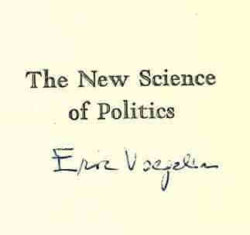
Eric Voegelin (1901–1985) was an Austrian-American political philosopher who sought to diagnose the spiritual derangements of modernity. In his 1952 classic The New Science of Politics—first delivered as the Walgreen Lectures at the University of Chicago—Voegelin proposed that politics cannot be understood as a merely empirical or procedural science. Power, institutions, and law arise from a deeper spiritual ground: humanity’s participation in transcendent order. When societies lose awareness of that participation, they fall into ideological dreams that promise salvation through human effort alone. The book is therefore both a critique of modernity and a call to recover the classical and Christian understanding of political reality (Voegelin 1952, 1–26).
1. The Loss of Representational Truth
Every stable society, Voegelin argued, “represents” its members within a larger order of being. In ancient civilizations and medieval Christendom, political authority symbolized this participation through myth, ritual, and law that acknowledged a reality beyond human control. The ruler was not a god but a mediator between the temporal and the eternal.
Beginning in the twelfth century, however, the monk Joachim of Fiore reimagined history as a self-unfolding divine drama in which humanity itself would bring about the final age of perfection. With this shift, Western consciousness began to “immanentize the eschaton”—to relocate ultimate meaning inside history rather than in its transcendent source. Out of this inversion grew the modern ideologies of progress (Comte, Hegel), revolution (Marx), and race (National Socialism), each promising earthly redemption through planning and will (Voegelin 1952, 107–132).
For Voegelin, the loss of representational truth meant that governments no longer reflected humanity’s place in divine order but instead projected utopian images of what they wished reality to be. Politics ceased to be the articulation of truth and became the engineering of salvation.
2. Gnosticism as the Modern Disease
Voegelin identified the inner structure of these movements as Gnostic. Ancient Gnostics sought hidden knowledge that would liberate the soul from an evil world; their modern successors, he said, sought knowledge that would liberate humanity from history itself. “The essence of modernity,” Voegelin wrote, “is the growth of Gnostic speculation” (1952, 166).
He listed six recurrent traits of the Gnostic attitude:
- Dissatisfaction with the world as it is.
- Conviction that its evils are remediable.
- Belief in salvation through human action.
- Assumption that history follows a knowable course.
- Faith in a vanguard who possess the saving knowledge.
- Readiness to use coercion to realize the dream.
From medieval millenarian sects to twentieth-century totalitarian states, these traits form a single continuum of spiritual rebellion: the attempt to perfect existence by abolishing its limits.
3. The Open Soul and the Pathologies of Closure
Against the Gnostic impulse stands the open soul—the philosophical disposition that accepts the “metaxy,” or the in-between nature of human existence. We live neither wholly in transcendence nor wholly in immanence, but within the tension between them. The philosopher’s task is not to resolve that tension through fantasy or reduction but to dwell within it in faith and reason.
Political science, therefore, must be noetic—concerned with insight into the structure of reality—not merely empirical. A society’s symbols, institutions, and laws can be judged by how faithfully they articulate humanity’s participation in divine order. Disorder, Voegelin warned, begins not with bad policy but with pneumopathology—a sickness of the spirit that refuses reality’s truth. “The order of history,” he wrote, “emerges from the history of order in the soul.”
Empirical data can measure economic growth or electoral results, but it cannot measure spiritual health. That requires awareness of being itself.
4. Liberalism’s Vulnerability and the Way of Recovery
Voegelin saw liberal democracies as historically successful yet spiritually precarious. By reducing political order to procedural legitimacy and rights management, liberalism risks drifting into the nihilism it opposes. When public life forgets its transcendent foundation, freedom degenerates into relativism, and pluralism becomes mere fragmentation.
Still, Voegelin’s outlook was not despairing. His proposed remedy was anamnesis—the recollective recovery of forgotten truth. This is not nostalgia but awakening: the rediscovery that human beings are participants in an order they did not create and cannot abolish. The recovery of the classic (Platonic-Aristotelian) and Christian understanding of existence offers the only durable antidote to ideological apocalypse (Voegelin 1952, 165–190).
To “keep open the soul,” as Voegelin put it, is to resist every movement that promises paradise through force or theory. The alternative is the descent into spiritual closure—an ever-recurring temptation of modernity.
5. Contemporary Resonance
Voegelin’s analysis remains uncannily prescient. Today’s ideological battles—whether framed around identity, technology, or climate—often echo the same Gnostic pattern: discontent with the world as it is, belief that perfection lies just one policy or re-education campaign away, and impatience with reality’s resistance. The post-modern conviction that truth is socially constructed continues the old dream of remaking existence through will and language.
Voegelin’s warning cuts through our century as clearly as it did the last: when politics replaces truth with narrative and transcendence with activism, society repeats the ancient heresy in secular form. The cure, as ever, is humility before what is—the recognition that order is discovered, not invented.
References
Voegelin, Eric. 1952. The New Science of Politics: An Introduction. Chicago: University of Chicago Press.
Hughes, Glenn. 2003. Transcendence and History: The Search for Ultimacy from Ancient Societies to Postmodernity. Columbia: University of Missouri Press.
Sandoz, Ellis. 1981. The Voegelinian Revolution: A Biographical Introduction. Baton Rouge: Louisiana State University Press.
Glossary of Key Terms
Anamnesis – Recollective recovery of forgotten truth about being.
Gnosticism – Revolt against the tension of existence through claims to saving knowledge that masters reality.
Immanentize the eschaton – To locate final meaning and salvation within history rather than beyond it.
Metaxy – The “in-between” condition of human existence, suspended between immanence and transcendence.
Noetic – Pertaining to intellectual or spiritual insight into reality’s order.
Pneumopathology – Spiritual sickness of the soul that closes itself to transcendent reality.
Representation – The symbolic and political articulation of a society’s participation in transcendent order.
To think that these individuals are going to be in charge soon is positively frightening.
The documentary presents unedited footage of a Spectrum Street Epistemology session conducted by Frances Widdowson at the University of Regina on October 3, 2024, facilitated with Indigenous psychologist Lloyd Hawkeye Robertson. It contextualizes the event within Widdowson’s broader conflicts over academic freedom, detailing the cancellation of her scheduled talks titled “Indigenization and Academic Freedom: Lessons from the Frances Widdowson Case” and “The Grave Error at Kamloops: Should It Be Described as a ‘Hoax’?”
Key background: Widdowson, formerly terminated from Mount Royal University amid disputes over “wokeism” and identity politics, arranged the talks through librarian Robert Thomas. University administrators, including Provost David Gregory and Associate Vice President John Smith, canceled room bookings citing “safety concerns,” particularly proximity to the National Day for Truth and Reconciliation. Widdowson defied warnings, invoking Charter protections for public universities, and proceeded with the informal epistemology exercise in a student center, filmed by former faculty member Daniel Page.
The session examines claims via positioned mats (strongly agree to strongly disagree). Core claim: “The University of Regina protects academic freedom.” Robertson places himself at “slightly agree,” citing institutional policies like collective agreements but noting exceptions (e.g., pressures on Page and computer scientist Trevor Tomesh for LGBTQ-related criticisms and social media posts, respectively). Widdowson highlights her own case and systemic failures.
Related claims probed:
– Academic freedom equates to unrestricted speech: Robertson slightly disagrees, viewing it as narrower (professorial judgment in expertise) yet inseparable from broader expression.
– Professors may claim residential schools benefited Indigenous people: Robertson agrees in principle for academic freedom but personally disagrees overall, acknowledging abuses while noting some schools provided successes and First Nations lobbied to retain them post-1960s closures.
– Residential schools were harmful: Robertson agrees, referencing “residential school syndrome” (PTSD-like symptoms including rage), physical/sexual abuse, and underfunding, but not “strongly” due to variations across institutions.
Interactions escalate with students and a professor (Russell Fayant, from the Teacher Education Program), who arrives with a primed class. Participants accuse Widdowson of denialism, hate, and harming reconciliation; one claims her presence spikes blood pressure and causes distress. Widdowson counters with evidence gaps, e.g., Kamloops’ 2021 announcement of “215 children’s remains” (initially ground-penetrating radar anomalies, unexcavated) and William Combes’ unsubstantiated claim of Queen Elizabeth II abducting 10 children in 1964 (contradicted by royal itineraries). Disruptions include threats to an elderly attendee, projector unplugging, and event relocation from Regina Public Library due to organized opposition by coordinator Rachel Jean and journalism professor Trish Elliot.
Verifiable outcomes: No physical violence; security (Brad Anderson) monitors without intervention. Widdowson maintains composure, emphasizing evidence over emotion. Comments (242 visible) overwhelmingly praise her patience and critique students’ emotionalism, immaturity, and evasion of substantiation—e.g., prioritizing “therapeutic mythologies” over facts, fearing critical thought’s social costs.
Core tension: Widdowson’s insistence on verifiable evidence (e.g., excavations, historical records) clashes with appeals to lived experience, oral knowledge, and relational healing. She argues truth precedes reconciliation; opponents prioritize avoiding harm and building ties, viewing scrutiny as divisive. The session exposes institutional suppression—cancellations without due process—and student unpreparedness for rigorous debate, underscoring academic freedom’s erosion under indigenization mandates. No evidence supports mass murder claims at Kamloops; anomalies remain unconfirmed graves. The exercise, though chaotic, demonstrates dialogue’s possibility despite hostility, affirming verifiable truth as essential to intellectual integrity.
Alberta’s education system is at a breaking point. As more than 51,000 teachers strike across the province over oversized classrooms, the battle over class-size caps, staffing levels, and funding formulas has erupted into a full-blown crisis. With reports of classes swelling into the 30s and even 40s—and with the province no longer publishing detailed class-size data—the dispute between the Alberta Teachers’ Association (ATA) and the Government of Alberta has become a referendum on whether quality learning can survive without clearer metrics, stricter rules, and targeted investments. This analysis examines the facts, details each side’s proposals, and steelmans both perspectives so readers can decide where the truth lies.
A Classroom Crisis or Budgetary Reality?
On October 6, 2025, teachers across Alberta walked out, declaring that the province’s classrooms have become “untenable.” The ATA’s strike action followed a decisive 89.5% rejection of the government’s offer—a signal of deep discontent.
(Source: Shootin’ the Breeze)
The core issues are class size, student complexity, and resource allocation. Teachers report classes of 30–40 students, rising numbers of high-needs children, and too few educational assistants or supports.
(Source: Learning Success Blog)
The government, meanwhile, stresses budget restraint, local flexibility, and warns that province-wide class caps would impose unsustainable costs.
What Do the Facts Reveal?
Data Transparency:
Until 2019, the province published annual class-size data for schools. In 2019, the current government ended that practice—making it difficult to establish accurate, province-wide numbers.
(Source: Braceworks)
Reported Trends:
An ATA survey found that 72% of Albertans believe class sizes are “too big,” while only 20% think they are “about right.”
(Source: ATA News)
Nearly 40% of teachers say their largest class has between 30 and 40 students; some exceed 40.
Funding and Growth:
In 2020, Alberta shifted to a three-year weighted moving average (WMA) for per-student funding. This was meant to stabilize budgets, but schools in fast-growing regions argue it made it harder to keep pace with enrollment increases.
(Source: Braceworks)
Together, these factors—rising enrollment, slower hiring, and more complex student needs—created the “classroom crisis” the ATA describes.
The ATA’s Position (Steelmanned)
- Binding Class-Size Caps:
The ATA calls for enforceable limits—especially smaller classes in early grades and high-needs classrooms. Oversized classes, they argue, reduce individualized feedback and classroom management capacity. - Staffing and Support for Complexity:
The ATA emphasizes that class composition matters as much as headcount. Classrooms with several students requiring individualized plans or behavioural supports demand additional staffing. - Funding to Hire 5,000+ Teachers:
To meet the province’s 2003 class-size recommendations, Alberta would need over 5,000 more teachers.
(Source: Swift News) - Quality of Learning:
The ATA contends this is not about wages—it’s about ensuring conditions where teachers can teach and students can learn.
In summary:
The ATA’s strongest case is that Alberta’s classrooms are objectively too large and complex for effective instruction, and only binding standards—backed by resources—can restore educational quality.
The Government’s Position (Steelmanned)
- Fiscal Responsibility:
The government argues that rigid caps would cost billions and force trade-offs with other priorities such as facilities and technology. - Local Flexibility:
Because school boards face different realities—urban crowding versus rural under-enrollment—the government says decisions should remain local, not imposed from Edmonton. - Targeted Investments, Not Blanket Caps:
The province has proposed hiring 3,000 teachers and 1,500 educational assistants over three years to focus on high-need areas, calling this a “strategic” alternative to universal caps.
(Source: CityNews Edmonton) - Continuity of Schooling:
The government invoked back-to-work legislation, arguing that prolonged strikes risk irreparable harm to students.
In summary:
The government’s steelmanned position is that it’s acting responsibly—preserving local flexibility, fiscal discipline, and stability while still targeting the worst pressure points.
What the Evidence Suggests
The educational research is nuanced:
- Smaller classes, especially in early grades, improve academic outcomes and behavioural management. (See: Project STAR, Krueger 2002)
- Benefits decline as grades rise or when teacher quality is not addressed simultaneously.
- Blanket reductions are expensive; targeted reductions often deliver higher returns per dollar.
Applied to Alberta:
The province may achieve the best results by targeting early-years and complex-needs classrooms, rather than imposing uniform caps across all grades. The evidence supports smaller classes where they matter most, not necessarily everywhere.
Where the Facts Should Lead Public Judgment
- Demand Transparency:
Reinstate province-wide class-size reporting so both government and ATA claims can be verified. - Target Early Grades and Complex Classes:
Evidence shows these investments yield the highest payoff. - Acknowledge Trade-offs:
Caps and hiring increases require billions in funding—citizens deserve clear accounting of costs and benefits. - Negotiate in Good Faith:
Both sides have legitimate claims: teachers on workload, government on fiscal prudence. A transparent mediation process focused on data—not ideology—would best serve students.
Final Thoughts
This strike is not just about teacher pay. It’s about the structure of public education itself—what class sizes are acceptable, how complexity is managed, and how Alberta balances fiscal discipline with classroom realities.
If your priority is student-centered learning and teacher retention, the ATA’s demand for enforceable caps has merit. If your focus is fiscal sustainability and flexibility, the government’s caution makes sense.
Either way, the solution must begin with facts: transparent class-size data, verifiable outcomes, and evidence-based reforms that put students first.
References
- Alberta Teachers’ Association – Class size issues top of mind for Albertans
- Learning Success Blog – Alberta’s 51,000 Teachers Strike Over Classroom Crisis as Class Sizes Hit 40 Students
- Braceworks – Alberta stopped tracking class sizes. Then it changed its funding formula. Now, it’s a teachers’ strike issue.
- Shootin’ the Breeze – Alberta teachers vote 95% for strike over wages and class sizes
- CityNews Calgary – Overcrowding in spotlight ahead of possible Alberta teachers strike
- Swift News – ATA Wants More Than 5,000 New Teachers To Meet Class-Size Recommendations
“The issue is never the issue; the issue is always the revolution.” This maxim, drawn from Saul Alinsky’s Rules for Radicals, exposes a tactical pattern: a left-wing movement cloaks a raw power-grab in moral-righteous language. Nowhere is that clearer than in the 2025 teachers’ strike in Alberta.
On the surface, the Alberta Teachers’ Association (ATA) insists the fight centres on a “funding crisis” harming students—demanding an additional C$2.6 billion plus large wage increases and stricter class-size caps. Yet the empirical record undermines the narrative that Alberta is desperately under-funded, and it raises the question: is this truly about pedagogy or about politics?
Funding vs Outcomes: The Data
In high-income countries, higher spending per pupil does not reliably produce higher student achievement. For example, U.S. elementary/secondary expenditure was about $15,500 USD per Full-Time Equivalent in 2019, compared with the OECD average of $11,300. (National Center for Education Statistics) A detailed Canadian analysis by the Fraser Institute found that spending fails to correlate strongly with performance on the Programme for International Student Assessment (PISA) tests. (Fraser Institute)
In Canada, real (inflation-adjusted) per-student spending on public schools increased only modestly from 2012/13 to 2021/22—5.1 % nationally—per the Fraser Institute. (Fraser Institute) More relevant: Alberta’s spending dropped 17.2 % in the same period. (Education News Canada) Hence the claim that Alberta’s education system is starving for funds is misleading.
Teacher Compensation & Relative Position
If wage deprivation were the core issue, one would expect Alberta teachers to be significantly out-of-line with their peers. But data show Alberta is not vastly behind. While the ATA asserts salary stagnation, the context is more nuanced: overall compensation is competitive at the national level. That suggests bargaining is less about emergency pay than about positioning. This implies the strike rhetoric—“kids first,” “funding crisis,” “education collapse”—acts as cover for political mobilization.
From Bargaining to Politics
The strike began October 6, 2025, involving some 51,000 teachers across the province and impacting hundreds of thousands of students. (Wikipedia) On October 28 the United Conservative Party (UCP) government invoked the notwithstanding clause through Bill 2—forcing teachers back and imposing a contract. (Alberta Teachers’ Association) That is a dramatic escalation for what many would expect to be a wage-and-conditions dispute.
The Broader Labour Mobilisation
But the strike did not remain isolated. The Alberta Federation of Labour (AFL) president called an “emergency meeting” of public and private-sector union leaders, demanding the government rescind Bill 2 or face “unprecedented collective action.” (Alberta Federation of Labour) Other unions—nurses, custodians, public-sector workers—were implicitly or explicitly aligned. This is no narrower labour stand-off. It is a broad labour front coalescing around a political narrative.
The Political Narrative: NDP Strategy
Enter the Alberta New Democratic Party (NDP). Its leadership framed the battle as existential for the UCP, calling Premier Danielle Smith “coward” and declaring the strike “the beginning of the end” for the ruling party. Polls report the UCP’s approval tumbling.
The symbiosis is clear: union mobilisation, educational disruption, and political leverage combine. The “funding for students” narrative appears to morph quickly into a power-battle for political realignment.
When the “Kids First” Slogan Masks a Revolutionary Agenda
Framing the strike as entirely student-centric hides the political logic. By shutting schools and generating parental strain, the strike creates electoral pressure. The rhetoric of “for the kids” serves as a Trojan Horse. Unions and the NDP do not merely seek more money—they seek to reshape fiscal policy, entrench union influence, and weaken the standing party. As the Fraser Institute reminds us, simply throwing more money at K-12 education rarely produces measurable gains; the real levers lie in teacher-quality, accountability, curriculum rigour—not just budgets. (Todayville)
In Alberta the material case for emergency action is thin: if funding and compensation are already broadly in line, the crisis rhetoric becomes suspect.
What Should Parents & Taxpayers Do?
- Demand transparency: If the ATA or any union claims a “funding crisis,” ask for hard numbers—what line-items, what enrolment ratios, what outcome improvements are promised?
- Insist on measurable results: Additional spending should come paired with accountability—higher literacy scores, lower drop-out rates.
- Consider union-monopoly reform: If classrooms become battlegrounds for ideological or political conflict rather than learning, the monopoly model must be questioned.
- Focus on high-leverage reform, not just dollars: Empirical studies suggest teacher quality and delivery matter far more than marginal increases in spending.
- Recognise tactics: If a labour dispute evolves suddenly into broad political mobilisation, parents must ask: am I seeing advocacy for children or agitation for power?
The Stakes
If the revolution behind the strike succeeds, classrooms become pawns in a much larger game: the transformation of Alberta’s political economy, the elevation of public-sector unions as political actors, the weakening of fiscal restraint.
Parents may believe they support “kids first,” but without scrutiny they might end up supporting ideological conquest. The issue is never merely education—it is power. The question isn’t only “will teachers get more pay?” but “who gets to control the education agenda?”
Let classrooms remain places of learning, not battlegrounds for political realignment.

Bibliography
- Fraser Institute. Education Spending in Public Schools in Canada, 2024 Edition. Vancouver: Fraser Institute. https://www.fraserinstitute.org/sites/default/files/education-spending-in-public-schools-in-canada-2024.pdf (Fraser Institute)
- Fraser Institute. School Spending and Performance in Canada and Other High-Income Countries. https://www.fraserinstitute.org/sites/default/files/school-spending-and-performance-in-canada-and-other-countries.pdf (Fraser Institute)
- Fraser Institute. “Six out of 10 provinces increased per-student spending on public schools, even after adjusting for inflation.” Education News Canada, August 23 2024. https://educationnewscanada.com/article/education/level/k12/3/1097267/six-out-of-10-provinces-increased-per-student-spending-on-public-schools-even-after-adjusting-for-inflation.html (Education News Canada)
- ATA. “ATA to Challenge Bill 2.” Alberta Teachers’ Association News Release, October 27 2025. https://teachers.ab.ca/news/ata-challenge-bill-2 (Alberta Teachers’ Association)
- Amnesty International Canada. “Alberta’s use of notwithstanding clause in Bill 2.” Press Release, October 28 2025. https://amnesty.ca/press-releases/alberta-notwithstanding-clause-bill-2/ (Amnesty International Canada)
- Discover Airdrie. Anna Ferensowicz, “Where Alberta stands in national school spending: Fraser study.” September 12 2025. https://www.discoverairdrie.com/articles/where-alberta-stands-in-national-school-spending-fraser-study (Discover Airdrie)
- Todayville. “Spending per K-12 student in Canada ranged from …” (2022-23 data summary) https://www.todayville.com/spending-per-k-12-student-in-canada-ranged-from-13494-in-alberta-to-19484-in-quebec-in-2022-23/ (Todayville)
- Global News. “Alberta teachers say fight just begun but will follow the law …” October 2025. https://globalnews.ca/news/11497853/alberta-teachers-strike-will-follow-law-back-to-work-bill/ (Global News)
- Wikipedia. “2025 Alberta teachers’ strike.” https://en.wikipedia.org/wiki/2025_Alberta_teachers%27_strike (Wikipedia)











 bleatmop
 Mystro


 Dead Wild Roses
Your opinions…