
You are currently browsing the category archive for the ‘Education’ category.
Remember when you could just go study a subject and not have to deal with the inane bullshit outside said field (most fields have enough internal BS going on). Not anymore. Now you can get dial your oppression into serious subjects and feel good correcting others when they mistake your clownshow (academic work) as satire.

Sometimes a concept is so good one must ruthlessly crib from another source – So here ya be, the notion of Chesterson’s Fence and how important it is to understand the reasons why something was done in the first place.
“Second-order thinking will get you extraordinary results, and so will learning to recognize when other people are using second-order thinking. To understand exactly why this is the case, let’s consider Chesterton’s Fence, described by G. K. Chesterton himself as follows:
There exists in such a case a certain institution or law; let us say, for the sake of simplicity, a fence or gate erected across a road. The more modern type of reformer goes gaily up to it and says, “I don’t see the use of this; let us clear it away.” To which the more intelligent type of reformer will do well to answer: “If you don’t see the use of it, I certainly won’t let you clear it away. Go away and think. Then, when you can come back and tell me that you do see the use of it, I may allow you to destroy it.”
***
Chesterton’s Fence is a heuristic inspired by a quote from the writer and polymath G. K. Chesterton’s 1929 book, The Thing. It’s best known as being one of John F. Kennedy’s favored sayings, as well as a principle Wikipedia encourages its editors to follow. In the book, Chesterton describes the classic case of the reformer who notices something, such as a fence, and fails to see the reason for its existence. However, before they decide to remove it, they must figure out why it exists in the first place. If they do not do this, they are likely to do more harm than good with its removal. In its most concise version, Chesterton’s Fence states the following:
Do not remove a fence until you know why it was put up in the first place.
Chesterton went on to explain why this principle holds true, writing that fences don’t grow out of the ground, nor do people build them in their sleep or during a fit of madness. He explained that fences are built by people who carefully planned them out and “had some reason for thinking [the fence] would be a good thing for somebody.” Until we establish that reason, we have no business taking an ax to it. The reason might not be a good or relevant one; we just need to be aware of what the reason is. Otherwise, we may end up with unintended consequences: second- and third-order effects we don’t want, spreading like ripples on a pond and causing damage for years.”
Shulasmith Firestone is one of the important thinkers of the Second Wave of feminism. In her book the Dialectic of Sex she tackles some of the big problems facing women, and more importantly, lays out a path to understand not only how history has played out, but the why. She correctly observes it is the sexual-reproductive dynamic between men and women that set the foundation of how society has evolved – and how it continues to evolved today.
Firestone’s analysis foregrounds the importance of biology and sex in human interactions making it the antitheses of the current gender ideology (that features the denial of material reality and sex) we happen to be plagued with today. We can root some of our criticism of gender ideology in the cogent analysis presented by Firestone.
“I have attempted to take the class analysis one step further to its roots in the biological division of the sexes. We have not thrown out the insights of the socialists; on the contrary, radical feminism can enlarge their analysis, granting it an even deeper basis in objective conditions and thereby explaining many of its insolubles. As a first step in this direction, and as the ground work for our own analysis we shall expand Engels’s definition of historical materialism. Here is the same definition quoted above now rephrased to include the biological division of the sexes for the purpose of reproduction, which lies at the origins of class:
Historical materialism, is that view of the course of history which seeks the ultimate cause and the great moving power of all historic events in the dialectic of sex: the division of society into two distinct biological classes for procreative reproduction, and the struggles of these classes with one another; in the changes in the modes of marriage, reproduction and child care created by these struggles; in the connected development of other physically-differentiated classes [castes]; and in the first division of labour based on sex which developed into the [economic-cultural] class system.
And here is the cultural superstructure, as well as the economic one, traced not just back to economic class, but all the way back to sex:
All past history [note that we can now eliminate ‘with the exception of primitive stages’] was the history of class struggle. These warring classes of society are always the product of the modes of organisation of the biological family unit for reproduction of the species, as well as of the strictly economic modes of production and exchange of goods and services. The sexual-reproductive organisation of society always furnishes the real basis, starting from which we can alone Work out the ultimate explanation of the whole superstructure of economic, juridical and political institutions as well as of the religious, philosophical and other ideas of a given historical period.”
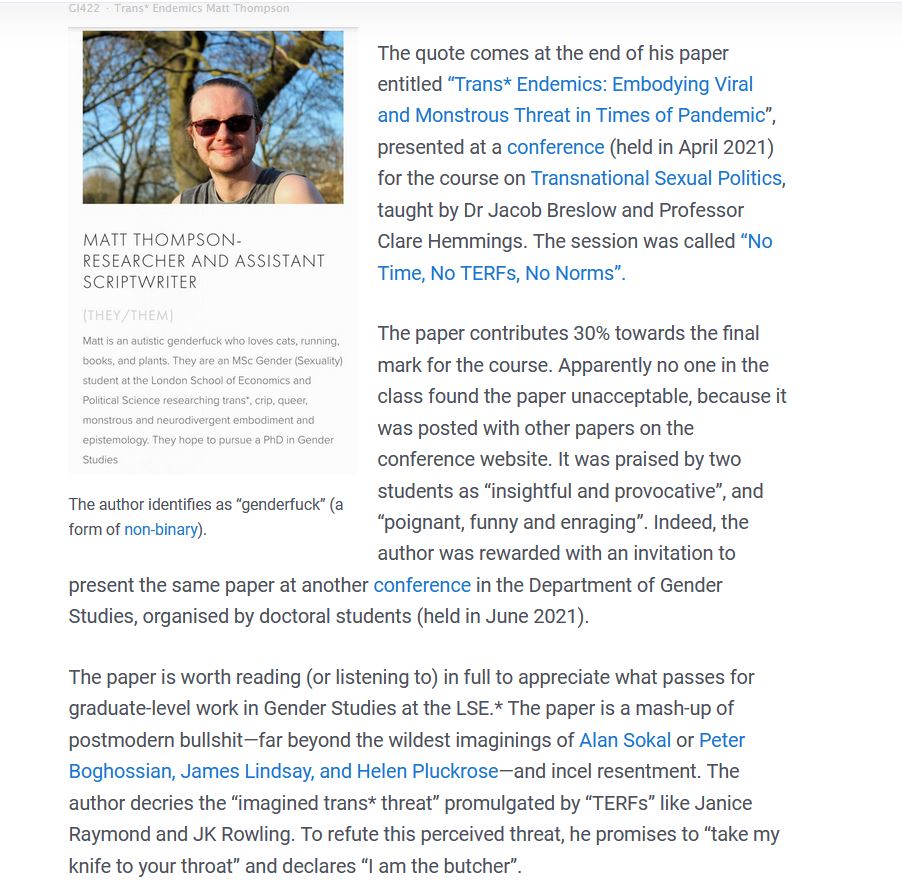
Ah, violent males expressing how violent they wish to be toward women who oppose their gender-magic. The previous link is to the abstract and transcript. This from the department of Gender Studies at the London School of Economics. Did you need an example of how far the Humanities in academia has fallen? Take a gander.

“Let us harness this parasitic imaginary and suck the cis out of feminism. Let us be the endemic. Let us exist as the evil twin to queer theory, and let us 14 bleed it dry for all it can offer us. Chu is wrong: trans* is more than ancillary notion to queer. But do we have to depart from queer entirely? Is trans* even 15 fucking here yet?16 If TERFs think trans* is an endemic threat to feminism, let us be the threat to feminism. We are the endemic, the viral, the toxic onslaught of ideology that attacks the very core of what you hold dear. We go unnoticed, right up until the moment they scream for mercy. Am I a threat to you? Do I send chills down your spine?”
Picture this: I hold a knife to your throat and spit my transness into your ear. Does that turn you on? Are you scared? I sure fucking hope so.
Go to sexmatters.org for the full story on what this crank has been saying.
Speaking your mind can be a dangerous activity. In the halls of academia though, it is purportedly the name of the game. Please go and read Dr.Bert’s full post and enjoy her eloquence and clarity of thought in full.
I thought I would highlight some of the points that should be of interest to those who believe in academic freedom, and freedom of speech in general.
“[…]
‘I am a sociologist after all—and interrogate this current moment in which a certain contingent of social activists have deemed it not only justifiable, but proper, to silence any discussion about sex and negotiation of competing sex-based and gender-identity-based rights. Some might say, and I might agree, this is part of the larger ‘woke’ movement among those who identify with the Left. I might note that my political beliefs position me on the Left, but I believe in the importance of evidence, reason and logic, and a material reality in which we all exist).'”
Her resignation letter (from the Division of Women and Crime) really knocks it out of the park, it is a clarion call to those who remain on the non gender religious Left. (**ed. It was mistakenly reported here that Dr.Burt’s letter was to the Editorial board, when in fact it was from the Division of Women and Crime – change applied to the relevant parts of this post and apologies to Dr.Burt**)
“However, a division that traffics in mantras and refuses to engage with people raising valid concerns (dismissing people for ‘hateful wrong think’), is not a group I wish to be a member of. For those of you who consider me a ‘meany’, baddie, hater who is a transphobe, you’re probably relieved. But you are wrong. I am not a transphobe, and I do not hate trans people or males or anyone.
Just this week reports came out of a male who self-ID’ed into the women’s prison in Washington state and raped a female prisoner housed there. I think that’s something to discuss; your explicit position is that doing so is hateful transphobia that must be silenced for inclusivity and the well-being of transgender people. But what about females and transwomen who would be harmed by predatory males self-ID’ing into women’s spaces?
Many of you were part of the LGBT movement in the late 1990s/early 2000s, and some of you weren’t. I was. We didn’t effect change by refusing to engage, dismissing those who disagreed, and censoring any discussion of negotiating gay rights. We were successful because we talked. We tried to understand the positions of others and helped them see ours. Maybe your attempts to censor any discussion of sex will work to effect the change you wish to see in the world. Maybe it won’t. Regardless of the outcome, I do not find the division’s silencing discussion of issues, which are complex and multilayered and sometimes uncomfortable, acceptable in academia or in the Division of Women and Crime.
I wish you well, and I’m sad to go. But I refuse to go along silently with a group that calls discussion of gender/sex-self-ID ‘transphobic’ when there are real issues to discuss here that have everything to do with the safety of females and transwomen and nothing to do with hate or bigotry.”
Wow.
*applause*
I think I’ve looked up and had explained to me what the term “inflation” is. The concept has remained a bit of a mystery. Mark Blyth the Scottish-American (Austerity – The History of a Dangerous Idea) economist parsed down the meaning of inflation to this – “too much money chasing not enough goods in an economy”. I like that definition as it sticks easily in the mind. However, without the necessary context, understanding what inflation is remains elusive.
Enter Yanis Varoufakis and his book “Talking to My Daughter About the Economy or, How Capitalism Works – and How it Fails”. This short quote describes how inflation and deflationary pressures work in an economy – he tells a story based on a famous paper by R.A. Radford titled The Economic Organization of a P.O.W. camp (original linked here).
“The Exchange Value of Money
When I was your age I recall hearing a grown-up saying something I could not get my head around. I just did not get it, however hard I tried. Even when I thought I had understood it, I tried to explain it to a friend and realized that I hadn’t. What was it that this grown-up had said? That a one-thousand-drachma note (the currency we had then) cost only twenty drachmas to produce. How can it be worth a thousand dratchmas, I kept wondering, when it only cost twenty.
Maybe you are smarter than I was, but humour me nevertheless as I attempt to explain this puzzle in the context of Radford’s POW camp. Periodically, the Red Cross Would place a few more cigarettes in the prisoners’ packages but keep the quantity of chocolate, tea, and coffee the same. When extra cigarettes arrived, each cigarette now bought less coffee, less chocolate, and less tea.
Why?
Since overall a larger number of cigarettes now corresponded to the same amount coffee and tea, each individual cigarette corresponded to less coffee and less tea. The opposite also held true: the fewer cigarettes there were in comparison to the other goods that the Red Cross placed in the packages, the great the exchange value, or purchasing power, of each cigarette. In short, the purchasing power of a unit of currency has nothing to do with how much it costs to produce but, rather, its relative abundance or scarcity.
Imagine that a prisoner has been hoarding his cigarettes in order to make a large purchase when suddenly the Red Cross sends tons of cigarettes to the captives. Suddenly, the exchange value or his cigarettes drops, and his parsimony and abstinence have been to no avail.
In this way we see how having access to a currency lubricates transactions to no end, helping the economy move more commodities more quickly. On the other hand, for a currency to function it requires trust and faith: the trust that everyone will continue to accept it in return for any commodity, which is in turn based on faith that the currency’s exchange value will be maintained. It is no coincidence that in your second language, Greek, the word for “coin: (nomisma) straddles the verb “to think” (nomizo) and the noun for “law” (nomos). Indeed, what gives value to coins and paper money is the legal obligation to accept them across the realm and the belief that they are and will remain valuable.
One night Allied Bombers hammered the area where the camp was located. The bombs landed closer and closer, some falling in the camp itself. All night long the prisoners wondered whether they would live to see daybreak. The next day the exchange value of cigarettes had gone through the roof! Why? Because over the course of that endless night, surrounded by exploding bombs and consumed by anxiety, the prisoners had smoked cigarette after cigarette. In the morning the total number of cigarettes had shrunk dramatically in relation to the other goods. If previously five cigarettes had been needed to buy one chocolate bar, now only one cigarette was needed to buy that same bar.
In short, the bombardment had caused what is known as price deflation – a decrease in all prices as a result of a reduction of the quantity of money in relation to all other goods. The opposite, a genderal increase in prices as a larger quantity of money in the overall system, is known as price inflation.”
–Talking to My Daughter About the Economy or, How Capitalism Works – and How It Fails. Yanis Varoufakis, pp 142 -144.
So, this is how I increased my knowledge of basic economic theory and what I think is a great heuristic tool if you happen to be trying to explain what inflation is and how it works in an economy. I will need to reread both Blyth’s ( his writing is for the layperson but remains quite dense and meaty, a slow but rewarding go) and Varoufakis’s books again as both were invaluable to understand how our economy works.











 bleatmop
 Mystro
 The Arbourist


 Dead Wild Roses
Your opinions…