
You are currently browsing the category archive for the ‘History’ category.
One of the many calculations going on in the background within varied historical contexts is the relationship between efficiency and resilience. Consider arch construction from Roman times and now.

The Roman arch has a distinct set of design principles that focus on the utilitarian principles of usefulness and longevity in public infrastructure.
The modern arch.

Same concept, but now a different formula has been employed, as different ends are in mind. Aversion to overbuilding, a focus on form rather than utilitarian concerns. Public architecture most certainly, but will these arches last centuries? Doubtful.
So, from here we can extrapolate the notion of the interplay between efficiency and resiliency, the Roman arch being the model of resiliency and the modern arch being the exemplar of efficiency. Neither is wrong per say but rather, each work displays what qualities are needed at a particular point in societal history.
Fast forward to the present. And yes, the present we speak of is the Covid-19 Pandemic of 2020. Like the Spanish Flu before it, the Coronavirus is rapidly burning through the various world populations.

The societal systems we have built are mostly modelled on the basis of maximizing efficiency, as efficient systems with capitalist societies are usually quite profitable. Jill Richardson writing in Counterpunch describes the model we are using for much of our economy.
“I went to business school 20 years ago. We learned about the efficiency of “just-in-time” supply management.
The goal was to cut costs by ordering inventory “just in time.” That way you don’t pay for all the extra, costly warehouses to store weeks or months of supplies. The example we were given was that if a certain large corporation’s supply chain shut down, they’d only have enough materials on hand to keep up production for four days.
Efficient? Yes. Resilient? No.”
Economic design decisions, like societal design decisions reflect the social priorities and needs of a people at a particular time. When paradigm shifting events happen, like a pandemic, the shortfalls of the system are revealed.
“My business school taught social Darwinism: survival of the fittest. The beauty of capitalism, we were taught, is that everyone competes for business and the competition drives innovation, while the least efficient companies go out of business.
It was an outlook that Ayn Rand would endorse: the most generous way to behave is to be selfish, because by doing your part to compete, you are doing your part to drive innovation and efficiency for everyone.
This crisis is pulling back the curtain on unfettered laissez-faire capitalism, showing that we are actually interconnected. And it’s far more serious than toilet paper.
A stark shortage of personal protective equipment has left health care workers without enough to go around. In my town, hospitals are organizing to receive donations from anyone who has a box of face masks, hand sanitizer, and gloves at home.
In short, they’re relying on community resilience where for-profit efficiency failed.”
Our capitalism system is a marvelous at maximizing efficiency, but when the base rules and global situation changes, the once successful model (should) quickly lose its lustre.
“In normal times, we justify a form of capitalism in which competition means accepting inequality and suffering in the name of improving efficiency for all. We accept that some face poverty, hunger, and homelessness, and we’re okay with it because of a myth that it’s natural, or better for everyone (or else caused by the moral failings of those who suffer).
Continuing to believe that myth now will cause millions of deaths worldwide. Instead, our only hope is pulling together to help others through shared sacrifice and collective action.
Resilience isn’t always profitable. But we need it now more than ever.”
We will need to adapt our models and societies for this new base set of conditions. A foundational requirement in the new normal will be building a higher level of cooperation in society and the fostering the willingness to critically evaluate the old paradigm and correct the models that do not jive with the new social reality. Building resilience into our societies must become a priority otherwise the pandemic lessons of 1918, and 2020 will need to be relearned at a great cost to human life and progress.
” Whenever we try to rearrange natural systems along the lines of a machine or a factory, whether by raising too many pigs in one place or too many almond trees, whatever we may gain in industrial efficiency, we sacrifice in biological resilience. The question is not whether systems this brittle will break down, but when and how, and whether when they do, we’ll be prepared to treat the whole idea of sustainability as something more than a nice word.”
A new model is necessary to mitigate future crisis, it must revolve around the idea that a formula weighted more toward resilience is necessary for a sustainable future.
“Instead of writing, the Inkas’ principal bureaucratic tool was the khipu. A khipu consists of a number of strings or cords, either cotton or wool, systematically punctuated with knots, hanging from a master cord or length of wood; pendant cords might also have subsidiary cords. The basis of khipu accounting practice was the decimal system, achieved by tying knots with between one and nine loops to represent single numerals, then adding elaborations to designate 10s, 100s or 1,000s. By varying the length, width, colour and number of the pendant cords, and tying knots of differing size and type to differentiate data, the Inkas turned the khipu into a remarkably versatile device for recording, checking and preserving information.
The main uses to which khipus were put were, firstly, to record births, deaths and movements of people, thereby providing an annual census upon which local labour, military and redistributive assessments could be made. They were also used to count commodities, especially the tribute payable by conquered provinces such as maize, llamas and cloth (there was no coinage). Maize, for example, might be represented by a yellow cord, llamas by a white cord, and so on. Early Spanish chroniclers and administrators were astonished at the accuracy of khipu calculations: according to Pedro de Cieza de León, writing in the late 1540s, they were ‘so exact that not even a pair of sandals was missing’.
Training in what anthropologists call ‘khipu literacy’ was compulsory for a specified number of incipient bureaucrats (khipukamayuqs) from each province. For this, they were sent to Cusco, where they also learned the Inka dialect, Quechua, and were schooled in Inka religion. Like most imperial rulers, the Inkas conquered in the name of an ideology, the worship of their chief deity, the Sun, and his child on Earth, the Sapa Inka. Sun-worship was mandatory throughout the empire, and vast resources were allocated to the performance of an annual cycle of festivals and rituals, and to the maintenance of the priests who staffed Tahuantinsuyu’s ubiquitous shrines. However, the Inkas also tolerated local deities, which, if perceived to be efficacious, might be incorporated into the Inka pantheon.
It is hard to see how alphabetic writing would have helped the Inkas to administer Tahuantinsuyu more efficiently: this was not an intensively governed empire but a federation of tribute-paying and politically allegiant provinces. In other spheres of government, such as law, writing would doubtless have made more of a difference, leading perhaps to the development of written law-codes, arguably even a ‘constitution’. But since writing was never developed, imperial rule remained weakly institutionalised, leading to a concentration of power and office, which meant that when the Sapa Inka was removed, there was little to fall back on.
So when Francisco Pizarro and his 200 or so conquistadores captured the Sapa Inka Atahualpa at Cajamarca on 16 November 1532, Tahuantinsuyu was left headless and disorientated. The confusion that followed was the crucible in which Spain’s New World empire was forged.”
So if you are homeschooling you have an answer to the question “why do I need to learn to read”? Answer: So the Spanish do not come from overseas and kick your ass.
Why does society work the way it does? Why is there such a disconnect between the common people and politics. Jonathan Cook examines the power structures in our society and how they work.
“Rather than thinking in terms of individuals, power is better visualised as the deep waters of a lake, while the powerful are simply the ripples on the surface. The ripples come and go, but the vast body of water below remains untouched.
Superficially, the means by which power conceals itself is through stories. Its needs narratives – mainly about those who appear powerful – to create political and social dramas that distract us from thinking about deep power. But more fundamentally still, power depends on ideology. Ideology cloaks power – in a real sense, it is power – because it is the source of power’s invisibility.
Ideology provides the assumptions that drive our perceptions of the world, that prevent us from questioning why some people were apparently born to rule, or have been allowed to enclose vast estates of what was once everyone’s land, or hoard masses of inherited wealth, or are celebrated for exploiting large numbers of workers, or get away with choking the planet to the point at which life itself asphyxiates.
Phrased like that, none of these practices seems natural. In fact, to a visiting Martian they would look pathologically insane, an irrefutable proof of our self-destructiveness as a species. But these conditions are the unexamined background to our lives , just the way things are and maybe always were. The system.
True, the individuals who benefit from the social and economic policies that uphold this system may occasionally be held to account. Even the policies themselves may occasionably be held up to scrutiny. But the assumptions behind the policies are rarely questioned – certainly not in what we are taught to call the “mainstream”.
That is an amazing outcome given that almost none of us benefit from the system we effectively sanction every time we turn out to vote in an election. Very few of us are rulers, or enjoy enormous wealth, or live on large estates, or own companies that deprive thousands of the fruit of their labours, or profit from destroying life on Earth. And yet the ideology that rationalises all that injustice, inequality and immorality not only stays in place but actually engenders more injustice, more inequality, more immorality year by year.
We watch this all unfold passively, largely indifferently because we believe – we are made to believe – we are powerless.
Regenerating like Dr Who
By now, you may be frustrated that power still lacks a name. Is it not late-stage capitalism? Or maybe neoliberalism? Globalisation? Or neoconservatism? Yes, we can identify it right now as ideologically embedded in all of those necessarily vague terms. But we should remember that it is something deeper still.
Power always has an ideological shape and physical structures. It has both faces. It existed before capitalism, and will exist after it (if capitalism doesn’t kill us first). Human history has consisted of power consolidating and regenerating itself in new form over and over again – like the eponymous hero of the long-running British TV sci-fi series Doctor Who – as different groups have learnt how to harness it, usurp it and put it to self-interested use. Power has been integral to human societies. Now our survival as individuals and as a species depends on our finding a way to reinvent power, to tame it and share it equally between us all – and thereby dissolve it. It is the ultimate challenge.”
To change a system, one needs to understand how it works.
An interesting article over at JSTOR by Manisha Claire It reminds me that that the reality we live today were conscious choices that were made by people in the past. Part of the American zeitgeist is a strong emphasis on personal responsibility and ‘rugged individualism’. These qualities did not mysteriously poof out of the ether, they were constructed and promoted for a reason. It is interesting see how the the historical seeds planted in society have come to fruition.
” instead of addressing housing inequality or the shortage of affordable units, political leaders were presenting home ownership as an attainable choice for all Americans, implying that an inability to live the BHA way was a matter of personal, rather than institutional, failing.”
“The ideology behind BHA ultimately privileged a white, middle-class version of home ownership. In 1922, The Delineator began to devote multiple pages to BHA and its mission, including suggestions for home furnishing and contributions from the organizers. In the October 1922 issue, Herbert Hoover wrote an article called “The Home as an Investment,” declaring that urban overcrowding and poverty “means a large increase in rents, a throw-back in human efficiency, and that unrest which inevitably results from inhibition of the primal instinct in us all for home ownership.”
In Agricultural History, Hutchison writes:
The homes put forth by the national leaders varied somewhat in design but included new household technology that stressed convenience and room layouts that emphasized both family interaction and privacy… In front of the ideal house lay a green, well-tended yard, while behind it might be a small garden. In short, the prescription endorsed by the Better Homes leaders at the national level was that of a suburban dwelling replete with new technological amenities and private space.
Meloney ran “The Ideal Small House,” a column by the architect Donn Barber, which stressed modernity, thrift, and American design for the entire home. There was also a “Rooms for Boys and Girls” column by Mrs. Charles Brady Sanders, dictating “dainty, bright and frivolous” furnishings for girls’ rooms. In boys’ rooms, “masculinity must be foremost.” These columns reinforced the ideals of BHA and made it clear that, despite any structural or financial barriers, readers could and should pursue them.
However, while this ideal was encouraged in literature disseminated to Americans across class and race lines, the realities of achieving this goal were not addressed. Segregationist housing policies, discrimination by banks, and poverty among racialized Americans prevented many people from buying and maintaining homes the BHA way. But BHA rhetoric made it clear that, instead of addressing housing inequality or the shortage of affordable units, political leaders were presenting home ownership as an attainable choice for all Americans, implying that an inability to live the BHA way was a matter of personal, rather than institutional, failing.”
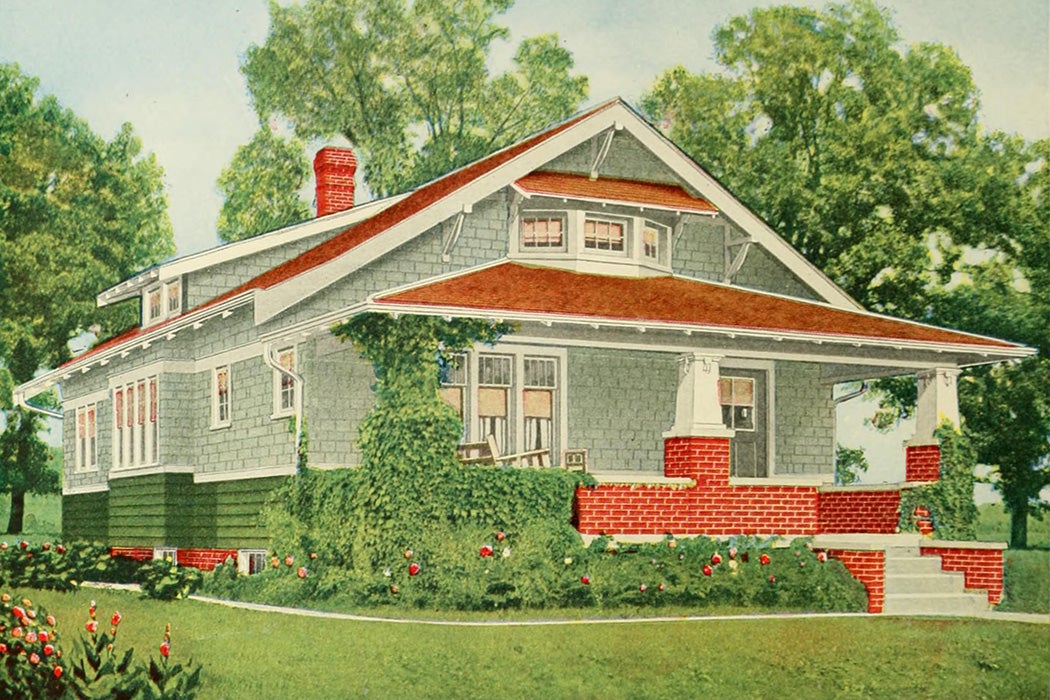
“On display at the national exhibition in D.C., the National Better Home included modern amenities like indoor plumbing and electricity, reflecting an attempt to encourage homeowners to purchase new appliances and embrace scientific thinking at home. Hutchison writes that the living spaces in the house were designed to “evoke sentimental images of family unity” while “the kitchen conveyed efficiency and cleanliness.” That approach to home design was emulated in cities and towns around the country, as local communities vied for the title of Best American Home. These exhibitions were written up in newspapers across the country, and the movement’s leaders emphasized thrift and sensibility over “commercialism.”
For Black and immigrant homeowners (or would-be homeowners), BHA offered a kind of aspirational modeling that decried their current living conditions, but offered no substantial way out of their circumstances.”
Along the lines of the History Oversimplified, a more in depth view of one of the important battles during the early stages of World War II.











 bleatmop
 Mystro
 The Arbourist


 Dead Wild Roses
Your opinions…