
You are currently browsing the category archive for the ‘Media’ category.
 When one turns to the word “propaganda” images of totalitarian states come to mind – Pravda, The North Korea Times. We envision an army of Winston Smith’s carefully scrubbing the news of improper thoughts and meanings, carefully crafting the government approved message of the day. Of course we don’t have that here in North America, we have freedom of speech, we have a free press, we have liberty! We also have institutionalized self-censorship,demarcated areas of approved debate, and a media establishment that tends to take the government’s word at face value. These factors contribute to a media system that appears to be free and without censure, but in reality, craft obsequious stories that pose no threat to power or the norms of society. Essentially, the (self)censorship we have in the West is on autopilot, it is subtle, unremarkable, but yet *very* effective (for more detail on our system, see my post on Manufacturing Consent).
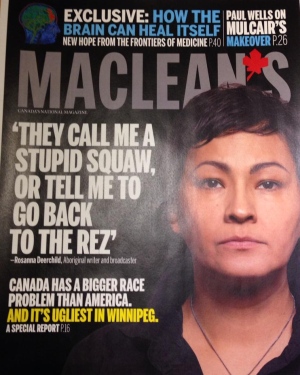
All this being said, sometimes our subtle system of media control goes a little haywire, it loses its subtle sheen, and becomes a little more transparent in how it operates. Stories slip through the net and give the status-quo a good shake. The recent furor caused by Maclean’s naming “Winnipeg: Where Canada’s Racism Problem is at its Worst.” is a prime example of such a happening. The article pokes many holes in white Canada’s notion of a vibrant multicultural society. Some highlights:
“One in three Prairie residents believe that “many racial stereotypes are accurate,” for example, higher than anywhere else in Canada. In Alberta, just 23 per cent do, according to polling by the Canadian Institute for Identities and Migration (CIIM). And 52 per cent of Prairie residents agree that Aboriginals’ economic problems are “mainly their fault.” Nationally, the figure drops to 36 per cent.”
***
“Earlier this fall, Robert Falcon-Ouellette, director of the University of Manitoba’s Aboriginal focus programs, hit the Grant Park Shopping Centre in Winnipeg’s south end to hustle for signatures for his mayoral nomination form. The 37-year-old was a late entrant to the election. He’d cobbled together a campaign staff—idealistic political neophytes he knew from academia and activists he’d met at last year’s Idle No More rallies.
It was an ugly entry into politics. “I know you,” a shopper told Falcon-Ouellette, approaching him shortly after he arrived at the mall. “You’re that guy running for mayor. You’re an Indian,” he said, pointing a finger at Falcon-Ouellette. “I don’t want to shake your hand. You Indians are the problem with the city. You’re all lazy. You’re drunks. The social problems we have in the city are all related to you.”
***
“Tyler Henderson, a 28-year-old Ojibway nursing student at the University of Manitoba, says he feels racism every time he walks out his front door. Henderson says Winnipeg police stopped him 15 times last year. “You fit the description,” police tell him when he asks what he did wrong. Once, police claimed he’d pulled to a stop a few inches beyond the stop line. “It makes me mad,” he says. “But there’s nothing I can do.” Some young indigenous men are stopped twice per month in the inner city, according to University of Manitoba criminologist Elizabeth Comack. “
***
“Don Marks, a Winnipeg writer, recently visited an ER with an indigenous friend. They’d dropped a painting, and the broken glass had cut his friend. “Aw!” a nurse exclaimed in greeting them. “Have we been drinking and fighting again?” The nurse’s assumptions were harmless, says Marks, who edits Grassroots News, an Aboriginal newspaper. “But this was someone responsible for treating Native people in our hospitals. We all know racism exists in our health care system.”
I would go read the entire article at Maclean’s as it touches many important points and different facets of the racist experience going on in Winnipeg. But the lowlights sampled here are enough to show that punches were not pulled in writing this article.
Response from the Mayor of Winnipeg was predictable.
“We have come together to face this head-on as a community,” Bowman added, noting that Winnipeg exists on what is traditional Treaty One territory. We have to shine a light on it. Without the light, we can’t see what we’re fighting. We’re not going to end racism tomorrow, but we’re sure as hell going to try.”
Way to go Mr.Mayor. Ending workplace inefficiency with enhanced system synergies is also on his “to do” list. I find the reactions of Robert-Falcon Ouellette and Rosanna Deerchild to be much more interesting.
Ouellette ran for Mayor in the last Winnipeg Civil election and of course faced racist comments on him an his campaign. He is no stranger to the ugly tide of racism in Winnipeg, but when asked of the Maclean’s article he said this:
“The cover treatment Maclean’s gave the story is sensationalist, he said. The cover features a quote from a Winnipeg resident who says,”They call me a stupid squaw or tell me to go back to the rez.”
“They used the word ‘squaw,’ which is very, you know, derogatory type of comment,” Ouellette said. “But at the same time, I understand they need to be selling magazines and getting people interested to buy the magazine.” Ouellette has experienced racism, including during his campaign, but it’s not something he sees on a daily basis. He said he believes the majority of people in the city aren’t racist, but that there’s always the loudmouth that stands out.”
His restraint and decorum in the face of such ugliness is impeccable. At the same time, troublesome because he’s just being so darn nice about the entire situation. We see the same pattern with Rosanna Deerchild, here is what she says:
“They call me a stupid squaw, or tell me to go back to the rez,” the quote reads. But on Friday, Deerchild recorded a segment for Saturday’s Unreserved, saying she does not want to be racism’s cover girl.
“I am far from the angry Indian complaining about being hard done by,” she says.
“Let me be clear. I love my city, my community, my home: Winnipeg, North End, Canada. But neither will I quantify, qualify or pacify racism in this place, or any place it rears its ugly head.”
I’m scratching my head a little over what she said. I applaud her for being so diplomatic in the face of injustice, but I think that she has every right to be royally pissed off over the state of affairs regarding Winnipeg and racism.
Her choice of words speaks volumes to how the concerns of aboriginal woman have been treated in white Canada in the past. She makes it very clear that she is not an “angry Indian complaining about being hard done by”. Deerchild, even in her respected position in society (broadcaster for the CBC), is keenly aware of the stereotypes and negative tropes arrayed against her. She is aware of what I was alluding to earlier in this post – the system of self censorship/censorship that marginalizes dissident views such as hers, in favour of the comforting white feel-good multicultural narrative that is an acceptable “truth” in Canadian society.
I applaud all those quoted in the articles, they are speaking directly to the problem of racism in our society. The fact that this article is creating so much noise and buzz in Canada is a testament to how adept our media is at maintaining the status-quo most of the time and for generally not allowing articles of this calibre to be published within the mainstream news establishment.
[Source: Macleans.ca]
Orac brings the pain to the masters(?) of woo.
TV does such a wonderful job of promoting fairy tales and fiction. Just like how the protagonists after being shot recover within forty-five minutes, accurate depictions of prison life by certain shows do not match up with reality.
The writers over at Media Lens have really outdone themselves. This will be in the next edition of the textbooks about media analysis and what happens once you go against the status quo. Russel Brand has made the mistake of categorizing and identifying what is wrong with our economic systems and society. Watch as the liberal press rallies against what can only be a threat to the system they inhabit.
“Brand’s Newsnight performance, then, was an inspiring cri de coeur. But a 10-minute, impassioned, ill-formed demand for ‘Change!’ from a lone comedian is not a problem for the media’s gatekeepers. It makes for great television, enhances the illusion that the media is open and inclusive, and can be quickly forgotten – no harm done.”
Brand’s new book, ‘Revolution,’ is different – the focus is clear, specific and fiercely anti-corporate. As we will see in Part 2 of this alert, the media reaction is also different.
Brand begins by describing the grotesque levels of modern inequality:
‘Oxfam say a bus with the eighty-five richest people in the world on it would contain more wealth than the collective assets of half the earth’s population – that’s three-and-a-half billion people.’ (p.34)
And:
‘The richest 1 per cent of British people have as much as the poorest 55 per cent.’ (p.34)
But even these facts do not begin to describe the full scale of the current crisis:
‘The same interests that benefit from this… need, in order to maintain it, to deplete the earth’s resources so rapidly, violently and irresponsibly that our planet’s ability to support human life is being threatened.’ (p.36)
For example:
‘Global warming is totally real, it has been empirically proven, and the only people who tell you it’s not real are, yes, people who make money from creating the conditions that cause it. (pp.539-540)
We are therefore at a crossroads:
‘”Today humanity faces a stark choice: save the planet and ditch capitalism, or save capitalism and ditch the planet.”
‘The reason the occupants of the [elite] fun bus are so draconian in their defence of the economy is that they have decided to ditch the planet.’ (p.345)
And so ‘we require radical action fast, and that radical action will not come from the very interests that created and benefit from things being the way they are. The one place we cannot look for change is to the occupants of the bejewelled bus.’ (p.42)
The problem, then, is that ‘we live under a tyranny’. (p.550) The US, in particular, ‘acts like an army that enforces the business interests of the corporations it is allied to’. (p.493)
But this is more than just a crude, Big Brother totalitarian state:
‘A small minority cannot control an uncooperative majority, so they must be distracted, divided, tyrannised or anaesthetised into compliance…’ which means ‘the colonisation of consciousness by corporations’. (p.165)
Brand notes that 70 per cent of the UK press is controlled by three companies, 90 per cent of the US press by six:
‘The people that own the means for conveying information, who decide what knowledge enters our minds, are on the fun bus.’ (p.592)
He even manages a swipe at the ‘quality’ liberal press:
‘Remember, the people who tell you this can’t work, in government, on Fox News or MSNBC, or in op-eds in the Guardian or the Spectator, or wherever, are people with a vested interest in things staying the same.’ (p.514)
Thus, the ‘political process’ is a nonsense: ‘voting is pointless, democracy a façade’ (p.45): ‘a bloke with a nice smile and an angle is swept into power after a more obviously despicable regime and then behaves more or less exactly like his predecessors’. (p.431)
The highly debatable merit of voting aside, anyone with an ounce of awareness will accept pretty much everything Brand has to say above. Put simply, he’s right – this is the current state of people, planet and politics. A catastrophic environmental collapse is very rapidly approaching with nothing substantive being done to make it better and everything being done to make it worse.
Even if we disagree with everything else he has to say, every sane person has an interest in supporting Brand’s call to action to stop this corporate genocide and biocide. A thought we might bear in mind when we subsequently turn to the corporate media reaction.
Ah, the joy of the free press down in the US. Let’s catch up with Noam as takes us through some possible solutions to the Palestine/Israel conflict.
You’d think they would get tired being wrong and laughed at all the time, but, they get full marks for their tenacious grasp on Stupid streaked with partisan politics, of course.
I’m always amused when I see people commentating on the “liberal bias” in the media. It is usually followed by a trenchant analysis of at least one instance of how news corporation X has finally gone off the rails and has lost all of its journalistic integrity blah blah blah.
Sitting where I am, in political and social Outlier-ville, I have to smile to myself. This might be a case of “liberal bias” but when you take a step back and look at what the media does, it is fairly easy to discern that mouldering just under the surface of “a vibrant free-press’ is a well tuned, self-selecting propaganda apparatus that exists only to serve the agenda of the state.
Oh sure we like to make fun of Pravada and point to those poor brain-washed induhviduals. Ironically we here in the west have even a better system in place, that masquerades as independent and unbiased, yet in the final analysis, is just as credible as the Pravda we like to point at and say “boo”.
Of course, using different sources, as I like to do, such as Counterpoint, Alter.net, Al-Jazeera, Tom’s Dispatch, et cetera often gets me into trouble as people who are firmly ensconced in the propaganda model get bent out shape fairly quickly when exposed to a non-official point of view.
Explaining the western version of the Propaganda model is what Media Lens does best:
The essential feature of corporate media performance is that elite interests are routinely favoured and protected, while serious public dissent is minimised and marginalised. The BBC, the biggest and arguably the most globally respected news organisation, is far from being an exception. Indeed, on any issue that matters, its consistently biased news coverage – propped up, by a horrible irony, with the financial support of the public whose interests it so often crushes – means that BBC News is surely the most insidious propaganda outlet today.
Consider, for example, the way BBC editors and journalists constantly portray Nato as an organisation that maintains peace and security. During the recent Nato summit in Wales, newsreader Sophie Raworth dutifully told viewers of BBC News at Ten:
‘Nato leaders will have to try to tackle the growing threat of the Islamist extremists in Iraq and Syria, and decide what steps to take next. (September 4, 2014)
As we have since seen, the ‘steps’ that were taken ‘next’ meant a third war waged by the West in Iraq in just 24 years.
The same edition of BBC News at Ten relayed, uncontested, this ideological assertion from Nato Secretary-General Anders Fogh Rasmussen:
‘Surrounded by an arc of crisis, our alliance, our transatlantic community, represents an island of security, stability and prosperity.’
In fact, the truth is almost precisely the reverse of Rasmussen’s assertion. Nato is a source of insecurity, instability, war and violence afflicting much of the world. True to form, BBC News kept well clear of that documented truth. Nor did it even remind its audience of the awkward fact that Rasmussen, when he was Danish prime minister, had once said:
‘Iraq has WMDs. It is not something we think, it is something we know.’
That was embarrassing enough. But also off the agenda was any critical awareness that the Nato summit’s opening ceremony was replete with military grandeur and pomposity of the sort that would have elicited ridicule from journalists if it had taken place in North Korea, Iran or some other state-designated ‘enemy’. Media Lens challenges you to watch this charade without dissolving into laughter or switching it off before reaching the end.
Oh Aunte-Beebs, say it ain’t so. Of course, it gets worse –
“Of course, it is ironic that leading politicians constantly strive to foster a media image of themselves as caring, truthful and fearless. In reality, they are all beholden to powerful business and financial interests, and even afraid to step out of line; notably so when it comes to criticism of Israel. Political ‘leaders’ are virtual puppets with little, if any, autonomy; condemned to perform an elite-friendly role that keeps the general population as passive and powerless as possible. The corporate media plays an essential role here, as the British historian and foreign policy analyst Mark Curtis observes:
‘The evidence is overwhelming that BBC and commercial television news report on Britain’s foreign policy in ways that resemble straightforward state propaganda organs. Although by no means directed by the state, their output might as well be; it is not even subtle. BBC, ITV and Channel 5 news simply report nothing seriously critical on British foreign policy; the exception is the odd report on Channel 4 news. Television news – the source of most people’s information – provides the most extreme media distortion of [foreign policy news coverage], playing an even greater ideological function than the press.’ (Mark Curtis, ‘Web of Deceit: Britain’s Real Role in the World’, Vintage, London, 2003, page 379).
Andrew MacGregor Marshall, the former Reuters bureau chief in Baghdad, recently related that:
‘there is tendency for the Western media to claim that it is neutral and unbiased, when in fact it’s clearly propagating a one-sided, quite nationalistic and selfish view of its own interventions in these countries.’
He continued:
‘If you want to accuse the US military of an atrocity, you have to make sure that every last element of your story is absolutely accurate, because if you make one mistake, you will be vilified and your career will be over. And we have seen that happen to some people in recent years. But if you want to say that some group of militants in Yemen or Afghanistan or Iraq have committed an atrocity, your story might be completely wrong, but nobody will vilify you and nobody will ever really check it out.’
The Dutch journalist Karel Van Wolferen recently wrote an insightful piece exposing the state-corporate propaganda that is so crucial to keeping the public in a state of general ignorance and passivity. There ‘could hardly be a better time than now’, he said, to study the effects of this ‘insidious propaganda’ in the so-called ‘free world’. He continued:
‘What makes propaganda effective is the manner in which, through its between-the-lines existence, it inserts itself into the brain as tacit knowledge. Our tacit understanding of things is by definition not focused, it helps us understand other things. The assumptions it entails are settled, no longer subject to discussion.’
Much of this propaganda originates in centres of power, notably Washington and London, and ‘continues to be faithfully followed by institutions like the BBC and the vast majority of the European mainstream media’. Thus, BBC News endlessly trumpets Western ‘values’ and takes as assumed that parliamentary ‘democracy’ represents the range of acceptable public opinion and sensible discourse. Underpinning this elite-supporting news framework is a faith-based ideology which Van Wolferen calls ‘Atlanticism’. This doctrine holds that:
‘the world will not run properly if the United States is not accepted as its primary political conductor, and Europe should not get in America’s way.’
The result?
‘Propaganda reduces everything to comic book simplicity’ of ‘good guys’ and ‘bad guys’.
So, really – tell me more about how about how damn liberally-biased our media is despite the fact that in the bigger picture, the majority of it (news media) is serving the propagandist needs of the state.











 bleatmop
 Mystro


 Dead Wild Roses
Your opinions…