
You are currently browsing the category archive for the ‘Medicine’ category.
“An anti-lockdown march in downtown Vancouver nearly spiralled out of control when dozens of protesters surrounded a hospital entrance and began berating frontline healthcare workers.
Vancouver’s anti-lockdown protests are mainly organized by anti-vaccine activists, along with a flat earth conspiracy group and individuals linked to far-right politics who promote the events through a web of private Facebook groups.
Multiple videos live streamed by participants show the crowd marching down the middle of Burrard Street on Sunday afternoon, before coming to a stop in front of the ambulance bay at St. Paul’s Hospital.
One protester shouted into a megaphone that they wanted to “talk to the doctors.”
Protesters can be heard directing chants of “no vaccines” and “let us in” at several healthcare workers who wandered outside the emergency room in their protective masks and medical scrubs.
“The hospitals are empty,” yelled one protester, along with others who are heard shouting “tell the truth” and demanding to know: “What are you hiding?”
“You’re all corrupt,” shouted another.
Protesters displayed signs referencing several conspiracies related to vaccines and 5G technology, including various messages blaming the government, Bill Gates and Satan for the lockdown.”

Nothing good has come from the Anti-Vax movement. Prove me wrong. jfc.
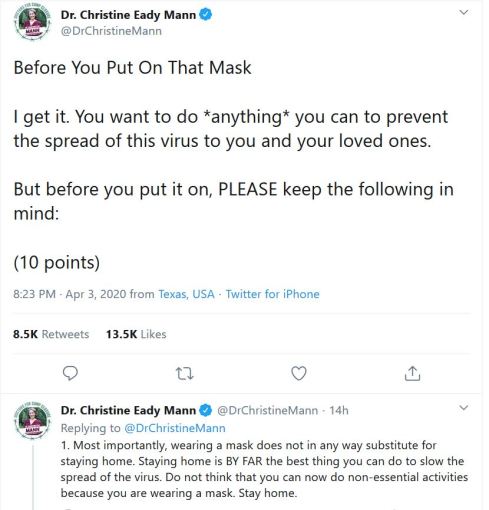


Interim Guidance for the Use of Masks to Control Seasonal Influenza Virus Transmission
Guidelines and Recommendations
The following interim CDC guidance was developed in response to questions about the role of masks for controlling seasonal influenza virus transmission.
Background
Seasonal influenza viruses are believed to be transmitted from person-to-person primarily through virus-laden droplets that are generated when infected persons speak, cough or sneeze; these droplets can be deposited onto the mucosal surfaces of the upper respiratory tract of susceptible persons who are near the droplet source. Transmission also may occur through direct and indirect contact with infectious respiratory secretions, (e.g., by hands that subsequently deliver infectious material to the eyes, nose or mouth).
A combination of infection prevention control strategies is recommended to decrease transmission of influenza viruses in healthcare settings. These include source control (immediately putting a surgical mask on patients being evaluated for respiratory symptoms), promptly placing suspected influenza patients in private rooms, and having healthcare personnel wear personal protective equipment (PPE) when caring for patients with suspected influenza. Additional information about PPE and other prevention strategies for personnel caring for patients with seasonal influenza is available. A mask should be worn by infectious patients any time they leave the isolation room.
The following recommendations focus on the appropriate use of masks as part of a group of influenza control strategies in healthcare settings. Masks are not usually recommended in non-healthcare settings; however, this guidance provides other strategies for limiting the spread of influenza viruses in the community.
Healthcare Settings
Symptomatic or Infected Patients
During periods of increased acute respiratory infections in the community, coughing patients and anyone suspected of having influenza should wear a mask at all times until they are isolated in a private room. (see Respiratory Hygiene/Cough Etiquette in Healthcare Settings). Masks should be worn by these patients until
- it is determined that the cause of symptoms is not an infection that requires isolation precautions or
- the patient has been appropriately isolated, either by placement in a private room or in some circumstances by placement in a room with other patients with the same infection (cohorting). The patient does not need to wear a mask while isolated, except when being transported outside the isolation room.
Healthcare Personnel
A surgical mask or fit-tested respirator should be worn by healthcare personnel who are within 6 feet of a suspected or laboratory-confirmed influenza patient. A respirator can be selected when antiviral medication supplies are expected to be limited and influenza vaccine is not available, e.g., during a pandemic. Standard and droplet precautions should be maintained until the patient has been determined to be noninfectious or for 7 days after illness onset or until 24 hours after the resolution of fever and respiratory symptoms, whichever is longer, while a patient is in a healthcare facility. In some cases, facilities may choose to apply droplet precautions for longer periods based on clinical judgment, such as in the case of young children or severely immunocompromised patients, who may shed influenza virus for longer periods of time. Further guidance is available at: Prevention Strategies for Seasonal Influenza in Healthcare Settings.
Non-Healthcare Settings
Symptomatic Persons
Adults can shed influenza virus 1 day before symptoms appear and up to approximately 5 to 7 days after onset of illness; thus, the selective use of masks (e.g., in proximity to a known symptomatic person) may not effectively limit transmission in the community. Young children, immunocompromised persons of any age, and critically ill patients with influenza can shed influenza viruses in the respiratory tract for prolonged periods. Moreover, because no single intervention can provide complete protection against influenza virus transmission, emphasis should be placed on multiple strategies including pharmaceutical (e.g., vaccines and antiviral medications) and non-pharmaceutical interventions. The latter group include: 1) community measures (e.g., social distancing and school closures); 2) environmental measures (e.g., routine surface cleaning); and 3) personal protective measures such as encouraging symptomatic persons to:
- cover their nose and mouth when coughing or sneezing,
- use tissues to contain respiratory secretions and, after use, to dispose of them in the nearest waste receptacle, and
- perform hand hygiene (e.g., handwashing with non-antimicrobial soap and water, and alcohol-based hand rub if soap and water are not available) after having contact with respiratory secretions and contaminated objects/materials.
Persons who are diagnosed with influenza by a physician or who have a febrile respiratory illness during a period of increased influenza activity in the community should remain at home until the fever is resolved for 24 hours (without fever-reducing medications) and the cough is resolving to avoid exposing other members of the public. If such symptomatic persons cannot stay home during the acute phase of their illness, consideration should be given to having them wear a mask in public places when they may have close contact with other persons. In addition, masks are recommended for use by symptomatic, post-partum women while caring for and nursing their infant (see Guidance for Prevention and Control of Influenza in the Peri- and Postpartum Settings).
Unvaccinated Asymptomatic Persons, Including Those at High Risk for Influenza Complications
No recommendation can be made at this time for mask use in the community by asymptomatic persons, including those at high risk for complications, to prevent exposure to influenza viruses. If unvaccinated high-risk persons decide to wear masks during periods of increased respiratory illness activity in the community, it is likely they will need to wear them any time they are in a public place and when they are around other household members.
Annual influenza vaccination is the primary method for preventing influenza in persons at high risk for complications from influenza virus infection. However, influenza vaccine effectiveness is variable, and some vaccinated persons can get sick with influenza. Administration of antiviral medications for early treatment of influenza is a useful adjunct in the control of influenza in these persons. Antiviral treatment is recommended as soon as possible for hospitalized influenza patients, people who are very sick with influenza but who do not need to be hospitalized, and people who are at high risk of serious complications based on their age or health if they develop influenza.
The Religious and the anti-vaxxers.

 I hate the rank smell of religious zealotry, so self-righteous, so sure, so confident that the grand ooga-booga has ordained that the status of women in Brazil needs to be taken down a score of notches.
As reported by the CBC:
“A congressional committee led by evangelical Christians has voted to ban abortion in Brazil in all situations, including cases of rape and where the mother’s life is in danger.
The decision was approved 18-1 late Wednesday by a special committee considering a constitutional amendment to extend maternity leave for mothers of premature babies.”
Let’s just call this instance #234987022808 of the institution of religion reinforcing the patriarchal status quo in a ‘modern’ society. The women in Brazil are just going to have to get used to the notion that their existence is defined by their patriarchally sanctioned social role as birthers of children (full stop). Also, the role as women who die in childbirth because apparently it is their ultimate calling. Fuck free will, bodily autonomy, and kooky notions of universal humanity for the female sex class.
Crimes against the female half of humanity aside(!), things were not all that amazing on the reproductive rights front for women in Brazil before hand. The church of choir-boy abuse..err..catholic church had the usual oppressive sanctions against women in place before hand.
“Abortion is illegal in predominantly Catholic Brazil except when the pregnancy is the result of a rape or puts the mother’s life at risk.”
Let’s let the high misogynists in charge speak for themselves:
“To defend abortion, like it or not, is a Satanic, diabolical and destructive act,” evangelical congressman Pastor Eurico told the committee, brandishing a replica of a 12-week-old fetus.”
Satanic… Indeed.
Specious bullshit like the above statement should be all the justification necessary for justification of separation of church and state. Further more, it is all the evidence required to illustrate how skull-explodingly bad religion is for women and society in general.
All isn’t *quite* lost yet though. The male politician might actually find it within themselves a shred of moral and ethical decency and kill this constitutional amendment before it becomes law.
“The move to criminalize all cases of abortion would require supermajorities, or two-thirds of the votes in both chambers of Congress, as it is part of a constitutional amendment.”
But then again, the men who seem to think it is their right to dictate how women lead their lives and make their reproductive choice might make a ‘compromise’ and merrily throw women under the bus for movement on the obviously much more important topic of pension reform.
“The measure could clear those hurdles as part of a trade-off for other legislation the governing coalition seeks to pass, such as pension reform needed to plug a gaping budget deficit.”
How magnanimous of the ruling dudes in charge. Because shitting on women will always result in the betterment of society. It’s 2017 and it would seem that most of the world isn’t exactly on board with the whole treating women like full members of human race yet.
What a time to be alive!
Let’s work together on this one folks. We should be done this by now.
Dr. Jen Gunter : Ben Carson says a 22 week fetus can feel pain. Science says Carson is wrong.
Wow, another dude Republican candidate who gets the vapours when it comes to female reproductive issues.
Dr.Carson is a neurosurgeon perhaps he can discover what is making his thoughts come from ass instead of his head.
Quelle Surprise.












 bleatmop
 Mystro


 Dead Wild Roses
Your opinions…