
You are currently browsing the category archive for the ‘Music’ category.
Vi Hart is truly amazing. Awe inspiring yet accessible, sublime yet exciting, her videos are strange, wonderful, fun, educational, and so many other great things combined.
Now it’s time to expand your mind with a delightful explanation and demonstration of Shepard Tones
I really like this song. Here’s the problem though, try singing it in the same key that JBJ does. Here is the lead sheet and let’s observe the melodic patterns that are going on in this song.
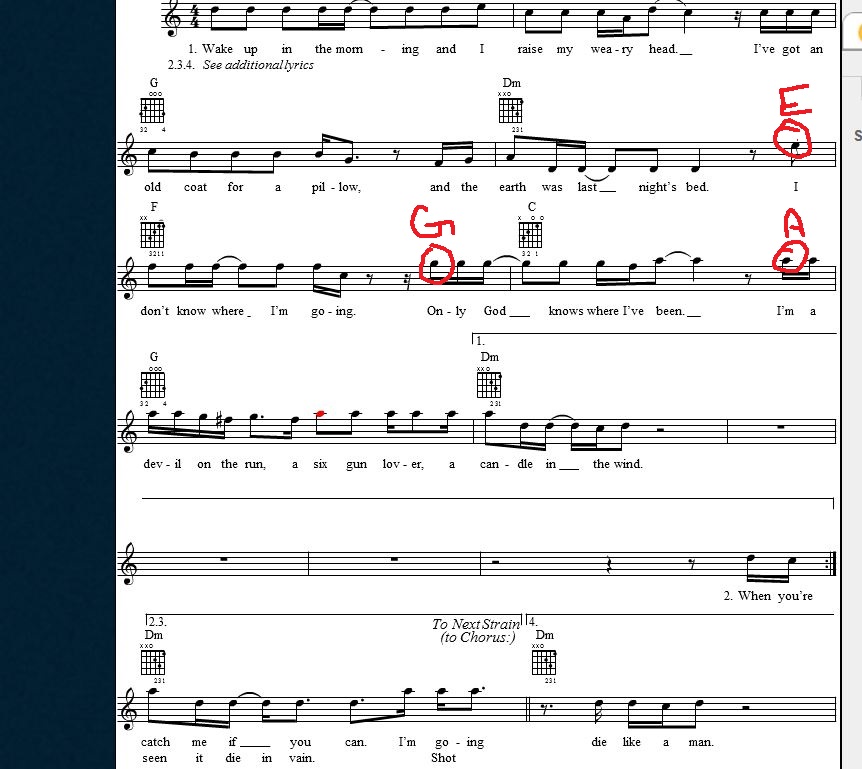
Those black dots keep going up higher on the staff. Damn you JBJ
Male vocal singing comes roughly in three flavours, Bass, Baritone and Tenor. The first highlighted note (E) will raise the eyebrows of most bases. It lies near the upper limit of where they can beautifully sing. Baritones (lazy tenors) are still well within their zone of comfort, however even they are pressed to produce the next series of notes (G). Of course JBJ doesn’t stop there and goes well into tenor territory with long passage of high notes (A’s). The general melodic tendency in this song is a ever increasing ascension of the C major scale. But wait, it get’s better.
If you listen to the song, you’ll notice the music presented here is only the intro and the intro builds into even a higher chorus. We’re now in the famously high C territory of Pavarotti and other classical singing masters. Let me assure you, gentle readers, High C territory is the undiscovered country for many tenors – as a amateur singing I have only once ventured into this land – it was rough and harsh encounter, let me assure you. Yet JBJ bashes out high notes like no ones business.
You may not like Bon Jovi, but one should at least appreciate the musicianship that goes into vocal production of this calibre.
I saw this today and I had to put it up. Enjoy some history, some math, some copywrite commentary, and some wonderful music, all delightfully wrapped together by the fantastic ViHart. Enjoy!
System of Down with their anti-capitalist bent, fills the bill when us dirty socialists need to rock out.
I’ve read about somewhat arcane nature of piano tuning and the various temperaments used through the ages, but Minute Physics succinctly describes what is going with all the math behind the production of sound.
Many factors cause pianos to go out of tune, particularly atmospheric changes. For instance, changes in humidity will affect the pitch of a piano; high humidity causes the sound board to swell, stretching the strings and causing the pitch to go sharp, while low humidity has the opposite effect.[1] Changes in temperature can also affect the overall pitch of a piano. In newer pianos the strings gradually stretch and wooden parts compress, causing the piano to go flat, while in older pianos the tuning pins (that hold the strings in tune) can become loose and don’t hold the piano in tune as well.[2] Frequent and hard playing can also cause a piano to go out of tune.[2] For these reasons, many piano manufacturers recommend that new pianos be tuned four times during the first year and twice a year thereafter.[3]
An out-of-tune piano can often be identified by the characteristic “honky tonk” wah-wah or beating sound it produces. This fluctuation in the sound intensity is a result of two (or more) tones of similar frequencies being played together. For example, if a piano string tuned to 440 Hz (vibrations per second) is played together with a piano string tuned to 442 Hz, the resulting tone beats at a frequency of 2 Hz, due to the constructive and destructive interference between the two tones. Likewise, if a string tuned to 220 Hz (with a harmonic at 440 Hz) is played together with a string tuned at 442 Hz, the same 2 Hz beat is heard.[4] Because pianos typically have multiple strings for each piano key, these strings must be tuned to the same frequency to eliminate beats.
The pitch of a note is determined by the frequency of vibrations. For a vibrating string, the frequency is determined by the string’s length, mass, and tension.[5] Piano strings are wrapped around tuning pins, which are turned to adjust the tension of the strings.
History
Piano tuning became a profession around the beginning of the 1800s, as the “pianoforte” became mainstream.[6] Previously musicians owned harpsichords, which were much easier to tune, and which the musicians generally tuned themselves. Early piano tuners were trained and employed in piano factories, and often underwent an apprenticeship of about 5–7 years. Early tuners faced challenges related to a large variety of new and changing pianos and non-standardized pitches.
Historically, keyboard instruments were tuned using just intonation, pythagorean tuning and meantone temperament meaning that such instruments could sound “in tune” in one key, or some keys, but would then have more dissonance in other keys.[7] The development of well temperament allowed fixed-pitch instruments to play reasonably well in all of the keys. The famous “Well-Tempered Clavier” by Johann Sebastian Bach took advantage of this breakthrough, with preludes and fugues written for all 24 major and minor keys.[8] However, while unpleasant intervals (such as the wolf interval) were avoided, the sizes of intervals were still not consistent between keys, and so each key still had its own distinctive character. During the 1700s this variation led to an increase in the use of equal temperament, in which the frequency ratio between each pair of adjacent notes on the keyboard was made equal, allowing music to be transposed between keys without changing the relationship between notes.[9]
Pianos are generally tuned to an A440 pitch standard that was adopted during the early 1900s in response to widely varying standards.[10] Previously the pitch standards had gradually risen from about A415 during the late 1700s and early 1800s to A435 during the late 1800s. Though A440 is generally the standard, some orchestras, particularly in Europe, use a higher pitch standard, such as A444.[11]
I love this piece and in my deepest and darkest piano dreams I’d be able to play it. :)
The prelude is organized into three main parts and a coda:
- The piece opens with a three note motif at fortissimo which introduces the grim C-sharp minor tonality that dominates the piece. The cadential motif repeats throughout. In the third bar, the volume changes to a piano pianissimo for the exposition of the theme.
- The second part is propulsive and marked Agitato (agitated), beginning with highly chromatic triplets. This passionately builds to interlocking chordal triplets that descend into a climactic recapitulation of the main theme, this time in four staves to accommodate the volume of notes. Certain chords in the section are marked with quadruple sforzando.
- The piece closes with a brief seven-bar coda which ends quietly.
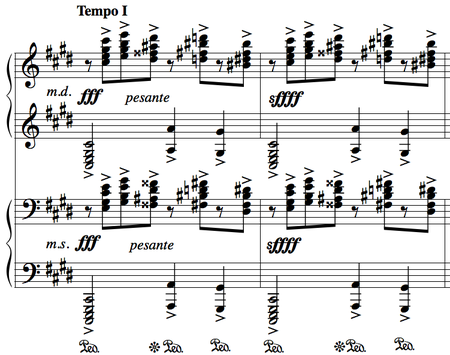
4 staves? Jesus…











 bleatmop
 Mystro


 Dead Wild Roses
Your opinions…