
You are currently browsing the category archive for the ‘Music’ category.
 The CBC Signature Series is hosted by Paolo Pietropaolo.
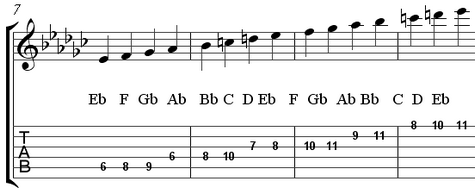
The E♭ (E-flat) minor scale consists of the pitches E♭, F, G♭, A♭, B♭, C♭, and D♭. In the harmonic minor, the D♭ is raised to D♮. Its key signature consists of six flats (see below: Scales and keys).
Its relative major is G-flat major, and its parallel major is E-flat major. Its enharmonic equivalent is D-sharp minor. Changes needed for the melodic and harmonic versions of the scale are written in with accidentals as necessary.
Despite the key rarely being used in orchestral music other than to modulate, it is encountered in a small fraction of keyboard music, and has been most popular in Russian pieces. For orchestration of piano music, some theorists recommend transposing to D minor or E minor.
This key is often popular with jazz or blues influenced keyboard players as, using all the black keys along with the A, it allows for an easily playable blues scale.
 In Book 1 of The Well-Tempered Clavier by Johann Sebastian Bach, Prelude No. 8 is written in E-flat minor while the following Fugue is written in D-sharp minor. In Book 2, both movements are in D-sharp minor.
One of the few symphonies written in this key is Prokofiev’s Symphony No. 6. A few other less well-known Soviet composers also wrote symphonies in this key, such as Andrei Eshpai, Janis Ivanovs (fourth symphony Atlantis, 1941), Ovchinnikov and Nikolai Myaskovsky. Aram Khachaturian wrote his Toccata in E-flat minor while studying under Myaskovsky.
It is also the key in which Dmitri Shostakovich composed his final string quartet.
Alexander Scriabin’s Prelude No. 14 from his 24 Preludes, Op. 11, is in E Flat Minor.
Sergei Rachmaninoff’s Elegie, Op. 3, No. 1, is in E-flat minor, as is his Étude-Tableau, Op. 39, No. 5. These pieces are noted for being dark and mysterious (a characteristic of this key), as shown even in the later jazz compositions “‘Round Midnight” and “Take Five”, which are also in the key.
Oskar Bohme’s Trumpet Sextet, Op. 30 is written in E-flat minor.
The extended orchestral introduction to Part II Gustav Mahler’s Eighth Symphony is in E-flat minor, as is the dark orchestral introduction to Beethoven’s only oratorio, Christ on the Mount of Olives. Jazz composer Thelonious Monk’s most famous composition, ‘Round Midnight is in E-flat minor.
Guitarist Yngwie Malmsteen has composed a number of pieces in E-flat minor, including the Concerto Suite for Electric
The CBC Signature Series hosted by Paolo Pietropaolo forges on with A-flat major.
A little bit more on A-flat major from Wikipedia:
The A-flat major scale consists of the pitches A♭, B♭, C, D♭, E♭, F, and G. Its key signature has four flats (see below: Scales and keys).
Its relative minor is F minor, and its parallel minor is A-flat minor.
It was used quite often by Franz Schubert; twenty-four of Frédéric Chopin‘s piano pieces[quantify] are in A-flat major, more than any other key.
Beethoven chose A-flat major as the key of the slow movement for most of his C minor works, a practice which Anton Bruckner imitated in his first two C minor symphonies and also Antonín Dvořák in his only C minor symphony.
Since A-flat major was not often chosen as the main key for orchestral works of the 18th Century, passages or movements in the key often retained the timpani settings of the preceding movement. For example, Beethoven’s Symphony No. 5 in C minor has the timpani set to C and G for the first movement. With hand tuned timpani, there is no time to retune the timpani to A-flat and E-flat for the slow second movement in A-flat; accordingly, the timpani in this movement are reserved for the passages in C major. In Bruckner’s Symphony No. 1 in C minor, however, the timpani are retuned between the first movement in C minor and the following in A-flat major.
Charles-Marie Widor considered A-flat major to be the second best key for flute music.[1]
Sir Edward Elgar‘s Symphony No. 1 in A-flat major is probably the best-known symphony in that key in the standard orchestral repertoire.[citation needed] However, Arnold Bax‘s 7th Symphony is also in the same key.
A-flat major was the flattest major key to be used in the keyboard and piano sonatas of Domenico Scarlatti, Joseph Haydn and Ludwig van Beethoven, with each of them using the key for two sonatas: Scarlatti’s K. 127 and K. 130, Haydn’s Hob XVI 43 and 46, and Beethoven’s Op. 26 and Op. 110, while Franz Schubert used it for one piano sonata. It was also the flattest major key to be used for the preludes and fugues in Johann Sebastian Bach‘s Well-Tempered Klavier, as flatter major keys were notated as their enharmonic equivalents.
Felix Mendelssohn, Johann Nepomuk Hummel, John Field, and Friedrich Kalkbrenner each wrote one piano concerto in A-flat (Mendelssohn’s being for two pianos); they had the horns and trumpet tuned to E-flat. Max Bruch‘s Concerto for Two Pianos in A-flat minor has its last movement in A-flat major, which is the parallel major; this concerto plays with the contrast between the two keys.
Works for stringed instruments in this key include Antonin Dvorak‘s String Quartet No. 14 and Benjamin Godard‘s Violin Sonata No. 4.
This space usually hosts a classical selection of music that I find appealing in one way another. But the genesis of today’s video lies in the dark sorcery better known as the CD wallet the resides in my car. As I was driving to my voice lesson I was perturbed at the distinct lack of musical profundity playing on CBC radio 2 Drive and at a red light I grabbed my trusty musical dark-side and flipped over to a CD labelled the Best of NIN.
“Hmm”, I thought to myself, “I haven’t listened to NIN like in FOREVER. Thus, in went NIN and out came the lovely baroque trio that I had been listening to ( La Gamme Et Autre Morceaux De Symphonie ). Anyhow…
I got to the second last track and boom, the rock-out started. Steering wheel tapping, head nodding, singing-along goodness that made the wait in traffic come quickly to end, saddening me slightly as there was more raw tuneage to listen to.
More about the song now, “Only”, like many NIN tunes has a distinct anti-religious message along with being able to easily rock out to, and that makes me happy.
The base 10 anniversaries are always important. :) Stravinsky’s Rite of Spring debuted 100 years ago today. Enjoy his music visualized by Stephen Malinowski and the info from Wikipedia.
Part I: The Adoration of the Earth
The opening melody is played by a solo bassoon in a very high register, which renders the instrument almost unidentifiable;[116] gradually other woodwind instruments are sounded and are eventually joined by strings.[117] The sound builds up before stopping suddenly, Hill says, “just as it is bursting ecstatically into bloom”. There is then a reiteration of the opening bassoon solo, now played a semitone lower.[118]
The first dance, “Augurs of Spring”, is characterised by a repetitive stamping chord in the horns and strings, based on E-flat superimposed on an triad of E, G-sharp and B.[119] White suggests that this bitonal combination, which Stravinsky considered the focal point of the entire work, was devised on the piano, since the constituent chords are comfortable fits for the hands on a keyboard.[120] The rhythm of the stamping is disturbed by Stravinsky’s constant shifting of the accent, on and off the beat,[121] before the dance ends in a collapse, as if from exhaustion.[117] The “Ritual of Abduction” which follows is described by Hill as “the most terrifying of musical hunts”.[122] It concludes in a series of flute trills that usher in the “Spring Rounds”, in which a slow and laborious theme gradually rises to a dissonant fortissimo, a “ghastly caricature” of the episode’s main tune.[117]
Brass and percussion predominate as the “Ritual of the Rival Tribes” begins. A tune emerges on tenor and bass tubas, leading after much repetition to the entry of the Sage’s procession.[117] The music then comes to a virtual halt, “bleached free of colour” (Hill),[123] as the Sage blesses the earth. The “Dance of the Earth” then begins, bringing Part I to a close in a series of phrases of the utmost vigour which are abruptly terminated in what Hill describes as a “blunt, brutal amputation”.[124]
Part II: The Sacrifice
Part II has a greater cohesion than its predecessor. Hill describes the music as following an arc stretching from the beginning of the Introduction to the conclusion of the final dance.[124] Woodwind and muted trumpets are prominent throughout the Introduction, which ends with a number of rising cadences on strings and flutes. The transition into the “Mystic Circles” is almost imperceptible; the main theme of the section has been prefigured in the Introduction. A loud repeated chord, which Berger likens to a call to order, announces the moment for choosing the sacrificial victim. The “Glorification of the Chosen One” is brief and violent; in the “Evocation of the Ancestors” that follows, short phrases are interspersed with drum rolls. The “Ritual Action of the Ancestors” begins quietly, but slowly builds to a series of climaxes before subsiding suddenly into the quiet phrases that began the episode.[117]
The final transition introduces the “Sacrificial Dance”. This is written as a more disciplined ritual than the extravagant dance that ended Part I, though it contains some wild moments, with the large percussion section of the orchestra given full voice. Stravinsky had difficulties with this section, especially with the final bars that conclude the work. The abrupt ending displeased several critics, one of whom wrote that the music “suddenly falls over on its side”. Stravinsky himself referred to the final chord disparagingly as “a noise”, but in his various attempts to amend or rewrite the section, was unable to produce a more acceptable solution.[79]
| 1 | Introduction |
Introduction | |
| 2 | Les Augures printaniers | Augurs of Spring | The celebration of spring begins in the hills, with pipers piping and young men telling fortunes. |
| 3 | Jeu du rapt | Ritual of Abduction | An old woman enters and begins to foretell the future. Young girls arrive from the river, in single file. They begin the “Dance of the Abduction”. |
| 4 | Rondes printanières | Spring Rounds | The young girls dance the Khorovod, the “Spring Rounds”. |
| 5 | Jeux des cités rivales | Ritual of the Rival Tribes | The people divide into two groups in opposition to each other, and begin the “Ritual of the Rival Tribes”. |
| 6 | Cortège du sage: Le Sage | Procession of the Sage: The Sage | A holy procession leads to the entry of the wise elders, headed by the Sage who brings the games to a pause and blesses the earth. |
| 7 | Danse de la terre | Dance of the Earth | The people break into a passionate dance, sanctifying and becoming one with the earth. |
|
Part II: Le Sacrifice (The Sacrifice)[9] |
|||
|---|---|---|---|
| 8 | Introduction |
Introduction | |
| 9 | Cercles mystérieux des adolescentes | Mystic Circles of the Young Girls | The young girls engage in mysterious games, walking in circles. |
| 10 | Glorification de l’élue | Glorification of the Chosen One | One of the young girls is selected by fate, being twice caught in the perpetual circle, and is honoured as the “Chosen One” with a marital dance. |
| 11 | Evocation des ancêtres | Evocation of the Ancestors | In a brief dance, the young girls invoke the ancestors. |
| 12 | Action rituelle des ancêtres | Ritual Action of the Ancestors | The Chosen One is entrusted to the care of the old wise men. |
| 13 | Danse sacrale (L’Elue) | Sacrificial Dance | The Chosen One dances to death in the presence of the old men, in the great “Sacrificial Dance”. |
Shall I compare thee to a Summer’s Day. Just finished singing this in choir, great piece and as usual, the tenor part is the hardest.. :)
Love it it or hate it, Bolero is a fine piece of music. I try and post work that make me stop what I’m doing and just listen. This performance by Hong Kong’s Orchestra did just that. Enjoy :)











 bleatmop
 Mystro
 The Arbourist


 Dead Wild Roses
Your opinions…