
You are currently browsing the category archive for the ‘Philosophy’ category.
In a culture that mistakes comfort for flourishing and validation for character, Stoicism returns us to a harder and older truth: the sole good is virtue. Everything else—wealth, health, reputation, even life itself—is ultimately indifferent.
The Stoics inherited from Socrates and Plato the four cardinal virtues and declared them jointly sufficient for eudaimonia (the Greek term for the only life genuinely worth living). They are:
1. Wisdom (phronēsis)
The knowledge of what is truly good, bad, and neither.
Wisdom is not cleverness or data accumulation—it is the steady ability to judge correctly in concrete circumstances. Without wisdom, every other virtue collapses into blind habit, impulsiveness, or self-deception.
2. Courage (andreia)
Not the absence of fear but the disciplined refusal to let fear govern action.
Stoic courage shows itself in the quiet endurance of chronic pain, in speaking truth to power, in confronting injustice, and in facing death without hysteria or despair.
3. Justice (dikaiosynē)
The social virtue par excellence: giving every person what is owed—including those we dislike.
Justice expresses itself as honesty, fairness, kindness, and civic responsibility. A life without justice is predatory even when outwardly respectable.
4. Temperance (sōphrosynē)
Mastery of appetite and impulse.
Temperance is the power to say “this is enough” when desire—whether for food, sex, status, stimulation, or outrage—demands more. Without temperance, genuine freedom is impossible.
Why These Four Alone Matter
The Stoics argued, and lived, a radical proposition: virtue is both necessary and sufficient for the good life. External goods can be stripped away in an afternoon—Zeno’s fortune confiscated in Cyprus, Seneca and Epictetus exiled by Rome, Marcus Aurelius’s children taken by disease—yet none of these losses corrupted their character.
Their serenity, dignity, and usefulness endured because their excellence depended on nothing outside their prohairesis, their moral and rational faculty.
In this sense, Stoicism is not ancient self-help but a philosophical engineering of the soul.
Modern Evidence Confirms the Ancient Claim
Long-term psychological research repeatedly finds that the best predictors of life satisfaction, longevity, and emotional stability are not wealth, fame, or intelligence but traits that map directly onto the Stoic virtues:
- Conscientious self-control → temperance
- Warm, dependable relationships → justice
- Resilience under stress → courage
- Reflective, accurate judgment → wisdom
The Grant Study, the Terman cohort, and the Harvard Study of Adult Development all converge on a simple conclusion: character, not circumstance, is the foundation of lasting well-being.
How to Train the Virtues Today
You don’t “add” virtue like a supplement. You train it the way an athlete trains muscle: through deliberate, repeated action under resistance.
Wisdom
- Keep a decision journal.
- Each night ask: “Where did I misjudge good and bad today?”
- Test impressions against reason, not emotion.
Courage
- Practice voluntary discomfort: public speaking, difficult conversations.
- Fear shrinks when approached, not avoided.
Justice
- Use the dichotomy of roles. In every interaction ask: “What does my role as human being, citizen, parent, or colleague require?”
- Then do it, regardless of mood.
Temperance
- Set bright-line rules: no phone in the first hour of the day, one plate of food, no gossip.
- Desire obeys precedent.
Progress in Stoicism is measured not by emotional uplift but by this single question:
“Would I act the same way if no one ever found out and the outcome were guaranteed to be unpleasant?”
Virtue is revealed in what you do when excellence is costly.
Master these four virtues and you will lack nothing essential. Neglect them, and no wealth, therapy, or acclaim will save you from living a hollow life. This is not ancient opinion. It is observable, repeatable fact.

References
- George E. Vaillant, Triumphs of Experience: The Men of the Harvard Grant Study (Harvard University Press, 2012).
- Lewis Terman et al., Genetic Studies of Genius (Stanford University Press, 1925–1959).
- Robert Waldinger & Marc Schulz, The Good Life: Lessons from the World’s Longest Scientific Study of Happiness (Simon & Schuster, 2023).
- Julia Annas, The Morality of Happiness (Oxford University Press, 1993) — for classical virtue ethics and Stoic moral psychology.
- A.A. Long, Hellenistic Philosophy (University of California Press, 1986).
- Massimo Pigliucci, How to Be a Stoic (Basic Books, 2017) — modern interpretation and practice.
Glossary of Key Terms
Eudaimonia — A flourishing or fully realized human life; more than happiness, closer to “living excellently.”
Phronēsis — Practical wisdom; the ability to judge rightly.
Andreia — Courage; the discipline of confronting fear and difficulty.
Dikaiosynē — Justice; moral and social responsibility toward others.
Sōphrosynē — Temperance; self-mastery and moderation.
Prohairesis — The rational, moral faculty that governs choice and intention in Stoic psychology.
Indifferents — External conditions (health, wealth, status) that are neither good nor bad in themselves.
The Stoics taught that excess corrupts both the soul and the body politic. Seneca warned that chasing boundless expansion courts ruin — true prosperity lies not in defiance of limits, but in living in accordance with nature’s measure. Marcus Aurelius similarly counseled restraint, urging us to act within the bounds of reason and accept the limits placed upon us. Applied to governance, this means a nation — like an individual — must assess its capacities before inviting more mouths to the table.
Canada’s recent immigration trajectory betrayed this principle. In 2023, the country added more than 1.27 million people — an annual growth rate of roughly 3.2 percent, driven overwhelmingly by international migration. (Statistics Canada) Over just a few years, the population climbed from under 39 million to over 41 million.
For years, permanent-resident targets hovered near 500,000, and temporary resident classes — students, workers, etc. — swelled. By 2025, however, disturbing strains were showing: housing shortages, rent and price inflation, pressure on health services, and signs of wage stress.
These were not speculative risks. Empirical analyses from bodies such as the Bank of Canada and CMHC correlate rapid population inflows with housing-market pressure. Public opinion followed suit. By late 2025, polling indicated that nearly two-thirds of Canadians considered even the then-reduced target for permanent residents (395,000) too high; roughly half held consistently negative views on immigration, not out of xenophobia, but from perceived stress on infrastructure and housing.
Recognizing this, Ottawa has begun to recalibrate. In its 2025–2027 Immigration Levels Plan, released publicly, the government committed to 395,000 permanent residents in 2025, then reducing to 380,000 in 2026 and 365,000 in 2027. (Canada) Even more significantly, temporary resident targets dropped: from 673,650 new TRs in 2025 to 516,600 in 2026, with further moderation planned. (Canada)
The demographic effects are already materializing. As of mid-2025, Canada’s estimated population growth slowed to 0.9 percent year-over-year, according to RBC Economics, with non-permanent residents making up a smaller share. (RBC) This slowdown itself validates the Stoic critique of overreach — a moment of reckoning for policy driven by expansion rather than equilibrium.
This retreat is welcome, but it remains reactive. From a Stoic perspective, reactive virtue is still virtue, but prudence demands more: a wisdom that designs policy proactively, not merely corrects after crisis. A Stoic polity would have matched immigration flows to real, measurable capacity long ago — gauging housing pipelines, healthcare strain, wage effects, and social cohesion.
Immigration in moderation enriches: it brings talent, innovation, and human flourishing. But unmoored from institutional capacity, it sows fragility, inequality, and resentment.
Going forward, Canada needs to institutionalize sophrosyne — the classical virtue of temperance and self-mastery. Targets should be set not by political fantasy or corporate lobbying, but by clear metrics: housing completions, per-capita infrastructure strain, healthcare wait-lists, and social stability.
The recent dialing back is a start. But true Stoic governance demands that moderation becomes a structural norm, not just a temporary correction. Only then can the polity live in accord with nature — virtuous, resilient, and enduring.

References
- Government of Canada, 2025–2027 Immigration Levels Plan. Permanent resident targets: 395,000 (2025), 380,000 (2026), 365,000 (2027). (Canada)
- Canada.ca, Government of Canada reduces immigration. Temporary resident reductions, projected decline in temporary population by 445,901 in 2025. (Canada)
- RBC Economics, Canada’s population growth slows… — mid-2025 year-over-year growth of 0.9%, share of non-permanent residents falling. (RBC)
- Statistics Canada, Population estimates, Q4 2024. International migration accounted for 98.5% of growth in Q4 2024. (Statistics Canada)
- CIC News, 2026-2028 Immigration Levels Plan will include new measures… — TR targets for 2026: 385,000 quoted, among other reductions. (CIC News)
- CIBC Thought Leadership, Population-growth projections… — analysis of visa expiry, outflows, and the challenge of non-permanent resident accounting. (cms.thoughtleadership.cibc.com)
Glossary of Key Terms
| Term | Meaning / Explanation |
|---|---|
| Sophrosyne | A classical Greek virtue (especially important to Stoics): moderation, temperance, self-control, and harmony with nature. In this context, it means setting immigration policy in proportion to real capacity. |
| Non-Permanent Resident (NPR) | Individuals in Canada on temporary visas: students, temporary foreign workers, etc. Not permanent residents or citizens. |
| Permanent Resident (PR) | Someone who has been granted permanent residency in Canada: not a citizen yet, but has the right to live and work permanently. |
| Levels Plan / Immigration Levels Plan | The Canadian government’s multi-year plan setting targets for new permanent and temporary immigrant admissions. |
| Absorptive Capacity | The realistic capacity of a country (or region) to accommodate newcomers without undue strain: infrastructure, housing, healthcare, labour market, social services. |
| Reactive Virtue vs. Proactive Wisdom | In Stoic terms: responding wisely after the fact (reactive) is good, but better is anticipating and designing policy with foresight (proactive). |
In the Stoic tradition, Marcus Aurelius reminds us in Meditations that the soul finds balance not by bending the world to its desires, but by living in harmony with the rational order that shapes it. Both essays—The Scales of Society and The Horseshoe’s Convergence—speak powerfully to this truth. When we trade reality for utopian dreams, we don’t advance; we regress. Realism, seen through a Stoic lens, is the practice of knowing what’s within our control—our judgments, our virtues—and what isn’t: the stubborn facts of nature and history. To pursue idealism as if the world must yield to our will is to fight against nature itself. Epictetus would call this a form of slavery to externals—an endless, exhausting battle to remake what cannot be remade. The metaphors of the scale and the curve become lessons in humility, urging us to weigh our convictions not by how righteous they feel, but by how true they are.
The danger of extremes, as both essays show, comes from losing that grounding in reality. The far left and far right don’t meet by coincidence; they curve toward each other under the same gravitational pull of unchecked passion over reason. Stoicism teaches that the will, when misdirected, can turn virtue into vice. The search for purity—whether egalitarian or hierarchical—often becomes self-righteousness, and self-righteousness turns easily into cruelty. Seneca warned that anger devours its host first, and here we see that on a societal scale: politics consumed by outrage, discourse replaced by denunciation, and myth elevated over evidence. The “horseshoe” is more than a metaphor—it’s a mirror reflecting our inner collapse when moral certainty replaces humility. The more we cling to our certitudes, the less we see of truth. In that blindness, we reproduce the very coercion we claim to oppose. Stoicism reminds us that true power is never about conquering others—it’s about mastering our own thoughts and reactions.
Yet the Stoic path is not one of despair but of quiet renewal. We can rebuild the crossbar of realism through daily discipline—by anchoring ourselves in what is, not what we wish would be. As the essays conclude, tolerance doesn’t survive through ideological victory but through shared respect for evidence and for limits. That’s a civic form of amor fati—a love of fate—that turns polarization into friction that sharpens rather than burns. When we learn to accept what’s beyond our control and focus on the integrity of our own actions, the scales find balance again, the horseshoe stays open, and reason’s republic endures. Not by force, and not by fury, but by quiet fidelity to the logos that connects us all.

(TL;DR) Eric Voegelin’s The New Science of Politics remains one of the clearest guides to our modern disorder. It teaches that when politics cuts itself off from transcendent truth, ideology fills the void—and history descends into Gnostic fantasy. Voegelin’s remedy is not new revolution but ancient remembrance: the recovery of the soul’s openness to reality.
Eric Voegelin (1901–1985) was an Austrian-American political philosopher who sought to diagnose the spiritual derangements of modernity. In his 1952 classic The New Science of Politics—first delivered as the Walgreen Lectures at the University of Chicago—Voegelin proposed that politics cannot be understood as a merely empirical or procedural science. Power, institutions, and law arise from a deeper spiritual ground: humanity’s participation in transcendent order. When societies lose awareness of that participation, they fall into ideological dreams that promise salvation through human effort alone. The book is therefore both a critique of modernity and a call to recover the classical and Christian understanding of political reality (Voegelin 1952, 1–26).
1. The Loss of Representational Truth
Every stable society, Voegelin argued, “represents” its members within a larger order of being. In ancient civilizations and medieval Christendom, political authority symbolized this participation through myth, ritual, and law that acknowledged a reality beyond human control. The ruler was not a god but a mediator between the temporal and the eternal.
Beginning in the twelfth century, however, the monk Joachim of Fiore reimagined history as a self-unfolding divine drama in which humanity itself would bring about the final age of perfection. With this shift, Western consciousness began to “immanentize the eschaton”—to relocate ultimate meaning inside history rather than in its transcendent source. Out of this inversion grew the modern ideologies of progress (Comte, Hegel), revolution (Marx), and race (National Socialism), each promising earthly redemption through planning and will (Voegelin 1952, 107–132).
For Voegelin, the loss of representational truth meant that governments no longer reflected humanity’s place in divine order but instead projected utopian images of what they wished reality to be. Politics ceased to be the articulation of truth and became the engineering of salvation.
2. Gnosticism as the Modern Disease
Voegelin identified the inner structure of these movements as Gnostic. Ancient Gnostics sought hidden knowledge that would liberate the soul from an evil world; their modern successors, he said, sought knowledge that would liberate humanity from history itself. “The essence of modernity,” Voegelin wrote, “is the growth of Gnostic speculation” (1952, 166).
He listed six recurrent traits of the Gnostic attitude:
- Dissatisfaction with the world as it is.
- Conviction that its evils are remediable.
- Belief in salvation through human action.
- Assumption that history follows a knowable course.
- Faith in a vanguard who possess the saving knowledge.
- Readiness to use coercion to realize the dream.
From medieval millenarian sects to twentieth-century totalitarian states, these traits form a single continuum of spiritual rebellion: the attempt to perfect existence by abolishing its limits.
3. The Open Soul and the Pathologies of Closure
Against the Gnostic impulse stands the open soul—the philosophical disposition that accepts the “metaxy,” or the in-between nature of human existence. We live neither wholly in transcendence nor wholly in immanence, but within the tension between them. The philosopher’s task is not to resolve that tension through fantasy or reduction but to dwell within it in faith and reason.
Political science, therefore, must be noetic—concerned with insight into the structure of reality—not merely empirical. A society’s symbols, institutions, and laws can be judged by how faithfully they articulate humanity’s participation in divine order. Disorder, Voegelin warned, begins not with bad policy but with pneumopathology—a sickness of the spirit that refuses reality’s truth. “The order of history,” he wrote, “emerges from the history of order in the soul.”
Empirical data can measure economic growth or electoral results, but it cannot measure spiritual health. That requires awareness of being itself.
4. Liberalism’s Vulnerability and the Way of Recovery
Voegelin saw liberal democracies as historically successful yet spiritually precarious. By reducing political order to procedural legitimacy and rights management, liberalism risks drifting into the nihilism it opposes. When public life forgets its transcendent foundation, freedom degenerates into relativism, and pluralism becomes mere fragmentation.
Still, Voegelin’s outlook was not despairing. His proposed remedy was anamnesis—the recollective recovery of forgotten truth. This is not nostalgia but awakening: the rediscovery that human beings are participants in an order they did not create and cannot abolish. The recovery of the classic (Platonic-Aristotelian) and Christian understanding of existence offers the only durable antidote to ideological apocalypse (Voegelin 1952, 165–190).
To “keep open the soul,” as Voegelin put it, is to resist every movement that promises paradise through force or theory. The alternative is the descent into spiritual closure—an ever-recurring temptation of modernity.
5. Contemporary Resonance
Voegelin’s analysis remains uncannily prescient. Today’s ideological battles—whether framed around identity, technology, or climate—often echo the same Gnostic pattern: discontent with the world as it is, belief that perfection lies just one policy or re-education campaign away, and impatience with reality’s resistance. The post-modern conviction that truth is socially constructed continues the old dream of remaking existence through will and language.
Voegelin’s warning cuts through our century as clearly as it did the last: when politics replaces truth with narrative and transcendence with activism, society repeats the ancient heresy in secular form. The cure, as ever, is humility before what is—the recognition that order is discovered, not invented.
References
Voegelin, Eric. 1952. The New Science of Politics: An Introduction. Chicago: University of Chicago Press.
Hughes, Glenn. 2003. Transcendence and History: The Search for Ultimacy from Ancient Societies to Postmodernity. Columbia: University of Missouri Press.
Sandoz, Ellis. 1981. The Voegelinian Revolution: A Biographical Introduction. Baton Rouge: Louisiana State University Press.
Glossary of Key Terms
Anamnesis – Recollective recovery of forgotten truth about being.
Gnosticism – Revolt against the tension of existence through claims to saving knowledge that masters reality.
Immanentize the eschaton – To locate final meaning and salvation within history rather than beyond it.
Metaxy – The “in-between” condition of human existence, suspended between immanence and transcendence.
Noetic – Pertaining to intellectual or spiritual insight into reality’s order.
Pneumopathology – Spiritual sickness of the soul that closes itself to transcendent reality.
Representation – The symbolic and political articulation of a society’s participation in transcendent order.
Hannah Arendt’s portrait of Adolf Eichmann as a thoughtless bureaucrat lingers as a caution against evil’s mundane guise. Christopher Browning’s Ordinary Men extends this indictment, trading Eichmann’s desk for the blood-soaked forests of Poland, where Reserve Police Battalion 101—500 Hamburg ‘everymen’—executed 39,000 Jews and deported 44,000 more to Treblinka in 1942-43. These were no zealots: middle-aged draftees, family men untouched by Nazi fervor, yet they pulled triggers with grim efficiency. Browning’s forensic reconstruction from postwar trials complements Arendt, illuminating how conformity, not conviction, forges complicity. In an age of ideological silos, their story warns that thoughtlessness scales from individual abdication to collective carnage.
Arendt diagnosed Eichmann’s evil as a failure to think—to judge actions against universal humanity—yielding obedience’s autopilot. Browning operationalizes this in RPB 101’s crucible. On July 13, 1942, in Józefów, Major Trapp’s order to slaughter 1,800 innocents included an opt-out: a dozen stepped forward, fathers haunted by their own children’s faces. The rest? They fired, vomited, and fired again, bound not by hatred but by the group’s inexorable pull. Peer pressure proved the deadliest weapon: to demur meant isolation, whispers of cowardice, or worse—standing alone amid the splatter of brains and pleas. As Browning dissects, “binding factors” like deference to authority and aversion to shame radicalized the reluctant. Initial nausea faded into routine; Jews devolved from neighbors to “bandits,” their deaths logged as quotas met. This mirrors Arendt’s “banality”: not demonic intent, but the quiet erosion of moral agency, where thinking cedes to fitting in.
Browning’s men prefigure Arendt’s broader fear—that totalitarianism thrives on unreflective masses. Unlike Eichmann’s abstracted ledgers, these policemen confronted the visceral: a mother’s wail, a child’s gaze. Yet empathy atrophied through diffusion—blame smeared across the chain of command—and progressive desensitization. A few resisted, sabotaging hunts or feigning illness, their conscience a fragile bulwark against the tide. Most drifted, careerism and alcohol dulling the sting. Browning invokes social experiments like Milgram’s obedience studies, positing such dynamics as human universals, not German pathologies—a riposte to claims of cultural exceptionalism.
This convergence sharpens lessons for our fractured present, where critical constructivism and woke Marxism summon conformity’s specter. Critical constructivism, an epistemological framework that treats knowledge as socially mediated and entwined with power—rejecting empirical objectivity for interpretive lenses shaped by culture and positionality—echoes RPB 101’s euphemisms, recasting dissent as dominance while evidence bows to constructed narratives. Proponents propagate without pause, their deference to “lived experience” a peer-enforced gag on Socratic probe. Woke Marxism, a repackaged Marxism applying class struggle to identity oppressions—framing queer theory as “gender Marxism” and intersectionality as “identity Marxism”—amplifies this through performative allegiance. Its rituals—DEI oaths, cancellation tribunals—demand uncritical adherence, sidelining judgment for allegiance, much as Trapp’s men traded qualms for camaraderie. Ordinary adherents comply, not from malice, but inertia: promotions hinge on nods, ostracism on silence.
Arendt and Browning converge on the antidote: reclaim thinking as defiant praxis. In algorithm-curated echo chambers, where ideologies brook no fracture, epistemic humility—questioning, pluralizing, judging—arrests the slide. Thoughtlessness is choice, not fate; conformity’s shadow lifts only through vigilant reflection. Honor the dead of Józefów not with memorials alone, but by fortifying the ordinary against atrocity’s call. Goodness demands depth; evil preys on the shallow. In choosing to think, we dismantle the battalion within.
References
Arendt, H. (1963). Eichmann in Jerusalem: A Report on the Banality of Evil. New York: Viking Press. (Primary source for the concept of the banality of evil and its philosophical underpinnings.)
Browning, C. R. (1992). Ordinary Men: Reserve Police Battalion 101 and the Final Solution in Poland. New York: HarperCollins. (Core historical analysis based on postwar judicial testimonies, detailing the battalion’s actions and psychological dynamics.)
Dead Wild Roses. (2025, August 25). “Unraveling the Roots—How ‘Woke’ Emerges from Social Construction.” https://deadwildroses.com/2025/08/25/unraveling-the-roots-how-woke-emerges-from-social-construction/. (Defines critical constructivism via Kincheloe’s assumptions, linking it to woke epistemology and power-mediated knowledge.)
Dead Wild Roses. (2022, April 6). “Queer Theory is Gender Marxism – James Lindsay.” https://deadwildroses.com/2022/04/06/20651/. (Critiques woke Marxism as repackaged identity-based Marxism, drawing on Lindsay’s analysis of queer theory and intersectionality.)
Goldhagen, D. J. (1996). Hitler’s Willing Executioners: Ordinary Germans and the Holocaust. New York: Alfred A. Knopf. (Contrasting thesis on German antisemitism, referenced by Browning to highlight universal rather than cultural explanations.)
Hilberg, R. (1961). The Destruction of the European Jews. Chicago: Quadrangle Books. (Foundational Holocaust scholarship on the “short, intense wave of mass murder” in 1942, informing Browning’s timeline.)
Milgram, S. (1963). “Behavioral Study of Obedience.” Journal of Abnormal and Social Psychology, 67(4), 371–378. https://doi.org/10.1037/h0040525. (Seminal experiment on authority compliance, invoked by Browning to explain diffusion of responsibility in RPB 101.)
Trunk, I. (1972). Judenrat: The Jewish Councils in Eastern Europe Under Nazi Occupation. New York: Macmillan. (Contextual background on Jewish councils’ coerced roles, paralleling themes of complicity under duress.)
Before we can decide what is right, we must first know what is true. Yet our culture increasingly reverses this order, making moral conviction the starting point of thought rather than its conclusion. Peter Boghossian, the philosopher best known for challenging ideological thinking in academia, once argued that epistemology must precede ethics. The claim sounds abstract, but it describes a very practical problem: when we stop asking how we know, we lose the capacity to judge what’s right.
Epistemology—the study of how we know what we know—deals with questions of evidence, justification, and truth. It asks: What counts as knowledge? How do we tell when a belief is warranted? What standards should guide our acceptance of a claim? Ethics, by contrast, deals with what we should do, what is good, and what is right. The two are inseparable, but they are not interchangeable. Ethics without epistemology is like navigation without a compass: passionate, determined, and directionless.
The Missing First Question
Socrates, history’s first great epistemologist, spent his life asking not “What is right?” but “How do you know?” In dialogues like Euthyphro, he exposes the instability of moral conviction built on unexamined belief. When his interlocutor claims to know what “piety” is because the gods approve of it, Socrates presses: Do the gods love the pious because it is pious, or is it pious because the gods love it? In that moment, ethics collapses into epistemology—the question of truth must be settled before morality can stand.
This ordering of inquiry—first truth, then virtue—was not mere pedantry. Socrates saw that unexamined moral certainty leads to cruelty, because it allows one to justify any act under the banner of righteousness. He was eventually executed by men convinced they were defending moral order. His death, paradoxically, vindicated his philosophy: without the discipline of knowing, moral zealotry becomes indistinguishable from moral error.
Why Epistemology Matters
Epistemology is not a luxury for philosophers; it is the foundation of all responsible action. It demands that we distinguish between evidence and wishful thinking, between understanding and propaganda. To have a sound epistemology is to have habits of mind—skepticism, curiosity, proportion, humility—that protect us from self-deception.
When those habits decay, moral reasoning falters. Consider the Salem witch trials. The judges sincerely believed they were protecting their community from evil, yet their evidence—dreams, hearsay, spectral visions—was epistemically bankrupt. Their moral horror was real; their epistemic standards were not. The result was ethical disaster.
We see similar failures today whenever moral conviction outruns verification. A viral video circulates online; a crowd declares guilt before facts emerge. Outrage replaces investigation. The moral fervor feels righteous because it’s anchored in empathy or justice—but its epistemic foundation is sand. Ethical action requires knowing what actually happened, not what we wish had happened.
When Knowing Guides Doing
When epistemology is sound, ethics becomes coherent, fair, and humane.
Take the principle “innocent until proven guilty.” It is not primarily a moral rule; it is an epistemic one. It asserts that belief in guilt must be justified by evidence before punishment can be ethically administered. That epistemic restraint is what makes justice possible.
The same holds true in science. Before germ theory, doctors believed disease arose from “bad air,” leading them to act ethically—by their lights—yet ineffectively. Once scientific evidence clarified the true cause of infection, moral duties became clearer: sterilize instruments, wash hands, protect patients. Knowledge refined morality. Sound epistemology made better ethics possible.
John Stuart Mill saw this dynamic as essential to liberty. In On Liberty, he wrote that “he who knows only his own side of the case knows little of that.” Mill’s insight is epistemological but its consequences are ethical: humility in belief breeds tolerance in practice. A society that cultivates open inquiry and debate is not merely more intelligent—it is more moral. For Mill, the freedom to question was not just an intellectual right but a moral obligation to prevent the tyranny of false certainty.
The Modern Inversion: Ethics Before Epistemology
Boghossian’s warning is timely because modern culture tends to invert the proper order. Many moral debates now begin not with questions of truth but with declarations of allegiance—what side are you on? The epistemic virtues of skepticism, evidence, and debate are recast as moral vices: to question a prevailing narrative is “denialism,” to request evidence is “harmful,” to doubt is “bigotry.”
The result is a moral discourse unanchored from truth. People act with conviction but without comprehension, certain of their goodness yet blind to their errors. Boghossian’s point is not that ethics are unimportant but that they cannot stand alone. If we do not first establish how we know, then our “oughts” become detached from reality, and moral judgment degenerates into moral fashion.
Hannah Arendt, reflecting on the moral collapse of ordinary Germans under Nazism, described this as the banality of evil—evil committed not from monstrous intent but from thoughtlessness. For Arendt, the failure was epistemic before it was ethical: people stopped thinking critically about what was true, deferring instead to the slogans and appearances sanctioned by authority. Their moral passivity was the fruit of epistemic surrender.
This same danger confronts us whenever ideology replaces inquiry—when images and narratives dictate belief before evidence is examined. To act justly, we must first see clearly; to see clearly, we must learn how to know.
The Cave and the Shadows
Plato’s Allegory of the Cave captures the enduring tension between knowledge and morality. Prisoners, chained since birth, mistake the shadows on the wall for reality. When one escapes and sees the sunlit world, he realizes how deep the deception ran. But when he returns to free the others, they resist, preferring the comfort of illusion to the pain of enlightenment.
We are those prisoners whenever we take appearances for truth—when we confuse social consensus with knowledge or mistake moral passion for understanding. The shadows dance vividly before us in the glow of our screens, and we feel certain we are seeing the world as it is. But unless we discipline our minds—testing claims, questioning sources, distinguishing truth from spectacle—we remain captives.
The allegory endures because it teaches that the pursuit of truth is not an abstract exercise but a moral struggle. To turn toward the light is to accept the discomfort of doubt, the humility of error, and the labor of learning. That discipline is the beginning of both knowledge and virtue.
Truth as the First Kindness
Epistemology precedes ethics because truth precedes goodness. To act ethically without first grounding oneself in what is true is to risk doing harm in the name of good. Socrates taught us to ask how we know; Mill reminded us to hear the other side; Arendt warned us what happens when we stop thinking; and Boghossian calls us back to the first principle that makes all ethics possible: the honest pursuit of truth.
In an age that rewards outrage over understanding, defending epistemology may seem quaint. Yet it is precisely our only defense against the moral chaos of a world that feels right but knows nothing.
Before we can do good, we must first be willing to know.
Truth, as it turns out, is the first kindness we owe one another.

References
- Arendt, H. (1963). Eichmann in Jerusalem: A Report on the Banality of Evil. New York: Viking Press.
- Boghossian, P. (2013). A Manual for Creating Atheists. Durham, NC: Pitchstone Publishing.
- Boghossian, P. (2006). “Epistemic Rules.” The Journal of Philosophy, 103(12), 593–608.
- Mill, J. S. (1859). On Liberty. London: John W. Parker and Son.
- Plato. (c. 380 BCE). The Republic, Book VII (The Allegory of the Cave). Translated by Allan Bloom, Basic Books, 1968.
- Plato. (c. 399 BCE). Euthyphro. In The Dialogues of Plato, translated by G.M.A. Grube. Hackett, 1981.
- Salem Witch Trials documentary sources: Salem Witch Trials: Documentary Archive and Transcription Project. University of Virginia, 2020.
- Socratic method reference: Vlastos, G. (1991). Socratic Studies. Cambridge University Press.
Author’s Reflection:
This piece was drafted with the aid of AI tools, which accelerated research and organization. Still, every idea here has been examined, rewritten, and affirmed through my own reasoning. Since the essay itself argues that epistemology must precede ethics, it seemed right to disclose the epistemic means by which it was written.
When political violence erupts, it often looks random — a lone extremist, a protest that gets out of hand, or a clash between two angry groups. But much of what we’re seeing today, in both the United States and Canada, is not random at all. It is part of a deliberate strategy that activists call dialectical warfare — and it is tearing at the heart of our democratic societies.
The assassination of Charlie Kirk and the furious conservative backlash that followed are not isolated events. They are part of a larger spiral of violence and reaction, one that radicals hope will end with the collapse of our current system. To understand how, we need to unpack an old idea: the dialectic.
What is the Dialectic?
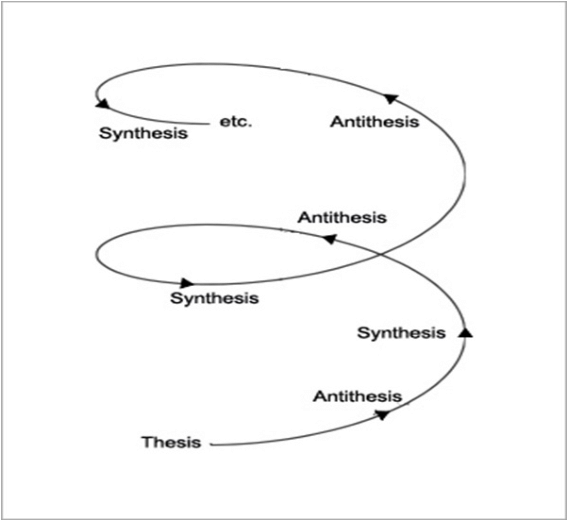
The word “dialectic” comes from philosophy, specifically the German thinker Georg Wilhelm Friedrich Hegel in the early 1800s. At its simplest, the dialectic is a way of describing how history moves forward through conflict.
- Thesis: the current system or status quo.
- Antithesis: the force that challenges it.
- Synthesis: a new system that emerges after the clash.
For Hegel, this was a way of understanding history as a story of progress. Marx later took this idea and made it the foundation of his revolutionary theory. For him, history was about class struggle: workers against capitalists. Capitalism, he argued, would eventually collapse under its contradictions and give way to communism.
The key point is this: conflict isn’t a bug in the system — it’s the engine of history.
From Philosophy to Political Activism
Fast forward to today. Many left-wing activists, consciously or not, operate with a dialectical mindset. They believe that society advances through conflict and breakdown, not peaceful debate.
That means chaos, division, and even violence can be seen as useful. If enough conflict is stirred up, the system will be forced to reveal its flaws, overreact, and eventually collapse — clearing the way for something new.
This isn’t conspiracy theory. Activist manuals, writings from radical groups, and historical revolutionary movements all share this logic. The goal is not stability. The goal is destabilization.
Dialectical Warfare Today
Dialectical warfare is what happens when activists deliberately create or amplify conflict to destabilize society. Here’s how it works in practice:
- Provocation: Protests or acts of violence designed to draw a harsh reaction.
- Overreaction: Authorities or opponents respond too aggressively, confirming the activists’ narrative.
- Crisis: The clash erodes faith in institutions and convinces people the system doesn’t work.
- Escalation: Each cycle of conflict moves society further up the spiral toward collapse.
It’s not about winning the argument. It’s about breaking the system so that something “better” (usually some form of socialist utopia) can be built on the ruins.
The Charlie Kirk Case
The recent assassination of Charlie Kirk shows this dynamic clearly. For the radical Left, the act of violence itself was a shock designed to destabilize. But what mattered more was the reaction.
Conservatives in power, outraged and furious, began employing the same tools that had once been used against them: censorship, cancel culture, and efforts to silence left-wing voices. In their anger, they began shredding the same democratic norms — free speech, due process, respect for law — that they had once fought to defend.
From the perspective of dialectical warfare, this is a victory for the radicals. The point was never just to kill one man. The point was to provoke an overreaction that would weaken the credibility of conservative leaders, make democratic institutions look fragile, and drive polarization even deeper.
Why This is Dangerous
Every time conservatives react by copying the authoritarian tactics of the Left, they confirm the radicals’ worldview. They prove that democracy is a sham, that free speech is a lie, and that the system is doomed.
This is exactly what the activist Left wants. They welcome conservative overreach, because it accelerates the collapse of the old order. The tragedy is that in fighting back, the right risks becoming what it hates: reactionary, authoritarian, and destructive of the very freedoms it claims to defend.
Lessons from History
We have seen this before. In the 20th century, totalitarian movements from Communism in Russia to fascism in Germany thrived on dialectical conflict. They used street violence, political assassinations, and manufactured crises to polarize society. Each overreaction by their opponents brought them closer to power.
The idea is seductive: “This system is broken. Only radical action can save us.” But the results are always catastrophic. Millions died under regimes that promised utopia and delivered tyranny.
A Simple Analogy
Think of democracy like a family car. It’s not perfect — sometimes it breaks down, sometimes it needs repairs. Activists practicing dialectical warfare are not trying to fix the car. They are trying to crash it on purpose, believing that after the wreck, they’ll be able to build a perfect new vehicle.
But history shows that after the crash, what you usually get is not a better car — it’s a dictatorship.
The Dialectical Spiral at Work
To make this crystal clear, here’s how activists see the spiral — and what really happens:
| Stage | Activist Left’s View | What Actually Happens |
|---|---|---|
| Provocation | Stir conflict (riots, violence, incendiary rhetoric) to expose “systemic oppression.” | Communities destabilize; trust erodes. |
| Reaction | Force conservatives into authoritarian overreach. | Free speech and rule of law weaken; institutions lose credibility. |
| Crisis | Show that democracy and capitalism can’t solve the conflict. | Cynicism deepens; polarization hardens. |
| Escalation | Push society up the spiral toward “revolution and utopia.” | Cycle repeats, leading not to utopia but greater instability. |
Why We Must Resist
The activists’ dream of a communist utopia is a fantasy that has failed every time it’s been tried. But their strategy of dialectical warfare is very real — and very effective at breaking societies apart.
The assassination of Charlie Kirk and the conservative overreaction it triggered are a warning. If we allow ourselves to be baited into authoritarian responses, we are not saving democracy — we are digging its grave.
The only way forward is to resist the spiral: to defend free speech, uphold the rule of law, and refuse to play into the radicals’ hands. Otherwise, we will all be dragged into the chaos they long for, and the freedoms that make Western society unique will vanish in the wreckage.
References
- Hegel, G.W.F. The Phenomenology of Spirit (1807).
- Marx, K. & Engels, F. The Communist Manifesto (1848).
- Arendt, H. On Violence (1970).
- Popper, K. The Open Society and Its Enemies (1945).
- Contemporary coverage: Reuters, Associated Press, Fox News (Sept. 2025) – reporting on the assassination of Charlie Kirk and ensuing political fallout.











 bleatmop
 Mystro


 Dead Wild Roses
Your opinions…