
You are currently browsing the category archive for the ‘Philosophy’ category.
There’s a low-grade feeling in the background of a lot of conversations right now that something isn’t quite working the way it used to.
Not broken. Not collapsing. Just… off.
The rules still exist. The institutions still function. On paper, everything is in place. But the sense that things are moving in the direction they claim to be moving has started to thin, and people tend to notice that long before they can explain it.
It’s difficult to point to a single cause. That’s part of why the feeling lingers. When something breaks, you can name it. When something drifts, you feel it first and only understand it later.
That unease tends to show up when the quiet constraints that keep systems stable begin to weaken.
In law, it looks like uneven enforcement. In politics, it shows up when power stops feeling like something that will eventually change hands. More generally, it appears whenever positions begin to feel fixed rather than contingent.
Most of the time, these constraints operate in the background. They don’t need to be defended constantly because they are demonstrated often enough that people take them for granted. You see rules applied. You see consequences land. You see people leave positions they once held.
That’s usually enough.
When those patterns become less consistent, the system doesn’t collapse. It adjusts. Power becomes a little less exposed, a little more predictable, but not in a reassuring way. Access narrows, not through explicit barriers, but through familiarity and repetition.
You start to see the same outcomes, or at least the same kinds of outcomes, and they become easier to anticipate.
At first, most people adapt without thinking much about it. Systems can absorb a surprising amount of this kind of drift. But the adjustment isn’t free. It changes how people relate to the system itself.
They rely on it less. They work around it more. And eventually, they stop assuming that the rules being stated are the rules that actually matter.
That shift is quiet, but it matters.
This is not an argument that the past was fair, pure, or evenly experienced. Many people never experienced the old constraints as neutral. The point is narrower. When the public no longer believes the operative rules match the stated rules, trust begins to thin.
Analysts of collapse tend to focus on endpoints. Resource exhaustion. Rising complexity. External shock. Those accounts are valuable, and they explain why systems eventually fail.
What they describe less clearly is the phase that comes before that.
The point where the system still functions, but no longer feels like it is working as intended.
That phase is where most people live, and it is where most systems are decided.
Because once a system reaches the point where it requires constant effort to maintain the appearance of fairness, the cost of sustaining it begins to rise. Not just in money, but in attention, coordination, and trust.
More oversight gets added. More process. More intervention. Each change is meant to correct a small imbalance. Taken together, they make the system heavier and harder to move.
At some point, the question shifts. It’s no longer just whether the system is fair or efficient. It becomes whether it is worth maintaining in its current form.
That’s where drift turns into something else.
Not collapse in the dramatic sense, but simplification. People disengage. Participation drops. Compliance becomes selective. The system doesn’t explode. It contracts.
If that is the direction of travel, then the question is not how to prevent collapse entirely. No system avoids change indefinitely.
The question is how to restore the constraints that keep drift from becoming the default condition.
The answer is less dramatic than most people expect.
It doesn’t require perfect leaders, sweeping reform, or a complete redesign of institutions. It requires something more basic, and more difficult to sustain.
The system has to demonstrate, consistently and visibly, that its constraints still hold.
That demonstration has to be more than messaging.
It has to take the form of consequences that land where they should, including on allies, insiders, and institutions themselves. It means oversight with teeth, rules applied even when politically inconvenient, and positions that remain genuinely vulnerable to replacement rather than quietly secured over time.
These are not abstract principles. They are operational ones.
A system that enforces its rules selectively teaches people to look for exceptions. A system that allows power to settle teaches people that outcomes are predetermined. A system that avoids disruption teaches people that disruption is no longer possible.
Reversing that drift doesn’t happen through messaging. It happens through action, repeated often enough that people begin to believe what they are seeing again.
Trust is not restored by argument. It is restored by demonstration.
And that demonstration has to be visible enough that people can recognize it without being told what it means.
That is the path forward.
Not a guarantee of stability. Not a return to some idealized past. But a re-establishment of the conditions under which systems remain both legible and worth participating in.
Because the alternative is not immediate collapse, it is something a little more quieter and under the radar.
A system that continues to function, but no longer convinces.

Suggested Further Reading
If this line of thinking resonates, these works explore different parts of the same problem from complementary angles:
- The Collapse of Complex Societies — Joseph Tainter
A clear account of how increasing complexity yields diminishing returns, and why systems often simplify rather than fail dramatically. - Collapse — Jared Diamond
Examines how societies respond—successfully or not—to environmental, political, and economic pressures over time. - Guns, Germs, and Steel — Jared Diamond
A broader look at how geography and structural conditions shape long-term societal development and stability. - Rivers of Gold, Rivers of Blood — Anthony Quinn
Explores how wealth, empire, and resource flows influence power, expansion, and institutional behavior. - Altered Carbon — created by Laeta Kalogridis (based on the novel by Richard K. Morgan)
A speculative take on what happens when one of society’s most fundamental constraints—biological exit—is removed entirely.
Imagine a society where death is no longer a hard stop.
Consciousness can be stored, transferred, and reinserted into a new body. The body becomes a vessel. Identity persists. Time, for those who can afford it, stretches indefinitely.
You do not need to know the details of Altered Carbon to see the structure of the problem. Remove biological limits, and you remove one of the most reliable forms of turnover any society has ever had.
What follows is not dramatic at first. It is cumulative.
In the world we recognize, power circulates in part because people leave it. Careers end. Wealth fragments. Networks decay. Even without formal limits, time imposes a boundary. That boundary forces renewal, not because the system is designed perfectly, but because it cannot avoid it.
If consciousness can persist indefinitely, that boundary weakens.
The same individuals remain in place. They retain capital, relationships, and institutional knowledge. They continue to make decisions, influence outcomes, and shape the system around them. Over time, the difference between participating in the system and becoming part of its permanent structure begins to blur.
This is not a question of morality in the first instance. It is a question of accumulation.
Wealth compounds across lifetimes. Influence compounds with familiarity. Access compounds through repeated interaction. The longer these elements remain uninterrupted, the harder it becomes for new entrants to meaningfully compete. Opportunity does not disappear, but it narrows.
That outcome is not guaranteed. Wider access, voluntary exit, or new institutional limits could disrupt it. But absent those constraints, the direction is difficult to avoid.
In such a system, inequality is no longer measured in degrees. It becomes structural.
“Without effective limits on power, continuity does not distribute advantage. It locks it in place.”
The usual guardrails weaken. In our current world, corruption has a kind of half-life. People age out. Scandals catch up. Networks dissolve under pressure or time. None of these mechanisms are perfect, but together they create friction. That friction limits how long any one configuration of power can persist.
Remove the time constraint, and that friction thins.
Relationships that would have faded can now endure. Favors accumulate across decades that turn into centuries. Institutional memory becomes personal memory. The system no longer resets itself. It settles.
It is possible that new forms of turnover would emerge to replace biological limits. Mandatory retirement, cultural norms of succession, or institutional resets could reintroduce friction. The question is whether such mechanisms would be strong enough to counteract uninterrupted accumulation.
There are arguments in favor of such continuity. Long-lived individuals might think in longer horizons. Experience might deepen judgment. Stability could replace volatility. These are not trivial advantages.
But they depend on something stronger than continuity itself. They depend on constraint.
Without effective limits on power, continuity amplifies existing advantages. It does not distribute them. It locks them in place.
This is where the connection to high-trust systems becomes clear.
Trust depends on more than fairness in the abstract. It depends on the visible circulation of power. People need to believe that positions are contingent, that access is not permanent, and that outcomes are not pre-set by those who have already secured their place.
If the same individuals can remain indefinitely, that belief becomes harder to sustain. The system may still function. It may even function efficiently. But it begins to feel less like a field of participation and more like a structure that has already been decided.
You do not need overt abuse of power for this shift to occur. You only need continuity without interruption.
Any system built on indefinite continuity would therefore depend on constraints that are more deliberate and more robust than those we rely on today.
A society organized this way would not necessarily collapse. It could be orderly, productive, and even stable.
But without mechanisms to force rotation, it would carry a persistent risk.
Power would not simply be held.
It would be kept.

Power no longer circulates; it settles. The immortal remains enthroned while new generations are blocked, and the clock of turnover lies shattered and chained forever.
[Note: The listening/mirroring technique here is adapted from approaches outlined in How to Have Impossible Conversations.]
Most arguments don’t fail because one side is wrong.
They fail because neither side is actually listening.
What passes for debate is often parallel monologue: each person waiting for their turn to correct, reframe, or condemn. The collapse happens early—sometimes before the first real claim is even made. A label is applied, a motive is assigned, a conclusion is declared. The exchange ends before it begins.
If you can get past that—and sometimes you can—there is a simple discipline that changes the quality of the conversation.
It feels slow.
It feels like you’re giving something up.
It works.
The Three-Step Method
1. Listen Without Drafting Your Rebuttal
This is the constraint.
When you disagree, your mind races ahead. You start assembling the counter while the other person is still speaking. You catch fragments, miss structure, and fill the gaps with what you expect them to say.
That is how you end up arguing with a version of their position that exists mostly in your own head.
If you want a real exchange, you have to let the argument land in full before you touch it.
2. Mirror the Argument Back
Once they’ve finished, restate their position in your own words:
“If I’ve got you right, you’re saying…”
This is not a rhetorical move. It is a calibration step.
You’re trying to capture the claim, the mechanism, and the stakes as you understand them—not a weaker version, not a cleaner version, but the version you think they actually mean.
3. Ask for Confirmation
Then check it:
“Is that a fair representation?”
If they say yes, you now share a starting point.
If they say no, you’ve just prevented a wasted argument.
Either way, you’ve improved the conversation.
Why This Works
Most arguments fail at the level of misunderstanding, not disagreement.
People talk past each other, attack softened targets, and leave thinking they’ve won. What they’ve done is avoid contact.
Mirroring forces contact.
It aligns the map before you start fighting over the territory.
The Cost
It is slower than trading blows.
It feels like conceding ground.
And it requires a small act of restraint: you prioritize their clarity before your correction.
That runs against instinct, especially when you’re confident they’re wrong.
The Payoff
When you mirror someone accurately, two things happen:
- Their defensiveness drops because they’ve been understood
- Your criticism lands because it targets their actual position
Now the disagreement can do useful work.
Not louder. Not sharper.
Just accurate.
Verdict
Arguing is an art.
But listening—disciplined, deliberate, and verified—is the condition that makes the art possible.
Without it, you’re not debating.
You’re performing.

I’m not a religious individual. This series has made that clear enough over time, and I’m not about to reverse course now. But looking out at the current cultural moment, something else is becoming difficult to ignore: within many of our influential cultural and institutional spaces, people are not stepping away from religion into something stronger or more coherent; they are drifting into something thinner, more unstable, and ultimately more corrosive.
Call it cultural relativism, call it critical theory, call it the downstream effects of postmodern deconstruction—it doesn’t much matter which label you prefer. What matters is the shared move underneath it. The older structures that once oriented people toward truth, obligation, and restraint are no longer treated as imperfect guides to be improved upon; they are treated primarily as systems of power to be exposed, delegitimized, and, where possible, dismantled.
That shift does not leave a neutral vacuum.
A society cannot sustain itself on permanent critique, because critique alone does not tell you what to build in its place, nor does it supply the habits of restraint needed to keep that construction from collapsing.”
On a more personal level, it is increasingly common to encounter people who describe their lives almost entirely through the lens of structural disadvantage, even when their circumstances are relatively stable. The framework offers an explanation for frustration, but it also narrows the space for agency, because improvement begins to look less like progress and more like complicity in the very systems being critiqued.
People require some kind of orienting framework, not necessarily a perfect one, but one stable enough to tell them what is worth building, what must be limited, and what ought to endure beyond their immediate preferences. When every structure is interpreted first as an instrument of domination, that framework does not evolve into something better calibrated—it fragments. What follows is not so much liberation as drift, where moral language remains in use but loses its anchor, and where personal identity begins to carry more explanatory weight than shared standards ever could.
Some of this thinking has value in narrow contexts. As a tool for examining institutions, it can reveal blind spots, excesses, and genuine injustices that deserve correction. But once it escapes those boundaries and becomes a general worldview, it scales badly. A society cannot sustain itself on permanent critique, because critique alone does not tell you what to build in its place, nor does it supply the habits of restraint necessary to keep that construction from collapsing under pressure.
The psychological effects are not incidental here. If a person is taught, explicitly or implicitly, that every system they inhabit is stacked against them, and that their standing within that system is best understood through grievance rather than agency, the result is not empowerment in any meaningful sense. It is demoralization dressed up as insight. Over time, that posture makes collective life harder to maintain, not easier, because it erodes the basic trust required for cooperation.
This is where the comparison with religion, uncomfortable as it may be, begins to sharpen.
Religious frameworks, even when metaphysically suspect or internally inconsistent, tend to provide a coherent structure of meaning, obligation, and limitation. They impose costs. They constrain behaviour. They bind individuals into something that extends beyond the self, whether that is a community, a tradition, or a conception of the good that cannot be endlessly revised to suit immediate preference. Those features can be abused, and often have been, but they are not accidental—they are part of what makes such systems socially durable.
It is worth noting that some of the most stable and prosperous societies today are also among the least religious. That observation deserves to be taken seriously. But those societies are not culturally unmoored; they are, in many cases, the beneficiaries of long-standing moral traditions that continue to shape behaviour even as explicit belief declines. The question is not whether a society can function after religion recedes, but how long it can continue to draw on inherited norms once the structures that sustained them are no longer reinforced.
If the practical choice is between a society that retains some shared, if imperfect, moral architecture and one that dissolves that architecture in favour of perpetual deconstruction, I am no longer convinced that the latter is the safer or more enlightened path. That is not because religion is true in any ultimate sense, but because it appears to do something that our current alternatives struggle to replicate at scale. Secular frameworks capable of supplying meaning and restraint do exist. What remains unclear is whether they can achieve the same level of cultural penetration and durability without borrowing from the traditions they seek to replace.
This is not an argument for theocracy. A classically liberal state remains the best framework we have for preserving freedom, dissent, and pluralism across deep differences. But liberalism has never been self-sustaining in the way its defenders sometimes imagine. It has historically relied on inherited norms—habits of restraint, notions of duty, a willingness to subordinate impulse to something more enduring—that it did not generate on its own.
When those supporting structures are steadily stripped away, the system does not immediately collapse, but it does begin to thin out. The language of rights remains, but the culture that made those rights workable starts to erode. At that point, something else will fill the gap, and it is not guaranteed to be gentler, freer, or more rational than what came before.
None of this erases the historical abuses tied to religion. It simply raises the possibility that removing it creates vulnerabilities we have not yet learned to manage.
Religion, for all its flaws, once carried a significant portion of that load.
Remove it, or hollow it out beyond recognition, and the question is no longer whether people will believe in something. It is what they will reach for instead—and whether that replacement will prove more stable than the thing it displaced.

In a previous piece, I described what happens when ideas move from abstraction into mass use. They tend to lose fidelity along the way. What begins as theory arrives as posture, and what returns is often a reinforced version of something only partially understood.
That process raises a second question.
What kinds of systems can survive that kind of pressure?
Whether we are talking about an ideology, a scientific framework, or a political structure, the answer is less mysterious than it first appears. The systems that endure—and, more importantly, the ones that improve over time—share a common feature: they contain some built-in way of correcting their own errors.
At some point in their operation, they turn inward. They compare outcomes to expectations, theory to reality, and allow that comparison to have consequences. When the mismatch becomes difficult to ignore, something gives. Assumptions are revised, methods adjusted, conclusions reconsidered. Not always quickly, and rarely cleanly, but the process exists.
Without that phase, a system can still function for a time. It can even appear successful. But it has no reliable way to distinguish between being right and merely being unchallenged.
This is where the divergence begins.
Some systems treat failure as information. Others treat it as an external intrusion. In the first case, error becomes a resource—something to be examined, incorporated, and learned from. In the second, it becomes something to be explained away, often by shifting attention outward.
The pattern is familiar. When predictions fail, the explanation drifts toward circumstances, interference, or incomplete implementation, rather than toward the model itself.
That difference is not cosmetic. It determines whether a system gradually converges toward reality or begins to drift away from it.
Certain ideological systems illustrate the problem. When outcomes fail to match predictions, the failure is often attributed not to the theory itself, but to contamination from external forces—imperfect implementation, hostile environments, insufficient commitment. The theory remains intact; the world is judged to have fallen short.
“If no possible outcome can count as disconfirming evidence, a system doesn’t just resist error—it begins to accumulate it.”
That move preserves internal coherence, at least on the surface, but it comes at a cost. If no possible outcome can count as disconfirming evidence, then the system has insulated itself from correction. It can adapt in form—changing language, adjusting strategy—while leaving its core assumptions largely untouched.
In practice, this kind of insulation does not operate in a vacuum. Correction, when it happens, is often forced from the outside—through competition, failure, or pressure from systems that are less tolerant of error. The process is uneven, sometimes delayed, and not always recognized for what it is.
Still, the underlying constraint remains.
No system is exempt from it. Any framework that cannot absorb disconfirming evidence will eventually begin to separate from the reality it claims to describe, regardless of how compelling its starting assumptions may have been.
Where error cannot be internalized, it does not disappear. It accumulates.
And once that accumulation becomes visible, trust begins to erode—not necessarily because people have worked through the theory in detail, but because the outputs no longer align with what they can see for themselves.
This is where the two dynamics meet.
Ideas that lose fidelity as they spread place additional strain on the systems that carry them. If those systems can absorb and correct for that loss, they tend to stabilize. If they cannot, the distortion compounds.
The difference is not a matter of intent or intelligence. It is structural.
A system that cannot, or will not, update itself in response to reality does not simply make mistakes it will simply accumulate them.

There’s a popular line making the rounds:
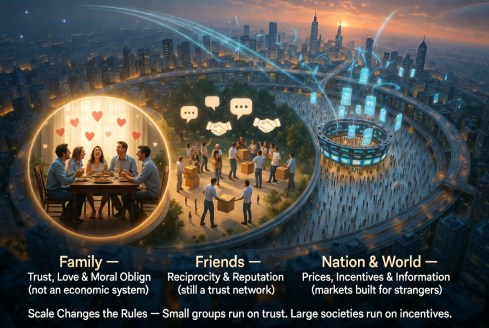
“I’m communist with my family, socialist with my friends, liberal with my country, and capitalist with the rest of the world.”
It’s clever. It’s also half right—and half sloppy.
The part worth keeping is simple enough: scale changes the rules.
What works for five people does not scale to fifty million. Not because people become worse, but because the system itself becomes something different. A family, a circle of friends, a town, a nation—these are not just larger and smaller versions of the same thing. They are different kinds of coordination problems.
Start with the family. From a distance, it can look vaguely “communist”: shared resources, little formal accounting, distribution by need rather than contract. But that description confuses appearances for mechanism. Families do not work because they have stumbled onto a workable version of communism. They work because they are held together by thick trust, intimate knowledge, moral obligation, and affection. You know who is trying, who is struggling, who is coasting, and who is carrying more than their share. Love and duty do much of the coordinating work that, elsewhere, would have to be done by prices, rules, or enforcement.
That is not an economic system. It is a moral one.
Expand outward to friendship networks and you get something looser but still recognizably personal. Friends split restaurant bills unevenly, help each other move, pick up tabs, lend money, and trade favors without keeping a precise ledger. Reciprocity exists, but it remains informal because reputation still does the work. The group is small enough that selfishness has social consequences, and generosity has memory.
Still not socialism. Still a trust network.
Scale it again, though, and the whole structure changes. Once you move from dozens of known people to millions of strangers, the conditions that made those smaller systems work begin to disappear. You no longer know the participants. You cannot directly observe effort. Reputation becomes local rather than systemic. Free riding becomes harder to detect and easier to excuse. The moral visibility that kept the small group coherent starts to fade.
And that is before you even reach the information problem.
Mises and Hayek saw this clearly. In a large society, the knowledge needed to coordinate production, consumption, scarcity, and changing local conditions is radically dispersed. No planner can gather it all in a usable form, still less process it in real time. Prices do something extraordinary here: they compress enormous amounts of scattered information into signals people can actually act on. They tell producers where demand is rising, tell consumers where scarcity is biting, and help strangers coordinate without ever needing to know one another.
But information is only half the story. The other half is incentives, and this is where many soft-focus arguments about solidarity fall apart.
In a family, the bond is part of the reward. Parents sacrifice for children because they love them. Children often learn obligation because they are formed inside a web of expectation and attachment. Friends help each other because affection, shame, pride, and mutual memory all shape conduct. In a large anonymous system, those bonds weaken. Once effort and reward drift too far apart, behavior changes. People conserve effort, game criteria, hide costs, seek advantages, and respond to whatever incentives the system actually creates rather than to the moral language used to defend it.
That is why bloated systems so often fill up with evasion, rent-seeking, bureaucratic padding, and endless struggles over who pays, who receives, and who gets to define fairness. This is not mainly because people are unusually wicked. It is because incentives shape conduct more reliably than rhetoric does.
The problem is not that people become monsters at scale. The problem is that systems stop being personal.
At small scale, coordination is moral and relational. At large scale, it must become impersonal and systemic.
That is where markets enter—not as a sacred ideology, but as a coordination mechanism built for strangers. Prices transmit information. Profit and loss impose discipline. Competition corrects error. Contracts reduce uncertainty. None of this requires perfect virtue. That is precisely the point. Markets work not because people are angels, but because the system does not depend on them being angels.
That is why they scale.
Now, a fair steelman is necessary here, because the redistributive instinct is not born from pure foolishness. Advocates of more social-democratic or socialist arrangements are often responding to something real. Human beings are not just market actors. They are children, parents, dependents, pensioners, caregivers, and sometimes casualties of bad luck they did not choose. A society that treats every need as a private burden and every vulnerability as a market outcome to be endured will become efficient in a narrow sense, but also harsh, brittle, and politically unstable. The desire to soften outcomes, provide public goods, and preserve a baseline of dignity is not irrational. It is, in many cases, a morally serious response to genuine dependency.
That much should be conceded.
What should not be conceded is the next leap: the claim that because markets need moral and political correction, they can therefore be replaced as the primary mechanism of large-scale coordination. They cannot. A decent society may use the state to cushion, insure, stabilize, and set guardrails. But the moment it starts treating political instruction as a substitute for price signals, or good intentions as a substitute for incentive alignment, it begins to lose the information and discipline that complex systems require.
As systems scale, coordination must shift from relationships to mechanisms, and from assumed goodwill to aligned incentives.
This is also why the original slogan overshoots. Markets are not the only thing that scales. States scale too, in limited and specific ways. Law, infrastructure, policing, and certain public goods are not produced by market exchange alone. And between the family and the nation lies an entire middle world of institutions—firms, charities, churches, schools, municipalities, associations—that mix trust, hierarchy, rules, custom, and incentives in different proportions.
The real lesson, then, is not “capitalism good, everything else bad.” That is too crude to be useful.
The real lesson is that systems must be judged by the kind of coordination problem they are trying to solve. Small groups can run on trust because trust is visible and enforceable. Large societies cannot. They need mechanisms that work under conditions of anonymity, partial knowledge, conflicting interests, and imperfect virtue. Any model that ignores those conditions will eventually break, no matter how beautiful its moral language sounds at dinner.
That is the recurring mistake. People take the emotional clarity of small-group life—sharing, sacrifice, mutual care—and try to project it onto systems too large for those tools to govern. When the result disappoints, they blame greed, selfishness, or insufficient solidarity. They almost never blame the mismatch between the model and the scale.
They should.
Because the deepest constraint here is not moral. It is structural.
You can run a family on trust. You can run a country on rules. But if those rules ignore incentives, trust will not save you.
References for Curious Readers
F. A. Hayek, “The Use of Knowledge in Society” (1945).
The classic statement of the knowledge problem: why the information needed to coordinate an economy is dispersed among millions of people and cannot be fully centralized. Published in The American Economic Review.
Ludwig von Mises, “Economic Calculation in the Socialist Commonwealth” (1920).
The foundational statement of the economic calculation problem: without market prices for capital goods, rational large-scale allocation becomes impossible.
Elinor Ostrom, Nobel Prize Lecture, “Beyond Markets and States” (2009).
Useful as a corrective to simplistic binaries. Ostrom’s work shows that some common resources can be governed successfully through rules, enforcement, and local institutions rather than either pure markets or total central control.
Nobel Prize in Economic Sciences 2009 – Popular Information / Summary.
A concise overview of why Ostrom and Oliver Williamson mattered: economic life is governed not only by markets and states, but also by firms, associations, and other institutions. This supports the essay’s “missing middle layer” point.
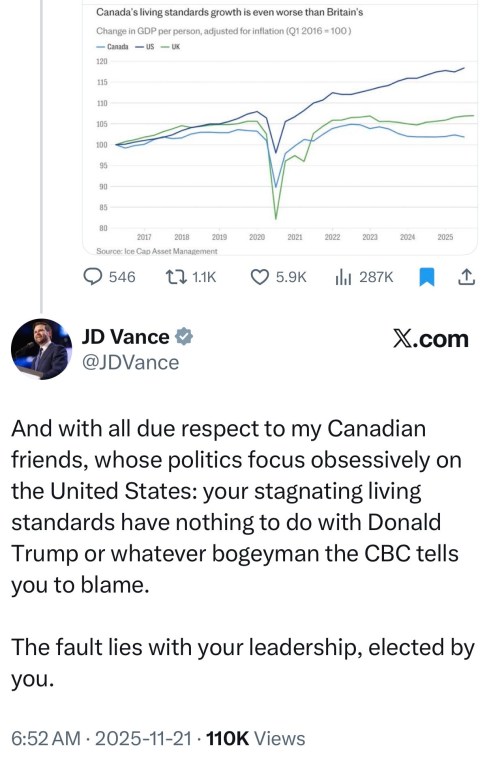
Canada finds itself at a crossroads. In recent years, per capita GDP growth has stalled, productivity remains sluggish, and housing, healthcare, and infrastructure face mounting pressure. These trends have prompted urgent debate about the causes of stagnation, ranging from global economic shifts and demographic aging to domestic policy decisions. Among commentators, JD Vance recently sparked attention with pointed critiques of Canada’s immigration policies and multicultural model, framing them as principal contributors to declining living standards. Beyond the immediate provocation, his intervention highlights a deeper question: how should Canadians assess responsibility for the state of their economy?
Immigration, Policy Choices, and Economic Outcomes
Canada’s foreign-born population now stands at approximately 23 percent, the highest in the G7, reflecting a sharp rise over the past decade. This increase was accelerated by post-pandemic labor shortages and policy decisions prioritizing high-volume admissions. While immigration is a crucial driver of population growth and labor supply, recent evidence indicates that integration has lagged, particularly for newcomers with credentials or skills mismatched to domestic demand. Unemployment rates among recent immigrants are approximately twice those of Canadian-born workers, and overall productivity growth has remained below historical trends.
These outcomes underscore a key point: while external factors including global commodity cycles, trade dynamics, and U.S. policy affect Canada’s economy, domestic decisions regarding immigration volume, infrastructure investment, and skills integration exert primary influence over living standards. The choice to expand immigration without simultaneously scaling capacity for integration, housing, and healthcare has consequences that voters ultimately authorize at the ballot box.
Stoic Lessons for Civic Responsibility
Confronted with these structural and policy realities, Canadians might feel tempted to externalize blame to markets, foreign governments, or pundits. Here, the Stoic philosophers offer timeless guidance. Marcus Aurelius wrote in his Meditations: “You have power over your mind—not outside events. Realize this, and you will find strength.” Epictetus similarly asserted: “It’s not what happens to you, but how you react to it that matters.” These principles demand that citizens distinguish between factors within their control and those beyond it, focusing energy on the former.
Stoicism is not a creed of passivity. It insists on rigorous self-examination and deliberate action. In Canada’s context, this means acknowledging the consequences of policy choices and recognizing that solutions—whether adjusting immigration strategy, improving integration programs, or investing in productivity-enhancing infrastructure—lie within domestic capacity.
Pathways to Renewal
Practical measures aligned with these principles include:
- Aligning immigration targets with absorptive capacity: Recent adjustments to temporary resident admissions, reducing projected numbers by approximately 43 percent, illustrate the potential for recalibration.
- Prioritizing skill-aligned integration: Investing in credential recognition, language training, and targeted labor placement can ensure that new arrivals contribute effectively to productivity.
- Strengthening domestic infrastructure and services: Housing, healthcare, and transportation require proportional investment to match demographic growth.
- Informed civic engagement: Voting with awareness of policy consequences is fundamental to maintaining democratic accountability and ensuring long-term economic stability.
By taking responsibility, Canadians act in accordance with Stoic precepts: focusing on what they can control rather than scapegoating external forces. The challenge is not merely economic—it is moral and civic. Prosperity depends as much on deliberate collective action as on external circumstance.
Conclusion
Canada’s stagnating living standards are the product of complex factors, yet domestic choices remain decisive. While commentary from external observers like JD Vance may provoke discomfort, the underlying lesson is clear: sovereignty entails responsibility, and agency begins at home. To confront stagnation, Canadians must embrace candid assessment of policy outcomes, deliberate reform, and disciplined civic engagement. In the words of Seneca: “We suffer more often in imagination than in reality.” Facing the realities we have constructed—and acting to improve them—is the first step toward renewal.
References
- Statistics Canada. Labour Force Survey, 2025. https://www150.statcan.gc.ca/n1/en/type/data
- Government of Canada. Immigration, Refugees and Citizenship Canada: Annual Report to Parliament on Immigration, 2024. https://www.canada.ca/en/immigration-refugees-citizenship/corporate/publications-manuals/annual-report-parliament-immigration.html
- Marcus Aurelius. Meditations. Trans. Gregory Hays, 2002.
- Epictetus. Enchiridion. Trans. Elizabeth Carter, 1758.
- Seneca. Letters from a Stoic. Trans. Robin Campbell, 2004.
Glossary
- Per Capita GDP: The average economic output per person, often used as a measure of living standards.
- Productivity: Output per unit of input; a key driver of sustainable economic growth.
- Integration Programs: Policies and services designed to help immigrants participate effectively in the labor market and society.
- Absorptive Capacity: The ability of a system (economy, infrastructure, institutions) to accommodate growth without adverse effects.
- Stoicism: Philosophical framework emphasizing rational control over one’s mind and actions rather than external circumstances.











 bleatmop
 Mystro
 The Arbourist


 Dead Wild Roses
Your opinions…