
You are currently browsing the category archive for the ‘Philosophy’ category.
People often use the word “liberal” in confusing ways. In modern politics, “liberal” is often used as a synonym for progressive, left-wing, socially permissive, or even as an insult.
Classical liberalism means something more specific.
Classical liberalism emerged out of the long struggle against arbitrary power: absolute monarchy, inherited privilege, religious coercion, and government by decree. Thinkers such as John Locke, Adam Smith, and later John Stuart Mill helped develop many of its core ideas.
A classically liberal society is built around the moral and legal priority of the individual person. It begins with the idea that people have rights that do not come from the state, the tribe, the church, the activist class, the monarch, or the majority. Government exists to protect those rights, not to grant them as favours.
At its core, classical liberalism is about equal liberty under the rule of law. It protects life, liberty, private property, conscience, speech, due process, voluntary exchange, and the right to live without needing permission from the state or the mob.
It does not promise a perfect society. It does not promise equal outcomes. It does not promise that everyone will agree, approve of one another, or live the same way.
It promises something more modest, and more important: a shared legal order in which free people can live together despite deep disagreement.
So what does a classically liberal society look like?
1. The individual comes first
Classical liberalism begins with the individual person.
That does not mean selfishness is the highest good. It does not mean people have no duties to family, neighbours, community, or country. It means that the basic unit of moral and legal concern is the person, not the group.
You are not merely a race, sex, class, religion, sexuality, nation, tribe, caste, or political category. You are a person first.
That matters because once society treats people primarily as members of groups, it becomes easier to assign guilt, innocence, virtue, blame, privilege, or victimhood by category. Classical liberalism resists that. It insists that people should be judged as individuals.
2. Rights are not gifts from the state
In a classically liberal society, rights are not treated as permissions handed down by government.
The state does not give you freedom of speech. It is supposed to protect your freedom of speech. The state does not give you liberty. It is supposed to protect your liberty. The state does not own your life and then generously allow you to live some portion of it.
This is one of the great dividing lines between classical liberalism and more authoritarian ways of thinking.
The government is not the parent of the citizen. It is not the priest of public morality. It is not the owner of society. It is a limited institution with specific duties.
Its job is to protect rights, enforce law, defend the country, maintain public order, and adjudicate disputes.
It is necessary, but because it is dangerous, it must be limited by design. That is why classically liberal societies tend to value constitutional limits, divided powers, independent courts, free elections, and restraints on what government may do even when it has popular support.
3. Liberty means freedom under equal law
Classical liberalism is not the belief that everyone should be able to do whatever they want.
That is not liberty under law. That is the absence of law.
A free society needs law because human beings live together. Your freedom and my freedom will sometimes collide. Property disputes, contracts, crimes, injuries, fraud, violence, and negligence all require rules.
The classical liberal answer is not “no rules.” It is equal rules.
My freedom extends as far as it can without violating yours. Your freedom extends as far as it can without violating mine. The law exists to draw those boundaries as fairly and consistently as possible.
That is why classical liberalism is better understood as equal liberty under general laws, not maximum personal desire without restraint.
4. The rule of law applies to everyone
A classically liberal society is based on the rule of law.
That means the law applies to rulers and citizens alike. It applies to the rich and the poor, the popular and the unpopular, the majority and the minority, the powerful and the powerless.
No one is above the law.
But just as importantly, no one is beneath its protection.
This means there should be no special legal castes. No hereditary privileges. No racial exemptions. No religious exemptions from ordinary justice. No political favourites. No group-based immunity. No automatic moral rank assigned by identity.
Equality before the law does not mean every person has the same life, talents, wealth, history, or circumstances. It means the law sees citizens, not castes.
5. Due process protects everyone
In a free society, accusation is not conviction.
This matters enormously. A classically liberal society requires due process: fair procedures, impartial hearings, evidence, the right to respond, the right to know the accusation, and protection from arbitrary punishment.
These protections are not technicalities. They are civilizational guardrails.
The reason is simple: the state is powerful, mobs are dangerous, institutions can be cowardly, and human beings are often wrong.
Due process protects the innocent. It also protects the unpopular. And at some point, every serious dissenter may become unpopular.
A society that abandons due process because it believes it has found the “right” villains has already begun to abandon liberalism.
6. Speech and conscience must be free
Classical liberalism depends on freedom of speech, thought, conscience, religion, and association.
People must be free to argue, doubt, publish, worship, criticize, organize, persuade, offend, change their minds, and refuse to affirm what they do not believe.
This is not because every opinion is wise. Many opinions are foolish. Some are ugly. Some are wrong.
But a free society does not survive by giving authorities the power to decide which ideas may be spoken. Once that power exists, it will not always be used by people you trust.
Freedom of speech is not only a personal right. It is also how society tests ideas. Bad claims need to be challenged. Good claims need to be defended. No proposition should be protected from examination by sacred status.
“A free society does not survive by giving authorities the power to decide which ideas may be spoken.”
7. There is no final authority on truth
A classically liberal society assumes human beings are fallible.
The king can be wrong. The church can be wrong. The majority can be wrong. Experts can be wrong. Activists can be wrong. Governments can be wrong. The fashionable consensus can be wrong.
That is why truth must remain open to challenge.
Classical liberalism does not say truth is whatever anyone wants it to be. Quite the opposite. It says truth matters so much that no institution should be allowed to permanently shield its claims from scrutiny.
There should be no sacred wisdom that cannot be questioned. No political doctrine beyond criticism. No identity group whose claims become true by default. No expert class whose authority replaces public reason.
The question must always remain: is the claim true?
8. Private property protects independence
Private property is central to classical liberalism.
This is not because money is sacred or greed is good. It is because property gives people independence.
If you cannot own anything, save anything, build anything, trade anything, inherit anything, or control the fruits of your labour, then your freedom is mostly theoretical. You become dependent on whoever controls access to resources.
Private property allows people to make plans, build families, start businesses, support causes, resist pressure, and live with some degree of independence from the state and the crowd.
Voluntary exchange matters for the same reason. This is why classical liberals have generally supported relatively free markets: not because markets are flawless, but because they are the system most consistent with voluntary cooperation and dispersed power.
Markets are not magic. They require law, trust, property rights, contract enforcement, and limits on fraud and coercion. But they allow people to cooperate without needing a central authority to command every relationship.
9. Civil society matters
Classical liberalism is not just the individual and the state.
A healthy free society depends on civil society: families, friendships, churches, charities, schools, clubs, unions, businesses, neighbourhoods, choirs, sports leagues, volunteer groups, and local associations.
These institutions create trust, belonging, obligation, memory, and meaning. They do much of the work that neither the individual nor the state can do alone.
This is important because if civil society weakens, people often turn to the state to fill the gap. The state then grows larger, more intrusive, and more moralistic.
Classical liberalism needs free citizens, but it also needs strong communities. Not every human problem should become a government program. Not every disagreement should become a legal battle. Not every social failure can be solved by bureaucracy.
“Not perfection. Not utopia. A disciplined defence of freedom for imperfect human beings.”
10. Freedom requires responsibility
A classically liberal society requires self-restraint.
This is the part many people forget.
Freedom is not only a legal arrangement. It is also a civic habit. It requires people who can tolerate disagreement, accept loss, respect boundaries, honour contracts, tell the truth, raise children, keep promises, and resist the temptation to use state power against every person who offends them.
A free society cannot survive if citizens constantly demand censorship, punishment, surveillance, deplatforming, ideological conformity, or emergency powers whenever they feel threatened.
Classical liberalism requires adults who can live with the discomfort that freedom inevitably produces.
That means other people will say things you dislike. They will worship differently, vote differently, spend differently, speak differently, and make choices you would not make.
The alternative is not harmony. The alternative is power.
And once politics becomes a contest to control everyone else, liberty does not last long.

Equal liberty under the rule of law.
In summary
A classically liberal society is one built around equal individual liberty under the rule of law.
It protects life, liberty, property, conscience, speech, association, due process, and voluntary exchange. It limits government because power is dangerous. It protects dissent because human beings are fallible. It treats citizens as individuals rather than members of political castes.
It does not promise equal outcomes. It does not promise moral agreement. It does not promise a world without conflict, offence, hardship, or foolishness.
It promises something better than enforced agreement: a shared civic order where free people can argue, work, worship, trade, build, dissent, cooperate, and live together without needing permission from the state or the tribe.
That is classical liberalism.
Not perfection.
Not utopia.
A disciplined defence of freedom for imperfect human beings.
One key idea behind activist-left identity politics is the ladder of oppression: the more marginalized identity categories a person can claim, the more moral and political weight their speech is assumed to carry.
 The theory has an old philosophical root. In the master/slave dialectic, the subordinate person is said to understand both worlds: his own condition and the world of the master who rules over him. The master, by contrast, often knows only his own comfort, his own assumptions, and the social order that flatters him. From this comes the later activist claim that oppressed people possess a clearer or “truer” insight into reality because they see power from below.
There is a partial truth here. People who live under a system often notice things the comfortable miss. A disabled person may see barriers others walk past. A woman may notice male behaviour men excuse or ignore. A racial minority may recognize social patterns the majority experiences only as normal background noise. Lived experience can expose blind spots.
The problem comes when this insight hardens into hierarchy.
Instead of treating experience as evidence to consider, activist politics often treats identity as authority. The more oppression factors a person can claim — race, sex, gender identity, sexuality, disability, poverty, colonial history — the higher they stand on the moral ladder. Their narrative is then “centred,” while those lower on the ladder are expected to listen, defer, apologize, or stay quiet.
At that point, argument has been replaced by ranking. A weak claim from the approved identity can be protected from criticism, while a strong claim from the wrong identity can be dismissed as privilege, fragility, or harm.
Lived experience matters, but it does not make someone automatically right. Suffering can reveal truths, but it can also narrow vision, sharpen resentment, or turn personal pain into bad policy.
A serious society listens to experience without making identity a substitute for reason. The question still has to be: is the claim true?
The double-slit experiment is one of those scientific ideas people love to borrow badly. It is strange, genuinely humbling, and easy to misuse. That makes it perfect material for people who want reality to be less stubborn than it is.
The basic version is simple enough. Fire particles through two slits without measuring which slit they pass through, and over time they produce an interference pattern, the kind of pattern we associate with waves. Try to measure which slit they go through, and that pattern changes. The system no longer behaves the same way.
That is the part people remember. Unfortunately, they often remember it badly.
The experiment does not show that human consciousness creates reality. It does not show that the universe waits around for a person to notice it before deciding what it is. “Observation” in this context does not mean vibes, attention, social agreement, or someone staring meaningfully at an electron. It means measurement. It means physical interaction with the system. The apparatus matters because the apparatus is part of the situation being tested.
That is weird enough. We do not need to add incense.
There are still serious debates in the foundations of quantum mechanics about how best to interpret what is happening. That is worth admitting. But those debates do not rescue the popular abuse of the experiment. Consciousness is not required, politics does not select the result, and social approval does not decide whether the interference pattern appears.
The real lesson is more disciplined and more interesting. Reality is not always available to common sense. How we investigate can affect what we are able to detect. At quantum scales, measurement is not a passive act, like glancing at a chair from across the room. It changes the conditions under which the result appears.
That should make people humble about truth-finding. It should not make them casual about reality.
This is where social constructivist thinking often slips in through the side door. It does not usually announce itself by saying, “Nothing is real.” That would be too crude, and too easy to reject. Instead, it emphasizes language, framing, power, interpretation, categories, and social meaning until the reader quietly stops treating reality as a constraint and starts treating it as a negotiation.
Reality is real, but not always simple. Because it is not simple, we need better methods, not ideological shortcuts.
Some things really are socially constructed. Money depends on shared agreement. Borders depend on law, force, recognition, and maps. Job titles, academic credentials, citizenship categories, and institutional rituals all rely on human systems to maintain them. That is not a trivial point. Human beings create layers of social meaning that shape how we live, distribute status, enforce rules, and decide what counts inside institutions.
But the fact that some realities are socially maintained does not mean all realities are socially produced. The category “doctor” is socially regulated. The body on the operating table is not. A passport is a legal object. A kidney is not. A government can change language around inflation, housing, crime, or sex, but the material world does not become more cooperative because the terminology became more fashionable.
This is the tell to watch for. A valid insight about interpretation gets stretched until it weakens contact with reality. “Categories have social meaning” becomes “categories are merely imposed.” “Observation matters” becomes “truth depends on standpoint.” “Language shapes perception” becomes “language can rearrange the world.” Each step sounds sophisticated enough in isolation. Put them together, and ordinary reality gets escorted out of the room by people who insist they are only asking questions.
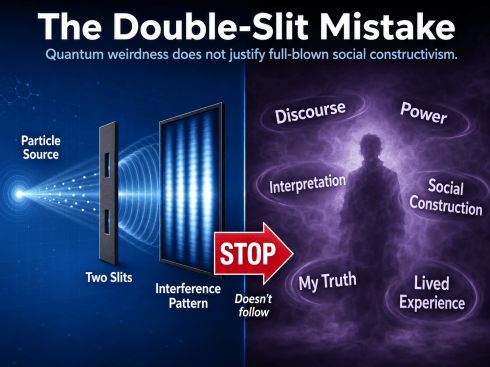
The double-slit experiment does not support that move. If anything, it rebukes it. The experiment is repeatable. The results are disciplined. The mathematics is unforgiving. You do not get a different interference pattern because your politics require one. You do not get to vote on the apparatus. The whole point of the experiment is that reality answers back, though not always in the form our intuitions expected.
That distinction matters far beyond physics. Bad theories of reality do not stay in seminar rooms. They eventually show up in schools, medicine, law, media, and public policy, often wearing the language of compassion or sophistication. If institutions lose the ability to distinguish between social meaning and material constraint, they do not become more humane. They become easier to fool.
Quantum weirdness should not become a permission slip for intellectual fog. It should remind us that careful methods are necessary precisely because reality can be subtle. The world is not always obvious, but it is also not waiting for our preferred theory to grant it permission to exist.
The better response to mystery is not social construction all the way down. It is patience, precision, and less eagerness to turn every difficulty in knowing into an excuse for pretending the thing known has disappeared.
Truth is the lifeblood of any serious civilization. Not comfort, not ideological harmony, and not the temporary social peace that comes from teaching people to suppress what they can plainly see.
A society can survive mistakes. It can survive corruption. It can survive periods of confusion and even mass foolishness, provided enough people remain willing to describe reality honestly when the pressure arrives to do otherwise. What societies struggle to survive is organized dishonesty.
Reality is the brick wall waiting at the end of every false belief. You can postpone the collision for a while. You can build bureaucracies around the falsehood, invent softer language to cushion it, and punish people for pointing at the wall. The impact still comes.
That is why a recent quote from J. K. Rowling landed with such force:
“The West is currently divided between people who know he is a man and are prepared to say so and those who know this is a man but lie out of obedience to an ideology. There is no third option. Literally nobody on earth thinks ‘Roxanne Tickle’ is actually a woman.”
The quote unsettled people because it named something many Western institutions have spent years trying to blur: the widening gap between public language and private belief.
Large numbers of people now routinely say things in public that they would once have regarded as obviously false, not because the underlying biology changed, but because the social cost of dissent rose dramatically. That distinction matters, because this is not primarily a debate about kindness.
A decent society should discourage cruelty. It should not encourage humiliation, harassment, or needless malice toward people struggling with alienation, identity, or psychological distress. Most ordinary people understand this instinctively. But courtesy is not the same thing as compelled belief.
Calling someone by a preferred name is one thing. Demanding that citizens affirm propositions they do not believe to be true is something else entirely. The first is social grace. The second is ideological obedience.
 Nor is this an argument for replacing one rigid orthodoxy with another. Conservative traditions have their own temptations toward enforced piety, inherited blindness, and social punishment for inconvenient truths. Any worldview, religious or secular, progressive or reactionary, becomes dangerous when it starts protecting sacred assumptions from scrutiny. The standard cannot be nostalgia or novelty. The standard has to be reality itself: when a belief hits the brick wall, the belief must yield.
Modern Western institutions increasingly refuse to yield.
People learn quickly which observations are permitted and which ones carry risk. Teachers self-censor in classrooms. Employees rehearse approved language in HR seminars. Professionals choose silence over scrutiny. Friends whisper obvious opinions privately, then publicly perform uncertainty they do not actually feel. Entire bureaucracies now operate through euphemism, ritual language, and carefully managed ambiguity designed less to clarify reality than to avoid conflict with activist moral frameworks.
The social choreography becomes exhausting to watch because everyone notices the contradiction, while almost nobody wants to be the first person to say so aloud.
That atmosphere corrodes more than speech. It corrodes trust itself.
Once institutions begin demanding verbal loyalty to claims that large numbers of people privately reject, public language starts losing contact with reality. Words stop functioning primarily as descriptive tools and become signals of social compliance. The goal is no longer clarity. The goal is demonstrating moral alignment with the approved consensus.
History offers repeated warnings about where this habit leads. Not always to catastrophe on cinematic scales. Sometimes the damage is quieter and more banal than that. Institutions become incapable of self-correction because honest feedback becomes socially dangerous. Bad ideas survive longer than they should. Obvious failures remain unacknowledged. Citizens retreat into cynicism. Public trust declines because people can feel the gap between official language and observable reality widening in real time.
The lie does not even need to convince everyone to become destructive. It only needs to become socially mandatory.
That is the deeper danger here. A liberal society depends on the ability of ordinary people to speak plainly about reality without fear that disagreement itself will be treated as moral contamination. Once that principle collapses, coercion inevitably expands to fill the space left behind, not always through laws, but often through softer mechanisms: reputational pressure, professional risk, social isolation, algorithmic mobbing, institutional gatekeeping. The effect is similar either way. Silence becomes safer than honesty, and so more people stay silent.
The defenders of this system often insist they are merely asking for compassion. In many cases, I suspect some genuinely believe that. But compassion detached from truth eventually mutates into something harsher. If reality itself becomes negotiable, then social power determines what may be spoken. At that point the argument is no longer about tolerance. It becomes a struggle over who has authority to define reality for everyone else.
That is not progress. It is regression wrapped in therapeutic language.
None of this requires cruelty toward individuals or hatred. It requires only the willingness to say that observable reality still matters, even when saying so becomes socially uncomfortable. Reality does not disappear when institutions stop acknowledging it.
The brick wall remains where it always was, and civilizations that train themselves to look away rarely avoid the collision forever.
Something feels off. You can hear it in the way certain arguments move too quickly, collapsing a complex moral landscape into a stark choice. On one side, morality is said to be subjective—nothing more than preference, culture, or perspective. On the other, we are told that without objective grounding, morality collapses into power. The argument is clean, decisive, and rhetorically effective. It is also incomplete.
The appeal of this framing lies in its speed. If morality is subjective, then moral claims reduce to preference. If they reduce to preference, there is no truth to adjudicate between them. And if there is no truth, disagreement can only be resolved through assertion and enforcement. The conclusion follows with a kind of mechanical certainty: without objective morality, ethics becomes power. It is a compelling chain, particularly in live discussion, where the pressure to respond quickly prevents careful unpacking. But the speed of the move is part of its strength—and its limitation. It skips over something most people already rely on in practice, even if they do not articulate it.
In everyday life, we do not treat all moral claims as interchangeable. Some feel as though they hold even in the face of disagreement; others do not. What distinguishes them is rarely stated explicitly, but it shows up in how people respond to rules and expectations. A simple test often operates in the background: does the rule apply both ways? Does it still make sense when the roles are reversed? Does it remain defensible when you are no longer the one benefiting from it?
You can see this play out in familiar disputes. A rule that restricts speech when it targets your side may feel justified; the same rule, applied in reverse, often feels like suppression. A policy that advantages your group can look like fairness in one direction and bias in the other. The reaction people have in those moments—that sense that something has shifted or isn’t being applied evenly—is not random. It’s the symmetry test quietly asserting itself.
“The question isn’t whether a rule benefits you—it’s whether it still makes sense if it doesn’t.”
When the answers line up, the rule tends to feel legitimate. When they don’t, something begins to grate. This is not a formal proof of moral truth. It is, however, a constraint on what people are willing to accept.
One way to bring that constraint into focus is through the thought experiment proposed by John Rawls. Imagine choosing the rules of a society without knowing who you will be within it—your position, your advantages, your vulnerabilities. From that standpoint, you cannot design the system to suit your own interests. You are forced to consider whether the rules would still be acceptable if you ended up on the losing side of them. Rawls does not claim to discover moral truth through this device. What he does is remove the most obvious avenue for bias and ask what remains once that advantage is gone.
What remains is not a set of metaphysical truths written into the structure of the universe. It is something more modest and, in practice, more useful: a constraint on justification. Some rules cannot be defended once you no longer know where you will stand. They rely too heavily on asymmetry, on the assumption that the person invoking them will not have to bear their cost. When that assumption is removed, the rule loses its force. This does not make morality objective in the way physical laws are objective, but it does show that not all moral systems are equally defensible.
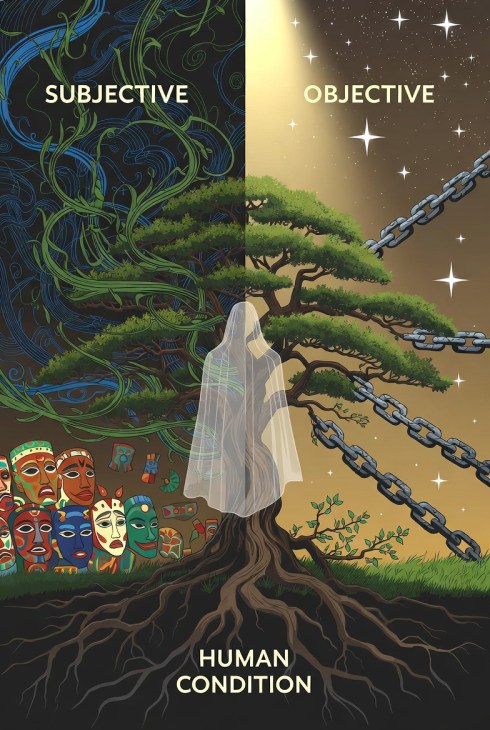
This is the space the binary argument overlooks. Morality does not have to be either fully objective in a metaphysical sense or entirely subjective and arbitrary. Most functioning moral systems occupy a middle ground. They are constructed and maintained through norms, institutions, and shared expectations, but they are also bounded by the conditions under which human beings live. We are vulnerable, dependent, and engaged in repeated interaction. Rules that exploit these conditions too aggressively tend to collapse under their own weight. Rules that can survive role reversal and long-term interaction tend to persist. They are not inevitable, but neither are they arbitrary.
The force of the “collapse into power” argument comes from its focus on weak forms of subjectivism. If morality is reduced to mere preference, then the conclusion follows quickly. But this is not how most moral reasoning operates in practice. Even absent a claim to objective truth, people appeal to considerations that go beyond preference: reciprocity, fairness, stability, and the costs of defection. These are not metaphysical foundations, but they are not empty either. They generate real limits on behavior and real expectations about what can be justified.
The question, then, is not simply whether morality is objective. That framing compresses too much into a single term. A more useful question is what constrains moral reasoning so that it does not collapse into preference or power. Rawls offers one answer in the form of symmetry under uncertainty. Ordinary social life offers another in the form of rules that must hold under repetition and reversal. Both point to the same underlying fact: moral systems are not free to take any shape whatsoever. They are limited by the requirements of justification and the conditions of human interaction.
This brings us back to the original feeling that something is off. That reaction often arises when a rule is applied inconsistently, when a principle shifts depending on who benefits, or when an argument demands compliance without offering a justification that would hold if positions were reversed. You do not need a fully developed moral philosophy to recognize that pattern. You only need to notice when the symmetry breaks.
Scientific objectivity does not require perfect scientists; it requires that their models survive contact with reality. Moral objectivity, if the term is to mean anything useful, does not require metaphysical certainty. It requires that the rules we live by survive contact with each other—across differences in position, power, and perspective. That is a narrower claim than the one often made in debate, but it is also a more defensible one.
Morality does not need to be written into the fabric of the universe to resist collapse. It needs something simpler: rules that can be justified without knowing who will bear their consequences, and that continue to function when they are applied to anyone over time. Once that is clear, the stark choice between objective truth and raw power begins to lose its grip. The problem is not that morality lacks a foundation, but that we often look for it in the wrong place.
Where This Goes Next
The question raised in the previous discussion—whether anything can meaningfully constrain our claims without collapsing into preference or power—does not end with morality.
It appears again, more sharply, in how we think about science itself.
If there is no constraint beyond social agreement, then scientific claims begin to look like moral ones at their weakest: negotiated, enforced, and revised under pressure. If there is a constraint, then we need to be precise about what it is and how it operates, because that distinction determines whether we are tracking reality or simply tracking consensus.
The essays that follow take up that question directly. They move from the same starting point—something feels off—to a clearer account of what, if anything, resists that collapse.
There is a reason the recent interview on TRIGGERnometry featuring Andrew Wilson has drawn attention. Wilson does not simply argue positions; he shifts the ground beneath them. In a discussion about subjective morality and objective truth, that ability is decisive. Much of his effectiveness comes not from the novelty of his claims, but from the speed and clarity with which he forces his interlocutors to confront the implications of their own assumptions.
At the center of his argument is a compressed but powerful move. If morality is subjective, then moral claims reduce to preference. If they reduce to preference, then disagreement cannot be resolved through appeal to truth, but only through assertion and enforcement. From there, the conclusion follows: without objective morality, ethics collapses into power. It is a clean chain of reasoning, rhetorically efficient and difficult to interrupt in real time, especially when opponents have not fully examined the foundations of their own views.
Part of what makes this approach so effective is that it presses on a genuine weakness in much contemporary moral discourse. Secular arguments about morality often appeal to harm, fairness, or consensus. These are intuitively compelling and widely shared, but they are not self-grounding in a strict sense. They rely on assumptions that are rarely defended at a deeper level. When Wilson asks why these principles should bind anyone who does not already accept them, the hesitation that follows is real. Moral language tends to present itself as if it refers to something objective, even when speakers explicitly deny that such objectivity exists. That tension creates an opening, and Wilson exploits it with precision.
There is, in other words, a strong version of his argument. If moral claims are entirely subjective, then their authority becomes difficult to justify beyond the boundaries of a given framework. The question “why should anyone outside your system care?” is not rhetorical; it is a genuine challenge. It exposes the gap between the way people speak about morality and the way they often ground it, if they ground it at all. On this point, Wilson is not merely performing. He is identifying a real philosophical pressure.
The difficulty lies in what follows. Wilson moves from the observation that subjective morality has grounding problems to the conclusion that it therefore collapses into power. That step is doing more work than it appears. It bypasses a large middle space in which most moral systems actually operate. Societies do not typically function by reducing all moral claims to arbitrary preference, nor do they rely on universally agreed metaphysical truths. They operate through a combination of norms, institutions, reciprocal expectations, and forms of reasoning that are neither purely objective nor wholly arbitrary. These structures impose real constraints on behavior. They shape incentives, establish boundaries, and generate predictability over time.
A simple example makes the point. Most people keep small promises—returning a borrowed item, showing up when they say they will—not because of objective moral truth, but because repeated interaction makes reliability valuable and defection costly. Over time, those expectations harden into norms that feel binding, even if their origin is entirely practical.
Underlying Wilson’s move is an assumption that if a claim is not objectively grounded, it has no binding force. That assumption is not obviously correct. Much of what governs human behavior lacks objective grounding in a strict philosophical sense. Laws, contracts, and social norms are not objective truths in the way physical laws are, yet they bind behavior effectively. Their force arises from shared expectations, enforcement mechanisms, and the long-term costs of violation. The relevant question, then, is not simply whether morality is objective, but what kinds of systems are capable of generating stable and predictable constraints on human conduct.
“Wilson doesn’t defeat morality without objectivity—he defeats weaker versions of it faster than they can defend themselves.”
Wilson’s own solution—grounding morality in God—does attempt to solve this problem by anchoring obligation outside human preference. Whether that succeeds is a separate question. It secures authority for those who accept it, but does not obviously resolve disagreement among those who do not.
This is where the conversation in the interview begins to fragment. Wilson is arguing at the level of justification: what ultimately grounds moral claims and gives them authority. The hosts, by contrast, are operating at the level of function: how moral systems work in practice and how societies maintain order and cooperation. These are related but distinct questions. One concerns philosophical legitimacy; the other concerns social viability. When they are treated as interchangeable, the discussion collapses into confusion. Wilson’s advantage is that he keeps the focus tightly on justification, where his binary framing is strongest. The hosts attempt to shift toward function, but without fully articulating how functional systems can resist the collapse he describes, their responses remain incomplete.
A more effective reply would have acknowledged the grounding problem while resisting the forced conclusion. Even if morality is not objectively grounded, it does not follow that it is arbitrary or that it reduces to raw power. Systems of cooperation and constraint can emerge from the conditions of human life itself: shared vulnerability, repeated interaction, and the high cost of disorder. These factors generate incentives for stable norms and predictable behavior. They do not eliminate conflict or disagreement, but they provide a framework within which those disagreements can be managed without constant recourse to coercion.
This does not eliminate the binding problem entirely. Functional systems explain why cooperation emerges and persists, but they do not fully answer why an individual should comply when defection is advantageous and enforcement is weak. That tension remains, even in the most stable societies.
Wilson’s rhetorical strength lies in the fact that he does not need to defeat this more complex position. He only needs to expose the instability of a weaker one. Once his opponents concede that morality is subjective without offering a robust account of how subjective systems generate binding norms, he can recast their position as preference backed by social pressure and, ultimately, by force. That recasting is not entirely wrong, but it is incomplete. It compresses a complicated reality into a stark alternative, and in doing so it gains persuasive force at the cost of nuance.
The result is an argument that is both powerful and limited. It succeeds as a critique of poorly grounded moral subjectivism, but it overreaches when it claims that subjectivity necessarily entails collapse into power. In practice, moral systems occupy a space between objective truth and arbitrary preference. They are constructed, negotiated, and enforced, but they are also constrained by human conditions that make certain arrangements more stable than others.
Wilson is, in this sense, asking a legitimate question. The problem is that he answers it too quickly. By collapsing the range of possible moral systems into a binary, he forces clarity but sacrifices accuracy. That trade-off is what makes him such an effective debater. It is also what limits the depth of the conclusions he draws.
This Is Not a Theology Argument
There’s a version of this argument that collapses on contact.
“Christian societies succeed because Christianity is true.”
That’s not serious. It’s too broad, too easy to counter, and it drags the discussion into theology. That’s not what this is.
This is narrower.
Modern successful societies appear to rely on a set of moral assumptions that did not arise randomly—and may not sustain themselves indefinitely once detached from the structures that produced them.
Not proof, not prophecy, but rather… dependence.
Name the Structure, Not the Institution
When I refer to “Judeo-Christian ethics,” I’m not talking about the historical behavior of churches or states. That record is mixed at best and often indefensible. It doesn’t need rescuing here.
I’m pointing to a moral architecture—a cluster of ideas that shaped behavior long before belief began to fade:
- intrinsic human worth
- moral equality beyond tribe
- limits on power
- individual responsibility
- restraint
- forgiveness over vendetta
These now feel obvious.
They weren’t.
What looks like baseline morality is often inherited structure—and inheritance has a way of disguising itself as inevitability.
Christianity Is Not the Only Path—And That Matters
If the claim were simply “Judeo-Christian societies do better,” it would fail.
There are Christian-majority countries that struggle. There are secular societies that thrive. There are atrocities carried out under religious banners that no serious reader will ignore.
And then there’s Japan.
Japan is not a counterexample. It’s a correction.
It demonstrates that similar outcomes—order, trust, cohesion—can emerge from entirely different traditions. Which means the key variable isn’t Christianity itself.
It’s something deeper.
Japan suggests the underlying requirement is not a specific doctrine, but a sufficiently internalized system of obligation—whether grounded in universal dignity or social duty. The forms differ. The function is similar: behavior is constrained before enforcement becomes necessary.
Not all structures are interchangeable. But high-functioning societies tend to converge on systems that reliably produce restraint, accountability, and continuity across generations—however they justify them.
These systems are not immune to strain. Japan’s own pressures—aging demographics, declining birth rates, and shifting social norms—suggest that even deeply internalized frameworks are not static under modern conditions.
What These Systems Actually Do
Strip away the language and look at function.
These frameworks tend to produce:
- higher social trust
- delayed gratification
- stable family structures
- informal accountability
- expectations that limit the use of power
These are not abstract outcomes. They follow from repeated behaviors:
- when restraint is internalized, fewer actions require enforcement
- when accountability is expected, trust rises and transaction costs fall
- when power is seen as limited, institutions stabilize rather than dominate
Over time, these behaviors compound into systems that rely less on coercion and more on expectation.
That sounds mundane. It isn’t. It’s what makes large, complex societies livable.
None of this requires belief.
But it does require internalization.
And internalization is slow, uneven, and difficult to rebuild once it thins out.
The Enlightenment Didn’t Start From Zero
The Enlightenment didn’t sweep this away and replace it with reason.
It reorganized it.
It challenged religious authority, formalized rights, and built institutions that still define modern life. That’s real progress and it shouldn’t be minimized.
But it did not begin from moral zero.
The assumptions were already there—about equality, dignity, and limits on power. The Enlightenment clarified and extended them. It did not generate them out of nothing.
The harder question is whether reason alone can reproduce the same depth of commitment, especially when those commitments become costly.
Reason is excellent at organizing systems. It is less reliable at compelling sacrifice—and societies eventually run into situations where something has to give.
The Problem Friedrich Nietzsche Identified
Nietzsche is often invoked carelessly. This isn’t that.
His point wasn’t that religion should be preserved. It was that removing it has consequences that don’t show up immediately.
You can discard a system and keep its language for a while.
You can keep its assumptions even longer.
What you can’t do indefinitely is treat the foundation as optional while expecting the structure to remain stable.
That process doesn’t announce itself.
It drifts—and by the time it becomes obvious, it is usually well underway.
Drift Shows Up as Substitution
Drift doesn’t look like collapse.
It looks like substitution.
As informal norms weaken, societies compensate with formal mechanisms:
- more regulation
- more surveillance
- more litigation
- more explicit enforcement of what was once assumed
That shift isn’t inherently catastrophic. In many cases it works.
But it changes how order is maintained. It replaces internal constraint with external management—and that trade is rarely free.
You can see it at the margins: rising regulatory density, increased reliance on formal compliance systems in workplaces and institutions, growing legal mediation of disputes that were once handled informally. These trends have multiple causes, but they share a common feature—behavior that once required little enforcement now requires more of it.
The Secular Case—and Its Limit
A secular answer exists.
We can justify these norms through reason, reciprocity, and shared interest. We don’t need theology to understand cooperation or stability.
And in many cases, this works. High-trust secular societies demonstrate that norms can be transmitted without widespread religious belief.
The question is not whether this is possible.
It clearly is.
The question is whether these systems are fully self-sustaining over long time horizons, or whether they depend—quietly—on inherited assumptions that become harder to justify as those assumptions lose coherence.
That dependency is easy to miss because it feels like common sense.
It isn’t. It’s memory.
If these systems are fully self-sustaining, we would expect high-trust, high-restraint behavior to remain stable even as the underlying moral frameworks continue to thin. If they are not, the pressure will show up first at the margins—in declining informal trust, rising enforcement costs, and increasing reliance on explicit rules to maintain baseline order.
What This Argument Is—and Is Not
This is not an argument for belief.
It’s an argument against pretending we’re starting from nothing.
Societies that function well do not run on law and incentives alone. They rely on internalized limits—on what people will not do, even when they can.
Judeo-Christian ethics provided one version of that in the West. Other civilizations developed their own.
The open question is not whether we can discard those frameworks.
We already have.
The question is whether we understand what they were doing well enough to replace them—or whether we are still relying on them while insisting we are not.
The Uncomfortable Conclusion
Removing a foundation does not collapse a structure immediately.
It exposes, slowly, what the structure depended on—and whether we’ve mistaken inheritance for design.












 bleatmop
 Mystro
 The Arbourist


 Dead Wild Roses
Your opinions…