
You are currently browsing the category archive for the ‘Politics’ category.


 I’m glad I’ll be dead when humanity’s collective shit hits the fan. I used to get all wrapped up in debates about Capitalism and the slow motion Seppuku we’re committing. I was genuinely flummoxed when my arguments were characterized as hopelessly naive and that my positions were unfounded vis-a-vis economic reality (a.k.a the dominant capitalist consumption paradigm).
Bollocks to that noise.
I’m out of fucks to give about important economic arguments and how super-fucking-awesome capitalism is. I will not be around when glitz comes off of our over-consumption and enough of humanity realizes how hard they’ve been screwed over by our benevolent job creating, all-boats-raising, [insert mendacious free-market dogmatic sentiment here], elite whose only goal is to keep their particular party going on the backs of every else. I, if consciousness exists after corporeal death, will be bathing in tears of the elite, relishing every savoury nanosecond of schadenfreude, as their hard “earned” lifestyle and material wealth crumbles to ash in a fiery pyre with the rest humanity.
Our human tendency to stratify our societies is our downfall. The inequalities that capitalism creates blinds those with power and privilege to the destruction of the very means of survival. Ronald Wright wrote this about the importance of the biosphere and the resources it supplies. To0 tree-huggy for you? Tough darts friend, the historical record is littered with the wrecks of societies that did not learn this fundamental lesson.
The lesson I read in the past is this: that the health of land and water – and of woods, which are the keepers of water – can be the only lasting basis for any civilization’s survival and success.
—A Short History of Progress, p 105
Don’t believe me? Well fuckmesideways bro, you don’t have too, it might be easier if you don’t see this one coming. The good scientists over at NASA have published a neat study on the merry death-spiral we happen to be inhabiting, The Guardian has an article summarizing said paper, thus we’ll peruse the highlights here.
This paragraph’s prescience is chilling:
“Noting that warnings of ‘collapse’ are often seen to be fringe or controversial, the study attempts to make sense of compelling historical data showing that “the process of rise-and-collapse is actually a recurrent cycle found throughout history.” Cases of severe civilisational disruption due to “precipitous collapse – often lasting centuries – have been quite common.”
Useful thought experiment time. Imagine when you were a teenager. Remember how thoroughly self absorbed, shallow, and brain-dead you were? That same myopic narcissism is reflected in intellectual, political and social stands that typify the attitudes of the elite. This NASA study is a smackdown of all of what our cherished elites hold dear.
Will a peer reviewed article suddenly change minds and ingrained attitudes? Considerthe prevalence and persistence of religious belief despite the wealth of knowledge that contradicts said venerated mythology. The sheer number of people that haplessly cling to religious delusion is a testament to the doggerel stupidity our species is infected with. The peoples minds we need to change have the influence and the inclination not to listen to reason. So let’s not get all lathered up about the ramifications of this report, even if does purportedly deal in fact.
“It finds that according to the historical record even advanced, complex civilisations are susceptible to collapse, raising questions about the sustainability of modern civilisation:
“The fall of the Roman Empire, and the equally (if not more) advanced Han, Mauryan, and Gupta Empires, as well as so many advanced Mesopotamian Empires, are all testimony to the fact that advanced, sophisticated, complex, and creative civilizations can be both fragile and impermanent.
Mmm. Sounds nothing at all like our society. But let’s not learn from the past because the ignoble fate suffered by those societies couldn’t possibly happen today.
Because hubris.
(I could have stopped the post here, but sadly, my sanguine nature runs both wide and deep, thus we continue, hoping a difference might be made)
But what are the causes of the downfall of human civilizations?
“[…]lead to collapse when they converge to generate two crucial social features: “the stretching of resources due to the strain placed on the ecological carrying capacity”; and “the economic stratification of society into Elites [rich] and Masses (or “Commoners”) [poor]” These social phenomena have played “a central role in the character or in the process of the collapse,” in all such cases over “the last five thousand years.”
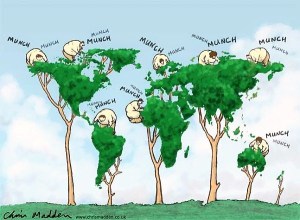 Wow. You mean the rich worry only about getting richer and fucking everyone else over is an actual historical(now supported with SCIENCE!!!)fact? Thank you brave scientists heads for nailing that conclusion that has been obvious to anyone who studies history and has more than two fucking neurons to rub together. So one could say that a system that creates stratification – CAPITALISM – isn’t a really a good system to blindly, balls-to-the-wall-style, endorse. Who would have figured that shit out (hint: rhymes with ‘parks’).
“Currently, high levels of economic stratification are linked directly to overconsumption of resources, with “Elites” based largely in industrialised countries responsible for both:
“… accumulated surplus is not evenly distributed throughout society, but rather has been controlled by an elite. The mass of the population, while producing the wealth, is only allocated a small portion of it by elites, usually at or just above subsistence levels.”
Are you enjoying your peon status? I know I certainly am. But hey, you could make it rich someday too and live just like the fat cats – not that the elites would propagate popular myths (thank you corporate media) to keep the drones in line. But why listen to bitter ole Arbourist? Ronald Wright has done the dirty work and comes to a similar (paraphrased)conclusion:
“Wright sees needed reforms being blocked by vested interests who reject multi-lateral organisations, and support laissez-faire economics and transfers of power to corporations as leading to the social and environmental degradations that led to the collapse of previous civilisations. Necessary reforms are, in Wright’s view, being blocked by vested interests who are hostile to change, including American market extremists. Wright concludes that “our present behaviour is typical of failed societies at the zenith of their greed and arrogance” and calls for a shift towards long-term thinking:”
 Yep, and the Elites and their libertarian teenager mentality are going to resolutely deny this until they are standing in the warm rich glow of their freshly razed gated communities and mansions. Only then does this sort of message sink in.
“Modelling a range of different scenarios, Motesharri and his colleagues conclude that under conditions “closely reflecting the reality of the world today… we find that collapse is difficult to avoid.” In the first of these scenarios, civilisation:
“…. appears to be on a sustainable path for quite a long time, but even using an optimal depletion rate and starting with a very small number of Elites, the Elites eventually consume too much, resulting in a famine among Commoners that eventually causes the collapse of society. It is important to note that this Type-L collapse is due to an inequality-induced famine that causes a loss of workers, rather than a collapse of Nature.”
So many options, how about option #2?
“Another scenario focuses on the role of continued resource exploitation, finding that “with a larger depletion rate, the decline of the Commoners occurs faster, while the Elites are still thriving, but eventually the Commoners collapse completely, followed by the Elites.”
Oh this sounds all gloomy and pretty shitty overall, do we have some sciency facts on this? Of course we do…
“In both scenarios, Elite wealth monopolies mean that they are buffered from the most “detrimental effects of the environmental collapse until much later than the Commoners”, allowing them to “continue ‘business as usual’ despite the impending catastrophe.” The same mechanism, they argue, could explain how “historical collapses were allowed to occur by elites who appear to be oblivious to the catastrophic trajectory (most clearly apparent in the Roman and Mayan cases).”
Pretty good argument for a more egalitarian society no? Because the status quo means most of us die and the remainder to to live life Hobbsian style: “Nasty, Brutish  and short.” Did statement that just send up a dog whistle for our dear friends of capitalism?? Sharing wealth, income redistribution.. the soon to be named spectre of unfuckingwashed Socialism?
Damn straight, son.
Oh were you contemplating bringing some apologia for capitalism to the comments section to set me straight on how fucking wonderful it is and how really if we just keep innovating it will be a panacea for all? (Tell that to third world parents whose kids(21 a minute if you have statistical fetish) are still dying of preventable diseases). Change this shitty system now or get used to the happy-funtime reality that Hobbes and Malthus intimately describe.
“Applying this lesson to our contemporary predicament, the study warns that:
“While some members of society might raise the alarm that the system is moving towards an impending collapse and therefore advocate structural changes to society in order to avoid it, Elites and their supporters, who opposed making these changes, could point to the long sustainable trajectory ‘so far’ in support of doing nothing.”
It won’t change, not by our hand. I get that – keep the orgy going kids; I expect nothing less.
But as I said earlier I won’t be around to stew when things go sideways (well maybe as a wizened old soul on a rocking chair with a shotgun and cats), so enjoy your mess assholes. I’m frackking done with this.
Let’s close with a non swear word laden summary from Ronald Wright of many of my thoughts on humanities majestic progress and the challenges we face:
“Things are moving so fast that inaction itself is one of the biggest mistakes. The 10,000-year experiment of the settled life will stand or fall by what we
do, and don’t do, now. The reform that is needed is not anti-capitalist, anti-American, or even deep environmentalist; it is simply the transition from short-term to long-term thinking. From recklessness and excess to moderation and the precautionary principle.
The great advantage we have, our best chance for avoiding the fate of past societies, is that we know about those past societies. We can see how and why they went wrong. Homo sapiens has the information to know itself for what it is: an Ice Age hunter only half-evolved towards intelligence; clever but seldom wise.
We are now at the stage when the Easter Islanders could still have halted the senseless cutting and carving, could have gathered the last trees’ seeds to plant out of reach of the rats. We have the tools and the means to share resources, clean up pollution, dispense basic health care and birth control, set economic limits in line with natural ones. If we don’t do these things now, while we prosper, we will never be able to do them when times get hard. Our fate will twist out of our hands.”
—A Short History of Progress, p 131–2
Short History of Progress Wikipedia.
Short History of Progress Review on Quill and Quire
Surviving Progress: Documentary Film featuring Ronald Wright.
The Massey Lecture Series: A Short History of Progress produced by the CBC on youtube-
Free markets make for a level playing field, ensuring the best products get to the consumers at the lowest price by rewarding hard working people who go the extra mile to bring the people what they want….except when someone other than the established upper class might take some of their wealth away. Then “free” markets make laws to ban that shit immediately.
The illusion that capitalism benefits anyone other than the haves over the have-nots is laid bare once again, this time in the automotive industry. Recently there have been two articles about Tesla Motors at wired.com that caught my interest.
 For those who haven’t heard of them, Tesla makes electric cars that actually look cool. That whole ‘you gotta be some kind of nerdy hipster to do away with gas guzzlers’ thing? Tesla says “Fuck that shit. Our cars will not only run on batteries, they will also look so awesome that autophiles will bust a nut at the sight of them.” Currently they cater a relatively wealthy demographic, but they are continually getting closer to producing an electric car that the masses could feasibly acquire.
The first article looks at how maintaining an electric vehicle requires so much less than a traditional gas car. No oil, pistons, air filters, pumps, belts, spark plugs, or any of that myriad of other bits and pieces that car garages charge you through the nose to look after for you. All this makes other car dealers very unhappy. These problems that Tesla is trying to make better is how car shops make money. In their eyes, selling the public a sub-standard product is preferable as it will ensure years of expensive repairs. On top of that, Tesla is offering flat rate plans for what little maintenance one might need for their electric car, rather than charging for each and every little thing they do. If the public ever got used to ideas like that, it would be the end of both seedy garages that will screw you out of a couple hundred bucks as well as the posh dealership garages that will screw you out of thousands.
The second article looks at how Tesla sells its vehicles. Apparently Tesla is trying to make the process of buying a car not suck gangrenous donkey sack. By selling only direct over the internet, Tesla stores are located in malls, not lots; staffed with informative promoters, not pushy salesmen; providing a consistent experience across stores, not a terrifying crap shoot. Taking away the dealership middleman may make things fantastically better for the customer, but threatens another crux of the established car industry. Oh the horror! If this catches on, people would stop putting up with manipulative pressuring assholes car salespeople, who would then, in turn, have to get some other job.
So this all sounds great. A new age of cleaner cars, better buying experiences, and a substantial drop in the sleaziness that the average person is exposed to. Except that the only losers in this scenario, the car dealers, have lots and lots of money. Enough money to buy big powerful lobbyists. But but we live in democracy with a free market, right? Whatever. People with money say no go. New Jersey has now banned Tesla stores, as car dealer lobbyists insist that Tesla’s better way of doing things gives them an unfair advantage. Legal battles like this are happening in many other places across the states.
A very grim and cynical part of me thinks it’s hilarious when capitalism advocates point at the corruptibility and horror of other economic systems. All the “free” market does is allow oppressors to pretend that they have earned the right to screw over the masses. Once stymying collective progress becomes easier and/or more profitable than short term individual gains, that invisible hand is much more likely to be used to beat down the public, rather than be any kind of positive force.
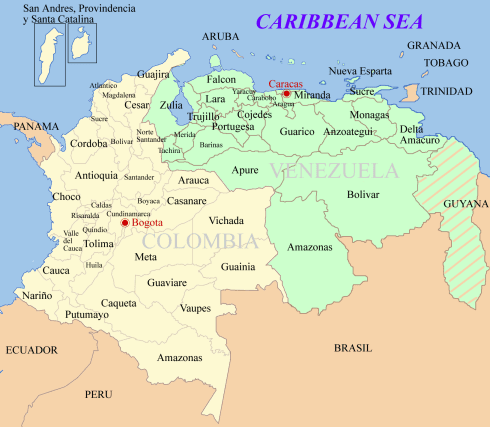
This article from counterpunch nails whats is wrong with how news is reported here in North America and also give a much different picture of what is going on in Venezuela. A big thanks to Mark Weisbrot for getting the down and dirty on events happening in South America.
The Class Conflict in Venezuela
The current protests in Venezuela are reminiscent of another historical moment when street protests were used by right-wing politicians as a tactic to overthrow the elected government. It was December of 2002, and I was struck by the images on U.S. television of what was reported as a “general strike,” with shops closed and streets empty. So I went there to see for myself, and it was one of the most Orwellian experiences of my life.
Only in the richer neighborhoods, in eastern Caracas, was there evidence of a strike, by business owners (not workers). In the western and poorer parts of the city, everything was normal and people were doing their Christmas shopping – images unseen in the U.S. media. I wrote an article about it for the Washington Post, and received hundreds of emails from right-wing Venezuelans horrified that the Post had printed a factual and analytical account that breathed air outside of their bubble. They didn’t have to worry about it happening again.
The spread of cell-phone videos and social media in the past decade has made it more difficult to misrepresent things that can be easily captured on camera. But Venezuela is still grossly distorted in the major media. The New York Times had torun a correction last week for an article that began with a statement about “The only television station that regularly broadcast voices critical of the government …” As it turns out, all of the private TV stations “regularly broadcast voices critical of the government.” And private media has more than 90 percent of the TV-viewing audience in Venezuela. A study by the Carter Center of the presidential election campaign period last April showed a 57 to 34 percent advantage in TV coverage for President Maduro over challenger Henrique Capriles in the April election, but that advantage is greatly reduced or eliminated when audience shares are taken into account. Although there are abuses of power and problems with the rule of law in Venezuela – as there are throughout the hemisphere– it is far from the authoritarian state that most consumers of western media are led to believe. Opposition leaders currently aim to topple the democratically elected government – their stated goal – by portraying it as a repressive dictatorship that is cracking down on peaceful protest. This is a standard “regime change” strategy, which often includes violent demonstrations in order to provoke state violence.
The latest official numbers have eight confirmed deaths of opposition protesters, but no evidence that these were a result of efforts by the government to crush dissent. At least two pro-government people have also been killed, and two people on motorcycles were killed (one beheaded) by wires allegedly set up by protesters. Eleven of the 55 people currently detained for alleged crimes during protests are security officers.
Of course violence from either side is deplorable, and detained protesters – including their leader, Leopoldo López – should be released on bail unless there is legal and justifiable cause for pre-trial detention. But it is difficult to argue from the evidence that the government is trying to suppress peaceful protests.
From 1999-2003, the Venezuelan opposition had a strategy of “military takeover,”according to Teodoro Petkoff (PDF), a leading opposition journalist who edits the daily Tal Cual. This included the military coup of April 2002 and the oil and business owners strike from December 2002 – February 2003, which crippled the economy. Although the opposition eventually opted for an electoral route to power, it was not the kind of process that one sees in most democracies, where opposition parties accept the legitimacy of the elected government and seek to co-operate on at least some common goals.
One of the most important forces that has encouraged this extreme polarization has been the U.S. government. It is true that other left governments that have implemented progressive economic changes have also been politically polarized: Bolivia, Ecuador, and Argentina for example. And there have been violent right-wing destabilization efforts in Bolivia and Ecuador. But Washington has been more committed to “regime change” in Venezuela than anywhere else in South America – not surprisingly, given that it is sitting on the largest oil reserves in the world. And that has always given opposition politicians a strong incentive to not work within the democratic system.
Venezuela is not Ukraine, where opposition leaders could be seen publicly collaborating with U.S. officials in their efforts to topple the government, and pay no obvious price for it. Of course U.S. support has helped Venezuela’s opposition with funding: one can find about $90 million in U.S. funding to Venezuela since 2000, just looking through U.S. government documents available on the web, including $5 million in the current federal budget (PDF). Pressure for opposition unity and tactical and strategic advice also helps: Washington has decades of experience overthrowing governments, and this is a specialized knowledge that you can’t learn in graduate school. Even more important is its enormous influence on international media and therefore public opinion.
When John Kerry reversed his position in April and recognized the Venezuelan election results, that spelled the end of the opposition’s campaign for non-recognition. But the opposition leadership’s closeness to the U.S. government is also a liability in a country that was the first to lead South America’s “second independence” that began with the election of Hugo Chávez in 1998. In a country like Ukraine, political leaders could always point to Russia (and more so now) as a threat to national independence; attempts by Venezuelan opposition leaders to portray Cuba as a threat to Venezuelan sovereignty are laughable. It is only the United States that threatens Venezuela’s independence, as Washington fights to regain control over a region that it has lost.
Eleven years since the oil strike, the political lines that divide Venezuela have not changed all that much. There is the obvious class divide, and there is still a noticeable difference in skin color between opposition (whiter) and pro-government crowds – not surprising in a country and region where income and race are often highly correlated.
In the leadership, one side is part of a regional anti-imperialist alliance; the other has Washington as an ally. And yes, there is a big difference between the two leaderships in their respect for hard-won electoral democracy, as the current struggle illustrates. For Latin America, it is a classic divide between left and right.
Opposition leader Henrique Capriles tried to bridge this divide with a makeover, morphing from his prior right-wing incarnation into “Venezuela’s Lula” in his presidential campaigns, praising Chávez’s social programs and promising to expand them. But he has gone back and forth on respect for elections and democracy, and – outflanked by the extreme right (Leopoldo López and María Corina Machado), last week refused offers of dialogue by the president. At the end of the day, they are all far too rich, elitist, and right wing (think of Mitt Romney and his contempt for the 47 percent) for a country that has repeatedly voted for candidates running on a platform of socialism.
Back in 2003, because it did not control the oil industry, the government had not yet delivered much on its promises. A decade later, poverty and unemployment have been reduced by more than half, extreme poverty by more than 70%, and millions have pensions that they did not have before. Most Venezuelans are not about to throw all this away because they have had a year and a half of high inflation and increasing shortages. In 2012, according to the World Bank, poverty fell by 20 percent– the largest decline in the Americas. The recent problems have not gone on long enough for most people to give up on a government that has raised their living standards more than any other government in decades.
Mark Weisbrot is an economist and co-director of the Center for Economic and Policy Research. He is co-author, with Dean Baker, of Social Security: the Phony Crisis.
This essay originally ran in the Guardian.
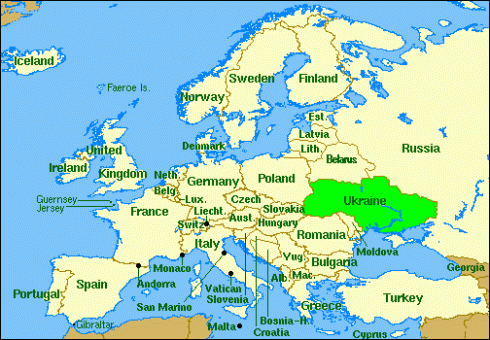
 What is so not-awesome about our news media is its propensity to relay to us news and events without the background context necessary have said news event make sense. Go take a look at the CBC’s reporting on what is happening in the Ukraine. I’ll reproduce the headlines here for sake of argument.
- Parliament votes to oust President Viktor Yanukovych
- Security forces now declining to take part in conflict
- Jailed opposition figure Yulia Tymoshenko may be released soon
- President and opposition sign deal meant to end crisis
- President Yanukovych leaves capital for pro-Russian eastern Ukraine
- Yanukoych accuses opposition of conducting a coup
- MPs replace speaker, interior minister
Fascinating stuff. But what does it mean? I mean, who is Yanukovych and what does his party stand for? Heck, what sort of political economic system does the Ukraine possess for starters. You can read all of those articles on Auntie Ceebs and not have even a fog-eyed view of what the hell is actually going on. The reporting we get suffers from what I’ll call the ‘keyhole syndrome’.
 Keyhole Syndrome is when people watching the news are presented with a important event but not the details surrounding said event that would allow them to make a decision, critical or otherwise about said event. Wow there is a coup attempt in Ukraine – how about that. How do we get from the Orange revolution to here? Do you even remember the orange revolution?
What is needed, honest readers is context, and I strive to provide a slightly larger keyhole looking into the events happening in the Ukraine. Read more in the full report at the Council for Foreign Relations website.
Economic Structure and Policies
Ukraine has a classic rentier curse. Oligarchs and politicians, often one and the same, extract rents from the transit of energy and other scams. Some prices are market based and others controlled, creating huge opportunities for arbitrage. Various licenses and concessions depend on political favor, facilitating corrupt lobbying, and oligarchs have manipulated the political process to ensure a supply of subsidized gas, coal, and electricity. Bursts of market reform in 1994–95 and 2000–2001 were only the minimum necessary to prevent international lenders from withdrawing completely. After 2004, the Orange Revolution’s leaders enacted populist measures rather than tackling systemic problems.
Notwithstanding relatively liberal privatization laws, the process came to benefit oligarchs. Most big enterprises were sold by closed discount cash sales. Today, without an effective legal system, all property remains insecure. Violent corporate raiding is widespread; oligarchs use mafia muscle to take over each other’s firms and scare away most foreign investors. The black economy accounts for 40 to 50 percent of official GDP. Ukraine has received support from international financial institutions, but these funds have been small relative to Ukraine’s GDP. The country’s failure to enact reforms has repeatedly marred its relationship with the International Monetary Fund.
Civil Society and Media
Ukraine’s civil society, though stronger than other aspects of democratic governance, remains weak. After the Orange Revolution, cohesion and engagement quickly disintegrated as people grew disillusioned by elites’ broken promises. Today, only 5 percent of Ukrainians belong to nongovernmental organizations (NGOs). The current Yanukovych government has curtailed freedom of assembly and used the security and tax services to harass activists. Despite this (or perhaps because of it), however, NGO activities are rising. Some elites, exasperated by the divided political opposition, are organizing civil society groups instead of pursuing political power.
Ukraine’s media have generally functioned as an instrument of power rather than an independent force. Many media companies have long been left in private hands under “reliable” oligarchic control, fostering self-censorship. The Orange Revolution allowed a window of media freedom, but today many journalists face bullying and bribery. By contrast, the internet remains lively and free, with growing social media and anticorruption sites.
Legal System and Rule of Law
The law in Ukraine is deliberately capricious and its application arbitrary. Because the population must constantly break the law, authorities can decide whom to prosecute, and they wield this authority to consolidate power. Punishment is used to disable anyone who challenges the system; forgiveness is used as patronage. Most judges are holdovers from the Communist era and continue to respond to instructions from officials. Conviction rates top 99 percent.
Reforms passed in 2010 have increased executive control over the judiciary. Yanukovych created two new courts to bypass relatively independent ones and he purged the Supreme Court and Constitutional Court. Other executive bodies gained control over judicial appointments. The ease with which authorities launched political prosecutions in 2011 and 2012—most prominently against Tymoshenko—showed the new system’s weakness. Today, politicians routinely take bribes from oligarchs or are oligarchs themselves. Members of parliament are immune from prosecution, making public office a gravy train. A place on an electoral list is estimated to cost $5 million in bribes to party leaders.
Government Structure and Division of Power
Ukraine has made almost every mistake imaginable in its institutional design. In the 1990s, it built ministries that recreated bad habits of the Soviet command economy. Prosecutors, tax police, and the former KGB were given too much power. Kuchma also expanded presidential authority but used it to act as the oligarchs’ patron. The constitutional changes to weaken the presidency agreed to during the Orange Revolution were therefore not necessarily bad ideas. However, they were hastily drafted and poorly implemented, allowing oligarchs to build an alternative power center in parliament. Nonetheless, the reversal of these changes in 2010 was unwise. It restored the status quo ante, rather than keeping the best of the reforms, and its aim was not rebalancing the system but entrenching Yanukovych’s administration.
Oh. So the Ukraine, despite its residual media memory as a ‘democracy’ is actually a oligarchy that thrives on looting the country of its wealth and maintaining its power through any means necessary.
A brief aside:this is the kind of system we inhabit here in North America. When you finally come to this conclusion (or not, please continue to consume the bread and circuses arranged for your leisure) the decisions our respective governments make become much more understandable and do have a rational, just not the type this is going to benefit *you*.
Ah, so now we can begin to understand what is going on in the Ukraine and start asking more reasonable questions to further our analysis of what is transpiring over there.
 When arguing about abortion and other moral topics, one is almost guaranteed to hear this lofty phrase trotted out. Like a a gentle desert sirocco, you only miss it when it isn’t there. People seem to have some very strange ideas about how we regularly treat each other here on Earth.
Realistically speaking, the phrase “sanctity of human life”is a misnomer. We here in the ‘Civilized West’ extinguish human life at a record pace whether actively though war or passively through indifference and neglect.
“But Arbourist!”, says the lay reader of DWR, “we in the West, have technology, capitalism and democracy that raises all of the boats and keeps our people well off. Well yes lay reader but, our relative prosperity is a direct result of our society almost always wielding the bigger stick and vigourously applying it to all of those people around us until they acquiesced or died under our not so gentle ministrations.
We laid waste other civilizations and then built our own in the blood soaked ashes of the wanton slaughter we perpetrated. There was no sanctity of human life then: it was us or them and jebus willing, it had better be them.
Yes, our lovely notions of morality are quickly set aside once it gets down to us vs. them. The best part is that “them” does not even need to be a threat; our benevolent political leadership will kindly manufacture a threat to dehumanize whomever stands in the way of our geopolitical goals (those damn Arabs having the temerity to live on top of our oil, for example). Sanctity of what again? If it wasn’t Churchill gassing the Arabs for being uppity for not subscribing to the benevolent British dictatorship administered by local satraps, it was those same Arabs who needed a good bombing/droning by the enlightened US of A to make them see all the benefits of a US sponsored benevolent dictatorship.
So many flavours of tyranny!
So many people that need to die before they understand what is good for them (us). All this respect for human life, and we’ve covered the ever so smallest part of the active destruction of humanity. For a change of depression let us flit over to the passive neglectful side of our deep commitment to the sanctity of human life.
From the Unicef site:
More than 70 per cent of almost 11 million child deaths every year are attributable to six causes: diarrhoea, malaria, neonatal infection, pneumonia, preterm delivery, or lack of oxygen at birth.
These deaths occur mainly in the developing world. An Ethiopian child is 30 times more likely to die by his or her fifth birthday than a child in Western Europe. Among deaths in children, South-central Asia has the highest number of neonatal deaths, while sub-Saharan Africa has the highest rates. Two-thirds of deaths occur in just 10 countries.
And the majority are preventable. Some of the deaths occur from illnesses like measles, malaria or tetanus. Others result indirectly from marginalization, conflict and HIV/AIDS. Malnutrition and the lack of safe water and sanitation contribute to half of all these children’s deaths.
But disease isn’t inevitable, nor do children with these diseases need to die. Research and experience show that six million of the almost 11 million children who die each year could be saved by low-tech, evidence-based, cost-effective measures such as vaccines, antibiotics, micronutrient supplementation, insecticide-treated bed nets and improved family care and breastfeeding practices.
Neat how that works. So much waste of human life, for what? A slight reduction in the standards of Western living? Well we certainly can’t see their suffering and dying, soooo…it doesn’t really count then right?
Right? Because sanctity of human life is such a important moral precept over here in the West. Because we value life so damn much and it is so important to us.
Bull.
Shit.











 bleatmop
 Mystro


 Dead Wild Roses
Your opinions…