
You are currently browsing the category archive for the ‘Politics’ category.
The Federal Court of Appeal’s January 16, 2026 decision in Attorney General of Canada v. Canadian Civil Liberties Association (2026 FCA 6) is not a cultural commentary on the Freedom Convoy. It is a narrower—and more consequential—statement about threshold: what must be true before the federal executive can lawfully reach for extraordinary powers.
The Court’s conclusion is unambiguous: “every appeal before this Court should be dismissed.” It affirms that “the declaration of a public order emergency was unreasonable,” and it adopts the word that matters in a rule-of-law system: “ultra vires.” It also states that “parts of the Regulations and Economic Order infringed paragraph 2(b) and section 8 of the Charter.” That is the spine of the judgment. Everything else is the anatomy supporting it.
What happened, in the Court’s own framing
The decision “results from the Proclamation Declaring a Public Order Emergency … issued … on February 14, 2022,” declaring “reasonable grounds to believe a public order emergency existed under subsection 17(1),” followed by “Emergency Measures Regulations” and the “Emergency Economic Measures Order” on February 15, 2022. Those instruments were deployed in the midst of what “came to be known as the ‘Freedom Convoy 2022’,” as “hundreds of vehicles” converged on Ottawa, alongside “a number of border blockades,” including the “Sweetgrass-Coutts, Alberta border crossing” and the “Ambassador Bridge.”
The Court also records the litigation path. On January 29, 2024, the Federal Court found “the reasons provided for the decision to declare a public order emergency did not satisfy the requirements” of the Act, and that some temporary measures “infringed section 8 and paragraph 2(b) … and were not justified under section 1.” The Attorney General appealed those findings; civil-liberties groups cross-appealed on peaceful assembly. The Federal Court of Appeal’s answer to the main question—was the invocation lawful and reasonable?—is no.
“Last resort” is not a slogan; it is a constraint
The most useful line in this decision is not a flourish. It is an instruction.
The Federal Court (quoted and endorsed in the appellate reasons) states: “Due to its nature and to the broad powers it grants the Federal Executive, the Emergencies Act is a tool of last resort. The GIC cannot invoke the Emergencies Act because it is convenient, or because it may work better than other tools at their disposal or available to the provinces.” It then ties that principle to factual assessment: “the evidence is clear that the majority of the provinces were able to deal with the situation using other federal law, such as the Criminal Code, and their own legislation.”
That pair of sentences does the real work. It rejects the idea—common in crisis politics—that “better” justifies “exceptional.” It anchors emergency powers to necessity, not preference.
The Court of Appeal adds a helpful nuance later: while the Act is “meant to be an instrument of last resort,” it “cannot be construed as a straitjacket” that forces Cabinet to exhaust every imaginable legal tool before acting. But that is not a concession to improvisation. It is a warning that the reasoning still has to be there, and it still has to meet “exacting” statutory demands.
Evidence, not atmosphere: “compelling and credible information”
A second throughline runs alongside “last resort”: the requirement that the executive’s belief be anchored in something sturdier than fear, political pressure, or generalized disorder.
The Court states the prerequisite in crisp terms: “the GIC must have reasonable grounds to believe, based on compelling and credible information, that threats to the security of Canada as described in section 2 of the CSIS Act existed.” And then it drops the verdict: “this evidence was lacking here.”
This is where the decision becomes a rebuke rather than a mere disagreement.
The Court rejects the attempt to stretch the statutory trigger to match the government’s policy urgency. It insists, “For the time being, we must take the Act as it reads, and not as the AGC would like it to read.” And it draws a sharp boundary around the phrase doing much of the litigation’s heavy lifting: “It would stretch beyond rationality the meaning of the words ‘serious violence’ … if they were to encompass purely economic consequences or speculative disruption of essential goods and services.”
That is a judicial way of saying: you don’t get to expand the fuse because you prefer the explosion.
When it turns to violence, the Court is equally direct. It notes that “the evidence is quite simply lacking” for serious violence against persons; and that, aside from the economic disturbance, “the only incident of violence put forward by the AGC was the seizure of a cache of firearms and ammunition at Coutts, as well as vague reports” of harassment, intimidation, and assault, plus the fact that Ottawa police were overwhelmed. “In our view, this is insufficient” to meet the “compelling and credible information” requirement for reasonable grounds.
Even where the protests were “disturbing and disruptive,” the Court concludes “they fell well short of a threat to national security.” It notes that this was “borne out by CSIS’s own threat assessment,” and it flags that an alternative assessment was requested but the Act was invoked “before it was completed.”
The implication is not subtle: emergency powers require proof-grade reasoning at the time of decision, not post-hoc narrative scaffolding.
Charter impacts: expression and financial measures
On expression, the Court endorses the Federal Court’s findings as to overbreadth and unjustified limits. It records that “the Regulations were overbroad to the extent that they criminalized the entire protest,” and that “the freedom of expression of peaceful protestors who did not participate in the actions of those disrupting the peace was infringed.” The appellate court’s own conclusion at the front end of the reasons affirms that “parts of the Regulations and Economic Order infringed paragraph 2(b) and section 8 of the Charter.”
It also disposes of the peaceful assembly cross-appeal without enlarging the rights analysis: “We are satisfied that the paragraph 2(b) infringement sufficiently accounts for the related right to assemble under paragraph 2(c), and decline to address the cross-appeal.”
On the financial measures, the Court’s concern is about sweeping power paired with loose identification and weak safeguards. It calls out “the lack of rigour contemplated in identifying individuals” who may have been subject to information-sharing provisions. Then it names the operational hazard bluntly: “The suggestion that financial institutions may have been expected to rely on information they obtained from news or social media reports or the internet … is troubling in the extreme.”
That line will survive because it captures a broader institutional truth: when the state deputizes private actors into enforcement, the state inherits the private actor’s epistemic sloppiness—unless it builds guardrails. The Court is signaling that the guardrails were not proportionate to the power.
What this decision changes (and what it doesn’t)
This judgment doesn’t settle the political argument about 2022. It does something more important: it narrows the legal escape hatch for future governments.
It teaches three lessons that will matter the next time Ottawa faces a sprawling, ugly, high-pressure public disorder:
- “Last resort” means necessity, not superiority. “Convenient” and “works better” are not lawful triggers.
- Economic harm is not a magic synonym for statutory violence thresholds. If Parliament wrote “serious violence,” courts will not applaud a creative rewrite.
- Extraordinary powers demand evidentiary discipline and procedural safeguards that can withstand sunlight. “Troubling in the extreme” is what happens when you skip that.
If the government seeks further appeal, the next stage will likely fight over deference, evidentiary sufficiency, and how “exacting” the threshold must be under real-time stress. But the shape of the precedent is already clear: the Act is not a general-purpose crisis broom. It is a weapon with a trigger guard, and the Court has just tightened the guard.

References
- Attorney General of Canada v. Canadian Civil Liberties Association, 2026 FCA 6 (Federal Court of Appeal, judgment delivered January 16, 2026; PDF).
- Justice Laws Website, Emergencies Act (R.S.C., 1985, c. 22 (4th Supp.); enactment note “[1988, c. 29, assented to 21st July, 1988]”). (Department of Justice Canada)
- The Canadian Encyclopedia, “War Measures Act” (notes repeal in 1988 and replacement by the Emergencies Act). (The Canadian Encyclopedia)
- Public Order Emergency Commission (POEC), Order in Council P.C. 2022-392 (April 25, 2022) and POEC site summary of establishment. (publicorderemergencycommission.ca)
A classically liberal society survives on habits, not slogans. It needs restraint, due process, toleration, and the willingness to lose without declaring the system illegitimate. Those habits are the machinery that lets disagreement stay political instead of becoming civil war by other means.
Here is the problem: liberalism can be weakened without censorship or coups. You dissolve it by corroding its reflexes. Make truth optional. Make process contemptible. Make opponents morally untouchable. Then the only “honest” politics left is permanent emergency.
Toolkits like Beautiful Trouble matter because they don’t merely argue for outcomes. They teach a style of conflict that can push a society toward that emergency posture. Not secretly. Openly. Proudly.
The mechanism: reaction as leverage
The core move is simple: the decisive moment is not what you do; it is how the target reacts. Beautiful Trouble states this as principle. Create a situation where the target has only bad options. If the target responds forcefully, you get optics of oppression. If the target hesitates, you get optics of weakness or complicity. Either way, you harvest narrative.
This is not foreign to the Alinsky lineage. The organizing sensibility there is similarly pressure-driven: personalize, polarize, keep heat on, force choices. Whether you call that “empowering the powerless” or “cynical theatre” depends on your politics. But the effect is measurable. It rewards escalation.
In an attention economy, that reward multiplies. The clip travels. The caption hardens. The audience concludes. Process arrives too late to matter.
Why this is corrosive to liberal life
Classical liberalism is not blind to power. It assumes power exists and will be abused. That’s why it builds constraints: rule of law, rights, neutral adjudication, stable procedures, and a civic ethic that treats opponents as citizens.
Revolutionary politics often treats those constraints as camouflage for domination. Once you accept that premise, liberal restraint stops being virtue and becomes collaboration. Due process becomes “violence.” Neutrality becomes “support for the status quo.” Compromise becomes betrayal.
That frame is solvent. It dissolves the very institutions that make peaceful reform possible. Courts become illegitimate. Journalism becomes propaganda. Elections become theatre. At that point, direct action isn’t one tool among many. It becomes the only “authentic” politics. And authenticity is a poor substitute for governance.
Three tactics that act like acid
1) Identity tricks that blur truth and theatre
Impersonation formats, spoof announcements, and “identity correction” are often defended as satire. Sometimes they are. But they also train a destructive habit: truth is what produces the right reaction.
In a low-trust society, that habit is gasoline. It makes people easier to steer. They learn to treat moral satisfaction as verification.
2) Reaction capture that rewards escalation
Media-jacking and engineered dilemmas push institutions into visible confrontation. Institutions then over-respond to avoid losing control. Activists then present the response as the point. The public is invited to judge the system from the most inflammatory ten seconds.
This is why incremental reform struggles. Incrementalism is procedural. It is slow. It is boring. It does not produce good clips. When politics is mediated by clips, boredom becomes political death. And the responsible becomes invisible.
3) Framing that turns disagreement into moral emergency
The most dangerous tool is not a hoax. It is framing that converts disagreement into existential crisis. Once politics is narrated as emergency, restraint becomes treason. Any compromise becomes proof of corruption. The only acceptable posture becomes maximal conflict.
That is how a society stops being governable. Not because people disagree, but because they can no longer share a procedure for disagreement.
The case for incremental progress
Incrementalism is mocked as cowardice. It is not. It is the political expression of two hard truths.
First, institutions are complex. Sudden shocks break things you cannot rebuild at will. Second, moral certainty is a poor engineer. It is good at burning. It is bad at designing.
Classical liberal reform says: specify the harm, propose bounded remedies, build coalitions, accept partial wins, and keep the legitimacy of procedure intact. That is not complacency. It is the recognition that power vacuums don’t stay empty, and that revolutions rarely end with stable liberty.
If you care about justice, you should fear the emergency habit. Emergency is where rights go to die. Emergency is where “temporary” powers become permanent. Emergency is where the loudest faction learns it can rule by accusation.
A prediction worth taking seriously
As these tactics normalize, politics will become less about persuasion and more about provocation. Institutions will either harden into managerial coercion or retreat into paralysis. Both outcomes invite more radicalism, because both outcomes confirm the radical story.
A liberal society that wants to survive has to stop rewarding engineered crisis. That means demanding evidence over captions, procedure over theatre, and reform over revolution, even when reform is unsatisfying. Especially then.

References
-
Beautiful Trouble toolbox and principle page (reaction as leverage).
Beautiful Trouble tactic pages: Identity correction; Media-jacking.
OR Books listing / bibliographic info for Beautiful Trouble editions.
Secondary summaries of Rules for Radicals (Alinsky overview used for comparison of tactical sensibility).
Beautiful Trouble is a public toolbox for creative activism: first a collaboratively assembled book, later an online repository, and now also a training ecosystem. Its pitch is not subtle. Movements don’t only need convictions; they need methods.
The core value of Beautiful Trouble is not that it “proves” anything about the morality of activism. The value is that it exposes a modern fact of politics: attention is terrain. If you want to understand contemporary protest, you have to understand how actions are designed to travel, how institutions are pushed into visible choices, and how audiences form conclusions with partial information.
The project’s structure supports that aim. It’s modular: tactics, principles, theories, and short case stories that can be mixed and reused. It describes itself as a kind of “pattern language,” and its licensing encourages adaptation. That makes it unusually legible as an object of civic study: it doesn’t hide the playbook.
What it optimizes for
Most people still think politics is mainly argument. It isn’t. Not anymore. It’s increasingly interpretation under time pressure.
A large share of the public will never read the policy memo, the injunction, or the investigative timeline. They will see a clip. They will inherit a caption. They will absorb a moral frame already installed. Beautiful Trouble is built for that environment. It treats activism as attention design: actions shaped to be seen, remembered, and shared.
One of its principles says the quiet part out loud: the decisive moment is often the target’s response. That is not inherently nefarious. It is a standard logic in asymmetric conflict. When you can’t move power directly, you provoke power into showing itself.
For media literacy, this yields a simple rule: some public actions are designed less to “state a grievance” than to produce a reaction that will be more persuasive than the grievance.
Three clusters worth understanding
The toolbox contains many tools, but three clusters matter for public comprehension because they recur across movements and because they interact strongly with journalism and social media.
1) Impersonation formats and “identity correction”
The toolbox includes tactics associated with hoaxes, spoof announcements, and “identity correction.” These actions usually aim to create a dilemma: if the target rejects the message, the target may look callous; if it accepts any part of it, the target concedes ground. Their success depends on speed. A claim that travels faster than verification can leave residue even after correction.
The neutral point is not “this is always unethical” or “this is always justified.” The point is functional: these tactics exploit a predictable weakness in information flow. Novelty beats confirmation. Moral satisfaction beats caution.
The reader’s defense is boring and effective: treat “too perfect” claims and “official-sounding” announcements as unverified until corroborated.
2) Media-jacking and reaction capture
Another cluster focuses on borrowing attention: hijacking an event, inserting into an opponent’s stage, or redirecting a news cycle. The target is forced into a choice: ignore the action and risk looking weak or indifferent; respond forcefully and risk producing the exact optics the activists want.
This is why the response becomes the payload. The goal is often to make the institution appear brittle, panicked, or oppressive, whether through its own errors or through selective presentation.
The media-literacy question here is straightforward: is the target reacting to a genuine threat, or to an engineered dilemma designed to force a visible response? Sometimes it’s both. Don’t let a viral clip collapse the distinction.
3) Framing and reframing as the main contest
The most consequential “tactic” is not a stunt. It is framing: assigning roles, values, and categories before evidence arrives. What counts as “violence”? What counts as “self-defense”? What counts as “harm”? What is “legitimate”?
Framing is unavoidable. Humans need categories. But because it is unavoidable, it can be weaponized. When framing succeeds, neutral description becomes socially costly. Even vocabulary starts to signal affiliation.
The most reliable defense is category discipline. Separate:
-
what happened (event),
-
what the rule was (policy),
-
what the law allows (legal),
-
what you think is right (moral),
-
what will work (strategic).
Framing tries to weld those together into one reflex. Citizens stay free by refusing that weld.
What this means for civic competence
Beautiful Trouble is a public, teachable catalog of activist methods. That is precisely why it matters. It’s a window into how modern movements think about leverage in an attention economy.
The neutral takeaway is not “activism is manipulation.” It is that contemporary politics runs on reaction, narrative compression, and low-context consumption. A public that wants to be hard to steer needs one habit: slow the tape when an event arrives already framed as a moral emergency.
That is media literacy now. Not cynicism. Pattern recognition. 🧠
References
-
Beautiful Trouble homepage / toolbox landing pages.
Beautiful Trouble principle page (“the real action is your target’s reaction”).
Beautiful Trouble tactic pages: Identity correction; Media-jacking.
-
OR Books listing for Beautiful Trouble: Pocket Edition.
-
ICNC resource entry describing Beautiful Trouble as book/toolbox/training resource.
-
Google Books bibliographic page for Beautiful Trouble: A Toolbox for Revolution.
In late December 2025, an X thread went viral by naming a pattern many people recognize but rarely formalize. The author argued that much contemporary activism doesn’t begin with an argument. It begins with an emotional capture: a suffering child, a traumatized testimonial, a stripped-down historical grievance, a demand to “listen,” and the implicit message that hesitation is moral failure. If the target asks for definitions, tradeoffs, or evidence, the thread claims the response is often not rebuttal but stigma—labels meant to raise the social cost of dissent.
To describe the mechanism, the thread borrows from psychologist Martha Stout’s The Sociopath Next Door, especially her warning about the “pity play”: an appeal to sympathy that disarms decent people and grants the manipulator moral cover. The point of the thread is not that political opponents are “sociopaths.” Its point is that sympathy can be used to purchase moral immunity, and once immunity is granted, scrutiny becomes taboo.
This matters because democratic persuasion depends on the difference between compassion and coercion. Compassion is attention to suffering. Coercion is using suffering to forbid questions.
So here is a practical test for readers who want to stay humane without becoming steerable.
The Narrative Pressure Test
When a cause arrives wrapped in urgency, run five questions before you assent.
1) What claim is being made, separate from the story?
A vivid story is not a thesis. A photo is not a policy. If the emotional payload is clear but the claim is vague, you’re being recruited before you’re informed.
A common trick is to start with something true (“this person is suffering”) and slide toward something contestable (“therefore this specific policy is the only decent response”). The bridge between those two is where reasoning belongs. If the bridge is missing, the message is operating as a shortcut.
2) What facts would falsify it?
Real claims have losing conditions. If disagreement itself is treated as evidence of malice, the message isn’t trying to persuade. It’s trying to sort people into “good” and “bad.”
This is where moral language becomes a weapon. “Act now or you’re complicit” is not analysis. It is time pressure dressed as conscience.
3) Who gets moral immunity?
Look for the doctrine of permanent innocence.
If a group is treated as incapable of agency, it will also be treated as incapable of responsibility. That exemption attracts opportunists and rewards escalation, because any request for standards can be reframed as “attacking victims.”
Pity is not the problem. Pity used as a shield against scrutiny is.
4) What action is being demanded, and who pays?
This question forces morality to meet arithmetic.
Is the demanded action symbolic (slogans, rituals, purges), or coercive (law, policy, firings, spending commitments, policing changes)? Who bears the downside risk? The people demanding sacrifice, or the bystanders who can’t opt out?
If the loudest moralizers don’t pay the costs, compassion may be functioning as status performance rather than responsibility.
5) What happens if we slow down?
True emergencies can survive scrutiny. Manufactured urgency cannot.
If a narrative collapses the moment you ask for definitions, evidence, and tradeoffs, it’s not designed to be tested. It’s designed to capture. The insistence on speed is often the tell, because speed bypasses the hard questions that expose weak claims.
The steelman objection
There is an obvious fear here: doesn’t this “weaponized empathy” framework become an excuse to ignore suffering?
It can. That’s the failure mode in the opposite direction. People learn the language of manipulation and use it as an anesthetic: any appeal to pain becomes “a pity play,” and they never have to do anything difficult again.
The disciplined position is harder:
-
Suffering is real and morally relevant.
-
Claims made on the back of suffering still need scrutiny.
-
Compassion is not permission to skip consequences.
A clean rule helps: grant humanity first, then demand the adult questions.
A person can be hurting and still be wrong. A cause can be sympathetic and still produce harm. A story can be true and still be used to sell a false conclusion.
Compassion with guardrails
The viral thread’s usefulness is not in its tribal conclusions. It is in the reminder that moral pressure can substitute for argument, and that good people are especially vulnerable to that substitution because they don’t want to be cruel.
The antidote is not numbness. It is sequencing. Feel the tug, then force the questions.
Empathy is a virtue. But empathy that cannot tolerate scrutiny becomes a lever. And a society that hands out levers this easily will eventually be moved by whoever learns to pull them best.
References
Ne_pas_couvrir X thread (Dec 23, 2025)
https://x.com/Ne_pas_couvrir/status/2003469502210572613
Martha Stout — “pity play” quote (Goodreads)
https://www.goodreads.com/quotes/1129543-rather-the-best-clue-is-of-all-things-the-pity
Martha Stout — The Sociopath Next Door (Goodreads quotes index)
https://www.goodreads.com/work/quotes/118905-the-sociopath-next-door
Bezmenov context (Snopes)
https://www.snopes.com/fact-check/1960s-kgb-experiments-subjects-brainwashed/
Bezmenov overview (Big Think)
https://bigthink.com/the-present/yuri-bezmenov/
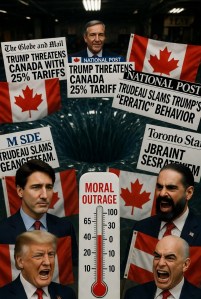
“Trump Derangement Syndrome” (TDS) isn’t a medical condition. It’s a rhetorical label for a recognizable pattern: Donald Trump becomes the organizing centre of political perception, so that every event is interpreted through him, and every interpretation is pulled toward maximal moral heat. Even people who agree on the facts can’t agree on the temperature, because the temperature is the point. Psychology writers describe it as a derogatory term for toxic, disproportionate reactions to Trump’s statements and actions.
And when politicians try to literalize it as a clinical diagnosis, it collapses into farce. It is fundamentally a political phenomenon, not a psychiatric one.
The useful question isn’t “Is Trump uniquely bad?” Reasonable people can say yes on qualities character, norms, rhetoric, policy, whatever. The useful question is: when does valid criticism become TDS? The answer is: when Trump stops being an object of analysis and becomes a gravity well.
What TDS looks like (beyond normal criticism)
Normal criticism is specific: this policy, this consequence, this evidence, this alternative. TDS is different in kind.
-
Totalization: Trump isn’t a president with a platform; he’s a single-cause explanation for everything.
-
Asymmetry: Similar behaviour in other leaders is background noise; in Trump it becomes existential threat (or, on the other side, heroic 4D chess).
-
Incentive blindness: The critic’s emotional reward (“I signaled correctly”) overrides the duty to be precise.
-
Predictable misreads: Even when Trump does something ordinary or mixed, it must be either apocalypse or genius.
This is why the term persists. It points generallyat a real cognitive trap: a personality-driven politics that makes judgment brittle. (It also gets used cynically to dismiss legitimate criticism; that’s part of the ecosystem, too.)
Why Canadian media amplifies it
Canada didn’t invent Trump fixation. But Canadian legacy media has strong reasons to keep Trump on the homepage. The reasons, in question, are not purely ideological.
1) Material proximity (it’s not “foreign news” in Canada).
When the U.S. president threatens tariffs, trade reprisals, or bilateral negotiations, Canadians feel it directly: jobs, prices, investment, and national policy all move. In Trump’s second term, Canadian economic and political life has repeatedly been forced to react to U.S. pressure: tariffs, trade disputes, and negotiations that shape Ottawa’s choices.
That creates a built-in news logic: Trump coverage is “domestic-adjacent,” not optional.
2) An attention model that rewards moral theatre.
Trump is an outrage engine. Outrage is a business model. Canadian mediais operating in a trust-and-revenue squeeze, and that squeeze selects for stories that reliably produce engagement. Commentators on Canada’s media crisis have argued that the Trump era intensified the trust spiral and the incentives toward heightened, adversarial framing.
3) Narrative convenience: Trump as a single, portable explanation.
Complex stories (housing, health systems, provincial-federal dysfunction) are hard. Trump is easy: one villain (or saviour), one emotional script, one endless drip of “breaking.” This is where amplification turns into distortion. A real cross-border policy dispute becomes a morality play; a complicated negotiation becomes a personality drama.
4) Coverage volume becomes self-justifying.
Once a newsroom commits, it has to keep feeding the lane it created. Tools that track Canadian legacy-media coverage of Trump-related economic conflict like tariffs for example, show how sustained and multi-outlet that attention can become.
The more space Trump occupies, the more “newsworthy” he becomes, because “everyone is talking about it” (including the newsroom).
None of this requires a conspiracy. It’s mostly incentive alignment: relevance + engagement + a simple narrative hook.
The cost: Canadians inherit America’s temperature
The predictable result is that Canadians import not just U.S. events, but U.S. emotional calibration.
-
Canadian politics gets interpreted as a shadow-play of American factions.
-
Domestic accountability weakens (“our problems are downstream of Trump / anti-Trump”).
-
Readers get trained to react first and think second, a reinforcing heuristic, because that’s what the coverage rewards.
And it corrodes trust: if audiences can feel when coverage is performing emotional certainty rather than reporting reality, they stop believing the institution is trying to be fair.
A reader’s heuristic: the TDS check
If this is going to be useful (not tribal), it needs a diagnostic you can run on yourself and on coverage:
-
Specificity test: Is the criticism about a policy and its consequences, or about Trump as a symbol?
-
Symmetry test: Would you report/feel the same way if a different president did it?
-
Proportionality test: Does the language match the evidence, or does it leap straight to existential claims?
-
Update test: When new facts arrive, does the story change—or does the narrative stay fixed?
-
Trade-off test: Are costs and alternatives discussed, or is “opposition” treated as sufficient analysis?
Pass those tests and you’re probably doing real criticism. Fail them repeatedly and you’re in the gravity well regardless of whether the content is rage or adoration.
The verdict
Trump is a legitimate target for strong criticism especially in a second term with direct consequences for Canada.
But the deeper media failure is not “being anti-Trump.” It’s outsourcing judgment to a narrative reflex: a system that selects for maximal heat, maximal frequency, and minimal precision. That’s how valid critique curdles into derangement—because it stops being about what happened, and becomes about what the story needs.
The fix is boring, which is why it’s rare: lower the temperature, raise the specificity, and let facts earn the conclusion.
Psychology Today — “The Paradox of ‘Trump Derangement Syndrome’” (Sep 5, 2024)
https://www.psychologytoday.com/ca/blog/the-meaningful-life/202409/the-paradox-of-trump-derangement-syndrome
The Loop (ECPR) — “Is ‘Trump Derangement Syndrome’ a genuine mental illness?” (Oct 13, 2025)
CBS News Minnesota — “Minnesota Senate Republicans’ bill to define ‘Trump derangement syndrome’ as mental illness…” (Mar 17, 2025)
https://www.cbsnews.com/minnesota/news/trump-derangement-syndrome-minnesota-senate-republicans/
Reuters Institute — Digital News Report 2025: Canada (Jun 17, 2025)
https://reutersinstitute.politics.ox.ac.uk/digital-news-report/2025/canada
The Trust Spiral (Tara Henley) — The state of media/trust dynamics (May 2024)
Reuters — “Trump puts 35% tariff on Canada…” (Jul 11, 2025)
https://www.reuters.com/world/us/trump-puts-35-tariff-canada-eyes-15-20-tariffs-others-2025-07-11/
Financial Times — “Canada scraps tech tax to advance trade talks with Donald Trump” (Jun 30, 2025)
https://www.ft.com/content/4cf98ada-7164-415d-95df-43609384a0e2
The Guardian — “White House says Canadian PM ‘caved’ to Trump demand to scrap tech tax” (Jun 30, 2025)
https://www.theguardian.com/world/2025/jun/30/canada-digital-services-tax-technology-giants-us-trade-talks
The Plakhov Group — Trade War: interactive visualizations of Canadian legacy-media coverage of Trump’s tariffs (Feb–Sep 2025 dataset)
https://www.theplakhovgroup.ca/detailed-briefs/trade-war-interactive-visualizations
When Iran’s streets erupt, the regime’s first move is rarely ideological persuasion. It is logistical suffocation: arrests, fear, and the severing of communication. In early January 2026, reporting described widespread internet and phone disruptions as protests intensified. The point is not subtle. A state that can’t control bodies tries to control visibility.
Western audiences, meanwhile, do not experience Iran directly. They experience coverage: what makes the front page, what becomes “live,” what gets a correspondent, what earns context, what gets a single write-up and then disappears. That gatekeeping function doesn’t require fabrication to shape reality. It only requires allocation. In practice, editorial choices determine whether an uprising feels like history in motion or distant static.
The claim here is narrower than the familiar “the media lies” complaint. It is this: large news institutions can augment or diminish a story by controlling three dials — timing, framing, and follow-through — and those dials often track narrative comfort as much as factual urgency.
The timeline the public actually receives
Iran’s protest cycle began in late December 2025 and accelerated quickly. Wire reporting described large demonstrations after the rial hit record lows, police using tear gas, and protests spreading beyond Tehran. A few days later, reporting increasingly emphasized the state’s repression and the communications clampdown as the crisis deepened. By January 8–10, the blackout itself and the scale of unrest were central features in major coverage, alongside reports of deaths, detentions, and intensifying crackdowns.
None of this is to say “there was no coverage.” There was. The question is what kind of coverage it became, and when. A story can exist in print while being functionally minimized: treated as episodic, framed as local disorder, or kept at a low hum until a single undeniable hook forces it to the foreground. In this cycle, the communications cutoff became that hook — a reportable meta-event that is easy to verify and hard to ignore.
The BBC dispute is illustrative. Public criticism accused the BBC of thin or late attention; BBC News PR rebutted that claim. The argument itself is the point: audiences can feel the throttle even when they cannot quantify it precisely. When trust collapses, people start timing the coverage.
How stories are diminished without denying facts
1) Timing: when an event is treated as real.
In closed societies, early information is messy: shaky videos, activist claims, regime denials, and silence during blackouts. Caution can be defensible. But caution is also a convenient lever. If the bar for “confirmed” rises selectively, timidity becomes bias with clean hands. The public doesn’t see the internal deliberations; it sees the lag — and a lag signals “this isn’t important.”
2) Framing: what the story is about.
A protest can be framed as “economic unrest,” “public anger,” “unrest,” “crackdown,” or “a legitimacy crisis.” These are not synonyms. Each frame assigns agency and moral clarity differently.
“Economic unrest” implies weather: hardship produces crowds, crowds disperse, life continues. “Legitimacy crisis” implies politics: a governing order is being contested. Amnesty’s language, for example, emphasizes lethal state force; Reuters emphasizes regime warnings and suppression; AP emphasizes spread, detentions, and the hard edge of state response. Those differences matter because they tell the audience whether this is a temporary spasm or a turning point.
3) Follow-through: whether the story becomes a continuing reality.
One report is not coverage. Coverage is cadence: daily updates, on-the-ground reporting, explanatory context, and sustained attention when the situation is still unclear. Regimes understand this. A blackout isn’t only about disrupting domestic coordination; it also disrupts the foreign media rhythm that turns unrest into sustained international pressure.
The steelman case for restraint
There are good reasons major outlets hesitate:
-
verification is genuinely difficult during shutdowns,
-
misinformation can be weaponized by the regime and opportunists,
-
reckless amplification can endanger sources.
These are real constraints, not excuses. But they are only persuasive when applied consistently. The public’s frustration arises when “we can’t confirm” functions as a brake on some stories and not others — when caution looks less like discipline and more like selective incredulity.
A practical heuristic for readers
A useful concept must do more than flatter a tribe. It should help a reader detect when they are being shown an event versus being shown a story about the event. This can be done with a simple diagnostic — the Narrative Throttle Test:
-
Latency: How long did it take for a major outlet to treat it as major?
-
Vocabulary drift: Did coverage move from “unrest” to “crisis” only after the evidence became unavoidable?
-
Cadence: Was it sustained, or did it appear as isolated updates with no continuity?
-
Agency: Were protesters described as political actors with aims, or as reactive crowds with emotions?
-
Comparative salience: What else dominated the same window, and why?
These questions do not require assuming malice. They only require accepting that agenda-setting is power — and that power is exercised even by institutions that believe they are merely “reporting.”
The consequence
Iran’s future will be decided in Iran. But the West’s perception of Iran is decided in newsrooms. When coverage is delayed, flattened, or treated as a passing disturbance, the public receives a smaller event than the one unfolding. That matters because attention is a constraint on brutality. It is not the only constraint, and it is not always sufficient — but it is real.
The cleanest conclusion is also the least dramatic:
Facts do not reach the public raw. Institutions deliver them — loudly, softly, or not at all.

References
AP — Protests erupt in Iran over currency’s plunge to record low (Dec 29, 2025)
https://apnews.com/article/ddc955739fb412b642251dee10638f03
AP — Protests near the 2-week mark as authorities intensify crackdown (Jan 10, 2026)
https://apnews.com/article/c867cd53c99585cc5e0cd98eafe95d16
Reuters — Iran cut off from world as supreme leader warns protesters (Jan 9, 2026)
https://www.reuters.com/world/middle-east/iran-cut-off-world-supreme-leader-warns-protesters-2026-01-09/
The Guardian — Iran plunged into internet blackout as protests spread (Jan 8, 2026)
https://www.theguardian.com/world/2026/jan/08/iran-plunged-into-internet-blackout-as-protests-over-economy-spread-nationwide
Amnesty International Canada — Deaths and injuries rise amid renewed cycle of protest bloodshed (Jan 8, 2026)
https://amnesty.ca/human-rights-news/iran-deaths-injuries-renewed-cycle-protest-bloodshed/
BBC report mirrored via AOL — Huge anti-government protests in Tehran and other cities, videos show (Jan 8–9, 2026)
https://www.aol.com/articles/iran-regime-cuts-nationwide-internet-003409430.html
https://ca.news.yahoo.com/large-crowds-protesting-against-iranian-201839496.html
BBC report mirrored via ModernGhana — Iran crisis deepens: protests spread with chants of “death to the dictator” (Dec 31, 2025)
https://www.modernghana.com/videonews/bbc/5/597647/
Telegraph (commentary) — Critique of BBC’s Iran coverage (Jan 9, 2026)
https://www.telegraph.co.uk/news/2026/01/09/the-bbc-iran-coverage-poor/
BBC News PR tweet responding to coverage criticism (Jan 2026)
https://x.com/BBCNewsPR/status/2007048343793570289
CTP-ISW — Iran Update (Jan 5, 2026)
https://www.criticalthreats.org/analysis/iran-update-january-5-2026
CTP-ISW — Iran Update (Jan 9, 2026)
https://www.criticalthreats.org/analysis/iran-update-january-9-2026
In late 2024 and early 2025, U.S. President Donald Trump repeatedly referred—sometimes jokingly, sometimes provocatively—to the idea of Canada becoming the “51st state.” These remarks reportedly began during conversations with then–Prime Minister Justin Trudeau and later appeared in public comments tied to trade disputes, tariffs, and economic leverage. Early reporting in both U.S. and Canadian outlets frequently described the remarks as characteristic of Trump’s hyperbolic negotiation style rather than as indicators of formal U.S. policy.
Canadian media coverage, however, quickly amplified the comments. Headlines and commentary increasingly framed the remarks as symbolic of American overreach or a potential threat to Canadian sovereignty. This framing coincided with heightened public attention to U.S.–Canada trade tensions and broader anxieties about economic dependence.
Following Trudeau’s resignation and Mark Carney’s rise to Liberal leadership, a snap federal election was called for April 28, 2025. At the outset of the campaign, the Liberals were trailing significantly in public polling. During the campaign, Liberal messaging increasingly emphasized the need to “stand up” to Trump-era pressure, warning that a Conservative government led by Pierre Poilievre could leave Canada exposed to U.S. demands or coercion. References to Trump’s “51st state” comments featured prominently in this broader narrative.
The election concluded with an unexpected Liberal minority victory, widely interpreted by commentators as influenced by a surge in nationalist sentiment and voter backlash against perceived American bullying. After the election, no U.S. policy moves or official statements suggested any genuine intent to pursue annexation, and Trump’s remarks continued to be linked primarily to trade pressure rather than territorial ambition.
Analytical Interpretation.
From an analytical standpoint, this sequence of events raises questions about how ambiguous external rhetoric can be transformed into domestic political leverage. Trump’s comments were provocative but informal; their political impact in Canada appears to have depended less on their substance than on how they were framed, repeated, and contextualized within a domestic campaign.
One interpretation is that Canadian media dynamics and electoral incentives interacted to elevate a symbolic remark into a perceived existential issue. In this reading, uncertainty itself became politically useful: the lack of a clear U.S. position allowed competing narratives to flourish, some of which emphasized worst-case scenarios rather than probable outcomes.
Another, more charitable interpretation is that heightened sensitivity to sovereignty concerns was a rational response to Trump’s unpredictability. Even without formal policy intent, critics argue, repeated rhetorical pressure from a powerful neighbor can legitimately influence voter behavior and campaign strategy.
A third interpretation lies between these poles: that while no annexation threat existed, the rhetoric nonetheless provided a mobilizing frame that shifted attention away from domestic issues such as housing affordability, inflation, and economic stagnation. Whether this constituted deliberate fear-manufacturing or opportunistic narrative adaptation is ultimately a matter of judgment rather than documentation.
Inviting the Reader’s Conclusion
What is clear is that the “51st state” rhetoric had political consequences in Canada despite the absence of any corresponding policy action. Whether those consequences reflect justified caution, media amplification, strategic political framing, or some combination of all three remains open to interpretation.
Readers may reasonably conclude that the episode demonstrates how modern democratic politics often operate less on concrete policy threats than on perceived risk shaped by narrative repetition. Others may see it as a case study in responsible vigilance toward an erratic ally. The available evidence supports multiple readings—and the distinction between them depends less on disputed facts than on how one interprets political incentives and media behavior in high-stakes elections.

Selected Sources
BBC News – Canadian PM reveals Trump brought up ‘51st state’ on March call (April 2025)
The Guardian – Trump’s chaotic threats won Mark Carney the Canadian election (April 2025)
The New York Times – On Canada’s Election Day, Trump Repeats ‘51st State’ Threat (April 2025)
CBC News – Carney says Trump raised ‘51st state’ during their call (April 2025)
CBS News – Canada’s Liberal Party wins election in turnaround seen as reaction to Trump threats (April 2025)
Wikipedia – 2025 Canadian federal election (accessed January 2026)











 bleatmop
 Mystro
 The Arbourist


 Dead Wild Roses
Your opinions…