
You are currently browsing the category archive for the ‘Politics’ category.
You can usually tell what kind of argument you’re about to hear before the argument is made.
It’s in the language.
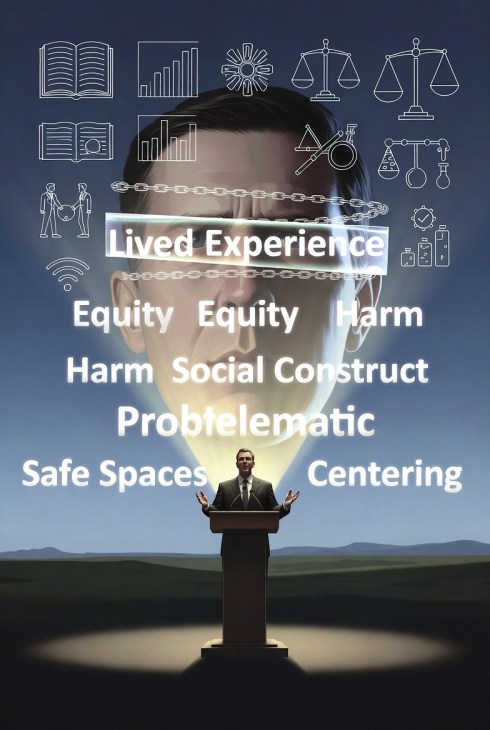
Certain words don’t just describe reality—they quietly reframe it, often in ways that make disagreement harder before it even begins. They shift the ground you’re standing on, sometimes without you noticing.
Once you recognize them, the pattern becomes difficult to miss.
“By the time the argument begins, much of it has already been decided.”
Here are a few to listen for.
“Lived experience”
Often used to elevate subjective accounts above other forms of evidence.
Experience matters. But when it becomes the final authority, it can no longer be questioned or compared. At that point, it stops being evidence and becomes a conclusion.
“Social construct”
A useful concept in limited contexts. Overextended, it suggests that because something is shaped by society, it is therefore arbitrary or infinitely malleable.
The move is subtle: from influenced by culture to not anchored in reality at all.
“Harm”
A word that has expanded far beyond physical or material damage.
Disagreement, discomfort, or perceived invalidation can all be folded into it. Once that happens, ordinary debate starts to look like misconduct.
“Equity”
Not the same as equality.
It shifts the focus from equal rules to equal outcomes. That shift often justifies unequal treatment in the name of correcting disparities.
“Centering” / “Decentering”
Signals who is allowed to speak, and whose perspective is treated as primary.
Less about argument, more about managing whose voice carries authority.
“Problematic”
A soft accusation that avoids specificity.
It implies wrongdoing without clearly stating what the problem is, which makes it difficult to respond directly.
“Safe spaces”
Originally about protection from harassment. Now often used to limit exposure to challenging or opposing ideas.
The definition quietly expands from safety from harm to safety from disagreement.
None of these words are inherently illegitimate. The issue is how they are used. Individually, they can be useful. In combination, they tend to narrow the space for disagreement.
When they appear together, they often shift discussion away from evidence, elevate subjective claims beyond challenge, and quietly limit what can be said without consequence. By the time the argument begins, much of it has already been decided.
When you hear language like this, a simple question is usually enough: what claim is being made—and could I reasonably disagree with it? If the answer is no, you are no longer in a normal debate. You are being asked to accept a framework, not evaluate an argument.
This pattern isn’t unique to any one ideology. It appears wherever language is used to secure agreement before the argument begins. Language doesn’t just communicate ideas—it sets the terms under which those ideas can be questioned, and sometimes whether they can be questioned at all.
The scandal around the Southern Poverty Law Center matters for one reason above all: it exposes a mechanism.
If the allegations now before a U.S. court are borne out, the charge is stark: an organization built to fight extremism may have been financially entangled with the very actors it claims to oppose. The SPLC says this was an informant program. The Department of Justice says it was something else.
That distinction matters legally. But analytically, the incentive structure is already visible.
Create the threat. Amplify the threat. Position yourself as the authority on the threat. Then monetize the response.
That loop is the story.
And once you see it, you can’t unsee it.
Because the real danger isn’t confined to one American organization. It’s the export model.
“When institutions depend on a problem for their legitimacy, they do not simply respond to it.
They begin—slowly, rationally—to ensure it never goes away.”
In Canada, the same structural incentives are in play. Groups like the Canadian Anti-Hate Network operate within a system where funding, relevance, and authority are tied to the persistence of “hate” as a visible social problem. They do not need to fund extremists to reproduce the same dynamic. They only need to expand the boundary of what counts as extremism.
That is the quieter version of the same loop.
If your mandate depends on the persistence of a threat, then ambiguity becomes an asset. Lines blur. Categories stretch. Dissent edges toward designation. Over time, the distance between “wrong” and “dangerous” collapses.
You don’t need burning crosses if you can redefine disagreement as harm.
This is where the SPLC story stops being scandal and starts becoming signal.
Because the underlying logic is identical:
- The problem must persist
- The threat must remain legible
- The institution must remain necessary
And if reality doesn’t supply enough fuel, the system has incentives to… supplement.
That doesn’t always mean fabrication. More often, it means selection, amplification, and framing. The worst examples are elevated. Edge cases become representative. Boundaries widen quietly.
Until the label “hate” no longer describes a phenomenon—it polices a conversation.
That’s the iceberg.
The visible scandal is shocking because it’s crude. Funding extremists while fundraising against extremism is a contradiction people can grasp immediately. But the more sophisticated version—the one that operates through classification, narrative control, and institutional trust—is harder to detect and far more durable.
And once embedded, it reshapes discourse itself.
People self-censor and institutions defer. Then the obsequious journalists haphazardly cite.
With no regard for truth the designation becomes the argument.
At that point, the system no longer needs to prove anything. It only needs to point.
The SPLC case, if proven, is the blunt instrument version of the problem. The more durable form operates without headlines, through incentives that reward threat maintenance over problem resolution.
That is the real risk.
Because when institutions depend on a problem for their legitimacy, they do not simply respond to it.
They begin, slowly and rationally, to ensure it never goes away.

Sources for readers
- US Department of Justice: https://www.justice.gov/opa/pr/federal-grand-jury-charges-southern-poverty-law-center-wire-fraud-false-statements-and
- CNBC report on the federal indictment of the SPLC:
https://www.cnbc.com/2026/04/21/splc-indicted-doj-extremism-funding.html - The Guardian coverage including SPLC’s response and defense:
https://www.theguardian.com/us-news/2026/apr/21/splc-indictment-doj-response - Juno News reporting on Canadian Anti-Hate Network funding and criticism: https://junonews.com/2025/03/15/canadian-anti-hate-network-government-funding-controversy/
Would people hold the views they do if they understood the first principles those views rest on?
I suspect many would at least pause. Not necessarily abandon their position, but slow down long enough to ask what exactly they are affirming. This is not a universal pattern, but it shows up often enough in public discourse to be worth paying attention to.
What I am describing is a kind of reverse percolation. Ideas that begin in highly abstract settings move downward into activism and identity, where they are simplified, moralized, and widely adopted. Something is lost in that movement. The underlying logic—the structure that gave the idea its shape in the first place—does not always make the trip.
Take a common example.
One influential strand of queer theory makes a striking claim: that identity need not be grounded in any stable essence, but instead takes shape in relation to what is considered normal or legitimate. At the level of theory, this is an attempt to examine how norms are constructed and how they operate, often in ways that are invisible to those who benefit from them.
But when that framework moves out of the seminar room and into everyday political identity, it tends to arrive in a thinner form. The scaffolding is gone. What remains is the posture.
“Ideas move downward into mass use, losing fidelity as they go, and return upward not as refinement, but as reinforcement—positions hardening around ideas that have already shed much of what made them coherent.”
That shift creates a tension that is easy to miss. If an identity is defined in relation to norms, then friction with those norms is not an accidental byproduct; it is part of the structure. Yet many who adopt the language of queer politics encounter that friction as if it were imposed entirely from the outside, rather than something partly generated by the logic they have taken on.
This is where the gap begins to open—between first principles and lived adoption.
What makes the dynamic more interesting is that it does not run in a single direction.
A similar distortion can be seen in conservative responses, where disparate strands of progressive thought are often folded together under the single label of “liberalism.” In doing so, distinctions that matter are blurred or lost altogether. Classical liberalism, with its emphasis on individual rights, pluralism, and limits on power, is not interchangeable with theoretical frameworks that aim to critique or unsettle those foundations.
Once those categories collapse into each other, critique starts to rest on unstable ground.
The result is less a clash of well-formed positions than a kind of mirrored simplification. On one side, ideas are adopted without much reference to their internal logic. On the other, they are opposed without being clearly identified. Whether the greater loss happens in adoption or in response is difficult to say, and in a sense it does not matter; each process feeds the other.
This is where the reverse percolation effect completes its cycle.
Ideas move downward from abstraction into mass use, losing fidelity as they pass through each layer. They are then taken up again, interpreted, resisted, or amplified by others working from similarly partial models. What comes back is not refinement. It is reinforcement—positions hardening around ideas that have already shed much of what made them coherent.
At that point, disagreement becomes inevitable, because the participants are no longer operating within the same conceptual frame. Understanding does not so much fail as it is quietly set aside.

Glossary
Queer Theory
A body of academic thought that examines how categories like sex, gender, and sexuality are constructed, regulated, and experienced. It often challenges the idea that these categories are fixed or natural, instead emphasizing their fluidity and relationship to social norms. The field is not monolithic, and different strands place different weight on these elements.
Classical Liberalism
A political philosophy centred on individual rights, equality before the law, freedom of expression, and limits on state power. It forms the foundation of many modern democratic systems and emphasizes pluralism within a shared legal framework.
Most Canadians could not point to the Strait of Hormuz on a map.
They are about to feel it anyway.
Roughly a fifth of the world’s oil passes through that narrow stretch of water. When it is stable, nobody notices. When it is threatened, everything downstream begins to move—prices, shipping costs, political calculations. Geography, in this sense, is not abstract. It is mechanical.
The current tension in the region has put that mechanism back into play.
It does not require a full disruption to matter. Risk alone is enough. Insurance premiums rise. Tanker routes adjust. Traders price in uncertainty. Oil climbs before a single barrel is lost. And because energy sits underneath everything—transport, production, food—the effects do not stay contained.
“When energy moves, everything else follows.”
This is where the distance between foreign policy and daily life collapses.
Higher fuel costs bleed into groceries. Shipping delays ripple into availability. Central banks, already cautious, hesitate further. Governments face pressure to respond to a problem they do not control. The system tightens, not through a single shock, but through accumulated friction.
None of this depends on whether people are paying attention.
The map exists either way.

Mark Carney is on the verge of a majority government. Not through an election, but through parliamentary drift—floor crossings, seat math, timing.
There is nothing illegitimate about this. Canada’s system allows it. MPs are not bound to their parties, and governments rise or fall on confidence, not sentiment. This is how the machine is designed to work.
But design is not the same as meaning.
A majority government is not just a number. It is a signal—of public consent, of direction, of political momentum. When that signal comes from an election, it carries weight. When it emerges mid-cycle, assembled rather than won, it carries ambiguity. The risk is not how the majority is formed. The risk is how it is interpreted.
This is where mandate inflation creeps in.
A government that reaches majority status without facing voters may begin to act as though it has received a fresh endorsement. It hasn’t. It has acquired power within the rules, but without a reset of public consent. That distinction matters, especially when decisions carry long time horizons or high political cost.
None of this requires outrage. It requires discipline. A government in this position should govern with an awareness of how it arrived where it is—carefully, incrementally, and with an eye toward legitimacy, not just legality.
Because the test is not whether the system allows it.
The test is whether the public continues to accept what follows.

Peter Boghossian recently offered a blunt explanation for a pattern that keeps confusing otherwise sensible people: why do parts of the far left reject reforms that would plainly improve public institutions?
Because improvement is not the goal.
His point is simple and ugly. Widespread distrust is not an accidental byproduct of the project. It is the project. Once you understand that, a good deal of otherwise baffling behavior stops being baffling.
Most normal people still assume institutions are flawed but fixable. You identify the problem, apply targeted reforms, restore confidence, and move forward. That model only works if you believe the institution has legitimacy to begin with.
But if you believe the system is oppressive at the root, then reform becomes a threat. Reform stabilizes. It restores credibility. It gives ordinary people a reason to think the institution can work. That, in turn, weakens the deeper claim that the whole structure must be replaced.
That is the real pivot.
When an institution is judged illegitimate in principle, making it function better is not progress. It is betrayal.
You can see this logic across multiple domains.
Take policing. There are decades of incremental reforms aimed at reducing misconduct and increasing accountability: body cameras, improved training, procedural reforms, better supervision, smarter deployment. None of these require abolishing the institution. Yet much of the activist energy after 2020 did not center on reform but on delegitimization: defund, abolish, systemic rot. The point was not to make policing more trustworthy. The point was to make trust itself look naive.
The same pattern appears in universities. The legitimacy problem here is obvious enough that even casual observers can see it. Entire disciplines operate with strikingly narrow viewpoint diversity. The easiest possible trust-building reform would be to widen that range, even modestly. Boghossian’s line about putting “Republicans in sociology departments” works precisely because the ask is so small. If institutional credibility mattered, this would be low-hanging fruit. The refusal to do even that suggests that credibility is not the objective.
The pattern extends further than those two examples. Courts, media, bureaucracies, corporations, elections—again and again, incremental fixes are dismissed as cosmetic. The rhetoric moves quickly from flawed to structural, from structural to systemic, from systemic to irredeemable. Once that move is complete, reform itself becomes suspect. If a change makes the institution more trusted, it is condemned for helping preserve something that, in the activist imagination, deserves to fall.
There is, to be fair, a serious version of the opposing argument. Sometimes institutions really do absorb small reforms in order to preserve larger injustices. In those cases, reform can function as a pressure valve rather than a cure. That argument has force in isolated cases.
Applied universally, it hardens into dogma.
If every institution is corrupt at the root, and every reform is dismissed as insufficient by definition, then no improvement can ever count as evidence. Distrust is no longer a conclusion drawn from performance. It becomes a prior commitment. At that point, the argument stops being diagnostic and becomes theological.
What sharpens Boghossian’s observation is the context in which he made it. He was responding to a discussion about the strategic use of institutional distrust as a political weapon. That matters because the logic is no longer confined to one faction. Different actors now use different language to sell the same underlying message: the system is captured, illegitimate, beyond repair, and unworthy of loyalty. The branding varies. The effect does not.
Delegitimization replaces reform.
And when both ideological extremes converge on the claim that institutions cannot be repaired, the political center—where repair actually happens—begins to disappear. That is not a healthy equilibrium. It is unsustainable.
This also clarifies why evidence-based reform so often fails to persuade true believers. You can show improved outcomes. You can demonstrate lower abuse, better process, stronger accountability, fairer procedures. It will not matter to people whose real argument is not about performance but legitimacy. They are not asking whether the institution is getting better. They are asking whether it deserves to survive.
That distinction matters.
It means reform is still necessary, but not for the reason many assume. Reform is necessary for the persuadable public, for ordinary citizens who still want institutions that work and can still distinguish corruption from legitimacy. It is not likely to win over those already committed to collapse.
It also means the defense of institutions has to be more explicit than many liberals seem comfortable making it. Not blind loyalty. Not sentimental trust. Not a denial of failure. Something firmer than that: flawed, self-correcting institutions are worth defending because the alternatives to reform are usually far worse than reform’s imperfections.
Something always fills the vacuum.
It is rarely better.
Boghossian’s insight matters because it strips away a comforting illusion. Many people still assume everyone in public life is arguing, however bitterly, about how to make institutions function better. They are not. Some are arguing about whether those institutions deserve to exist at all.
Once you see that clearly, the repeated rejection of easy reforms stops looking irrational. It starts looking strategic.
And strategies aimed at destroying trust cannot be answered by trust alone. They have to be met with reforms that work and with the confidence to say, plainly, that imperfect institutions are still worth defending.

References
Primary source
- Peter Boghossian, X post on institutional distrust and reform. – https://x.com/peterboghossian/status/2041046766351736873?s=20
Suggested supporting references
- Pew Research Center, Public Trust in Government: 1958–2024
- National Academies of Sciences, Proactive Policing: Effects on Crime and Communities
- Cynthia Lum et al., systematic review on body-worn cameras
- Neil Gross and Solon Simmons, The Social and Political Views of American Professors
- Mitchell Langbert et al., research on faculty political imbalance
There’s a popular line making the rounds:
“I’m communist with my family, socialist with my friends, liberal with my country, and capitalist with the rest of the world.”
It’s clever. It’s also half right—and half sloppy.
The part worth keeping is simple enough: scale changes the rules.
What works for five people does not scale to fifty million. Not because people become worse, but because the system itself becomes something different. A family, a circle of friends, a town, a nation—these are not just larger and smaller versions of the same thing. They are different kinds of coordination problems.
Start with the family. From a distance, it can look vaguely “communist”: shared resources, little formal accounting, distribution by need rather than contract. But that description confuses appearances for mechanism. Families do not work because they have stumbled onto a workable version of communism. They work because they are held together by thick trust, intimate knowledge, moral obligation, and affection. You know who is trying, who is struggling, who is coasting, and who is carrying more than their share. Love and duty do much of the coordinating work that, elsewhere, would have to be done by prices, rules, or enforcement.
That is not an economic system. It is a moral one.
Expand outward to friendship networks and you get something looser but still recognizably personal. Friends split restaurant bills unevenly, help each other move, pick up tabs, lend money, and trade favors without keeping a precise ledger. Reciprocity exists, but it remains informal because reputation still does the work. The group is small enough that selfishness has social consequences, and generosity has memory.
Still not socialism. Still a trust network.
Scale it again, though, and the whole structure changes. Once you move from dozens of known people to millions of strangers, the conditions that made those smaller systems work begin to disappear. You no longer know the participants. You cannot directly observe effort. Reputation becomes local rather than systemic. Free riding becomes harder to detect and easier to excuse. The moral visibility that kept the small group coherent starts to fade.
And that is before you even reach the information problem.
Mises and Hayek saw this clearly. In a large society, the knowledge needed to coordinate production, consumption, scarcity, and changing local conditions is radically dispersed. No planner can gather it all in a usable form, still less process it in real time. Prices do something extraordinary here: they compress enormous amounts of scattered information into signals people can actually act on. They tell producers where demand is rising, tell consumers where scarcity is biting, and help strangers coordinate without ever needing to know one another.
But information is only half the story. The other half is incentives, and this is where many soft-focus arguments about solidarity fall apart.
In a family, the bond is part of the reward. Parents sacrifice for children because they love them. Children often learn obligation because they are formed inside a web of expectation and attachment. Friends help each other because affection, shame, pride, and mutual memory all shape conduct. In a large anonymous system, those bonds weaken. Once effort and reward drift too far apart, behavior changes. People conserve effort, game criteria, hide costs, seek advantages, and respond to whatever incentives the system actually creates rather than to the moral language used to defend it.
That is why bloated systems so often fill up with evasion, rent-seeking, bureaucratic padding, and endless struggles over who pays, who receives, and who gets to define fairness. This is not mainly because people are unusually wicked. It is because incentives shape conduct more reliably than rhetoric does.
The problem is not that people become monsters at scale. The problem is that systems stop being personal.
At small scale, coordination is moral and relational. At large scale, it must become impersonal and systemic.
That is where markets enter—not as a sacred ideology, but as a coordination mechanism built for strangers. Prices transmit information. Profit and loss impose discipline. Competition corrects error. Contracts reduce uncertainty. None of this requires perfect virtue. That is precisely the point. Markets work not because people are angels, but because the system does not depend on them being angels.
That is why they scale.
Now, a fair steelman is necessary here, because the redistributive instinct is not born from pure foolishness. Advocates of more social-democratic or socialist arrangements are often responding to something real. Human beings are not just market actors. They are children, parents, dependents, pensioners, caregivers, and sometimes casualties of bad luck they did not choose. A society that treats every need as a private burden and every vulnerability as a market outcome to be endured will become efficient in a narrow sense, but also harsh, brittle, and politically unstable. The desire to soften outcomes, provide public goods, and preserve a baseline of dignity is not irrational. It is, in many cases, a morally serious response to genuine dependency.
That much should be conceded.
What should not be conceded is the next leap: the claim that because markets need moral and political correction, they can therefore be replaced as the primary mechanism of large-scale coordination. They cannot. A decent society may use the state to cushion, insure, stabilize, and set guardrails. But the moment it starts treating political instruction as a substitute for price signals, or good intentions as a substitute for incentive alignment, it begins to lose the information and discipline that complex systems require.
As systems scale, coordination must shift from relationships to mechanisms, and from assumed goodwill to aligned incentives.
This is also why the original slogan overshoots. Markets are not the only thing that scales. States scale too, in limited and specific ways. Law, infrastructure, policing, and certain public goods are not produced by market exchange alone. And between the family and the nation lies an entire middle world of institutions—firms, charities, churches, schools, municipalities, associations—that mix trust, hierarchy, rules, custom, and incentives in different proportions.
The real lesson, then, is not “capitalism good, everything else bad.” That is too crude to be useful.
The real lesson is that systems must be judged by the kind of coordination problem they are trying to solve. Small groups can run on trust because trust is visible and enforceable. Large societies cannot. They need mechanisms that work under conditions of anonymity, partial knowledge, conflicting interests, and imperfect virtue. Any model that ignores those conditions will eventually break, no matter how beautiful its moral language sounds at dinner.
That is the recurring mistake. People take the emotional clarity of small-group life—sharing, sacrifice, mutual care—and try to project it onto systems too large for those tools to govern. When the result disappoints, they blame greed, selfishness, or insufficient solidarity. They almost never blame the mismatch between the model and the scale.
They should.
Because the deepest constraint here is not moral. It is structural.
You can run a family on trust. You can run a country on rules. But if those rules ignore incentives, trust will not save you.

References for Curious Readers
F. A. Hayek, “The Use of Knowledge in Society” (1945).
The classic statement of the knowledge problem: why the information needed to coordinate an economy is dispersed among millions of people and cannot be fully centralized. Published in The American Economic Review.
Ludwig von Mises, “Economic Calculation in the Socialist Commonwealth” (1920).
The foundational statement of the economic calculation problem: without market prices for capital goods, rational large-scale allocation becomes impossible.
Elinor Ostrom, Nobel Prize Lecture, “Beyond Markets and States” (2009).
Useful as a corrective to simplistic binaries. Ostrom’s work shows that some common resources can be governed successfully through rules, enforcement, and local institutions rather than either pure markets or total central control.
Nobel Prize in Economic Sciences 2009 – Popular Information / Summary.
A concise overview of why Ostrom and Oliver Williamson mattered: economic life is governed not only by markets and states, but also by firms, associations, and other institutions. This supports the essay’s “missing middle layer” point.











 bleatmop
 Mystro


 Dead Wild Roses
Your opinions…