
You are currently browsing the category archive for the ‘Politics’ category.
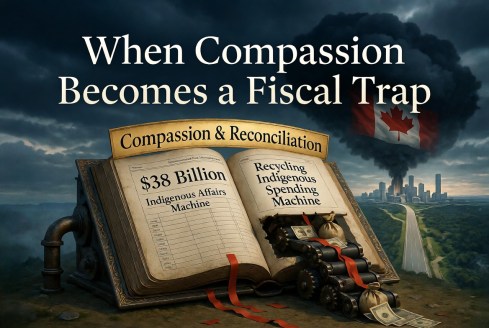
Canada’s Indigenous spending model has a problem it can no longer hide behind good intentions.
We are spending roughly $38 billion a year through core departments alone, after a decade of rapid expansion. The question is not whether that money is justified in principle. The question is whether it works.
On the outcomes that matter most—housing, child welfare, clean water reliability, and long-term economic independence—the answer is uneven at best and stagnant at worst. Progress exists. It is real. But it is not proportional to the scale of the spending. That gap between money spent and results achieved is the whole argument.
A system that cannot convert large, sustained spending into durable independence is not compassionate. It is failing.
The current model does not primarily produce independence. It manages dependency.
Spending has risen sharply, yet the Auditor General still found unsatisfactory progress on 53% of prior recommendations across core areas such as water, health access, emergency management, and socio-economic gaps. That is the mechanism in plain terms: more money flows, the system expands, compliance and administration thicken, and outcomes move slowly.
This is not just a funding shortage. It is a delivery failure.
And a delivery system that cannot convert major, repeated spending increases into reliable improvement is not neutral. It is misallocating resources at scale.
Canada is not bankrupt. But it is not insulated from fiscal reality either.
Federal spending is approaching half a trillion dollars. Debt-service costs are rising. Demographics are tightening the margin for error. You do not need a full sovereign-debt crisis for political choices to narrow. You just need pressure. A serious downturn, rising interest costs, or prolonged fiscal strain can force governments into reprioritization very quickly.
And when that happens, governments do not trim politely. They cut where they can.
That is where the current model becomes morally and fiscally dangerous at the same time. A system built on permanent federal transfers is stable only while those transfers keep flowing at politically tolerable levels. The moment that assumption weakens, those most dependent on the state become the most exposed to its limits.
That is the point too many sentimental arguments glide past. Dependency is not merely expensive. It is fragile.
A support model that only works while fiscal capacity keeps expanding is not a support model. It is a fair-weather dependency machine.
The present structure also rewards the wrong things. It rewards program expansion over completion, compliance over outcomes, announcements over maintenance, and federal management over local accountability. Money moves. Reports get written. Conditions improve, if they improve, far too slowly.
Look at drinking water. Ottawa rightly points to advisories lifted over the past decade. That progress matters. But Ottawa’s own figures also show that long-term advisories remain, and that many systems still require operational improvements before advisories can be lifted. That is not mainly a ribbon-cutting problem. It is a maintenance and systems problem. Building is politically photogenic. Sustaining is harder. The current model has often been better at funding capital headlines than at securing competent long-run operation.
The same broader pattern appears elsewhere. Indigenous children remain dramatically overrepresented in foster care. In 2021, Indigenous children made up 7.7% of children under 15, but 53.8% of children in foster care. A system that absorbs this much money and still leaves such ratios in place does not get to call itself successful because it can point to process, intent, or moral vocabulary.
If a model is expensive, underperforming, and fragile, it does not get preserved untouched. It gets triaged.
That means being willing to contemplate deep reductions—on the order of half to two-thirds over time—not as punishment, but as forced prioritization. The case is not for abandoning Indigenous communities. The case is for abandoning the fantasy that every current layer of spending is equally necessary, equally effective, or equally defensible.
Not everything should survive.
What should be protected is what is plainly essential: clean water systems with funded long-term maintenance, core health and emergency services, schooling, literacy, child protection, housing tied to credible upkeep plans, and communities that demonstrate effective local governance capacity.
What should be cut, compressed, or eliminated is the non-essential layer that accumulates in every morally protected spending regime: duplicative federal administration, consultant-driven program layers, pilot projects that never scale, compliance regimes that consume resources without clearly improving lives, and symbolic reconciliation spending detached from measurable outcomes.
If a program cannot show serious, durable improvement, it does not get to exist because it sounds compassionate in a press release.
This is where critics will predictably panic and moralize. They will say that Indigenous communities cost more to support because of historical injustice, geographic isolation, damaged infrastructure baselines, and the enduring effects of state misconduct. That is the strongest version of the opposing case, and parts of it are obviously true.
Historical injustice matters. Geographic isolation matters. Remote delivery costs are real. Weak starting conditions are real.
But that argument does not rescue the current model.
Historical injustice explains the starting line. It does not excuse a decade of rapidly expanding budgets with only partial and uneven progress. A moral claim to support is not the same thing as a proof that the delivery structure works. And after this much spending, defenders of the status quo still cannot point to outcome improvement proportionate to the scale of expenditure.
That matters because dependency wrapped in the language of reconciliation is still dependency. A model that leaves communities structurally tied to Ottawa’s fiscal condition is not empowering them. It is exposing them.
The answer, then, is not cuts for their own sake. It is reallocation.
Savings from the non-essential layer should be redirected in two directions. First, toward fiscal stabilization, because a state that loses control of its finances loses control of its choices. Second, toward connective infrastructure: roads, bridges, utilities, and other corridors that physically integrate isolated communities into provincial economies and reduce the permanent cost of remoteness.
Isolation is not an identity. It is, in significant part, an engineering and governance problem.
If you do not solve that problem, you will subsidize its consequences forever.
Historical injustice explains the starting line. It does not excuse ten years of bigger budgets with only marginal gap closure.
This is the part polite politics hates to say aloud. A country that refuses to discipline failing systems during periods of relative control increases the odds that future discipline will arrive under pressure instead. Markets impose limits. Debt-service costs impose limits. Fiscal stress imposes limits. In more extreme scenarios, countries lose the luxury of setting their own reform timetable and their own reform terms.
Better a hard reallocation now than a panicked contraction later.
Better to choose triage than to have it chosen for you.
The question is not whether Canada should support Indigenous communities. It should.
The question is whether Canada is willing to admit that the current model is not delivering enough, not fast enough, and not durably enough to justify its scale. Because the worst outcome is not reform. The worst outcome is drift: a system that consumes, reassures, and congratulates itself right up until the moment it cannot continue.
And then fails all at once.
References
- Indigenous Services Canada and Crown-Indigenous Relations and Northern Affairs Canada planned spending totals for 2025–26, approximately $38 billion combined.
- Office of the Auditor General of Canada follow-up finding that 53% of prior recommendations showed unsatisfactory progress.
- Indigenous Services Canada figures on long-term drinking water advisories, including advisories lifted and those still active.
- Statistics Canada figures showing Indigenous children as 7.7% of children under 15 but 53.8% of children in foster care in 2021.
- Federal spending and debt-pressure context from the budget and main estimates material summarized in the source text.
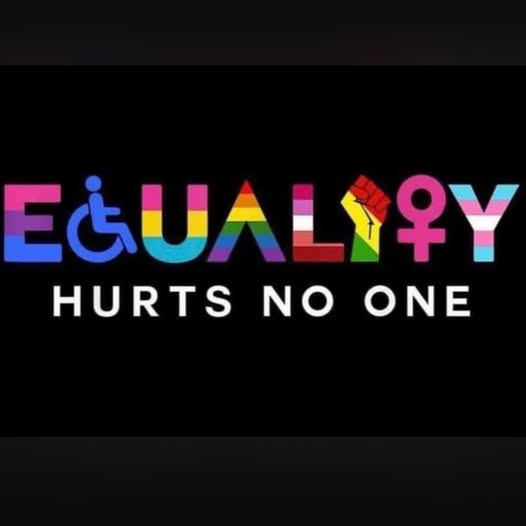
There’s a reason this image works. It uses a word almost everyone agrees with—equality—and then quietly fills that word with something else. The result is not an argument. It’s a substitution.
Look at it closely. The word “EQUALITY” is rendered in bright, appealing colors, layered with symbols of recognizable identity categories: disability, sexuality, gender, race, activism. Beneath it, the slogan: “hurts no one.” At the level of feeling, this is uncontroversial. Of course equality hurts no one. That’s the point of the concept. Equal treatment under the same rules is the baseline promise of any liberal order. But that is not what the image is actually depicting. The text says equality. The visual payload says something else entirely.
Equality, properly understood, is individual and procedural. It asks a simple question: are the same rules being applied to each person, regardless of who they are? It does not guarantee equal outcomes. It does not engineer results. It does not sort people into categories and adjust treatment accordingly. It holds the line at equal standing before the law and equal access to opportunity. That is why it is durable. It does not require constant intervention or measurement. It does not need to know who you are in order to decide how you should be treated.
The imagery in this poster points in a different direction. It is not concerned with individuals. It is concerned with groups. Each symbol represents a category that, within contemporary political frameworks, is treated as requiring not just equal treatment, but differential treatment in order to achieve parity of outcomes. That is the logic behind quotas, preferences, representational mandates, and a wide range of institutional policies now grouped under the umbrella of equity. That distinction matters. Because once you move from equal treatment to managed outcomes, you have to start making choices about who gets what, and why.
This is where the slogan “hurts no one” stops doing honest work. Equality, in the classical sense, really does not hurt anyone. It simply refuses to privilege or penalize based on identity. Equity, by contrast, is not costless. It reallocates opportunities. It lowers or shifts standards in some contexts. It elevates some groups explicitly. That may be justified in specific cases, but it is not neutral, and it is not universally painless. Someone is always paying the adjustment.
The poster resolves this tension through a familiar rhetorical move. It collapses the distinction. By wrapping equity-coded symbols inside the word equality, it invites the viewer to endorse a more controversial framework under the banner of a universally accepted one. The move is subtle enough that many people will not notice it, but strong enough that disagreement can be framed as opposition to “equality” itself. That is not clarification. It is camouflage.
The poster says equality. It is not. And pretending otherwise is not harmless, no matter how bright the colors or how reassuring the slogan.
You can see the tell in the composition. If the message were truly about equality in the classical sense, the image would not need to foreground identity categories at all. It would not need symbols. It would not need color-coding. The entire point of equality is that the categories do not matter when rules are applied. Here, the categories are the point. They are not incidental. They are doing the conceptual work.
None of this means the concerns associated with those categories are trivial or illegitimate. Some are serious. Some are contested. Some are overextended. All of them deserve to be argued on their own terms. But that argument has to be made honestly. It cannot be smuggled in under a word that already carries broad moral agreement.
This is the broader pattern. Take a term with a stable, widely accepted meaning. Expand or alter the underlying concept. Keep the original word. Let the new meaning ride on the old legitimacy. If challenged, collapse the distinction and accuse critics of opposing the original value. It is effective. It is also corrosive.
Words are not decoration. They are load-bearing. If we stop distinguishing between equality and equity, we lose the ability to argue about either of them clearly. And when that happens, policy follows confusion. Decisions get made without admitting what is being traded off, or who is being prioritized. That is not a small failure. It is how serious disagreements get papered over until they break.
This is how activists frame their lies and misdirection.

Here is their bullshittery in full:
The introduction of new rules restricting participation in women’s sport categories to “biological females”, determined through mandatory genetic screening and testing, imposes exclusionary criteria. These measures not only bar transgender women from competition, but target and disqualify cisgender women with differences in sex development.
This policy will apply to the Los Angeles 2028 Olympic Games and beyond, despite the absence of clear evidence that any transgender women were poised to participate in those Games. The IOC’s approach aligns itself with the U.S. government’s 2025 executive order “Keeping Men Out of Women’s Sports” which threatened to withdraw funding from organizations that permit transgender athletes to compete and to deny visas to certain athletes seeking to participate in the Los Angeles Olympics. The convergence of international sport governance with exclusionary state policy raises serious concerns about the politicization of athletic participation and the erosion of independent, rights-respecting governance.
“While framed as a measure to ensure fairness, this policy imposes exclusionary criteria that will disproportionately harm transgender women and also place cisgender women at risk, particularly those with natural biological variations,” says Aaden Pearson, Trans Rights Legal Fellow at the Canadian Civil Liberties Association. “The policy authorizes intrusive scrutiny of women’s bodies and asserts authority over who gets to participate as a ‘real’ woman under the guise of regulation.”
This policy will have detrimental impact on Canadian athletes that may be barred from participating in the Olympics because of this policy who otherwise would qualify to represent Canada.
A rights-respecting approach to sport must be grounded in inclusion, evidence, and proportionality. Fairness and human dignity are not mutually exclusive. The legitimacy of sport depends on ensuring that all athletes are able to participate without discrimination.
The CCLA calls on the IOC and national sporting bodies to:
- Immediately reconsider the implementation of these eligibility rules;
- Ensure that any policies governing participation in sport are evidence-based, proportionate, and consistent with international human rights obligations; and
- Uphold the principle that sport must be accessible to all, without discrimination.
The legitimacy of sport depends not only on fairness in competition, but on fairness in access. Policies that exclude, surveil, and stigmatize athletes have no place in a rights-respecting sporting system.”
————————
When a civil liberties organization cannot define a category, it cannot defend a right.
That is the move.
The IOC’s policy does not abolish sport as a “human right.” It sets an eligibility rule for the female category: from LA 2028 onward, athletes in that category must pass a one-time SRY gene screen, using saliva, a cheek swab, or blood. Athletes who do not qualify are still eligible for male, mixed, or open categories. This is not exclusion from sport. It is boundary enforcement within sport.
That distinction is the entire argument, and the CCLA refuses to engage it.
Instead, it leans on the language of “inclusion” as though inclusion means entitlement to every category. But sport has never worked that way. Weight classes exclude. Age divisions exclude. Paralympic classifications exclude. Women’s sport exists because sex matters. Calling sex-based eligibility “exclusionary” does not answer that reality. It simply renames the boundary and hopes no one notices.
The claim that the policy “targets cisgender women with differences in sex development” is similarly evasive. The IOC framework uses SRY screening because it is strong evidence of male development. World Boxing’s policy is explicit: eligibility for the women’s category excludes athletes with Y-chromosome material or male androgenization. The relevant question is not whether someone identifies as a woman, but whether they have undergone male development. The CCLA substitutes sympathetic language for that question rather than answering it.
The argument about there being no “clear evidence” of transgender women poised to compete in LA 2028 is weaker still. Rules are not written only after a problem becomes numerically large. They are written to clarify the category before competition begins. “There aren’t many” is not an argument against having a rule. It is an admission that the rhetoric is disproportionate to the scale of the issue.
“It treats female sport as though it were an access program rather than a sex-based category.”
The claim of “intrusive scrutiny” is also inflated. The IOC’s first-line test is a one-time genetic screen using saliva, cheek swab, or blood. That is not the same thing as the mid-20th century abuses activists like to invoke. A serious civil-liberties analysis would distinguish between limited modern verification and historical excess. This statement deliberately blurs them.
And then there is the core contradiction. The CCLA says fairness and dignity are not mutually exclusive. That is true. But it follows that female athletes can be treated with dignity and retain a protected category that excludes males. The CCLA resolves this tension by dissolving the category instead. In practice, its position requires female athletes to absorb the cost: compromised fairness, weakened boundaries, and—in contact sports—elevated risk.
That is not a neutral rights framework.
It is a redefinition of rights in which access to the female category is prioritized, and the integrity of that category is treated as negotiable.
A civil liberties organization should be able to state the purpose of a category before it critiques its rules. The CCLA does not. It treats the female category as a site for validating identity claims rather than as a sporting class organized around sex.
Once that happens, the conclusion is pre-determined.
Female boundaries become suspect.
Enforcement becomes cruelty.
And reality becomes something to be managed with language.

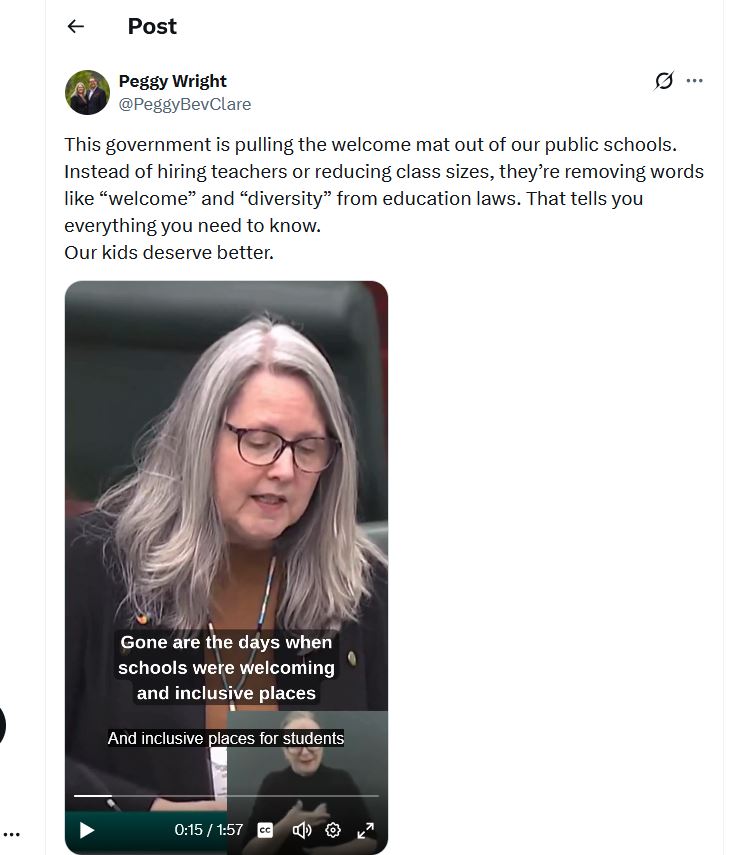
Posted by the NDP’s Peggy Wright on X.
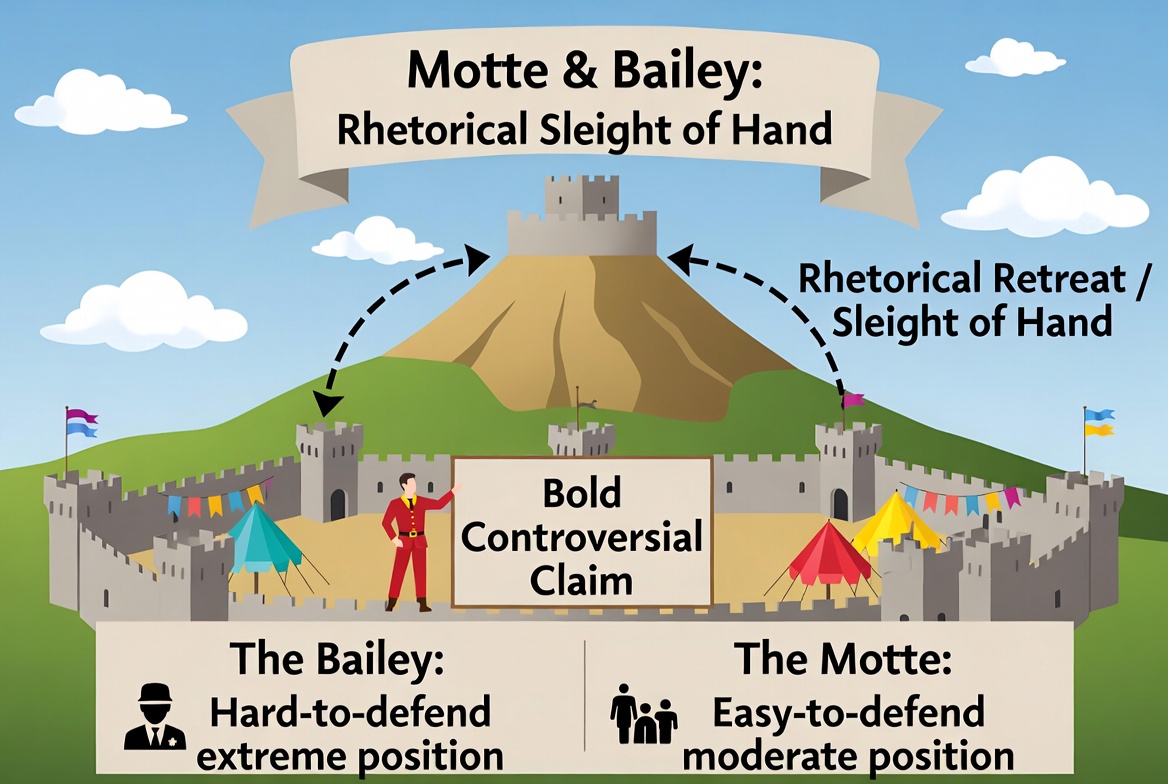
There is a recurring pattern in modern policy debates that most people sense but struggle to name. The argument presented to the public is not the policy that gets implemented. Instead, a broadly agreeable claim—something no reasonable person would oppose—is used to carry a far more specific and contested agenda into law. By the time the details become visible, the argument has already been won at the level that matters.
This is the structure known as the motte and bailey. The “motte” is the safe, defensible position: a statement so benign it feels almost churlish to resist. The “bailey” is the real position—the one with consequences, tradeoffs, and enforcement mechanisms. The move is simple. Sell the motte. Build the bailey. When challenged, retreat to the motte and accuse critics of attacking something obviously good.
You can see the pattern clearly in the recent dispute over education language. The public claim is that schools should be “welcoming,” “inclusive,” and respectful of “diversity.” No serious person objects to that in the abstract. But those terms are not operating as neutral descriptions. They have acquired specific policy meanings, often tied to particular ideological frameworks, institutional practices, and expectations placed on teachers and students. When legislation attempts to narrow or neutralize that language—shifting toward behavior-based standards like “safe and caring” environments grounded in responsibility and respect—the response is immediate: the government is “removing welcome,” attacking “diversity,” harming children. The motte is invoked as if it were the policy itself. The bailey disappears from view.
Watch the Move
In a recent legislative speech, MLA Peggy Wright provides a clean example of how this works in practice. She begins with a familiar image:
“Albertans put welcome mats in front of their doors. It means ‘come on in’ and we’re glad you are here.”
No disagreement is possible there. It is a moral and cultural baseline. But then the shift occurs. A change in statutory language becomes:
“the UCP is pulling up the welcome mat from all public schools.”
A metaphor replaces the policy. The audience is invited to react to exclusion rather than examine the legislation. The escalation continues:
“Gone are the days when schools were welcoming and inclusive places… celebrating diversity and uniqueness.”
At this point, the argument is no longer about wording. It is about intent, character, and harm. The key moment follows:
“the latest amendments… would strip words like ‘welcoming’ and ‘diversity’ from it.”
This is where the real question should be asked: does removing those words remove the underlying protections, or does it replace one framework of description with another? That question is never addressed. Instead, the speech returns immediately to moral framing:
“Diversity is a strength.”
In the abstract, yes. But the dispute is not over the abstract claim. It is over what “diversity” means in policy and practice. By collapsing the contested meaning into the harmless one, the argument avoids defending the actual implications. Criticism of the policy is recast as opposition to a universal good.
“The argument people agree to is not the policy that gets implemented.”
The most revealing line in the speech is this:
“Words are important… because they set the tone.”
That is true—and it explains the entire strategy.
This pattern isn’t random. It reflects a broader shift in how language is used in politics. Words like “diversity,” “inclusion,” and “safety” are no longer just descriptive. They function as instruments. If language helps shape how institutions operate and how people interpret reality, then controlling definitions becomes a form of power. Under that logic, you don’t need full public agreement on the details of a policy. You need agreement on the framing. Once that is secured, the content can expand behind it.
That helps explain why the motte and bailey is so effective. It allows advocates to operate on two levels at once. The public-facing level is morally attractive and broadly supported. The operational level is narrower, more contested, and often insulated from direct scrutiny. When the two are conflated, consent is manufactured. People believe they are endorsing a general principle when, in practice, they are enabling a specific program.
It works because most people are not trained to interrogate language this way. “Inclusion” sounds like inclusion. “Diversity” sounds like a mix of backgrounds and perspectives. “Safety” sounds like protection from harm. The terms carry moral weight before any definition is examined. By the time someone asks what they actually entail in practice, the rhetorical ground has already shifted. Opposition can be framed as hostility to the value itself rather than disagreement with its implementation.
The cost is not just confusion. It is the erosion of honest disagreement. If every critique of a policy can be recast as an attack on a universally accepted good, then meaningful debate becomes impossible. Language stops clarifying differences and starts concealing them. Institutions drift, not because the public has clearly chosen a direction, but because the terms of choice were never presented plainly.
This is why the technique matters. It is not just sharp rhetoric. It is a way of bypassing consent. If citizens cannot distinguish between the principle they are being asked to affirm and the policy that will follow from it, then they are no longer participating in a genuine democratic process. They are being managed through language.
If you think this reading is unfair, read the full remarks below and decide for yourself.
Appendix: Full Speech Transcript (April 2, 2026)
How to read this: Watch for the shift between general claims (“welcome,” “diversity”) and the specific policy being discussed. The argument depends on treating them as the same.
Full transcript of the video (Alberta Legislative Assembly session, ~1:57 long):
“Mr. Speaker, Albertans put welcome mats in front of their doors. It means ‘come on in’ and we’re glad you are here. And welcome to our house.But now the UCP is pulling up the welcome mat from all public schools.Gone are the days when schools were welcoming and inclusive places for students, celebrating diversity and uniqueness.That’s because the latest amendments to the Education Act would strip words like ‘welcoming’ and ‘diversity’ from it.This government combed through that bill and pulled the word ‘welcoming’ out eight times.Not satisfied with making our public schools less inviting — even as they function as important community hubs for many of our communities — then they went through and chopped the word ‘diversity’ out five times.Diversity is a strength.It used to say so in government policy, in legislation. But I guess not anymore.Words are important, Mr. Speaker, and that’s because they set the tone.When those in charge are threatened by words like diversity, welcome, and sense of belonging, there’s a problem. Because this is then about ideology and politics outside the classroom, not within.Instead of focusing on reducing class sizes, hiring teachers, and ensuring supports are there for all kids who need them, we get this distraction from a bill and government intent to narrow the frame so much that there is room for only one worldview: the UCP’s.And that’s the point.Straight out of the authoritarian playbook, Mr. Speaker.But, Mr. Speaker, our kids deserve that welcome mat back. I, for one, am extremely happy to let them know that they can expect it come next election, when it’s NDP in government and UCP — not our kids — who will find themselves unwelcome.”
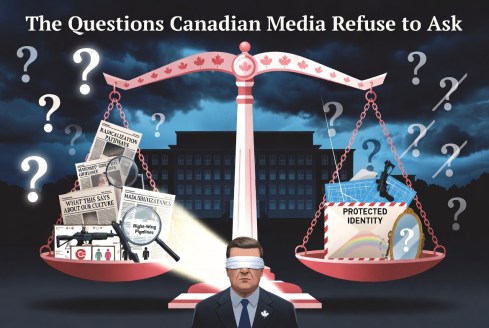
Canadian media know how to do pattern recognition when they want to.
Give them the right suspect, the right ideology, or the right grievance story, and they will produce instant analysis about pathways, warning signs, radicalization, social meaning, and what the event “says” about the culture. But let violence intersect with a politically protected identity category, and the appetite for explanation suddenly disappears.
That is the real story here.
A youth in Nova Scotia is accused in a foiled school attack plot involving online coordination, handwritten plans, imitation weapons, hate symbols, and threats. Weeks earlier, Canada saw the Tumbler Ridge massacre, one of the country’s rare school-linked mass shootings, carried out by a trans-identified male with prior mental-health-related police contacts. Two cases do not prove some grand law. They do, however, justify a question. When identity disturbance, grievance, alienation, and violence begin to cluster, are we allowed to notice, or does the conversation get shut down the moment the demographic becomes inconvenient?
That question is treated as indecent when it should be treated as basic public seriousness.
The point is not that trans identification causes violence. That would be a stupid claim, and an unserious one. The point is that severe identity instability, grievance, social isolation, and moral insulation from scrutiny can form a combustible mix, and our institutions become evasive when gender ideology is somewhere in the picture. They know how to be curious. They simply become selective about when curiosity is allowed.
That selectivity matters because schools are not seminar rooms. They are places where adults are supposed to notice risk before bodies hit the floor.
Instead, the public gets the usual flattening language. Troubled youth. Mental health struggle. Isolated incident. Complex circumstances. All of that may be true as far as it goes. What is missing is any willingness to ask whether a culture that treats identity claims as sacred, untouchable, and morally beyond scrutiny might also be making honest risk assessment harder than it should be. If a young person’s entire psychic life is being organized around grievance, estrangement, fantasy, and a demand that reality ratify the self at all costs, that is not automatically a violence pathway. But it is certainly not nothing.
And yet the moment this territory appears, Canadian media go soft in the head.
“When violence intersects with a protected identity category, Canadian media suddenly lose their appetite for explanation.”
They will interrogate masculinity, whiteness, right-wing pipelines, online extremism, misogyny, colonial resentment, and institutional failure when those frames are available. But when gender ideology may be part of the unstable mix, the analysis collapses into vagueness. Suddenly nobody wants to generalize. Nobody wants to connect dots. Nobody wants to risk saying the wrong thing. The protected category gets narrative shelter that other categories do not receive.
That is not neutrality. It is selective curiosity.
None of this means most gender-distressed youth are violent. Of course they are not. But public safety is not served by pretending that every cluster of instability must be discussed in the most generic terms possible just because one part of the profile has become politically delicate. Schools, parents, and the public deserve better than ritual euphemism after every near miss or body count.
The issue is not a proven demographic pattern. The issue is that when violence and identity pathology appear together inside a protected narrative, Canadian media suddenly lose their nerve. They stop asking explanatory questions not because the questions are irrational, but because the answers might offend the wrong people.
And that is how taboo makes serious societies stupider than they can afford to be.
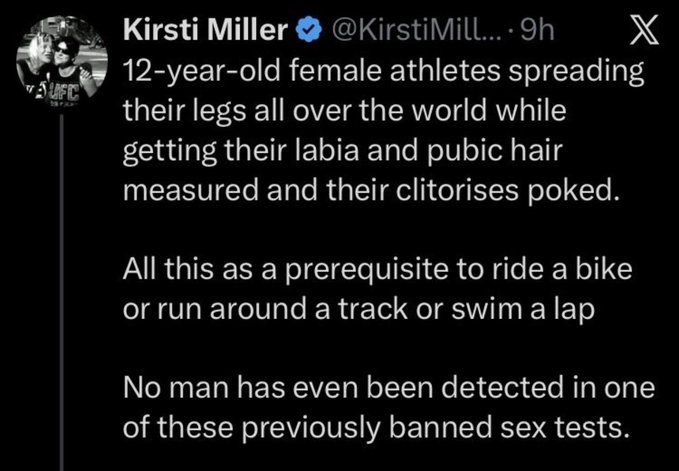
This is not argument. It is selective framing used to shut the argument down before it begins.
Yes, sport once used degrading sex tests. The old “nude parade” era was real. Women were subjected to visual and even anatomical examination in the 1960s, and those practices deserved to die. But that is not the current rule. The current activist trick is to drag the ugliest abuses of the past into the frame, staple them to a modern eligibility rule, and hope the reader is too disgusted to notice the switch.
The IOC’s new Olympic rule is not genital inspection of random girls. Reuters reports it is a one-time SRY-gene screen for elite female-category eligibility, using saliva, a cheek swab, or blood, and that it applies from LA 2028 onward to the Olympic pathway, not to amateur sport. Athletes who test positive can still compete in male, mixed, or open categories. That is not barbarism. It is category enforcement.
World Boxing is also not what the tweet implies. Its published policy applies to athletes over 18 in World Boxing-owned or sanctioned events, using a once-in-a-lifetime PCR or equivalent genetic test. Again, this is not “little girls can’t ride a bike without a genital exam.” It is a rule for elite competition in a combat sport where fairness and safety are not decorative concerns.
That is why this rhetoric is dishonest. It does not answer the real question, because the real question is hard: if female sport is a protected sex category, how is that category enforced when eligibility is disputed? Instead of answering that, activists change the subject. They substitute panic imagery, selective history, and moral blackmail. They want “naked parade” and “cheek swab” to feel like the same thing. They are not the same thing.
“A category that cannot be enforced is not protected. It is ornamental.”
The old methods were degrading and scientifically crude. Fine. Then make the process narrower, cleaner, and more private. But do not pretend that the female category can exist on the condition that no one is ever allowed to verify it. A category that cannot be enforced is not protected. It is ornamental. And that is the actual goal of this rhetoric: not to protect women from cruelty, but to make fairness, boundaries, and safety in female sport impossible to defend without first apologizing for something nobody is proposing.
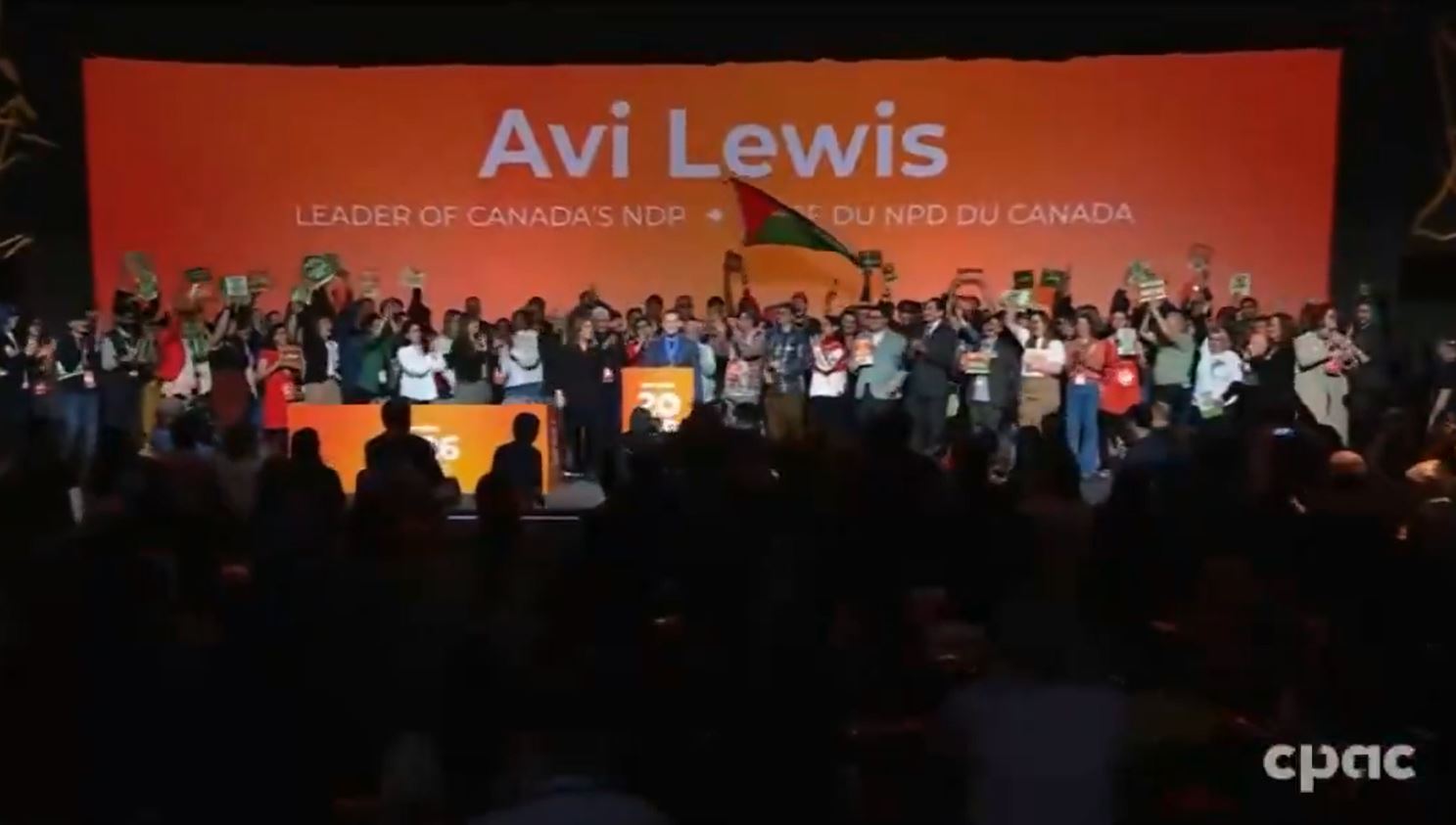
The election of Avi Lewis as leader of the federal NDP is not a routine leadership change. It is a directional shift, and not a subtle one. Under Jack Layton, the NDP was a labour party first and a movement second. It spoke the language of wages, jobs, unions, and working-class dignity. It was left-wing, yes, but it was still anchored in the material economy Canadians actually live in. Lewis’s NDP flips that order. The organizing principle is no longer the worker. It is the cause.
This is a party moving from social democracy toward activist politics. Look at the priorities. Lewis’s platform centers a Green New Deal framework that treats climate policy not as one file among many, but as the axis around which everything else turns. He has aligned himself with a politics that is openly hostile to new fossil fuel development, including pipelines, LNG expansion, and further oil and gas growth. That has consequences. Canada is not an abstract emissions profile. It is a country where entire regions such as Alberta, Saskatchewan, and Newfoundland are economically structured around resource extraction. Supply chains stretch across provinces. Public revenues depend on it. A politics that treats those sectors as something to be rapidly wound down is not neutral. It is redistributive by destruction.
“Jack Layton’s NDP tried to defend workers inside the economy Canada actually had. Avi Lewis’s NDP looks far more interested in remaking Canada around activist priorities, even if that means sacrificing the workers and regions that built the party’s old base.”
That is the core rupture. Layton’s NDP tried to expand its coalition by speaking to workers where they were. Lewis’s NDP speaks to them about where they should be. That difference sounds small, but it is not. One builds from existing economic reality. The other attempts to override it. Supporters will argue this is necessary. Climate change is real. Transition is unavoidable. Delaying it increases long-term costs. A Green New Deal promises new jobs, new industries, and a more sustainable economy. There is truth in that. The problem is not whether transition happens. It is how.
A politics that promises that no worker will be left behind while simultaneously targeting the industries that employ those workers is making a timing claim it cannot guarantee. Transitions are not theoretical. They are lived. If replacement industries lag, and they often do, workers do not experience a just transition. They experience unemployment, relocation, or downward mobility. Layton understood that tension and tried to manage it. Lewis appears far more willing to push through it.
There is a second shift, quieter but just as important. Lewis’s politics are deeply embedded in activist networks, including the kind of internationalist cause politics that increasingly dominates sections of the contemporary left. That includes intense pro-Palestinian activism, a space that in recent years has repeatedly struggled, or refused, to draw clean lines between legitimate criticism of Israeli policy and rhetoric or associations that slide into hostility toward Jews as a group. That matters for a national party. Not because criticism of Israel is forbidden, it is not, but because leadership sets tone. When a movement ecosystem blurs those lines, the result is predictable: internal division, public backlash, and the corrosion of trust among voters who still expect a federal party to maintain basic moral clarity. The problem is not criticism. The problem is drift, indulgence, and the refusal to police one’s own side when the language curdles.
The NDP’s historical strength was its credibility with working Canadians. If it becomes seen primarily as a vehicle for activist causes, climate absolutism, movement politics, and international solidarity campaigns, it risks losing that base without replacing it. Urban activists are loud. Workers are numerous. Parties that forget that distinction tend to learn it the hard way.
The NDP has not simply chosen a new leader it has chosen a new radical center of gravity. It has moved from worker-first pragmatism to cause-first transformation, from building within the system to trying to remake it around activist priorities. That is a radical departure from the party of old. And if it fails, it will not be the activists who pay the highest price.











 bleatmop
 Mystro


 Dead Wild Roses
Your opinions…