
You are currently browsing the category archive for the ‘Politics’ category.
By now the pattern should be familiar. A movement begins with a grievance, often a real one. It then defines the good chiefly by what must be abolished: oppression, domination, impurity, exclusion, hierarchy, stigma. The ideal remains vague, but the stain is vividly named. Reality resists. Limits persist. Tradeoffs do not disappear. At that point the movement faces a choice. It can revise its ambitions in light of the world as it is, or it can moralize the gap between promise and outcome. When it chooses the second path, disappointment hardens into blame, blame hardens into sorting, and sorting prepares the way for coercion.
That is the political logic this series has traced. The danger does not lie in idealism as such. A society without ideals becomes cynical, managerial, and spiritually thin. The danger begins when an ideal cannot survive contact with limits. Then every obstacle looks illegitimate. Every compromise looks corrupt. Every dissenter looks stained. The world is no longer a difficult place to govern. It becomes a field of obstruction to be purified.
The question, then, is what politics looks like once that temptation is recognized. The answer is not indifference. It is not quietism. It is not a shrug in the face of genuine injustice. The answer is a recovery of political adulthood. That recovery begins with three recognitions that negative idealism resists at every stage: limits, tradeoffs, and tragedy.
First, politics must recover the category of limits. Human beings are finite. Institutions are blunt. Knowledge is partial. Incentives matter. Scarcity does not vanish because a cause is morally urgent. Conflict does not disappear because a slogan sounds redemptive. Not every social friction is evidence of oppression. Not every persistence of imperfection is proof of sabotage. A mature politics begins by asking what kind of order flawed people can actually sustain, not what kind of redeemed world can be imagined at emotional full stretch.
“The refusal to admit tradeoffs does not abolish them. It merely disguises them until one side is forced to absorb the cost in silence.”
Second, politics must recover the reality of tradeoffs. Goods collide. Inclusion can conflict with standards. Freedom can conflict with equality. Privacy can conflict with recognition. Safety can conflict with access. Truth can conflict with the social desire to avoid offense. This is not a defect in politics. It is politics. The refusal to admit tradeoffs does not abolish them. It merely disguises them until one side is forced to absorb the cost in silence.
That point matters especially where female boundaries are concerned. One of the clearest signs of political infantilism in our time is the demand that women treat sex-based boundaries as optional whenever they obstruct a moral narrative someone else wishes to impose. Privacy, fairness, vulnerability, and safety are not relics of prejudice. They are goods. They sometimes conflict with other claims. That conflict cannot be solved by euphemism or moral intimidation. It must be faced as a tradeoff and judged accordingly. A politics that cannot say this plainly has already surrendered reality to abstraction.
Third, politics must recover the category of tragedy. Some conflicts do not admit a clean moral victory. Some losses cannot be fully repaired. Some goods cannot be simultaneously maximized. There are wounds in social life that can be mitigated but not abolished, tensions that can be managed but not transcended. Tragedy is not a counsel of despair. It is a protection against fanaticism. Once tragedy is denied, every unhealed wound becomes someone’s crime.
These three recognitions do not solve politics. They civilize it. They narrow the space in which utopian movements can turn ordinary disappointment into moral accusation. They remind us that not every unresolved problem is evidence of bad faith, and not every limit is a betrayal. Most importantly, they restore the possibility of settlement.
Settlement is not a glamorous word. It lacks the heat of liberation, the purity of justice, the romance of revolution. But settlement is what makes free societies livable. It is the hard-won agreement to live together under conditions of disagreement, conflict, and imperfection without constantly converting those conditions into moral war. It asks less of politics than redemption does, but it asks more of citizens. It requires restraint, proportion, compromise, and the discipline to distinguish between what must be opposed and what must simply be endured.
This is why the alternative to negative idealism is not cynicism. It is constructive seriousness. A constructive politics still names injustice. It still seeks reform. It still protects the vulnerable and disciplines abuse. But it does so without pretending that every problem has a pure solution or that every failure must be the work of enemies. It seeks correction before purification. It prefers workable arrangements to emotionally satisfying absolutes.
That preference may sound modest, but modesty is one of the great political virtues. The most dangerous movements are rarely modest. They are animated by total explanations and final promises. Once that certainty hardens, coercion begins to feel less like a failure of politics than its highest expression.
This is how moral sorting becomes institutional force. First come the categories of suspicion. Then the rituals of denunciation. Then the pressure to conform in language, thought, and association. Then the administrative rules that punish refusal. Before the knock on the door comes the explanation for why someone deserves it. Before force comes the story that makes force feel righteous.
“We can recover a harder, less intoxicating, and more humane standard: a politics that accepts limits, faces tradeoffs, admits tragedy, and prefers settlement to redemption.”
The task, then, is not to abolish ideals, but to discipline them. Ideals must be forced to pass through reality before they are allowed to govern it. They must answer questions about costs, institutions, enforcement, boundaries, and competing goods. An ideal that cannot endure that test is not a guide to politics. It is a danger to it.
That is the real choice at the end of this series. We can continue to treat politics as a theater of purification in which every unresolved tension demands a culprit and every limit must be denounced as oppression. Or we can recover a harder, less intoxicating, and more humane standard: a politics that accepts limits, faces tradeoffs, admits tragedy, and prefers settlement to redemption.
One path offers permanent moral excitement and permanent social war. The other offers no final victory, only the difficult dignity of living truthfully with one another in an unfinished world. That is not a small thing. It is civilization.

No redemption. No final victory. Only the difficult dignity of living in an unfinished world.
The argument so far has been simple. Some movements define the good less as a workable order to be built than as a stain to be removed. They know with great intensity what must disappear, but with much less clarity what a livable settlement would require, permit, or cost. That is what I have called negative idealism. Its danger does not lie in one doctrine alone. It lies in a recurring structure. A purified horizon is announced. Reality fails to comply. The gap is moralized. The search for the guilty begins.
That structure does not make all radical movements identical. Their moral vocabularies differ. Their goals differ. Their institutions differ. Their body counts differ. Some are more total than others, more lethal than others, more metaphysical than others. The point is not sameness. It is family resemblance. Very different movements can exhibit the same political logic once their ideal collides with reality and failure has to be explained.
Begin with revolutionary communism. Marxism gained its power not because it saw nothing real, but because it saw a great deal: exploitation, class hierarchy, alienation, and the concentration of economic power. Its danger emerged when those insights were fused to a purified horizon, a classless society in which private property, exploitation, and alienation had been abolished. Once that ideal is announced, reality predictably fails to conform. Scarcity persists. Self-interest persists. Coordination problems multiply. Political power concentrates rather than withering away. At that point defenders often retreat to a familiar refrain: the theory was sound, but it was never properly implemented. Yet that defense weakens with repetition. A theory does not remain innocent when its real-world enactments, across countries and decades, repeatedly produce coercion, censorship, prison systems, famine, terror, and death on a scale measured in the tens of millions. Recurrence is evidence. The problem is no longer bad luck, bad leaders, or accidental betrayal. It is that the theory cannot admit the limits it was built to transcend. So the gap between promise and outcome is moralized and blamed on sabotage: the kulak, the wrecker, the bourgeois remnant, the counter-revolutionary. What began as a critique of economic relations ended, again and again, in purges, show trials, and the Gulag. The engine is the same: limits are recoded as betrayal, and the search for the guilty supplies the movement with both explanation and mission.
“A theory does not remain innocent when its real-world enactments, across countries and decades, repeatedly produce coercion, censorship, prison systems, famine, terror, and death on a scale measured in the tens of millions. Recurrence is evidence.”
Fascism is not the same doctrine, and it is not purely negative in the same way. It carried positive mythic content of its own: blood, nation, destiny, rebirth, struggle. Yet a partial but important family resemblance appears once that mythic horizon collides with reality. The nation does not become pure. Decline is not reversed. Social unity remains elusive. The promised restoration fails to arrive in the form imagined. At that point, failure too is personalized. The saboteur, the degenerate, the outsider, the parasite, the internal traitor become the explanation for why renewal has been delayed. The ideal may be clothed in heroic language rather than egalitarian language, but the structure is still recognizable. Limits are not admitted. They are assigned a human face. The result is not compromise but purification.
One sees a softer but still recognizable version of the same dynamic in some activist and institutional descendants of critical race theory. The academic tradition itself is not reducible to slogan or HR catechism, and it would be lazy to pretend otherwise. But once its ideas are translated into bureaucratic and activist practice, a recurring pattern appears. Persistent disparities are treated less as problems requiring multi-causal explanation than as proof that racist obstruction remains embedded everywhere. The stain is no longer merely prejudice in the ordinary sense, but structures coded as whiteness, norms coded as domination, and habits of dissent treated as evidence of complicity. Again, the issue is not that racism is unreal. It is that an explanatory framework built around permanent moralized suspicion has difficulty recognizing limits, tradeoffs, agency differences, or the possibility that some disparities may have causes not fully captured by oppression alone. The purified horizon remains a world without hierarchy, stigma, or unequal outcomes traceable to race. When reality resists, the gap is moralized. Someone, somewhere, must still be carrying the stain forward.
The same temptation now appears in movements of the dissident or woke right as well, which is useful precisely because it shows that the engine is not confined to the left. Here too one often finds an idealized social order imagined as cleansed of decadence, weakness, corruption, betrayal, demographic threat, or liberal softness. Here too disappointment seeks a culprit. The managerial class, the traitor elite, the degenerate, the subversive, the foreign contaminant, the internal enemy: different labels, same explanatory move. What matters is not the formal ideology but the recurring habit of treating the limits of politics as evidence that enemies must be rooted out. Once that habit takes hold, the movement acquires the same dangerous moral convenience. Failure need not falsify the ideal. Failure merely proves that the guilty still obstruct it.
This is why family resemblance matters more than doctrinal content alone. Movements do not need to agree on the good in order to behave similarly when the good fails to arrive. One wants class abolition. Another wants racial purity. Another wants permanent anti-oppression. Another wants civilizational restoration. The language changes. The symbols change. The designated enemies change. But the political logic keeps recurring. A purified horizon is held before the faithful. Reality resists. Limits are refused. Friction is personalized. Scapegoats enter. Purification replaces politics.
The differences still matter. Revolutionary communism, fascism, activist anti-racism, and dissident right populism are not morally or historically interchangeable. Their scales differ. Their claims differ. Their capacities for violence differ. Some culminate in camps and mass graves. Others work through bureaucratic coercion, reputational terror, compelled speech, institutional sorting, and moral denunciation. These are not trivial distinctions. But they do not erase the structural resemblance. The same engine can recur across very different movements once political disappointment becomes impossible to interpret except through guilt.
“Movements do not need to agree on the good in order to behave similarly when the good fails to arrive.”
That is also why the language of unfinished justice or not yet fully realized deserves more suspicion than it often receives. Those phrases can describe real work still left to do. They can also function as shields against correction. If the ideal remains permanently pure, then every failure can be attributed outward. The theory need not be revised. The movement need not be humbled. Reality itself becomes the accused. At that point, dogma begins to wear the mask of moral seriousness.
The deeper lesson is not that ideals are dangerous simply because they are ideals. Politics without ideals collapses into cynicism and management. The danger begins when an ideal cannot survive contact with limits, tradeoffs, tragedy, or rival goods. Then every obstacle looks illegitimate. Every dissenter looks stained. Every failure demands a culprit. The question is no longer what kind of order human beings can actually sustain. It becomes who must be exposed, silenced, excluded, or punished so that the redeemed horizon can remain morally intact.
This is where the next essay begins. Once a movement has learned to interpret failure through enemies rather than limits, the step from moral sorting to coercion becomes much easier. Before the knock on the door comes the explanation for why someone deserves it. Before force comes the story that makes force feel righteous.
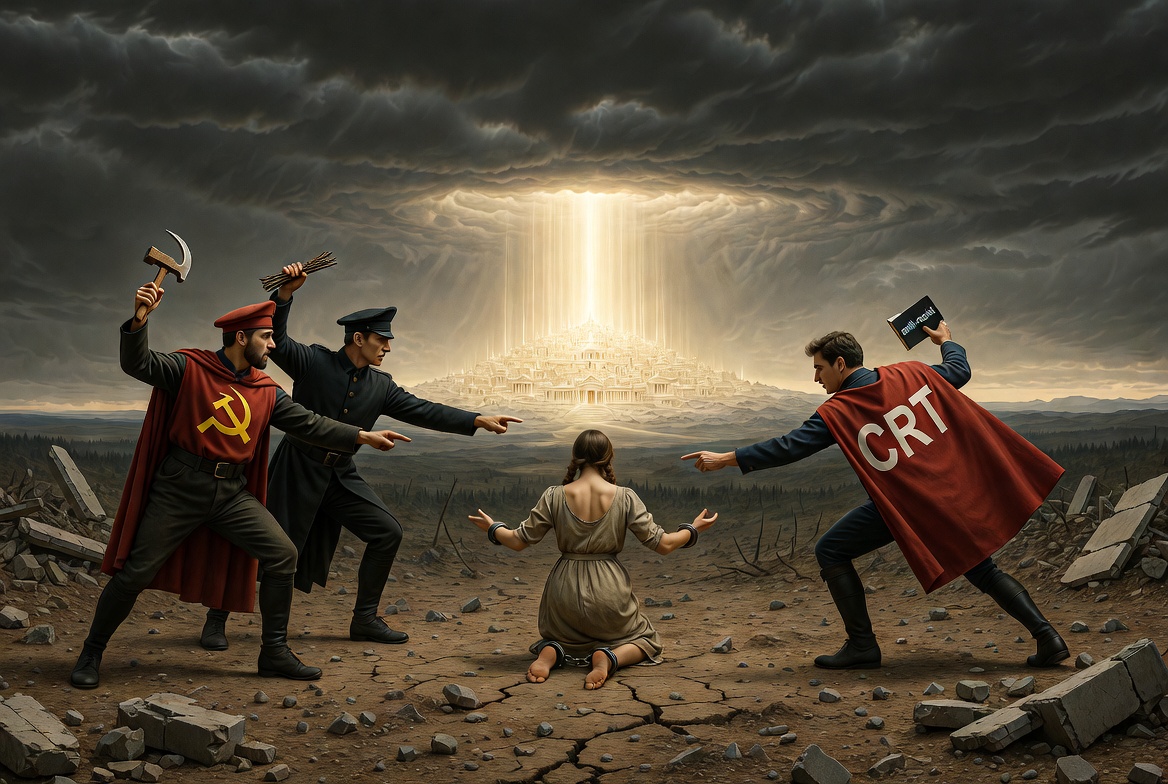
Some political movements seek to reform institutions. Gender ideology asks for something larger and stranger. It asks society to treat subjective identity as more authoritative than sexed embodiment, and then to reorganize language, law, education, medicine, and intimate social norms around that priority. The promise is liberation from constraint. The reality is collision. When the self is treated as sovereign over the body, every boundary that still reflects sex begins to look like an injustice in need of correction.
That point has to be stated carefully. This essay is not a denial that some people experience genuine dysphoria, distress, or alienation from their bodies. Nor is it a claim that every trans-identifying person arrives at that identity through the same motives, pathways, or degree of ideological commitment. The target here is narrower and more political: an activist doctrine that turns subjective identification into a public demand, treats resistance as harm, and insists that the rest of society ratify its claims even where doing so dissolves clarity, boundaries, and truth.
At its most ambitious, gender ideology offers a redemptive promise. The conflict between self and body can be resolved. Alienation can be overcome. The old constraints of sex can be socially, medically, and linguistically superseded. The person need not reconcile himself to reality. Reality can be revised until it reflects the inner claim. But that promise carries a built-in instability. The body does not cease to be sexed because the surrounding vocabulary changes. Social reality does not become infinitely plastic because institutions adopt new rules. Other people continue to perceive bodies as they are, not merely as they are declared to be. Where the doctrine expects resolution, it encounters friction.
“Women are told to absorb the contradiction and treat it as progress.”
That friction matters because it does not remain abstract for long. Women’s boundaries are among the first places where sex remains socially visible and morally non-negotiable. Changing rooms, shelters, prisons, sports, hospital wards, quotas, maternity language, and the ordinary right to name male bodies as male all become targets once identity is treated as sovereign. The demand is not merely for courtesy. It is for override. Women are told to absorb the contradiction and treat it as progress. If they object, their objection is rarely treated as a competing rights claim grounded in privacy, vulnerability, fairness, dignity, or safety. It is moralized as exclusion, cruelty, or hatred.
This is where the negative-idealist mechanism, already traced in earlier essays, sharpens into focus. In a visible subset of male transition pathways, the conflict is intensified by a contested but persistent pattern: autogynephilia, the eroticization of the self as female. The concept is disputed and does not explain every case. Even so, it accounts for observable features in some trajectories: fantasy-driven identification, idealized femininity, online reinforcement, and a demand that others ratify the internal image as socially real. Where that pattern is present, sexed reality appears not as a limit to be reckoned with, but as an insult to be overcome. What cannot be secured inwardly is demanded outwardly through language, ritual affirmation, institutional policy, and the erosion of boundaries once thought too basic to require defense.
Institutions then inherit the contradiction. They are asked to affirm that sex is real enough to matter in medicine, reproduction, and anatomy, but unreal or irrelevant wherever women seek exclusion, protection, or clear naming. They are asked to treat words as both descriptive and compulsory, as if language were a branch of ethics rather than a tool for tracking reality. They are asked to uphold fairness while denying the relevance of the sex differences that made female categories necessary in the first place. The result is not ordinary accommodation. It is organized unreality, maintained by euphemism, fear, and social pressure.
Once the doctrine reaches this stage, dissent can no longer be treated as ordinary disagreement. Neutral refusal leaves sex standing. Clear language leaves the body visible. Female boundaries leave the claim of total override incomplete. So resistance must be moralized. Women defending sex-based spaces become aggressors. Parents asking for caution become extremists. Professionals who refuse to lie become threats. The contradiction is externalized so the doctrine can remain innocent. What it cannot resolve, it accuses.
“The result is not ordinary accommodation. It is organized unreality, maintained by euphemism, fear, and social pressure.”
At that point the familiar mechanism returns. The promised reconciliation between self and world fails to arrive in full. The body remains sexed. Other people keep noticing. Boundaries persist. Tradeoffs refuse to disappear. Rather than treating this as evidence that the doctrine asks too much of reality, the movement interprets the friction as proof that enemies remain active. A purified horizon is announced. Reality fails to comply. The gap is moralized. The search for the guilty begins.
The cost is now visible everywhere. Women lose the confidence to defend boundaries without being cast as moral offenders. Institutions lose the ability to speak plainly about sex without fear of sanction. Children are taught contested metaphysical claims as though they were settled truths. And a doctrine too unstable to secure assent through evidence alone increasingly relies on compulsion, euphemism, intimidation, and institutional pressure. What begins as a politics of identity becomes a politics of override.
The problem, then, is not simply that gender ideology is confused, though it often is. It is that confusion has been translated into policy, pedagogy, and compulsion. A doctrine built on unstable metaphysics now presses against some of the most basic social distinctions human beings have long relied on: male and female, mother and father, privacy and exposure, fairness and force, truth and courtesy. Because the doctrine cannot secure its claims through evidence or peaceful coexistence alone, it increasingly seeks protection through euphemism, intimidation, and institutional pressure. That is why the breakdown of female boundaries is not a side issue. It is one of the clearest signs that the ideology has moved from private belief to coercive social power.
When a movement cannot make reality yield, it begins by demanding silence and ends by punishing those who still name what they can see.

When an ideology cannot make reality yield, women are often told to bear the cost in silence.
Political movements rarely collapse under the weight of disappointment alone. More often they reinterpret it. The promised future fails to arrive and the social stain lingers. The purified horizon recedes. Yet instead of asking whether the ideal was underdescribed, whether tradeoffs were real, or whether some tensions are permanent, the movement reaches for a simpler, more morally useful answer. Someone must be responsible. Someone must be standing in the way.
That move is not incidental. It is one of the recurring temptations built into negative idealism. A politics that defines the good chiefly as the removal of stain will struggle to explain why the stain persists. It can admit limits, revise its assumptions, and accept that some conflicts are permanent. Or it can personalize failure. It can insist that justice was within reach and that redemption was delayed only because obstructing people refused to yield. The first response chastens politics. The second radicalizes it.
Scapegoats appear when disappointment is moralized and limits are no longer acceptable. That is the core mechanism. An ideal remains unrealized. Frustration mounts. The possibility of tragedy, tradeoff, or flawed assumptions is set aside. Failure is pinned on agents. ‘Obstructors’ are named. Politics begins to shift from persuasion toward purification. The opponent is no longer merely someone who disagrees. The opponent now explains why the world has not yet been redeemed.
The pattern recurs for powerful reasons. To admit permanent tensions is to surrender the fantasy of total resolution. To admit real tradeoffs is to abandon moral simplicity. To admit that one’s own vision may be incomplete is harder still, because movements do not merely carry ideals. They build identities around them. Limits humble. Enemies vindicate. Blame preserves innocence. The fault lies not in the ambition itself, but in the people who would not let justice arrive.
Scapegoats are politically useful because they do more than absorb frustration. They organize power. They compress complexity into a story with clear villains and motives. They unify believers by giving them a common target. Diffuse resistance hardens into visible obstruction. Disagreement ceases to look like ordinary pluralism. It begins to look like sabotage. Critics are not merely wrong. They are carrying forward the very stain the movement exists to erase.
This logic also carries a psychological advantage. Human beings prefer agency to accident, sabotage to friction, guilt to limitation. A stubborn social problem becomes easier to bear when it can be attached to a face, a faction, or a contaminating group. Moral frustration seeks an author. The scapegoat supplies one. Enemy-making is therefore not only political. It is cognitively comforting.
“Scapegoats appear when disappointment is moralized and limits are no longer acceptable.”
The pattern has surfaced across very different traditions. Revolutionary movements have blamed classes, wreckers, or traitors. Racial utopias have pointed to impurity and contamination. Religious purges have singled out heretics and corrupters. Newer forms of moralized identity politics often begin with abstract systems, then gradually attach those systems to suspect categories of persons whose resistance, speech, habits, or mere presence becomes evidence that the harm endures. The doctrines change. The designated enemies change. The underlying move remains the same: disappointment is personalized so the ideal can remain morally intact.
Once that move is made, the atmosphere shifts. Persuasion gives way to exposure, isolation, discipline, and, if necessary, removal of those said to make redemption impossible. The language of diagnosis becomes the language of contamination. The social problem is no longer located chiefly in institutions or arrangements. It is carried by enemies. Disagreement itself now appears as complicity.
In ordinary politics, argument tests judgments under conditions of pluralism. In a politics of purification, argument becomes secondary. The real task is sorting: who is aligned with the redeemed future, and who is not? Who is mistaken, and who is stained? Who can be re-educated, and who must be excluded? Pluralism starts to look like weakness. Procedural restraint starts to look like moral cowardice.
“The enemy, then, does not merely explain failure. The enemy gives the movement its mission.”
The enemy, then, does not merely explain failure. The enemy gives the movement its mission. It supplies urgency, focus, solidarity, and justification for harder measures. Disappointment is redirected into action. Instead of questioning whether the ideal itself was flawed or impossible to complete, the movement can declare that justice remains delayed because the guilty remain active. The search for a better order becomes inseparable from the search for those who prevent it.
Scapegoating is therefore not a side effect of negative idealism. It is one of its built-in temptations. A movement that cannot define completion, accept limits, or survive disappointment without moral injury will search for a human cause for what reality refuses to yield. Before force comes justification. Before punishment comes moral sorting. The search for the guilty is how purification prepares itself for power.
This is where the next danger begins.

When limits cannot be named, someone must be blamed.
Over the next week, I will be publishing a five-part essay series on a pattern that has become increasingly visible across contemporary politics.
The pattern is not confined to any one ideology. It appears in different forms, with different moral vocabularies, and at different levels of intensity. But the structure is often recognizable.
A movement begins with a grievance, often a real one. It defines the good chiefly by what must be abolished. The ideal remains vague, but the stain is vividly named. Reality resists. Limits persist. Tradeoffs do not disappear.
At that point, a choice presents itself. The movement can revise its ambitions in light of the world as it is, or it can moralize the gap between promise and outcome. When it chooses the second path, disappointment hardens into blame. Blame hardens into sorting. Sorting prepares the way for coercion.
That is the mechanism this series examines.
The aim is not to collapse different movements into one another, nor to deny that many of the grievances in question are real. The aim is to describe a recurring political logic that can emerge across very different doctrines once ideals are treated as immune to revision.
The essays proceed in sequence:
- Essay 1: The structure of negative idealism
- Essay 2: The turn to scapegoating
- Essay 3: Gender ideology and the breakdown of boundaries
- Essay 4: Family resemblances across radical movements
- Essay 5: Settlement against redemption
Each essay builds on the last. They are meant to be read together.
The argument is not that politics should abandon ideals. It is that ideals must be able to survive contact with limits, tradeoffs, and an unfinished world. When they cannot, the pressure to explain failure shifts outward, and the search for the guilty begins.
This series is an attempt at diagnosis. It is also, in its final movement, an argument for a different posture: one that prefers settlement to redemption, and construction to purification.

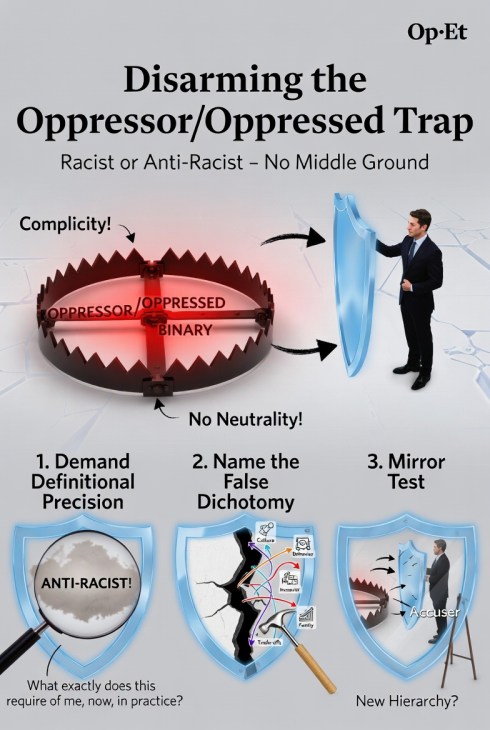
One of the most manipulative habits in contemporary politics is the oppressor/oppressed binary. It takes a complicated society, flattens it into a morality play, and assigns everyone a role before the argument even begins. You are not allowed to be a citizen, a skeptic, or simply a person trying to judge a claim on its merits. You must be either a resister of oppression or an accomplice to it. There is no middle ground. There is no neutrality. There is only confession or guilt.
This is the logic behind slogans like Ibram X. Kendi’s claim that the opposite of racist is not “not racist,” but “anti-racist.” It sounds brave and morally serious. In practice, it is a trap. It abolishes the possibility that a person can reject racism while also rejecting activist dogma, racial essentialism, or race-based policy. Once the slogan is accepted, disagreement itself becomes incriminating. Silence is violence. Skepticism is fragility. Restraint is complicity. The argument is rigged before it starts.
That is what makes the framework so effective. It does not persuade. It corners. It takes a difficult moral and empirical question and turns it into a loyalty test. Once that move is made, debate stops being a search for truth and becomes a public sorting ritual. On affirmative action, immigration, policing, school curricula, crime, history, or speech, the details matter less than whether you submit to the script. You are not judged by the quality of your reasoning. You are judged by whether you have signalled the right side.
The first way to break the trap is to demand definitional precision. Ask the simplest possible question: what, exactly, does “anti-racist” require of me here, now, in practice? What specific belief, action, or policy would prove that I am not complicit? Force the slogan to cash itself out. This matters because many activist terms draw their power from strategic vagueness. They sound morally elevated precisely because they are never pinned down. Once pinned down, they often expand into endless duties of confession, endorsement, and ideological retraining. When the standard can never be met, the point is no longer moral clarity. The point is obedience.
The second move is to name the false dichotomy. Calmly, but without apology. The binary assumes that every disparity is evidence of oppression and that every refusal to endorse the preferred remedy is therefore collaboration with injustice. But reality does not work that way. Human beings are not made of one motive. Institutions do not produce one kind of outcome. Policies have trade-offs. Causes are mixed. Incentives matter. Culture matters. History matters. Family structure matters. Behaviour matters. Human variation matters. A worldview that permits only one explanation is not morally deep. It is intellectually cheap.
“The point is no longer moral clarity. The point is obedience.”
Complexity starts to look like cowardice. Nuance starts to look like betrayal. Evidence that cuts against the preferred story is dismissed as harm. The framework protects itself the way bad frameworks always do: by treating every challenge as proof that the challenge was necessary.
The third move is the mirror test. If disagreement with your theory makes someone morally tainted, what exactly are you doing to dissenters? If refusal to use your language, endorse your policies, or accept your metaphysics makes a person an oppressor, then you have not abolished domination. You have redistributed it. You have built a new moral hierarchy with yourself at the top and everyone insufficiently converted beneath you. The names have changed. The structure has not.
This is why the binary feels so powerful. It flatters the speaker while shaming the listener. It offers moral clarity without the inconvenience of evidence. It turns political disagreement into a purity test and ordinary citizens into suspects. That is intoxicating, especially for people who enjoy the feeling of righteousness more than the discipline of thought.
Racism is real. Injustice is real. But so is the danger of any framework that treats disagreement as guilt and complexity as sin. Liberalism was built on the harder truth that citizens will differ, causes will be mixed, and power must be restrained even when exercised in the name of virtue. The oppressor/oppressed binary rejects that discipline. It wants a world of permanent accusation, permanent sorting, and permanent moral theatre.
Do not argue inside that trap. Do not accept the role of defendant in someone else’s catechism. Ask for definitions. Expose the binary. Turn the logic back on itself. The moment a moral framework abolishes the right to dissent, it has stopped being a tool of justice and become a costume for power.
One of the most destructive temptations in politics is the urge to turn disagreement into moralized tribal war. Not argument. Not persuasion. Not the hard, frustrating work of governing a society full of competing interests and imperfect people. War. Friends and enemies. Allies and traitors. The pure and the contaminated. Once that frame takes hold, politics stops being about order, restraint, and judgment. It becomes a loyalty machine. Carl Schmitt gave this instinct its most famous formulation in The Concept of the Political, where he argued that the essence of politics lies in the distinction between public friend and public enemy. He was right to see that real political life can descend to existential conflict. He was wrong to treat that descent as the essence of politics rather than one of the permanent dangers civilized politics is supposed to contain. The friend-enemy distinction is not the foundation of healthy politics. It is the logic of political decay.
The danger is not only that the framework is harsh. Politics can be harsh. The danger is that it installs enmity at the center of public life and pushes everything else to the margins. Institutions, laws, debate, compromise, constitutional limits, due process, even ordinary factual disagreement all become secondary. What matters is identifying the enemy, consolidating the team, and punishing hesitation. That is why this logic travels so easily across ideologies. It can appear in revolutionary Marxism, in Maoist “enemies of the people,” in Islamist loyalty-and-disavowal frameworks, in activist binaries like ally versus bigot or oppressor versus oppressed, and in right-wing scripts about traitors, regime collaborators, and weak conservatives who supposedly enable the left. The vocabulary changes. The mechanism does not. A public enemy is named, and then a moral test is imposed: how fully will you align against him?
“The ratchet always turns one way: toward greater fanaticism, greater purification, greater moral ugliness. Truth is subordinated to solidarity. Principle is subordinated to faction.”
What makes this logic totalitarian is that it abolishes the space for dissent. Once the enemy has been declared, neutrality is no longer allowed. You either join the mobilization or you are suspected of serving the enemy’s cause. Hesitation becomes complicity. Refusal becomes betrayal. Moderation becomes guilt. That is how political movements become purge machines. You can either be anti-racist or you are helping racism. You can either be a trans ally or you are enabling bigotry. You can either fight the deep state, resist the regime, and oppose the left without reservation, or you are a RINO, a coward, a collaborator. This is the structure that matters. Not the tribe wearing it. Once politics is moralized into friend and enemy, the pressure falls hardest not only on official opponents, but on the insufficiently zealous within one’s own camp.
That is why factions organized around “no enemies to the left” or “no enemies to the right” almost always radicalize inward. The outer edge of the movement becomes untouchable because criticizing it risks helping the enemy. So the only safe targets are moderates, doubters, and fellow travelers who fail the loyalty test. The left protects its most extreme activists and attacks liberals who cannot keep up. The right protects its own hardliners and attacks conservatives who still think prudence, constitutional restraint, or factual discipline matter. In both cases, the center is hollowed out first. The ratchet always turns one way: toward greater fanaticism, greater purification, greater moral ugliness. Truth is subordinated to solidarity. Principle is subordinated to faction. Politics ceases to be the art of living together under conditions of disagreement and becomes a permanent sorting mechanism for friends, enemies, and suspects.
A civilized society cannot survive on those terms. That does not mean pretending enemies never exist. They do. Free societies are not obliged to indulge movements openly hostile to liberty, law, and peaceful coexistence. But the achievement of constitutional civilization is precisely that it refuses to make enmity the organizing principle of normal public life. It channels conflict through law, opposition, procedure, restraint, and rights. It leaves room for disagreement without turning every disagreement into proof of treason. That is the line Schmitt blurred and totalitarian movements erase completely. The mistake is not in noticing that politics can become existential. The mistake is in treating that possibility as the deepest truth of politics and then building public life around it. Once you do that, purges are no longer an accident. They are the destination. Friend-enemy politics is not realism. It is the operating system of political decay.












 bleatmop
 Mystro
 The Arbourist


 Dead Wild Roses
Your opinions…