
You are currently browsing the category archive for the ‘Politics’ category.
 The West’s policies and actions in the Middle East have set the stage for tragedy. The destruction and destabilization of states and the creation of a new Cold War flash-point in Syrian (and one upcoming in the Ukraine) are spreading chaos in the world. The mass murder in Nice, France is an example, par excellence, of what Chalmers Johnson describes as Blowback. What is ‘Blowback’?
Blowback – is a term invented by the CIA, refers to the unintended consequences of American policies that are predicated on projecting its military power to every corner of the earth and using American capital and markets to force global economic integration on its own terms.
So this is what happened in Nice [from cbc.ca]:
The Islamic State in Iraq and Syria claimed responsibility for the truck attack on the French city of Nice on Saturday as French police arrested three people there in connection with the carnage that claimed the lives of at least 84 people.
“The person who carried out the operation in Nice, France, to run down people was one of the soldiers of Islamic State,” the news agency Amaq, which supports ISIS, said via its Telegram account.
“He carried out the operation in response to calls to target nationals of states that are part of the coalition fighting Islamic State,” the statement said.
We in North America tend to think (unless you happen to not to be white) of terrorism and war as something that happens ‘over there’. We sit with a manufactured placidity behind our oceans and vicariously experience the horror visited on people in foreign lands and, if moved enough, make a post about it on some social media platform (irony noted). What is difficult for North Americans is the teasing out the questions of “How, if at all(?), does this relate to us?”, while wading though the media slideshow of human misery and death. Our media is failing us by not providing context to the images we see, so we don’t know how to respond.
Blowback is coming. Through the direct result of our use of military and economic power we are fracturing countries and immiserating their people for our Geo-poltical gain. The people of North America are subject to a severe disconnect between the foreign policy goals stated at home and what those goals look like when actualized in reality. I am fairly confident that most of the policy initiatives that involve displacing people and murdering them wouldn’t get much popular support.
However, call it (murder et cetera) bringing “stability’ to a region, it sounds palatable to the citizenry, and thus their consent is ensured. How many lives hang in the balance or have been sacrificed because of word/not-words like ‘precision bombing’ and ‘democracy promotion’? Our use of opaque sanitized language cuts people off from the empathy we all possess and allows for the most pernicious of behaviours.
We in the West feel connected only when the chickens of violence come home to roost and vengeance is delivered to our innocent populations. The sympathetic news coverage begins immediately, more so if the victims happen to be Caucasian (because #whitelivesmattermore), and we can connect with the sorrow and horror being visited on the people in question.
Did believe in Islam play a role in the mass-murder in Nice. Almost certainly. Even traumatized desperate people need persuading to enable them to commit murderous acts. The ISIS brand of Islam is tailor made to undermine empathetic thoughts and feelings, to numb the fundamental kindness we feel toward each other (this applies to almost all organized religions, of course) and make atrocities such as what happened in Nice possible.
Fervent belief in ideology – religious or otherwise – helps make disastrous events possible, because as soon as we can start people as the ‘enemy’ and the ‘other’ it becomes so much easier to destroy their lives.
So, did Allah take the wheel and instigate vehicular homicide on a grand scale? Probably not, but he certainly put gas in the tank and keys in hand.
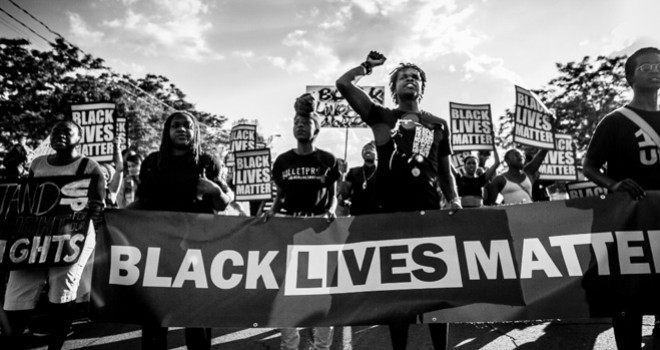 Some peoples lives are worth more than others.
In the context of American society one of the deciding factors of how much your life is worth is determined by the colour of your skin. Here in Canada a similar skin tone gradient applies as being First Nations in Canada gets you the special police attention you don’t deserve. Bonus features of being in First Nations in Canada include (but are not limited to), poverty, limited access to potable water, and an hostile educational system. Make no mistake, we have much to do in Canada to address the needs of our people. We have a Canadian Highway of Tears that sullies our escutcheon and is indicative of the racism that still permeates our society.
The inherent racism present in Canada pales before the horrendous shitshow that is running south of the border. Racial divisions and discrimination represent a clear and present danger to fabric of the civil society of the United States (necessarily so). The scale of protests against the racial violence of the white establishment is increasing – fuelled by social media that circumvents mainstream media and offers a small gory window into the lives of black people who are being murdered by the security apparatus of the state.
I cannot imagine the horror of witnessing your partner being shot to death in your car, having to be polite to the individual that just inflicted moral wounds on our loved one while having your child witness the entire blood spattered episode from the backseat.
…
Violence breeds violence.
The unidirectional nature of the violence was reversed as an individual who proclaimed his hatred for white police, killed five white police officers in Dallas. The shooter was a reservist and had seen a tour of duty in Afghanistan. Lives are being lost because we have tied how much humanity you’re allotted to the colour of your skin.
Madness. It is sheer madness that we have allowed our societies to be shaped by racism and that the status quo is in fact racist. Is this series of murders in the US the tipping point? It certainly seems like people have had enough and are willing to entertain a large spectrum means to achieve their ends. It should be (like the constant stream of black people being murdered by police hasn’t been) a wake up call to the American congress and its legislative position on systemic racism and gun control. Henry Giroux paints a darker picture when he says:
“In the increasingly violent landscape of anti-politics, mediation disappears, dissent is squelched, repression operates with impunity, the ethical imagination withers, and the power of representation is on the side of spectacularized state violence. Violence both at the level of the state and in the hands of everyday citizens has become a substitute for genuine forms of agency, citizenship, and mutually informed dialogue and community interaction.”
The response of the law makers will tell the tale though, because the disconnect between public opinion and public representatives is being brought into stark relief. Congress has been mostly bought and paid for – but they have to at least look like they are serving the needs of the public on occasion, will the murder of five police officers stir the sycophants into action? I really don’t know, because getting reelected seems to override important qualities of being a decent human being. Qualities like empathy, compassion, and morality seem strangely missing when it comes to societal issues that threaten idea of moving toward a just society.
The cynical side of me contemplates this question: Would the US have gun control if members of Congress were similarly subjected to the murder/assassination program the rest of America is being subject to?

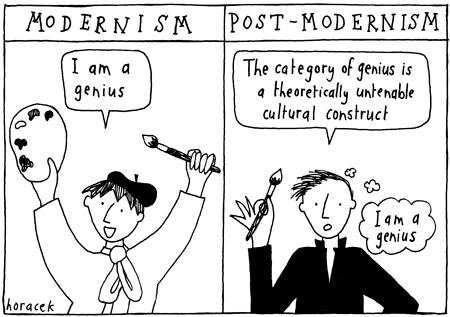 “How We Reached the Point Where We Can’t Hear Each Other” is a article on Counterpunch by Joseph Natoli. I’ve excerpted some of the beginning bits for context, but the best is when he focuses on what is happening in Education and how people are taught to think these days. I’m also a fan of his borrowing of radical feminist methodology that focuses on the the material reality of the situation and the naming of the problem. I heartily recommend you read the full article, as it suggests reasons why we are becoming less social despite ‘social’ media and the corrosive effect that identity politics, one of the crown jewels of post-modern theory, is having on our society.
[…]
“The intent of a past analog world to put us all on the same page so we could all direct ourselves in common to our common, societal problems is something now disseminated into an infinitude of self-designed enclaves. We have connectivity between the like-minded, or opinionated, but not conjunction which Bifo Berardi defines “as a way of becoming other.” (And: Phenomenology of the End, 2015)
If you want to reflect beyond the entrapment of your own personal experiences and the personal opinions derived from such, you are desiring something that has been superseded.
If you want not to be the blind man who feels the tail of an elephant and pronounces the elephant to be shaped like a snake, you are hoping for a door that leads out of the room of your own limited experience.
Unfortunately, there is no longer any need to leave that room because cyberspace has designed the whole world to be your room. You can blog, tweet, text. Video, emoji your reflections online without any intent to augment social knowledge or understanding or to encounter a counter-punch that will cause you to adjust your views.”
[…]
“We exist now within narratives, not impeccable logics and sound proofs, air-tight arguments or binding adjudications. For reasons too elaborate to condense, we have accepted Nietzsche’s view of reason as a pawn of power and have retreated to our own personal reasoning.
This retreat to personal arbitration of all matters is expressed in the politics of identity, a politics concerned with the full emancipation of the individual not as defined within any cultural, religious, historical, or anthropological notion of the individual, but defined by each and every variety of individual. It is as if the individual is a knowledge within itself.”
[…]
Education is also in a special dilemma considering the mission here is get a student to put his or her personal opinions and preferences and different experiences out of sight and attend to a rationally validated collective representation of a subject.
Nathan Heller points out that elite colleges find that the cultivation of the individual is not an easy matter when students will not leave their personal “experiential authority” at the door. (“The Big Easy,” The New Yorker May 30, 2016) One is not reading to extract eternal verities, the Enlightenment dream, or to deconstruct the pretenses of those same verities. In the climate that Heller describes, no content can be permitted to transgress the personally defined identity of the reader or listener.
An Oberlin student who Heller describes as “a trans man …educated in Mexico, walks with crutches, and suffers from A.D.H.D. and bipolar disorder …lately on suicide watch” objected to a discussion of Antigone without a trigger warning, i.e., characters in the play committed suicide. Identity-based oppression is responded to with a theory of intersectionality, which contends, “who knows what it means to live at an intersection better than the person there?” Thus, personal experiential authority now contends with a pedagogic tradition of minimizing the effects of personal experiential authority on objective, rational reflection.
Education attempts to respect individual arrangements of the results of critical thinking but not allow those arrangements to taint the process of critical thinking. This long standing agreement is no longer in effect. We have reached the point where we cannot engage in any way what may “trigger” our personal dislike or what may upset a private space we have self-designed. Long standing notions of both education and society are dissolving.
We now listen to our own voices and our clones in “social” media, a pathological condition that undermines much needed social and political communication and interrelationships. The way out, as with all pathologies, is to first recognize the condition, observe the point we have reached and reorient our compass.”
Teaching critical thinking in public education has always been a revolutionary activity, as this article confirms, it looks like it shall continue to be in the revolutionary category for quite some time.
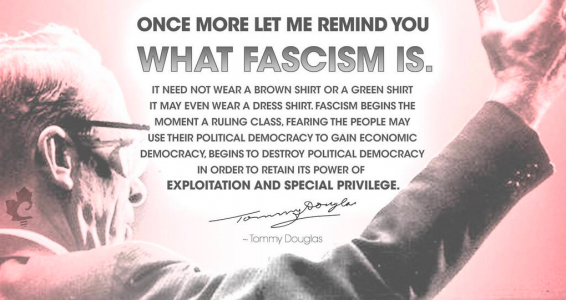
“It need not wear a brown shirt or a green shirt. It may even wear a dress shirt. Fascism begins the moment a ruling class, fearing the people may use their political democracy to gain economic democracy, begins to destroy political democracy in order to retains its power of exploitation and special privilege. – Tommy Douglas
Who doesn’t like to kick back and watch the US primary election campaign? I just scan the highlights, but John Feffer is big picture prognosticating with his recent article on Tom’s Dispatch titled Donald Trump and America B. The article examines the disaffected people who make up America B and who have bought into his faux-populist message. I encourage you to follow the above link and read the entire article as it is well written and laden with trenchant political observations that stretch into the near future.
In the 1990s, the United States changed its political economy. It was not quite as dramatic a shift as the regime changes that took place across Eurasia, but it had profound consequences for the realignment of voting patterns in America.
During that decade, the U.S. economy accelerated its shift from manufacturing — along with the well-paying blue-collar jobs that sector had once generated — to an ever more dominant service economy. In terms of employment, manufacturing jobs dropped from 18 million in 1990 to 12 million in 2014, while wages for such jobs tumbled as well. Over that same period, the health-care and social assistance sector alone grew from 9.1 million to more than 18 million jobs. At one end of that service economy were the 1% in financial services making stratospheric sums, particularly as compensation packages soared from the mid-1990s on. On the other end were the people who had to add shifts at McDonald’s or Walmart to their full-time jobs or monetize their spare time by driving for Uber just to make what they or their parents once earned with one job at the local factory.
America was not alone in undergoing this shift. Thanks to technological innovations like computers and robotics, greater access to cheap labor in places like Mexico and China, the rise of the Internet, and the deregulation of the financial world, the global economy was being similarly transformed. Blue-collar workers no longer played as vital a role in any advanced economy.
In the U.S., put bluntly, the imagination of America A no longer needed the muscle of America B.
[…]
“Falling behind economically and feeling betrayed by politicians on both sides of the aisle, America B might have moved to the left if the United States had a strong socialist tradition. In the 2016 primary campaign, many of the economically anxious did, in fact, support Bernie Sanders, particularly the younger offspring of America A fearful of being deported to America B. Unlike Europe B, however, America B has always been more about rugged individualism than class solidarity. Its denizens would rather buy a lottery ticket and pray for a big payout than rely on a handout from Washington (Medicare and Social Security aside). Donald Trump, politically speaking, is their Powerball ticket.
Above all, the inhabitants of America B are angry. They’re disgusted with politics as usual in Washington and the hypocritical, sanctimonious political elite that goes with it. They’re incensed by how the wealthy have effectively seceded from American society with their gated estates and offshore accounts. And they’ve focused their resentment on those they see as having taken their jobs: immigrants, people of color, women. They’re so desperate for someone who “tells it like it is” that they’ll look the other way when it comes to Donald Trump’s inextricable links to the very elite who did so much to widen the gap between the two Americas in the first place.”
[…]
“America B has a fondness for Donald Trump and his almost childlike audacity. (Gosh, kids say the darndest things!) Right now, his fans are attached to an individual, rather than a platform or a party. Many of his supporters don’t even care whether Trump means what he says or not. If he loses, he will fade away and leave nothing behind, politically speaking.
The real change will come when a more sophisticated politician, with an authentic political machine, sets out to woo America B. Perhaps the Democratic Party will decide to return to its more populist, mid-century roots. Perhaps the Republican Party will abandon its commitment to entitlement programs for the 1%.
More likely, a much more ominous political force will emerge from the shadows. If and when that new, neo-fascist party fields its charismatic presidential candidate, that will be the most important election of our lives.
As long as America B is left in the lurch by what passes for modernity, it will inevitably try to pull the entire country back to some imagined golden age of the past before all those “others” hijacked the red, white, and blue. Donald Trump has hitched his presidential wagon to America B. The real nightmare, however, is likely to emerge in 2020 or thereafter, if a far more capable politician who embraces similar retrograde positions rides America B into Washington.
Then it will matter little how much both liberals and conservatives rail against “stupid” and “crazy” voters. Nor will they have Donald Trump to kick around any more. In the end, they will have no one to blame but themselves.”
End game summary here is this – actual politicians are watching to see how successful DT is. The pull of false populism is strong and in the right(wrong) hands could be forged into a general election winning platform that will take America into a new darker age. So if we see in 2020 the new charming face of proto-fascism rise in the US, remember Tom Dispatch and DWR called it first in 2016.
David Cromwell excels at identifying key points of friction between public and private interests. In this excerpt he examines how higher learning is being bent to fulfil its corporately mandated responsibilities to society.
“This [Academia] is a privileged sector where critical thought and enquiry into human society, the natural world and the cosmos ought to be the norm; not where overwhelming pressure to conform to state-corporate interests should be exerted on teaching and research agendas.
How can academic ‘collaboration’ with large corporations which are, after all, centralised systems of illegitimate power, not lead to compromise, distortion or worse? It is clearly not in the interests of such institutions to promote rational and honest study into the problems of a corporate-shaped society. It is in their interests to commandeer the publicly-funded research while co-opting supposedly neutral and objective academia as ‘partners’. And all the better if highly trained university researchers working in narrow, focused disciplines remain disconnected from the interests in other disciplines, or more importantly, from the concerns of the general populace.
‘To work on a real problem (like how to eliminate poverty in a nation producing eight hundred billion dollars’ worth of wealth each year) one would have to follow that problem across many disciplinary lines without qualm, dealing with historical materials, economic theories, political obstacles’, observed historian Howard Zinn, author of The People’s History of the United States, who died in 2010. ‘Specialisation ensures that one cannot follow a problem through from start to finish. It ensures the functioning in the academy of the system’s dictum: divide and rule.’ Zinn provided a potent example: ‘Note how little work is done in political science on the tactics of social change. Both students and teacher deal with theory and reality in separate courses; the compartmentalisation safely neutralises them.’
Any management vision of how the university sector, or any place of higher education, ought to develop that does not recognize the nature of the iniquitous capitalist society in which the university finds itself embedded, is short-sighted. And, moreover, any such ‘vision’ that is not committed to making radical changes in the way society is structured is tacitly, if not actively, supporting the status quo. The same argument applies to any major institution in society.”
-David Cromwell. Why Are We The Good Guys? pp. 216 – 217
So, great you have a degree, well done sport! Did they teach you to comply or to question the society that you inhabit?
 Did you want to get the gist of Edward Herman and Noam Chomsky’s master work ‘Manufacturing Consent’ but not have to read that long, dryly informative tomb? Have I got the book for you. ‘Why are we the Good Guys?’ by David Cromwell runs on essentially the same thesis but is many more times engaging and yet at the same time, marginally less academically verbose than Manufacturing Consent. I thoroughly enjoyed the entire work and would like to share a pertinent excerpt on how media coverage perpetuates the destructive cycles (the financial meltdown of 2008 et cetera) we see in our society.
“All the media samples we’ve seen so far in this chapter are indicative of the narrow spectrum of permitted corporate and political opinion on the financial and economic crisis. Viewpoints are heavily biased toward the status quo, with only occasional fig leave of mild dissent. This spectrum of news reporting and commentary is systemically biased; it avoids scrutiny of an economic system that is both fundamentally flawed and stacked against the majority of humanity.
As Shutt notes, one of the most striking features of the ongoing crisis is: “the uniformly superficial nature of the analysis of its causes presented by mainstream observers, whether government officials, academics or business representatives. Thus it is commonly stated that the crisis was caused by a combination of imprudent investment by bankers and others […] and unduly lax official regulation and supervision of markets. Yet the obvious question begged by such explanations – of how or why such a dysfunctional climate came to be created – is never addressed in any serious fashion”. Shutt continued: ” The inescapable conclusion […] is that the crisis was the product of a conscious process of facilitating ever greater risk of massive systemic failure.”
With a few ruffled feathers here and there, Western leaders and their faithful retinue in the media and academia continue to deceive the public about the global economic crisis and its root causes; because power and profits demand it. Otherwise these elites run the serious risk of a huge slump in public confidence in the current system and even in what passes for democratic policies. As it turned out, the chair of the prestigious US law firm Sullivan & Cromwell was not far off in his prediction that ‘Wall Street, after getting billions of taxpayer dollars, will emerge from the financial crisis looking much the same as before the markets collapsed.’ Indeed it was strengthened, as explained by Simon Johnson, former chief economist of the IMF: ‘Throughout the crisis the [US] government has taken extreme care not to upset the interests of the financial institutions, or to question the basic outlines of the system that got us here.’ Moreover, the ‘elite business interests … [who] played a central role in creating the crisis, making ever-larger gambles, with the implicit backing of the government, until the inevitable collapse … are now using their influence to prevent precisely the sorts of reforms that are needed, and fast, to pull the economy out of its nosedive’ while ‘the government seems helpless, or unwilling to act against them.’ As Chomsky notes: this is ‘no surprise, at least to those who remember their Adam Smith,’ and adds, ‘The outcome was nicely captured by two adjacent front-page stores in the New York Times, headlined “$3.4 Billion Profit at Goldman Revives Gilded Pay Packages” and “In Recession, a Bleaker Path for Workers to Slog.”‘
-David Cromwell. Why Are We The Good Guys? pp 174 – 175
Cheery stuff I realize, but its good to know who is doing what to who. Perhaps during the next collapse we’ll hold the bastards accountable.
I keep thinking about all of the rhetoric about how wasteful social spending is, and how programs for the poor are being taken advantage of, then I read something like this… then I get mad.
“From spending $150 million on private villas for a handful of personnel in Afghanistan to blowing $2.7 billion on an air surveillance balloon that doesn’t work, the latest revelations of waste at the Pentagon are just the most recent howlers in a long line of similar stories stretching back at least five decades. Other hot-off-the-presses examples would include the Army’s purchase of helicopter gears worth $500 each for $8,000 each and the accumulation of billions of dollars’ worth of weapons components that will never be used. And then there’s the one that would have to be everyone’s favorite Pentagon waste story: the spending of $50,000 to investigate the bomb-detecting capabilities of African elephants. (And here’s a shock: they didn’t turn out to be that great!) The elephant research, of course, represents chump change in the Pentagon’s wastage sweepstakes and in the context of its $600-billion-plus budget, but think of it as indicative of the absurd lengths the Department of Defense will go to when what’s at stake is throwing away taxpayer dollars.
Keep in mind that the above examples are just the tip of the tip of a titanic iceberg of military waste. In a recent report I did for the Center for International Policy, I identified 27 recent examples of such wasteful spending totaling over $33 billion. And that was no more than a sampling of everyday life in the twenty-first-century world of the Pentagon.
The staggering persistence and profusion of such cases suggests that it’s time to rethink what exactly they represent. Far from being aberrations in need of correction to make the Pentagon run more efficiently, wasting vast sums of taxpayer dollars should be seen as a way of life for the Department of Defense. And with that in mind, let’s take a little tour through the highlights of Pentagon waste from the 1960s to the present.”
Somehow I think that when neoconservative politicians talk about smaller government, they are not referring to the Offense spending, or state/corporate fixtures like the Pentagon.











 bleatmop
 Mystro


 Dead Wild Roses
Your opinions…