
You are currently browsing the category archive for the ‘Politics’ category.
 I’m curious as to how our military procurement system is intends to differentiate itself from the awesome-fun game of spitting into the wind.
“The Harper government is terminating its contract with Thales Canada Ltd., which was to supply new radar units to support Canada’s CF-18 fighter jet squadrons in Cold Lake, Alta., and Bagotville, Que.”
The idea behind the procurement process is to investigate the fine details of a piece of equipment and estimate how much the supplier intends to soak you with bullshit added-costs, delays and ‘upgrades’.
“The deal signed in November 2010 was initially worth $55 million for two tactical-control radar systems, with delivery to begin in 2013. Thales won the tender over one other bidder.
Defence Department documents show costs had risen to more than $78 million by 2013. And by November last year, the Public Works Department was deep in negotiations with Thales to resolve problems.
“In February 2015, Canada and Thales reached agreement in principle to terminate this contract by mutual consent,” said Public Works spokeswoman Annie Trepanier.”
Somewhere along the line our Master Procurers must have had a rectal cranial inversion as a jump from $55 million to $78 million dollars seems a little extreme. It is not like we enjoy spending money on overpriced non-functional military hardware…
“The botched deal is yet another military procurement gone sour, alongside the more high-profile F-35 Stealth Fighter project, the Cyclone helicopter purchase to replace the aging Sea Kings, and used British submarines that have been sinkholes for maintenance and repair dollars.”
Errr…whoops. I wonder when our lovely government will realize that we need our military primarily for domestic security – (full props to Canada’s army for mobilizing units to fight forest fires) and peacekeeping roles. Imperial ambitions and force project have never been our forte and we should stop trying to compete with more imperialistically focused nations.
Canadian foreign policy concerns aside some careful attention should be paid to this:
“Negotiations for a final termination agreement are still underway, and Public Works declined to provide any information about penalties, losses to the taxpayer or even the reason for the termination.
“Public Works is working with DND [Department of National Defence] to identify an appropriate path forward to meet their long-term capability needs on this project,” Trepanier said in a terse email.”
From a government whose platform trumpeted accountability and transparency to the high-heavens and back, this response from Public Works can be reasonably classified as neither accountable, nor transparent to the Canadian public.
 If you have been watching our beloved conservative government the above response is not out of place with the deep centralization of power that our PM has undertaken. This government has been all about the control and management of information and unsubtle PR for the hoi-paloi. The Prime Ministers Office has subsided into the shadows, sorta like Sauron in LOTR – sure you can see the flaming eye up there on the tower – but you have no idea what it is doing or what policies it happens to be crafting. Canadians just have to brace themselves for whatever crap policy that magically appears on the horizon and hope for the best.

Wow, Cultural Marxism apparently is nightmare fuel to the wingnut, racist right.
Cultural Marxism? As the feminist tag in the wordpress reader becomes more diverse (read filled with dudes and their important ideas) this phrase is popping up all over as of late. I’ve never seen it before, and as a minor logophile my curiosity was peaked. The context of how the term Cultural Marxism (CM) is being used was my first clue that this is yet another sad portmanteau of the right-wingers/dudes to mischaracterize ideas and notions that make them uncomfortable.
It was this putrid nugget of a sentence, fresh from the high mountains of Turdistan, that started my logophilic escapade:
“Leftist ideology (cultural Marxism) ascribes all observed statistical differences in group performance to nefarious cultural forces, therefore nefarious cultural forces must be at work everywhere, therefore you must be oppressed at all times, thus you must dedicate yourself to finding the oppression in every aspect and moment of your life. “
What we can see above exhibit the hallmarks of what will be a reason-free mind-fap-festival of fail; usually with a side of misogyny or racism thrown in just for fun. But, apart from the haphazard generalizations, the erection of grand strawmen and a generally uncharitable starting point, the above sentence is perfectly fine.
So doing some arduous research, a.k.a typing “Cultural Marxism” into Duck Duck Go, the fateful shrouds of mystery were slowly pulled back. Oh the magic of Wikipedia:
“The Frankfurt School (German: Frankfurter Schule) is a school of social theory and philosophy associated in part with the Institute for Social Research at the Goethe University in Frankfurt, Germany. The school initially formed during the interwar period in Germany and consisted of dissidents who were at home neither in the existent capitalist, fascist, nor communist systems that had formed during the interwar period. Meanwhile, many of these theorists believed that traditional theory could not adequately explain the turbulent and unexpected development of capitalist societies in the twentieth century. Critical of both capitalism and Soviet socialism, their writings pointed to the possibility of an alternative path to social development.[1]
Although sometimes only loosely affiliated, Frankfurt School theorists spoke with a common paradigm in mind, thus sharing the same assumptions and being preoccupied with similar questions.[2] To fill in the perceived omissions of traditional Marxism, they sought to draw answers from other schools of thought, hence using the insights of antipositivist sociology, psychoanalysis, existential philosophy, and other disciplines.[3] The school’s main figures sought to learn from and synthesize the works of such varied thinkers as Kant, Hegel, Marx, Freud, Weber and Lukács.[4]
Following Marx, they were concerned with the conditions that allow for social change and the establishment of rational institutions.[5] Their emphasis on the “critical” component of theory was derived significantly from their attempt to overcome the limits of positivism, materialism and determinism by returning to Kant’s critical philosophy and its successors in German idealism, principally Hegel’s philosophy, with its emphasis on dialectic and contradiction as inherent properties of human reality.“
Erm…ya. A lot of word salad that makes academics feel important and the basis of a school of interpretive historical though. In other words, nothing about leftist ideology and ‘oppression seeking’ going on there outside of arcane historical theory relevant mostly to academic historians. The Rational Wiki though has a pithy summation of Cultural Marxism which roughly aligns with my first impressions of the use of the word:
“In current wingnut usage, the term is a favourite of Pat Buchanan and, to the most dangerous extent, Anders Behring Breivik. It is a Cold Warrior’s way of decrying “political correctness” or “multiculturalism.”[2][3] It’s when capitalism and democracy are still the law of the land, but they don’t work exclusively for you anymore.
Despite its widespread popularity among the hard-right, many on the right have thoroughly debunked the concept as not being Marxist at all, including Christian Dominionist Gary North, Michael Acuña from Common Ruin, and How to Paint Your Panda.[4][5][6][7]
It’s become a favorite term of many of the nuttier Gamergaters—demonstrating the movement’s attraction of many anti-Semites, white supremacists, and MRAs — to explain why those bitch slut whores won’t shut up about sexism in video games. They got their collective jockstraps in a knot when discussions on Wikipedia predating their obsession with the term resulted in the “Cultural Marxism” article on Wikipedia being redirected to the “Conspiracy theory” section of Frankfurt School, restored after appealing to the God-King, no consensus after that, then deletion and redirection back to the conspiracy theory.“
Laughing out loud forever – you know when the gamergaters show up sexism and misogyny are never far behind.
Well, fellow word travellers, that’s all there is for this session. I’ve done the long form work here, but all you need to know is in the title of this blogpost. :)
 Here at DWR we’ve been keeping an eye on the Greek economic situation. As early as 2010 we commented that the IMF had been working its magic on the Greek economy:
“Did you ever want to see a society remade into the corporatist mode? Greece is going down that path right now. The IMF is gleefully setting out conditions and ‘austerity measures’ necessary for Greece to qualify for the bailout package. How much would you wager that the Public Sector is going to take a beating? Today’s news is part of a cycle of the forced privatization of the Greek economy.”
Here we are in 2015:
“Greek lawmakers have approved a government motion that allows reform proposals [AUSTERITY] to be used as a basis for negotiations with international creditors, as the country seeks a third bailout.
The 300-member parliament passed the motion by majority vote, with 251 lawmakers voting in favor, 32 against and 8 voting ‘present’ — a form of abstention indicating dissent from their own party line.
In a speech delivered ahead of the vote, Greek Prime Minister Alexis Tsipras sought to persuade lawmakers, including dissenters within his own left-wing Syriza party, to back the proposals and grant his finance minister the authorization to use them as a basis for negotiations with creditors over the weekend.”
You see? The IMF hasn’t stopped its slow destruction of the Greek economy, like slowly metastasizing cancer, the financial skulduggery makes fixing the economy untenable. The recently ousted Greek finance minister Yanis Varoufakis comments:
“Varoufakis explains exactly why he fought for a NO vote and how unfair and irrational the creditors have been in refusing to discuss debt re-structuring. As Varoufakis points out, it is perfectly normal in the world of finance for us to be offered long term loans that suit our budget. It happens every day, yet Greece has not been offered a sustainable debt repayment plan that will enable it to pay back its creditors with interest, without forcing people at home to suffer as they do right now. If Greece has no money left, then how can it possibly pay what the IMF and the ECB expect it to? Varoufakis had suggested that his country pay an increased sum of money back over a longer time period, enabling the economy to grow over time. The creditors refused. When Prime Minister Tspiras announced a referendum would take place, the creditors were absolutely furious. Democracy is not something they understand, it seems.”
This is exactly the no-win situation that Disaster Capitalism sets up. Which leads to this inescapable conclusion:
“And herein lies the problem. We live in a neo-liberal, globalized plutocracy. An elite group of bankers control the global money supply (and the politicians we vote for), and here’s the thing: they do not believe in democracy. They do not believe that ordinary people have the right to an opinion, let alone a vote, on issues as enormous as the one facing Greece. This is all the more infuriating when you consider the fact that it’s regular members of the public who are being forced to bail out private banking debts. Worst of all, rather than listen with interest to Varoufakis’s logical and intelligent argument, corporate journos like Paul Mason prefer to doggedly defend the position of Greece’s creditors, while peddling fear and lies about the consequences of a Greek exit from the Eurozone.”
So what to do in Greece? The proposed “bailout plan” is shite, and the people of Greece have already said no to similar BS:
“The proposed measures, including tax hikes and cuts in pension spending, are certain to inflict more pain on a Greek public who just days ago voted overwhelmingly against a similar plan.”
“The new measures overturn many of the election promises of Tsipras’ left-wing Syriza party, which had vowed to overturn bailout austerity, and come less than a week after 61 per cent of voters opposed similar reforms, proposed by creditors, in last Sunday’s referendum.”
The Greek people have said “No” to Austerity and Greece’s political elite are apoplectically pretzelling trying to make the societal poison known as Austerity somehow palatable to masses.
A quick review of what is coming next:
We need to watch what happens in Greece very carefully now. The forces of international neo-liberal capitalism need to make an example of Greece to scare other countries in similar situations (Spain, Italy) into accepting the resculpting of society for the benefit of the hyper-rich.
Democracy is expected to bend a knee toward this insidious neo-liberal economic paradigm – the will of the people subsumed to corporate interests – an for what?
We all know the answer.
 Well you know it is important when Al Gore is in the house:
“Al Gore says there’s a “powerful voice” speaking out about climate change: Mother Nature.
Gore, citing “striking” examples of extreme climate-related conditions, said while scientists have long agreed climate change is real, the real environmental challenges facing people will drive change.”
What you don’t see is the changes being made to our global system of economics and trade that will actually do something to move the planet away from the lovely CO2 oven outcome that we’re building for ourselves. One of the key aspects of the problems surrounding controlling global warm is the compartmentalization of the climate talks and the trade talks.
“Not that there was any question about which side would win should any of the competing pledges to cut emissions and knock down commercial barriers ever come into direct conflict: the commitments made in the climate negotiations all effectively functioned on the honour system, with a weak and unthreatening mechanism to penalize countries that failed to keep their promises. The commitments made under trade agreements, however, were enforced by a dispute settlement system with real teeth, and failure to comply wold land governments in trade court, often facing harsh penalties.
In fact, the hierarchy was so clear that the climate negotiators formally declared their subservience to the trading system from the start. When the U.N. climate agreement was signed at the Rio Earth Summit in 1992, it made clear that “measures taken to combat climate change, including unilateral ones, should not constitute… a disguised restriction on international trade.” (Similar language appears in the Kyoto Protocol.)”
-Naomi Klein. This Changes Everything p. 76 – 77.
So even back in the day we were being screwed over by capitalism (shocked). The notion that we can’t restrict trade in order to preserve our biosphere has underwritten almost every climate agreement the world has put forward. And that is the problem – moving goods all over the globe is carbon intensive and for the necessary work to start in tackling climate change the fundamental economic principles of neo-liberal capitalism and trade need to be rewritten.
So until you see a climate conference that includes the WTO, IMF, and World Bank be prepared for nothing more than important words and no real change in the system.
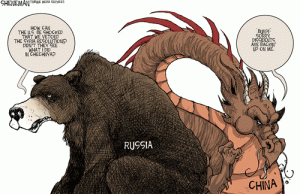 The concluding paragraphs from Michael Klare’s Essay on the Coming Cold War 2.0.
“For those of us residing outside Washington, this choice may appear to have few immediate consequences. The defense budget will rise in either case; troops will, as now, be shuttled desperately around the hot spots of the planet, and so on. Over the long run, however, don’t think for a second that the choice won’t matter.
A stepped-up drive to counter Russia will inevitably produce a grim, unpredictable Cold War-like atmosphere of suspicion, muscle-flexing, and periodic crises. More U.S. troops will be deployed to Europe; American nuclear weapons may return there; and saber rattling, nuclear or otherwise, will increase. (Note that Moscow recently announced a decision to add another 40 intercontinental ballistic missiles to its already impressive nuclear arsenal and recall Senator Cruz’s proposal for deploying U.S. anti-missile batteries in Eastern Europe.) For those of us who can remember the actual Cold War, this is hardly an appealing prospect.
A renewed focus on China would undoubtedly prove no less unnerving. It would involve the deployment of additional U.S. naval and air forces to the Pacific and an attendant risk of armed confrontation over China’s expanded military presence in the East and South China Seas. Cooperation on trade and the climate would be imperiled, along with the health of the global economy, while the flow of ideas and people between East and West would be further constricted. (In a sign of the times, China recently announced new curbs on the operations of foreign nongovernmental organizations.) Although that country possesses far fewer nuclear weapons than Russia, it is modernizing its arsenal and the risk of nuclear confrontation would undoubtedly increase as well.
In short, the options for American global policy, post-2016, might be characterized as either grim and chaotic or even grimmer, if more focused. Most of us will fare equally badly under either of those outcomes, though defense contractors and others in what President Dwight Eisenhower first dubbed the “military-industrial complex” will have a field day. Domestic needs like health, education, infrastructure, and the environment will suffer either way, while prospects for peace and climate stability will recede.
A country without a coherent plan for advancing its national interests is a sorry thing. Worse yet, however, as we may find out in the years to come, would be a country forever on the brink of crisis and conflict with a beleaguered, nuclear-armed rival.”
The geopolitics of the future continue to darken as the interests of the state and corporate elites once again trump the interests of the people of the world. The elephant in the room, of course, is climate change and no one in power seems to care. I imagine, when New York is underwater – action might be considered.
No one tells me ‘nuthin anymore. We missed the UN international torture day, it happened on June 26th and of course I hear about it after it happens. Our media coverage was, underwhelming, as torture must not bring us down from the elation felt in the US for the SCOTUS SSM decision.
I’m not even sure what to wear to celebrate UNITD, orange jumpsuit? Bruises? How does one costume lifelong psychological trauma.
I’ll be ready next year though, rest assured. :/
“The real world of capitalism is one in which capitalists demand state intervention on their behalf while opposing government intervention on behalf of their employees or the poor. In a broader sense, the state is the guarantor of the capitalist system, providing the framework of laws and protections it needs to exist. Taxpayers fund the state, thereby ensuring capitalism’s viability. Capitalism cannot exist without a host state, just as corporations cannot exist without property laws, state charters, copyrights and patent protections, and a host of other government “interventions.”
— Brian Oliver Sheppard, The Inefficiency of Capitalism











 bleatmop
 Mystro


 Dead Wild Roses
Your opinions…