
You are currently browsing the category archive for the ‘Quackery’ category.
This is a common activist argument. It often arrives pre-loaded with moral certainty, as if the analogy itself settles the question. That should set off your spider-senses immediately: when moral certitude and ideological correctness are doing the work, argumentative rigour usually is not.
The claim is familiar. Left-handedness once looked rare because it was stigmatized and suppressed; stigma eased, reported rates rose. Therefore, the rise in transgender identification among youth should be read the same way.
The analogy is rhetorically useful. It is also weak.
It forces two different kinds of phenomena into one moral script. Left-handedness is a motor preference: early-emerging, directly observable, and generally stable across the life course. Childhood transgender identification is not that. It involves self-interpretation, language, social meaning, and developmental concepts that mature unevenly. Whatever one’s broader politics, these are not the same kind of thing. Treating them as equivalent does not clarify the issue. It pre-loads the conclusion.
The first failure is developmental. Handedness does not require a child to grasp an abstract social category. A child reaches for a spoon, a crayon, a ball. The preference is visible in action. Gender identity claims are different. They depend on how a child understands sex categories, role expectations, persistence over time, and what it means to “be” a boy or girl beyond clothing, imitation, or preference. That is a heavier cognitive task. Piaget and Kohlberg do not settle today’s policy disputes, but they do establish a relevant caution: young children often reason concretely, and stable identity concepts develop in stages. A child can show a hand preference before the child can fully articulate an abstract identity claim in a mature sense.
That difference changes what counts as evidence. Handedness does not need interpretive reinforcement to remain legible. It persists without adults affirming a narrative about the child’s inner state. Childhood gender self-description does not operate that way. It unfolds inside a social field: family language, peer dynamics, institutional scripts, online models, and adult interpretation. Saying that does not make every case shallow or insincere. It does mean the left-handedness analogy smuggles in false simplicity by equating a physical preference with a socially mediated self-concept.
The second failure is pattern. The rise in reported left-handedness is commonly explained, in large part, by declining suppression and changing norms around forcing children to write with the right hand. The increase was broad and gradual. It was not driven by intense peer clustering in narrow demographic bands. Recent increases in transgender identification among youth have shown a different profile, including marked concentration in particular age and sex cohorts in some settings. That pattern is harder to explain by destigmatization alone. At minimum, it supports a mixed account in which social influence, peer effects, and online environments may contribute in some cases. That is not proof of a single-cause “contagion” model for every child. It is enough to show that the left-handedness analogy is doing more moral work than explanatory work.
The third failure is stability. Handedness, once established, is typically stable and does not initiate a pathway of medical intervention. Childhood gender distress is more variable. Longitudinal studies from earlier clinic-referred cohorts often found that many children presenting with gender dysphoria did not continue to identify as transgender in adulthood, especially after puberty. Those findings need careful handling. They come from older cohorts, older diagnostic frameworks, and a literature now heavily contested on definitions and generalizability. Even with those caveats, the central point remains: childhood gender distress has historically shown developmental fluidity in a way handedness does not. That alone should make the analogy suspect.
The practical asymmetry is harder to ignore. If society was wrong to suppress left-handedness, the correction was simple: stop forcing children to switch hands. No endocrine pathway. No fertility implications. No irreversible surgeries. No high-stakes clinical decisions under uncertainty. Pediatric gender care is not identical in stakes or consequences. That does not answer every clinical question. It does mean “this is just like left-handedness” is not an argument. It is a reassurance strategy.
A more honest framing is available. Stigma can affect disclosure and prevalence reporting without making every rise in identification analogous to left-handedness. Some young people experience deep and persistent gender distress. Childhood identity development is also shaped by cognition, peers, institutions, and timing. Those claims can coexist. Compassion does not require category collapse.
The left-handedness comparison survives because it is emotionally efficient. It offers a ready-made progress narrative and casts skeptics as yesterday’s moral failures. Efficient is not the same thing as accurate. If the aim is responsible care for vulnerable young people, the first obligation is conceptual hygiene: use comparisons that illuminate developmental reality, not analogies that flatten it.

References
- Kohlberg, L. (1966). A cognitive-developmental analysis of children’s sex-role concepts and attitudes. In E. E. Maccoby (Ed.), The Development of Sex Differences. Stanford University Press.
- Gilbert, A. N., & Wysocki, C. J. (1992). Hand preference and age in the United States. Neuropsychologia, 30(7), 601–608.
- Steensma, T. D., Biemond, R., de Boer, F., & Cohen-Kettenis, P. T. (2011). Desisting and persisting gender dysphoria after childhood: A qualitative follow-up study. Clinical Child Psychology and Psychiatry, 16(4), 499–516.
- Singh, D., Bradley, S. J., & Zucker, K. J. (2021). A follow-up study of boys with gender identity disorder. Frontiers in Psychiatry, 12, 632784.
- Cass, H. (2024). Independent Review of Gender Identity Services for Children and Young People (Final Report).
The rapid proliferation of gender ideology over the past decade—especially the surge of adolescent-onset gender dysphoria—stands as one of the clearest examples of social contagion in modern Western societies. A clinical framework once reserved for a very small number of adults with persistent, childhood-onset dysphoria was transformed into a cultural mandate through the convergence of three forces: institutional capture, algorithm-driven identity formation, and activist-driven medical practice.
Between 2015 and the early 2020s, referrals for gender services exploded—driven overwhelmingly by teenage girls with no prior history of dysphoria. Peer-group clustering, sudden identity shifts following intense online exposure, and the complete inversion of historic sex ratios all point to a socially transmitted phenomenon rather than a newly discovered biological one. Yet under the “affirmation” model, minors were placed on puberty blockers, cross-sex hormones, and permanent surgeries despite limited evidence, poorly understood risks, and a professional culture that increasingly discouraged clinical skepticism.
The hardest obstacle to unwind, however, will not be the institutions that enabled this shift. Policies can change, clinics can be restructured, and professional bodies can revise guidelines—as they already have across parts of Europe. The most immovable barrier will be parents. Many acted from compassion, social pressure, or a sincere desire to be “supportive,” but they now face an excruciating truth: they approved irreversible medical interventions on psychologically vulnerable teenagers during a developmental window historically marked by transient distress, identity confusion, and social sensitivity.
Double mastectomies on minors, lifetime fertility loss, and surgeries with complication rates exceeding anything considered acceptable elsewhere in medicine are not abstract debates. They are lived consequences. For parents, acknowledging error would require confronting a moral reality few can bear: that they were active participants in harming their own child. The human mind is built to avoid that revelation at all costs.
As a result, the detransition wave—real, growing, and increasingly documented—will face its fiercest resistance not from clinics or activists, but from within families. Parents will cling to the “lifesaving care” narrative long after the institutions that encouraged it have quietly retreated. They will reinterpret events to preserve psychic stability, even if doing so deepens the suffering of the child who must now live with the consequences.
Reversing the damage will require more than policy reform or legal accountability. It will require a public reckoning with the psychological mechanisms of self-deception, moral injury, and sunk-cost loyalty that allowed an entire society to medicate and operate on distressed adolescents in the name of affirmation. That reckoning—private, painful, and unavoidable—is the hardest part still to come.

References
-
The Cass Review – Independent Review of Gender Identity Services for Children and Young People (Interim Report) — NHS-commissioned review (Feb 2022) by Dr. Hilary Cass. Sex Matters
-
The Cass Review: Final Report (April 2024) — Hilary Cass’s full independent review. BASW+1
-
NHS England: Public Consultation Analysis & Summary – Interim Clinical Policy on Puberty-Suppressing Hormones (Jan 2024) — analysis of feedback on proposed policy changes. NHS England
-
Commission on Human Medicines (UK) Report – Proposed Restriction on GnRH Agonists for Under-18s — recommendation to restrict puberty blockers. GOV.UK
-
Equality & Health Inequalities Impact Assessment (EHIA), NHS England — assessment of health-inequality risks from the policy change on puberty blockers. GOV.UK+1
-
Karolinska Institutet Systematic Review on Hormonal Treatment in Youths (<18) — finds that GnRHa treatment should be considered experimental due to lack of long-term data. Karolinska Institutet News
-
Karolinska Hospital Policy Statement (April 2021) — stops prescribing puberty blockers and cross-sex hormones to minors under 16 except in research settings. Feminist Legal Clinic
Children are being harmed because medical practitioners are either ideologically captured or too scared to speak out against the grotesque medical experimentation undertaken in the name of transgender ideology.
The transgender debate revolves around thought terminating clichés being flung at people rather than actual arguments based on facts and evidence. “No debate”, “TWAW”, and of course “you don’t want trans people to exist!” are all meant to emotionally manipulate and coerce people into agreement or at least silence on the the matters of gender affirming care specifically, and transgender health care in general. This is why (trans) activists almost always take this route because the facts (and medical evidence) DO NOT support their position and said evidence often indicates a risk of significant iatrogenic harm for children and adults.
When talking with the gender religious another dodge they will use is puberty blockers are just being used in a small number of cases. Replace ‘puberty blockers’ with lobotomies or thalidomide treatments to see how well this argument holds up…
This tragic medical scandal is what happens when we allow medical decisions to be made on the basis of feelings and activism, as opposed to evidence based medicine.
GAC is being halted in the UK and across Europe – Canada needs to get its head out of the sand and rejoin the medical community that follows evidence based medicine instead of the strictures of transgender activism. Children’s lives are being ruined because of this quackery and it needs to stop.
The article quoted below by Maria Maynes describes the content of the study. Read the full article here.
“A new study has suggested that damage done by puberty blockers is permanent, casting doubt on claims by trans campaigners that the hormone drugs simply “pause” puberty and provide time for children who question their gender.
The preprint study from the Mayo Clinic, a world-renowned leader in medical research, found mild to severe atrophy in the testes and sperm of male children on puberty blockers. The authors of the groundbreaking study have expressed doubt about the “reversibility” of such blockers, a claim made by campaigners who promote the use of the drugs for gender dysphoric children.
Scientists at the world-renowned clinic who carried out the study found that puberty blockers can lead to fertility problems, withering testicles, and even cancer among children who take them. Authors found that puberty blockers hurt the development of testicles and sperm production in ways that cannot be fully reversed, with problems including impacting users’ ability to have children in adulthood.”
[…]
“The recently published preprint came ahead of the long-anticipated Cass Review in Britain, released on Wednesday, with the independent review warning that healthcare professionals felt afraid to discuss their views on transgender services for children. The report also found that there was no evidence that puberty blockers or hormone drugs “buy time to think” or reduce the suicide risk in children suffering from gender dysphoria.
The publication of the review by paediatrician Dr Hilary Cass has confirmed the NHS in England’s shift away from the medicalised treatment of children struggling with their gender, to one focused on talk therapy and support.
The Mayo Clinic preprint, although not yet peer-reviewed or published, suggests that some of the effects of puberty blockers on testes and sperm may not be reversible, sparking concern from leading medics.
Prof Ashley Grossman, a University of Oxford endocrinologist, has pointed to the study as proof that there is ‘no good evidence’ showing puberty blockers help children.
The endocrinologist highlighted the study, saying that the drugs are too risky to be given to the “greatly increased” number of adolescents who identify as transgender.
“Routine puberty blocking treatment for this use has not yet been adequately studied, and many of these children may have other problems for which they need help,’ he added, hinting at a growing body of evidence showing gender confused youngsters often have other, underlying mental health issues,” he said, as he pointed to the early data released by the Mayo Clinic in the preprint last month.
The UK last month joined the Netherlands, Sweden, Finland and Norway in a growing list of European nations to have either placed restrictions on or banned medical interventions for gender dysphoric children.”
We need to act now to stop this reckless experimentation on our children.


There is going to be an accountability crisis in our institutions. They have knowingly and actively participated in medical practices (Gender Affirming Care) that have little to no evidence of their efficacy and plenty of evidence of their harm.
The lawsuits are just around the corner as children are still being surgically mutilated and sterilized for life by medical professionals who decided to throw the notion of “do no harm” and “evidence based medicine” out the window in favour of dogmatic fact free ideologies (transgender ideology).
Tildeb is a frequent loquacious commenter here on DWR, but in this comment he really puts a fine point on what is about to happen in so many of our institutions here in Canada. I recommend you check out his work over at Questionable Motives. Tildeb writes:
“Now we get to find out who is actually ethical – and able to change their much ballyhooed ‘just-be-kind’ opinions and beliefs based on best evidence and facts to align with reality – and who is not. Let’s see who the ideologues really are, the modern day snake oil conmen.
We get to see the naked truth about those who remain dedicated to a lie: they are not concerned with what’s true nor are they able to use reality to judge their beliefs. They do so for some other reason… and they leave a trail of victims in their wake… a small price, apparently, to pay for them to feel oh-so-good about themselves.We get to see who is promoting even more deceit in order to maintain this incredibly selfish need to feel good about themselves over and above the basic health of children.
Children!
Now we get to see which of these ‘champions of social justice’ who have claimed they ‘support the science’ step up and actually do so by rejecting the lies of gender ideology. And we will see who is rejecting the science when reality is unable to align with what turns out to be a faith-based belief narrative about gender ideology with its harsh and condemning judgement of it, that implementing this ideology on vulnerable children – supported from the classrooms of the nation to our ‘best’ legal minds – is both scientifically incoherent/unjustifiable and medically cruel.
And we shall see why those who insist that they are concerned about the welfare and mental health of vulnerable children are not the ones acting against these kids’ best interests in the name of this pernicious pseudoscience but those who have been so widely condemned as ‘transphobes’ for their criticism of it.
Truth will win out in the end because reality is not a personal opinion or cherished belief. It is not altered by magical words, by playing linguistic games. It is there waiting to arbitrate our beliefs about it. The method to do so is called ‘science’ and it is uncompromising. And that’s why more of us need to support seeking what’s true and be humble enough to go along with its judgement about our beliefs rather than giving in and giving up to activists promoting this most recent example of hysterical popular delusions in the name of something else.”
Powerful stuff. Thank you Tildeb for your words.
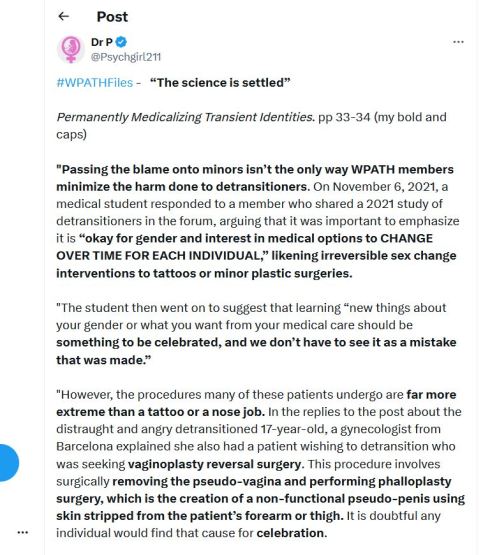
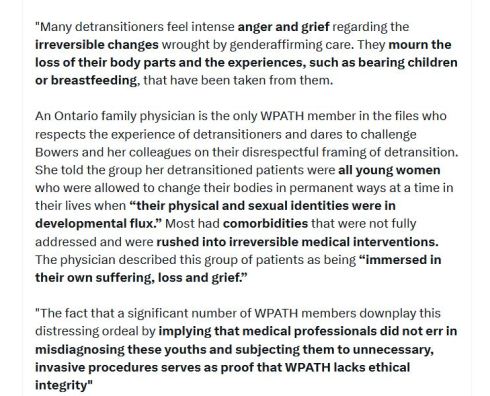
This is big folks. The WPATH files show exactly how unscientific gender medicine is. It is a travesty that a ‘professional association’ could be so irresponsible. But see for yourself.











 bleatmop
 Mystro
 The Arbourist


 Dead Wild Roses
Your opinions…