
You are currently browsing the category archive for the ‘Radical Feminism’ category.
It’s time to organize against the gender religion. I’ve got the book… somewhere. One of the worst feelings in the world is to know you have the book in question, but cannot find it. So here is a quick summary I found on the web.
“According to Alinsky, the organizer, especially a paid organizer from outside, must first overcome suspicion and establish credibility. Next the organizer must begin the task of agitating: rubbing resentments, fanning hostilities, and searching out controversy. This is necessary to get people to participate. An organizer has to attack apathy and disturb the prevailing patterns of complacent community life where people have simply come to accept a bad situation. Alinsky would say, “The first step in community organization is community disorganization.”
Through a process combining hope and resentment, the organizer tries to create a “mass army” that brings in as many recruits as possible from local organizations, churches, services groups, labor unions, corner gangs, and individuals.
Alinsky provides a collection of rules to guide the process. But he emphasizes these rules must be translated into real-life tactics that are fluid and responsive to the situation at hand.
Rule 1: Power is not only what you have, but what an opponent thinks you have. If your organization is small, hide your numbers in the dark and raise a din that will make everyone think you have many more people than you do.
Rule 2: Never go outside the experience of your people.
The result is confusion, fear, and retreat.Rule 3: Whenever possible, go outside the experience of an opponent. Here you want to cause confusion, fear, and retreat.
Rule 4: Make opponents live up to their own book of rules. “You can kill them with this, for they can no more obey their own rules than the Christian church can live up to Christianity.”
Rule 5: Ridicule is man’s most potent weapon. It’s hard to counterattack ridicule, and it infuriates the opposition, which then reacts to your advantage.
Rule 6: A good tactic is one your people enjoy. “If your people aren’t having a ball doing it, there is something very wrong with the tactic.”
Rule 7: A tactic that drags on for too long becomes a drag. Commitment may become ritualistic as people turn to other issues.
Rule 8: Keep the pressure on. Use different tactics and actions and use all events of the period for your purpose. “The major premise for tactics is the development of operations that will maintain a constant pressure upon the opposition. It is this that will cause the opposition to react to your advantage.”
Rule 9: The threat is more terrifying than the thing itself. When Alinsky leaked word that large numbers of poor people were going to tie up the washrooms of O’Hare Airport, Chicago city authorities quickly agreed to act on a longstanding commitment to a ghetto organization. They imagined the mayhem as thousands of passengers poured off airplanes to discover every washroom occupied. Then they imagined the international embarrassment and the damage to the city’s reputation.
Rule 10: The price of a successful attack is a constructive alternative. Avoid being trapped by an opponent or an interviewer who says, “Okay, what would you do?”
Rule 11: Pick the target, freeze it, personalize it, polarize it. Don’t try to attack abstract corporations or bureaucracies. Identify a responsible individual. Ignore attempts to shift or spread the blame.
According to Alinsky, the main job of the organizer is to bait an opponent into reacting. “The enemy properly goaded and guided in his reaction will be your major strength.”
No idea is sacred in a society that values freedom of speech and expression. Yet, if one questions the tenets of trans-ideology then seemingly all bets are off. Disrupting one’s professional career, receiving threats, losing opportunities to speak are all possible consequences of questioning trans-ideology. That fact in itself should give pause to anyone who fancies calling themself progressive. Robert Jensen writing for commondreams.org writes eloquently on this topic.
“To be clear: Humans do create cultural meaning about sex differences. Humans who have a genetic makeup to produce sperm (males) and humans who have a genetic makeup to produce eggs (females) are treated differently in a variety of ways that go beyond roles in reproduction.
In the struggle for women’s liberation, feminists in the 1970s began to use the term “gender” to describe the social construction of meaning around the differences in biological sex. When men would say, “Women are just not suited for political leadership,” for example, feminists would point out that this was not a biological fact to be accepted but a cultural norm to be resisted.
To state the obvious: Biological sex categories exist outside of human action. Social gender categories are a product of human action.
This observation leads to reasonable questions, which aren’t bigoted or transphobic: When those in the transgender movement assert that “trans women are women,” what do they mean? If they mean that a male human can somehow transform into a female human, the claim is incoherent because humans cannot change biological sex categories. If they mean that a male human can feel uncomfortable in the social gender category of “man” and prefer to live in a society’s gender category of “woman,” that is easy to understand. But it begs a question: Is the problem that one is assigned to the wrong category? Or is the problem that society has imposed gender categories that are rigid, repressive, and reactionary on everyone? And if the problem is in society’s gender categories, then is not the solution to analyze the system of patriarchy—institutionalized male dominance—that generates those rigid categories? Should we not seek to dismantle that system? Radical feminists argue for such a radical change in society.
These are the kinds of questions I have asked and the kinds of arguments I have made in writing and speaking. If I am wrong, then critics should point out mistakes and inaccuracies in my work. But if this radical feminist analysis is a strong one, then how can an accurate description of biological realities be evidence of bigotry or transphobia?
When I challenge the ideology of the transgender movement from a radical feminist perspective—which is sometimes referred to as “gender-critical,” critical of the way our culture socially constructs gender norms—I am not attacking people who identify as transgender. Instead, I am offering an alternative approach, one rooted in a collective struggle against patriarchal ideologies, institutions, and practices rather than a medicalized approach rooted in liberal individualism.
That’s why the label “TERF” (trans-exclusionary radical feminism) is inaccurate. Radical feminists don’t exclude people who identify as transgender but rather offer what we believe is a more productive way to deal with the distress that people feel about gender norms that are rigid, repressive, and reactionary. That is not bigotry but politics. Our arguments are relevant to the ongoing debate about public policies, such as who is granted access to female-only spaces or who can compete in girls’ and women’s sports. They are relevant to concerns about the safety of puberty blockers, cross-sex hormones, and surgical interventions. And radical feminism is grounded in compassion for those who experience gender dysphoria—instead of turning away from reality, we are suggesting ways to cope that we believe to be more productive for everyone.
Now, a final prediction. I expect that some people in the transgender movement will suggest that my reproduction/respiration analogy mocks people who identify as transgender by suggesting that they are ignorant. Let me state clearly: I do not think that. The analogy is offered to point out that an argument relevant to public policy doesn’t hold up. To critique a political position in good faith is not to mock the people who hold it but rather to take seriously one’s obligation to participate in democratic dialogue.
In a cancel culture, people who disagree with me may find it easy to ignore the argument and simply label me a bigot, on the reasoning that because I think a certain ideology within the transgender movement is open to critique, I obviously am transphobic.“
One of my goals here at DWR is to provide a resource that can help when the arguments start flying and you need a little argumentative boost to counter the tomfoolery going on with the other side. Dr. Jane Clare Jones intellectual rigor and acumen will almost never steer you wrong.
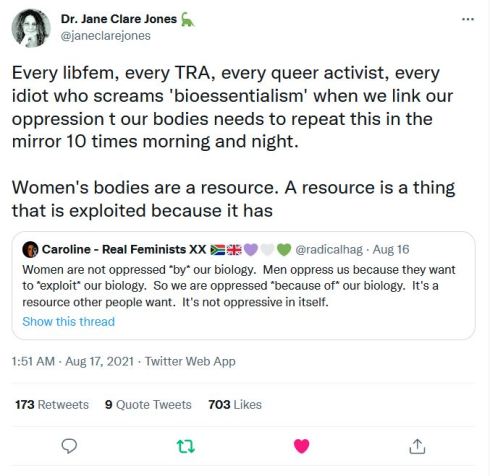

My apologies for having to source fox news, but hey when you find an authentic feminist given public air time, you have to spread the word.
The ‘freedom’ that is offered to women is conditional in nature. You see, if it comports with male desire – pornography, wearing womanface – it deemed acceptable and worthy in society. However, saying no to the ‘peen in both situations is most definitely not acceptable. How do we know?
Calling prostitution damaging and exploitative one gets called anti-sex as if somehow rallying against paid-rape is prudish and old fashioned. In the second case rightly recognizing the threat and danger of males in female spaces one is called ‘transphobic’ or anti-trans for acknowledging safeguarding and ever present threat of male violence in society. Identify however you’d like but, your gender fantasy ends where the safety of others begins.
In both cases, this bullshit comes from the Left and it is completely unacceptable.
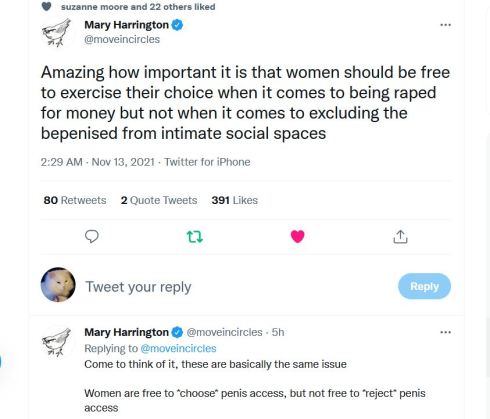
The theme in both cases is that women asserting boundaries is not acceptable. Thus, the feminist struggle must continue, because freedom for women should not be conditional on the acceptance of the male member.
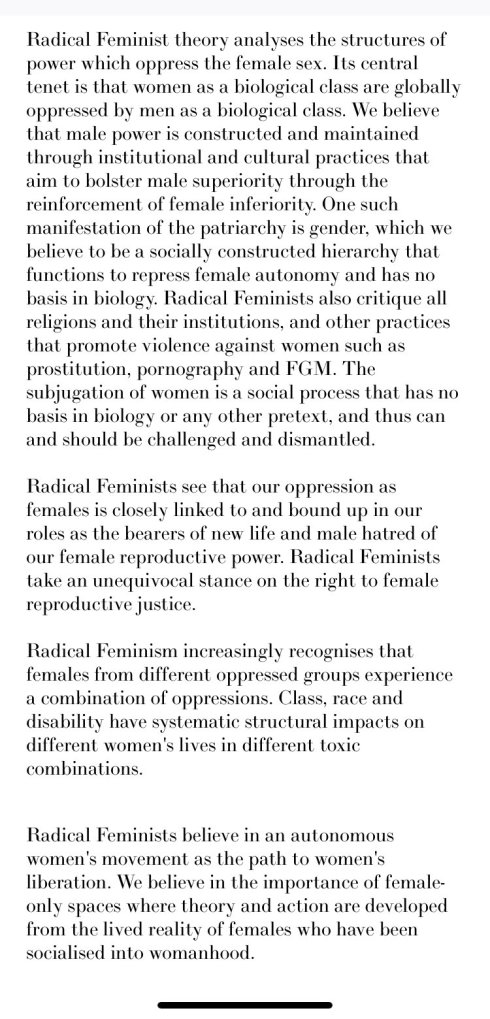
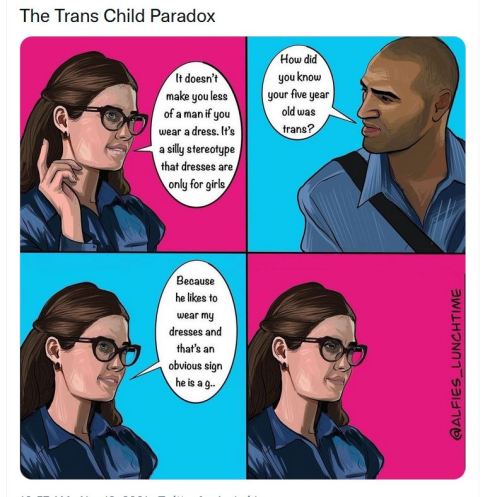
Transgender ideology is rife with paradox. This is one of the more important aspects because it illustrates the friction between a supposedly liberating dogma and its actual effects.
Gender stereotypes are, for the most part, harmful for the women and men that follow them. Like the cartoon above – the stereotype is that dresses are worn by women. Well we all know that clothing for the most part, has no gender and can be worn by anyone. But men are ‘not supposed’ to wear dresses because they are for women – men will feel social pressure not to wear a dress because of the arbitrary gender stereotypes.
So what is transgender ideology to do when it argues that wearing a dress, in fact, makes you a woman. Transgender ideology reinforces the stereotypical notion of gendered clothing and who is allowed to wear what. It maintains the status quo and is no way revolutionary.
Contrast this with the gender abolitionist radical feminist position – Let’s dispense with the notion of gender stereotypes altogether and celebrate gender non conforming behaviour because clothes are for people – the end. A woman in a suit or a man in a dress are simply that, a female and a male with clothing that matches their personality and goals for the day. Easy peasy lemon squeezy.











 bleatmop
 Mystro


 Dead Wild Roses
Your opinions…