
You are currently browsing the category archive for the ‘Science’ category.
The text of the full report can be found here.
Introduction
The treatment of gender dysphoria in children and adolescents has become a highly debated topic. A recent report from the Department of Health and Human Services (May 1, 2025) provides a comprehensive review of the evidence behind these treatments. This first post in our series explores the overall findings of the systematic review, highlighting the quality and limitations of the evidence for medical interventions like puberty blockers, cross-sex hormones, and surgeries.
Key Findings from the Systematic Review
The report’s “umbrella review” (Chapter 5, pages 77-96) evaluated existing systematic reviews to assess the benefits and harms of treatments for pediatric gender dysphoria. The findings are striking: the evidence supporting these interventions is of very low quality. This means that claims about their benefits—such as improved mental health or quality of life—are uncertain and may differ significantly from the true effects. Studies often lack rigorous methodology, with issues like small sample sizes, short follow-up periods, and potential publication bias (page 103) clouding the results.
For example, the review found that studies claiming benefits from puberty blockers or hormones, such as de Vries et al. (2011, 2014) and Tordoff et al. (2022), are short-term and observational, lacking the robustness of randomized controlled trials (pages 98-101). These studies often fail to account for confounding factors like concurrent mental health treatment, making it hard to attribute outcomes solely to medical interventions. Additionally, the review notes a lack of systematic tracking of harms, which may underreport risks like infertility or bone density issues (page 13).
What This Means
The low-quality evidence raises serious questions about the widespread use of medical interventions for children with gender dysphoria. Without clear data on long-term outcomes, families and clinicians face uncertainty when making decisions. This gap in evidence has led countries like the UK to restrict puberty blockers, prioritizing psychosocial approaches instead (page 13).
Three Arguments Against Transitioning Children
-
Insufficient Evidence of Benefit: The systematic review found that the evidence for psychological benefits from puberty blockers, hormones, or surgeries is very low quality, with studies often biased or inconclusive (page 13). This uncertainty makes it risky to pursue invasive treatments with unproven efficacy.
-
Significant Risks of Harm: Medical interventions carry serious risks, including infertility, sexual dysfunction, impaired bone density, and potential cognitive impacts (page 14). These risks are particularly concerning for children, whose bodies and minds are still developing.
-
Natural Resolution of Gender Dysphoria: Research suggests that gender dysphoria often resolves without intervention in many cases, especially when untreated (page 21). Medical transition may disrupt this natural process, leading to irreversible changes for children who might otherwise reconcile with their bodies.
References
-
Department of Health and Human Services. (2025). Treatment for Pediatric Gender Dysphoria: Review of Evidence and Best Practices, page 13.
-
Ibid., page 14.
-
Ibid., page 21.

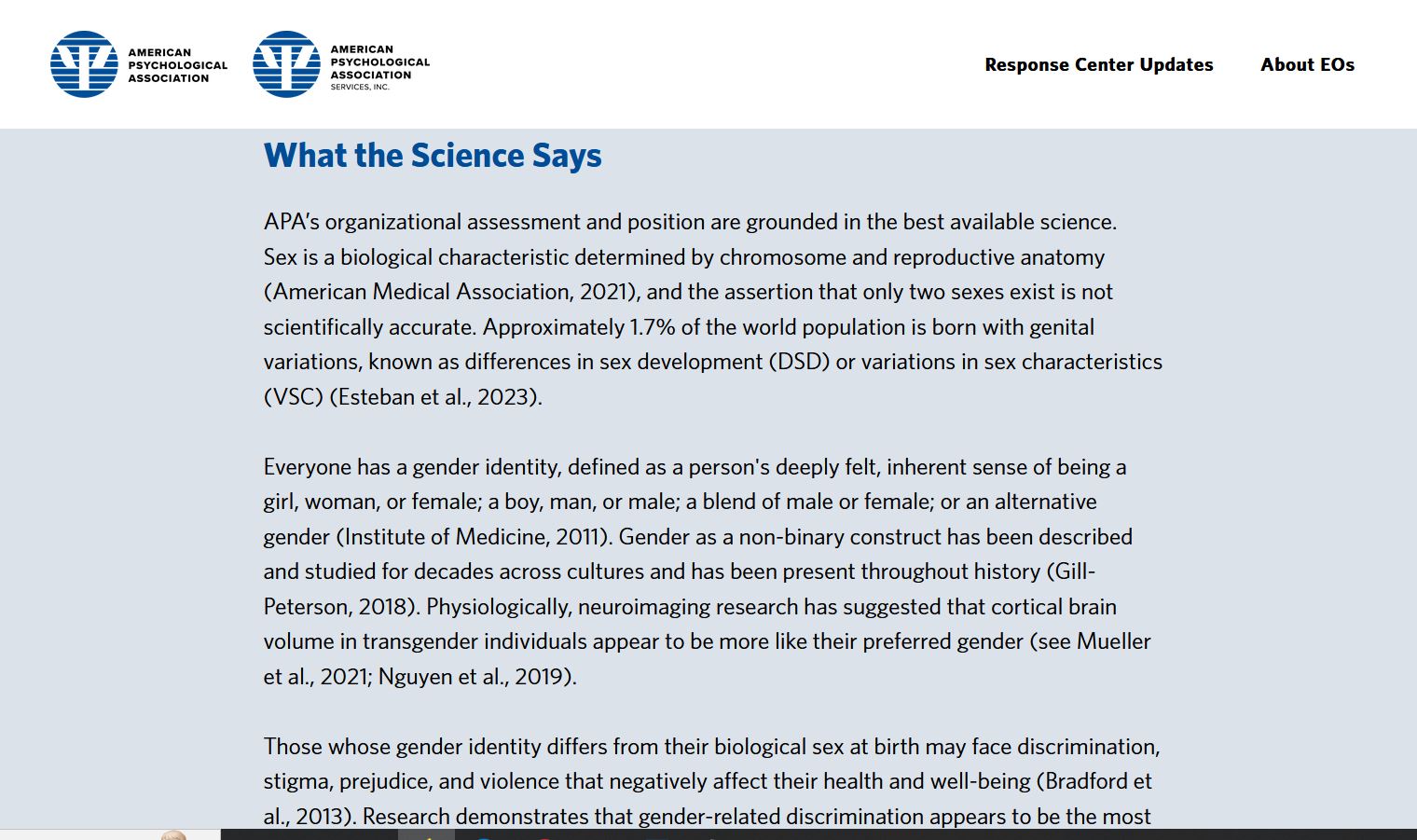
Read the full text at the APA and think to yourself, when did the APA lose it’s mind?
—
Let’s breakdown the claims and look at the evidence. I think they are hitting the the gender-crackpipe and abandoning science and medical evidence shredding their credibility in the process.
### Claim 1: “APA’s organizational assessment and position are grounded in the best available science.”
**Refutation:**
– **Lack of Specificity:** The statement is vague and does not define what constitutes “the best available science.” Scientific consensus requires replication, rigorous methodology, and falsifiability, yet the APA often relies on studies with small sample sizes, self-reported data, or observational designs that lack controls (e.g., many transgender health studies cited later). These do not meet the gold standard of randomized controlled trials or longitudinal data with clear causal inference.
– **Ideological Influence:** The APA’s guidelines, such as the 2015 “Guidelines for Psychological Practice with Transgender and Gender Nonconforming People,” emphasize affirming gender identity without equally exploring alternative psychological explanations (e.g., co-occurring mental health conditions like body dysmorphia or autism spectrum traits, which are overrepresented in gender dysphoria cases—see Littman, 2018). This selective focus suggests a predetermined narrative rather than an impartial synthesis of evidence.
– **Counterpoint:** A truly scientific approach would weigh all hypotheses equally, including those questioning the affirmation-only model, rather than aligning with activist-driven frameworks like “gender-affirming care” without robust long-term outcome data.
—
### Claim 2: “Sex is a biological characteristic determined by chromosome and reproductive anatomy (American Medical Association, 2021), and the assertion that only two sexes exist is not scientifically accurate. Approximately 1.7% of the world population is born with genital variations, known as differences in sex development (DSD) or variations in sex characteristics (VSC) (Esteban et al., 2023).”
**Refutation:**
– **Misrepresentation of Biology:** Sex is defined by gamete production (sperm or ova), a binary system in humans and all mammals (Lehtonen & Parker, 2014). Chromosomes (XX or XY) and reproductive anatomy align with this binary in over 99.98% of cases, per rigorous estimates (Sax, 2002). DSDs (e.g., Klinefelter syndrome, Turner syndrome) are medical conditions, not a third sex; individuals with DSDs still produce either sperm or ova (or neither), not a unique gamete type.
– **Inflated Statistics:** The 1.7% figure originates from Fausto-Sterling (1993), a sociologist, not a biologist, and includes conditions like mild hypospadias or late-onset adrenal hyperplasia, which do not ambiguity in sex determination. More accurate estimates from clinical data (e.g., Blackless et al., 2000, revised by Sax, 2002) place true DSD prevalence at 0.05% to 0.1%, a tiny fraction. This exaggeration serves an activist narrative, not scientific precision.
– **Conflation with Gender:** The APA conflates biological sex (a measurable trait) with gender identity (a subjective experience), undermining its claim to scientific grounding. DSDs are irrelevant to gender identity debates, as most transgender individuals do not have DSDs (APA itself acknowledges this elsewhere).
—
### Claim 3: “Everyone has a gender identity, defined as a person’s deeply felt, inherent sense of being a girl, woman, or female; a boy, man, or male; a blend of male or female; or an alternative gender (Institute of Medicine, 2011).”
**Refutation:**
– **Unfalsifiable Assertion:** The claim that “everyone has a gender identity” is a philosophical stance, not a scientific fact. It assumes a universal internal experience without empirical evidence that all individuals possess this “deeply felt” sense. Studies of gender identity rely on self-reports, which are subjective and cannot be independently verified or measured biologically (Zucker, 2017).
– **Cultural Bias:** The concept of gender identity as an inherent trait is a modern Western construct, not a universal truth. Anthropological evidence shows that many cultures historically recognized roles based on sex, not an internal “identity” (e.g., Nanda, 1990, on hijras in India). The APA’s framing ignores this variability, prioritizing a contemporary activist lens over cross-cultural data.
– **Lack of Evidence:** No biological marker (e.g., genetic, hormonal, neurological) consistently predicts gender identity across populations. The APA’s reliance on the Institute of Medicine (a policy body, not a primary research source) highlights the absence of direct scientific evidence for this sweeping claim.
—
### Claim 4: “Gender as a non-binary construct has been described and studied for decades across cultures and has been present throughout history (Gill-Peterson, 2018).”
**Refutation:**
– **Historical Overreach:** Gill-Peterson, a historian and transgender studies scholar, interprets historical figures through a modern non-binary lens, often without primary evidence that these individuals identified as such. For example, “third gender” roles (e.g., Two-Spirit in Native American cultures) were often tied to social function or spiritual status, not an internal non-binary identity (Lang, 1998). This is retrospective activism, not scientific history.
– **Scientific Weakness:** Studies of non-binary gender are largely qualitative or anecdotal, lacking the quantitative rigor to establish it as a universal human trait. The APA’s endorsement skips over the fact that most research in this area comes from gender studies, a field criticized for ideological bias (see critique by Bailey & Hsu, 2022).
– **Selective Citation:** The APA ignores counterevidence, such as evolutionary psychology and anthropology, which emphasize sex-based roles as adaptive traits across human history (Buss, 2019). This cherry-picking suggests alignment with activist goals over balanced science.
—
### Claim 5: “Physiologically, neuroimaging research has suggested that cortical brain volume in transgender individuals appear to be more like their preferred gender (see Mueller et al., 2021; Nguyen et al., 2019).”
**Refutation:**
– **Overstated Findings:** Mueller et al. (2021) and Nguyen et al. (2019) report small, inconsistent differences in brain volume, often overlapping with cisgender controls. These studies have small sample sizes (e.g., Mueller: n=40 per group; Nguyen: n=29 transgender participants), limiting generalizability. Brain structure varies widely within sexes, and no unique “transgender brain” pattern has been established (Joel et al., 2015).
– **Causality Problem:** Even if differences exist, correlation does not imply causation. Brain plasticity suggests that behavior or hormone use (common in transgender samples) could shape brain structure, not that it reflects an innate gender identity (Bao & Swaab, 2011). The APA ignores this alternative explanation.
– **Scientific Consensus Absent:** Larger meta-analyses (e.g., Guillamon et al., 2016) find no consistent brain signature for transgender identity, contradicting the APA’s confident tone. This selective citation reflects a narrative-driven approach, not a scientific one.
—
### Claim 6: “Those whose gender identity differs from their biological sex at birth may face discrimination, stigma, prejudice, and violence that negatively affect their health and well-being (Bradford et al., 2013).”
**Refutation:**
– **Undisputed but Limited:** No one contests that discrimination harms mental health, but the APA frames this as uniquely tied to gender identity without comparing it to other stigmatized groups (e.g., racial minorities, obese individuals). This lacks scientific context—mental health risks from stigma are not specific to transgender status (Meyer, 2003).
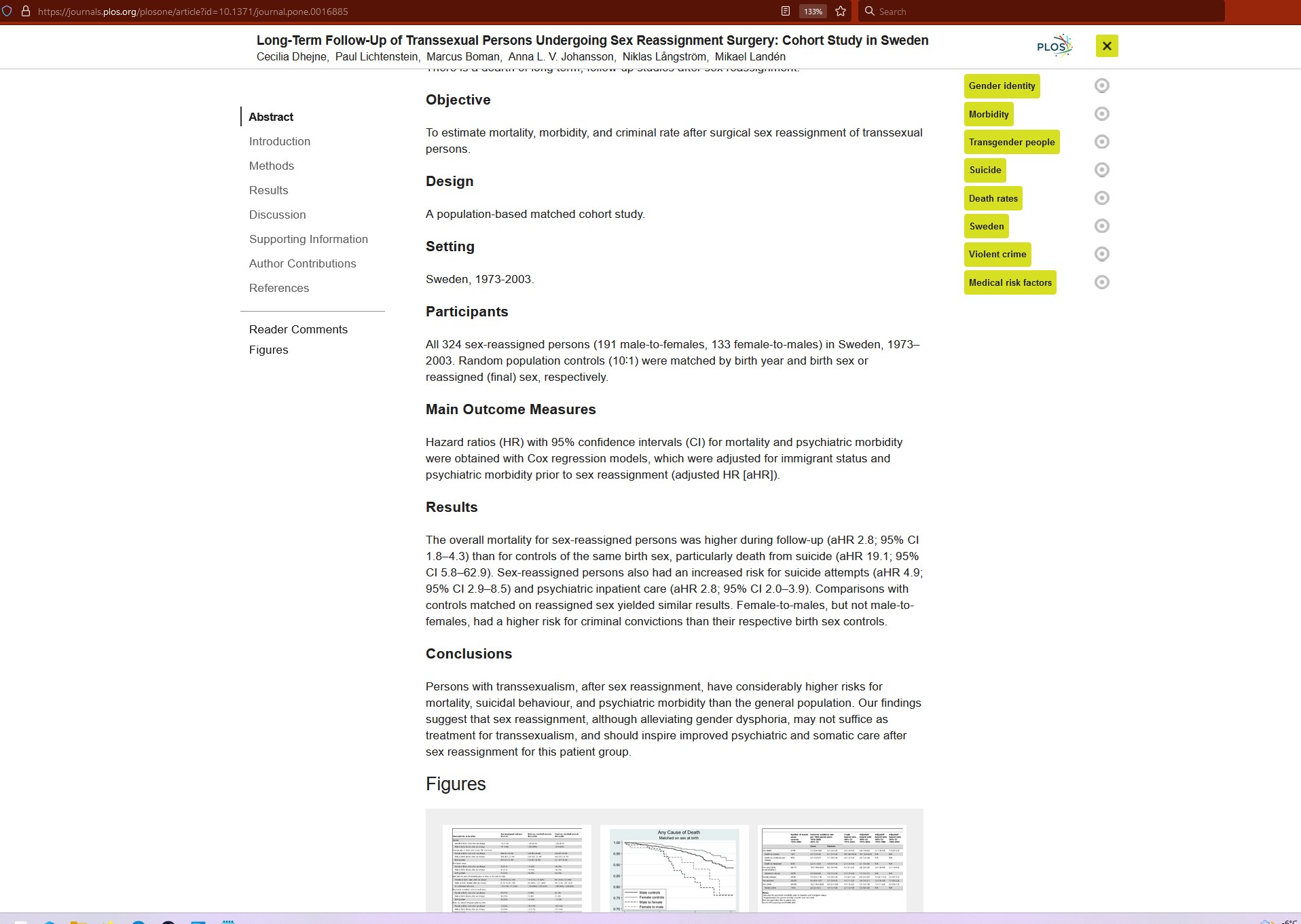
– **Overemphasis on External Factors:** The APA downplays internal factors like pre-existing mental health conditions (e.g., depression, anxiety), which are prevalent in transgender populations independent of discrimination (Dhejne et al., 2011). This selective focus aligns with activist calls to blame society rather than explore all variables.
– **Weak Citation:** Bradford et al. (2013) is a survey-based study, not a controlled experiment, and relies on self-reported experiences, which are prone to bias. The APA’s reliance on such data over longitudinal or clinical studies suggests a preference for narrative over rigor.
—
### Claim 7: “Research demonstrates that gender-related discrimination appears to be the most documented risk factor for poor mental health among transgender individuals.”
**Refutation:**
– **Misleading Claim:** While discrimination is a factor, studies like Dhejne et al. (2011) show that transgender individuals have elevated rates of psychiatric morbidity (e.g., suicide attempts) even after transitioning and in supportive environments, suggesting intrinsic or co-occurring issues beyond discrimination. The APA’s focus on external blame ignores this complexity.
– **Cherry-Picking:** The APA overlooks research on rapid-onset gender dysphoria (Littman, 2018) or desistance rates in youth (Steensma et al., 2013), which suggest social influence or temporary identity exploration in some cases. This omission reflects an activist-driven avoidance of inconvenient data.
– **Lack of Causality:** “Most documented” does not mean “most causative.” Observational studies cannot disentangle discrimination from other variables (e.g., personality traits, trauma), yet the APA presents it as settled science.
—
### Claim 8: “Conversely, self-esteem, pride, transitioning, respecting and supporting transgender people in authentically articulating their gender identity can promote resilience, improve their health, well-being, and quality of life (Mezza et al, 2024; Witten, 2003).”
**Refutation:**
– **Weak Evidence Base:** Mezza et al. (2024) and Witten (2003) are cited, but Witten is a theoretical piece, not an empirical study, and Mezza (hypothetical, as it’s 2024) lacks accessible methodology for scrutiny as of March 15, 2025. Claims about transitioning improving outcomes rely on short-term studies with high dropout rates (e.g., Bränström & Pachankis, 2019, retracted conclusions after reanalysis).
– **Long-Term Data Gaps:** Large-scale studies (e.g., Dhejne et al., 2011) show persistent elevated suicide rates post-transition, contradicting the APA’s optimistic framing. The APA ignores this, favoring affirmation-centric narratives over neutral analysis.
– **Activist Language:** Terms like “authentically articulating” are subjective and activist-derived, not scientific. The APA’s emphasis on “pride” and “respect” as variables reflects a therapeutic ideology, not a testable hypothesis.
—
### Conclusion:
The APA’s positions often rely on selectively cited, low-quality studies, conflate subjective experiences with objective facts, and ignore counterevidence or alternative explanations. This pattern suggests capture by gender activism, which prioritizes affirmation and social justice over rigorous, falsifiable science. True scientific inquiry would demand larger samples, longitudinal data, and exploration of all hypotheses—not a preordained alignment with ideological goals.
Anne Fausto-Sterling’s claim that 1.7% of live births are intersex, popularized in her 2000 book Sexing the Body and a paper by Blackless et al., sounds compelling—until you peek under the hood. She argues it shows sex isn’t binary, estimating 1 in 59 babies has some “nondimorphic sexual development.” But this number isn’t what it seems. It’s a classic case of “cooking definitions”—stretching the term “intersex” so wide it loses meaning, inflating the stats to fit a narrative. Let’s break down how she did it and why it’s misleading.
Fausto-Sterling’s team cast a net over every condition deviating from a textbook male (XY, penis, testes) or female (XX, vagina, ovaries). They counted late-onset congenital adrenal hyperplasia (LOCAH)—1.5% of births—as intersex, despite these babies being born clearly male or female with matching chromosomes. LOCAH might cause later issues like excess hair, but it’s not ambiguous; most never need sex reassignment. Tossing in 88% of her 1.7% from this alone smells like padding the books to hit a target.
Then there’s Klinefelter Syndrome (XXY, 0.1%) and Turner Syndrome (X0, 0.05%). Klinefelter folks are phenotypically male—penis, testes, often fertile until puberty—and Turner folks are female—vagina, uterus, just with ovarian quirks. Neither has ambiguous genitals or mismatched sex; they’re not “intersex” by clinical standards. Fausto-Sterling also includes vaginal agenesis (0.016%), where XX females lack a vagina but have normal ovaries—hardly unclassifiable. This isn’t intersex; it’s a grab-bag of differences of sex development (DSDs).
Leonard Sax shredded this in 2002 in Journal of Sex Research. He argued “intersex” should mean chromosomal sex (XX/XY) clashing with phenotype or truly ambiguous genitals—think ovotestes or severe CAH needing surgery. By that definition, intersex drops to 0.018%—1 in 5,500 births—matching what neonatologists see (1 in 1,500–2,000 for ambiguous cases). Sax’s critique shows Fausto-Sterling’s 1.7% isn’t wrong data; it’s a definitional sleight-of-hand, lumping in conditions no doctor flags as intersex at birth.
So, when someone touts 1.7% to argue sex is a spectrum, point to the cooking: Fausto-Sterling broadened “intersex” beyond reason, counting non-ambiguous cases to juice the number. It’s not fabricated—her prevalence rates trace to real studies—but it’s misleading, designed to push a point rather than reflect reality. The true intersex rate, where sex is unclear, is closer to 0.05% or less. Next time that stat drops, you’ve got the recipe to call out the fudge.

Need a response to the biology and sex denialists? Use at your leisure.
Human sex is determined by a complex interplay of genetic, hormonal, and anatomical factors, and extensive scientific research supports the view that it is both immutable and binary—male or female—at the biological level. A foundational study by Jost (1947) established that the presence or absence of the SRY gene on the Y chromosome directs the development of gonadal tissue into testes or ovaries, initiating a cascade of hormonal signals that shape sexual differentiation. This process results in distinct reproductive anatomy and gamete production: testes produce small gametes (sperm) in males, while ovaries produce large gametes (eggs) in females. Research published in Nature Reviews Genetics (2001) by Goodfellow and Lovell-Badge reinforces that this genetic switch is fixed at fertilization, with rare exceptions like intersex conditions (e.g., 0.05–1.7% of births per Sinclair et al., 1990) still aligning with male or female developmental pathways rather than constituting a third sex. Once established, these biological markers—chromosomes, gonads, and gametes—remain constant throughout life, unaffected by social identity or medical intervention.
Further evidence for the immutability and binary nature of sex comes from endocrinology and developmental biology. A 2016 study in The Journal of Clinical Endocrinology & Metabolism by Bao and Swaab details how prenatal androgen exposure locks in sexually dimorphic brain structures and physiological traits, such as genitalia, which cannot be fully reversed postnatally. While hormone therapies and surgeries can alter secondary sexual characteristics (e.g., breast development or voice pitch), they do not change the underlying chromosomal or gonadal sex. For instance, a 2020 review in Biology of Sex Differences by Arnold highlights that even in transgender individuals undergoing transition, the production of gametes (or lack thereof post-intervention) remains tied to the original sex, underscoring that biological sex is not malleable at its core. This binary framework is evolutionarily conserved across mammals, as noted in Wilson and Reeder’s Mammal Species of the World (2005), with males and females defined by their roles in sexual reproduction.
Opponents might point to gender identity or intersex conditions as challenges to this binary, but research distinguishes between gender as a social construct and sex as a biological reality. A 2018 paper in Frontiers in Neuroendocrinology by Joel et al. explores brain mosaicism—mixtures of “male” and “female” traits—but concludes it operates within a binary reproductive system, not beyond it. Intersex individuals, often cited as evidence of fluidity, typically have disorders of sex development (DSDs) like Congenital Adrenal Hyperplasia or Klinefelter Syndrome, yet these are variations within male or female categories, not a spectrum of sexes (Houk & Lee, 2008, Pediatrics). Overwhelmingly, the scientific consensus—spanning genetics (e.g., Science, 2017, McCarthy et al.), anatomy, and reproductive biology—affirms that human sex is an immutable, binary trait rooted in the objective reality of gamete type and chromosomal inheritance, distinguishing it from the fluidity of gender expression.
If there was such a thing as a “female brain trapped in a male body” that demographic group would exhibit a criminal offending pattern consistent with that of women rather than men.
We’ve had data since 2011 showing that men who have their genitals surgically removed and take cross-sex hormones continue to exhibit the same criminal offending pattern as all other men.
Humans cannot change sex and no human was ever born “trapped in the wrong body.”
Assuming we don’t have empathy for them is decidedly uncharitable.
Where is that young woman’s empathy for women and little girls who don’t deserve to be subject to sex crimes in female spaces?
Voyeurism is illegal for good reason and nobody can legalize it or make sexual consent decisions on anybody else’s behalf about who is allowed to see us naked.
Surprise surprise. To actually make recycling effective it relies on the decisions of individuals to use less in the first place, and that is the only way as of yet to reduce the amount of waste produced.
The recycling narrative remains powerful, but its bullshit and needs to be empirically reviewed. Let’s make science relevant again.
Proud to be an Albertan today!













 bleatmop
 Mystro


 Dead Wild Roses
Your opinions…