
You are currently browsing the category archive for the ‘Science’ category.
Transgender ideology is based on lies and emotional coercion. Very effective lies and coercion mind you – enough to make doctors forget about the “do no harm” part of their medical training and instead take up gender-woo and non evidence based medical practices.
So here it is – the beginning of the unraveling, and more importantly the beginning of the lawsuits for medical malpractice. The gender cult adherents are about to enter the FAFO phase of what happens when you let feelings supersede evidence based medicine.
Unfortunately, doctors, psychologists, and many other mental health professionals are deep within the folds of the gender-woo cult and will not leave willingly. The road ahead is long, but we are starting to make the trek back to reality and evidence based medicine.
March 4, 2024
Newly leaked files from within the leading global transgender healthcare body have revealed that the clinicians who shape how “gender medicine” is regulated and practiced around the world consistently violate medical ethics and informed consent. The files, which were leaked from within the World Professional Association for Transgender Health (WPATH), were published today by the US-based think tank Environmental Progress.
WPATH is considered the leading global scientific and medical authority on “gender medicine,” and in recent decades, its Standards of Care have shaped the guidance, policies and practices of governments, medical associations, public health systems and private clinics across the world.
However, the WPATH Files reveal that the organization does not meet the standards of evidence-based medicine, and members frequently discuss improvising treatments as they go along. Members are fully aware that children and adolescents cannot comprehend the lifelong consequences of “gender-affirming care,” and in some cases, due to poor health literacy, neither can their parents.
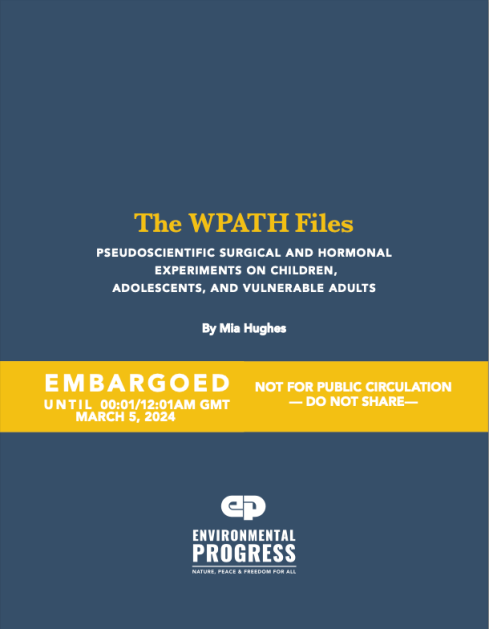
“The WPATH Files show that what is called ‘gender medicine’ is neither science nor medicine,” said Michael Shellenberger, President and founder of Environmental Progress. “The experiments are not randomized, double-blind, or controlled. It’s not medicine since the first rule is to do no harm. And that requires informed consent.”
The raw files have been published in a report called The WPATH Files: Pseudoscientific surgical and hormonal experiments on children, adolescents, and vulnerable adults, which contains analysis by journalist Mia Hughes that puts the WPATH Files in the context of the best available science on gender distress.
Environmental Progress has made all files available to read at the end of the report. The leaked files include screenshots of posts from WPATH’s internal messaging forum dating from 2021 to 2024 and a video of an internal panel discussion. All names have been redacted other than several WPATH members of public significance, such as Dr. Marci Bowers, an American gynecologist and surgeon who is the President of WPATH, and the Canadian pediatric endocrinologist Dr. Daniel Metzger.
In the WPATH Files, members demonstrate a lack of consideration for long-term patient outcomes despite being aware of the debilitating and potentially fatal side effects of cross-sex hormones and other treatments. Messages in the files show that patients with severe mental health issues, such as schizophrenia and dissociative identity disorder, and other vulnerabilities such as homelessness, are being allowed to consent to hormonal and surgical interventions. Members dismiss concerns about these patients and characterize efforts to protect them as unnecessary “gatekeeping.”
The files provide clear evidence that doctors and therapists are aware they are offering minors life-changing treatments they cannot fully understand. WPATH members know that puberty blockers, hormones, and surgeries will cause infertility and other complications, including cancer and pelvic floor dysfunction. Yet they consider life-altering medical interventions for young patients, including vaginoplasty for a 14-year-old and hormones for a developmentally delayed 13-year-old.
The WPATH Files also show how far medical experiments in gender medicine have gone, with discussions about surgeons performing “nullification” and other extreme body modification procedures to create body types that do not exist in nature.
A growing number of medical and psychiatric professionals say the promotion of pseudoscientific surgical and hormonal experiments is a global medical scandal that compares to major incidents of medical malpractice in history, such as lobotomies and ovariotomies.
“Activist members of WPATH know that the so-called ‘gender-affirming care’ they provide can result in life-long complications and sterility and that their patients do not understand the implications, such as loss of sexual function and the ability to experience orgasm,” Shellenberger said. “These leaked files show overwhelming evidence that the professionals within WPATH know that they are not getting consent from children, adolescents, and vulnerable adults, or their caregivers.”
Spoiler Alert: Nothing good.
Reproduced in full – Find the original here.
“A common claim by Americans who oppose state restrictions on “gender-affirming care” is that Sweden, Finland, and the U.K. have not done away with hormonal interventions—and therefore that Republican lawmakers who seek such restrictions are going beyond Europe, and presumably against what European health authorities recommend. Jack Turban, a prominent voice in the affirmative-medicine movement and a notorious source of misinformation on this issue, has said that “not a single country” in Europe “has banned gender-affirming care for trans youth.” The claim is true in a narrow and technical sense, but highly misleading.
In the past few years, European health authorities conducted systematic reviews of evidence for the benefits and risks of puberty blockers and cross-sex hormones. The findings from these reviews—that the certainty of benefits is very low—guided the hand of policymakers there to restrict access to hormones. Currently, minors in these countries can access puberty blockers and cross-sex hormones only if they meet strict eligibility requirements as set out in the Dutch protocol and only in the context of a tightly controlled research setting.
As I’ve explained in pastwritings, the research from the Dutch clinics is championed even by American proponents of “affirmative” medicine as the gold standard in pediatric gender medicine. These advocates either don’t know or are deliberately misleading the public about the discrepancy between the Dutch protocol and what is actually happening in American clinics. The American approach effectively puts distressed teenagers in the driver’s seat of making risky and irreversible medical decisions. It assumes that “gender identity” is innate and immutable, that some kids are just born “trans” and can know this from as young as toddlerhood. It also uses the “minority stress” model to explain away co-occurring mental-health problems, which appear in roughly three-quarters of patients presenting at pediatric gender clinics.
In effect, once a child declares that he is trans, the role of doctors is to “affirm” that declaration medically. Parents are to consent to treatments or get out of the way. Mental-health professionals are there only to help the child cope with the stress that comes from being in a minority, since, as Turban puts it, “most of society is awful.”
One source of confusion, therefore, concerns what, exactly, white-gowned activists like Turban mean when they say “gender-affirming care.” As Hilary Cass noted in her report to the U.K.’s National Health Service, the American affirmative model removes the main guardrails put in place by the Dutch protocol, resulting in a lack of medical “safeguarding.” At least in its official policy, Europe is decidedly not practicing what Turban considers “gender-affirming care.”
To be sure, the problems with the American affirmative model should not conceal the fact that the Dutch study itself rests on a very shaky empirical foundation. The study’s flaws were discussed at length in a recent peer-reviewed article, but two in particular should be mentioned before considering the European systematic reviews.
First, the Dutch study’s lead author, Annelou de Vries, has admitted that “resolution of gender dysphoria” was its “main finding.” But this finding was based on a highly questionable use of the Utrecht Gender Dysphoria Scale—a measure originally developed for diagnostic purposes, not to assess treatment outcomes. The scale is sex-specific, which means that biological males and biological females are given different versions of it. Among other differences, the female version includes questions on menstruation while the male version includes questions about erections. In their follow-up assessments, the Dutch team gave boys who had undergone hormonal treatments the girls’ scale and girls who had undergone hormonal treatments the boys’ scale. Thus, biological males were asked whether experiencing menstruation caused them distress. Since even boys who “transition” do not get periods, those who answered the questionnaire reported a low level of distress. In other words, the plummeting scores in gender dysphoria that the Dutch team reported as their “main finding” was not necessarily due to actually resolved dysphoria, but more likely to switching the scales.
Second, replication is a bedrock of scientific analysis, yet the only attempt to date to replicate the Dutch study, conducted in the U.K., failed. Preliminary results from the study, which began in 2010, were reported as very unimpressive, with adolescents after one year of puberty suppression showing an “increase in internalising problems and body dissatisfaction, especially natal girls.” Moreover, the cohort that received puberty blockers showed no statistically significant difference from the cohort that received only psychotherapy. As Michael Biggs has pointed out, the full picture of the study’s findings became public only after a prolonged campaign to force the researchers to publish their findings.
Contrary to what American activists imply, the systematic reviews of evidence in Sweden, Finland, and the U.K. did not find that the Dutch study, on which the Dutch protocol is based, constitutes high-quality evidence. One of the core questions in the systematic review by the U.K.’s National Institute for Health and Care Excellence (NICE) was this: “In children and adolescents with gender dysphoria, what is the clinical effectiveness of treatment with GnRH analogues [puberty blockers] compared with one or a combination of psychological support, social transitioning to the desired gender or no intervention?” Using the Grading of Recommendations, Assessment, Development, and Evaluations (GRADE) system, NICE assessed the Dutch study for seven reported metrics of mental health impact: gender dysphoria, depression, anger, anxiety, body image, global functioning, and psychosocial functioning.
It found that evidence for benefits across all seven measures was of “very low” certainty. NICE’s conclusion about all the studies on puberty blockers, including the Dutch, was unequivocal: “Studies that found differences in outcomes could represent changes that are either of questionable clinical value, or the studies themselves are not reliable and changes could be due to confounding, bias or chance.” NICE conducted a separate systematic review for cross-sex hormones (which the Dutch study did not independently cover) and found that “[a]ll the studies . . . are uncontrolled observational studies, which are subject to bias and confounding and were of very low certainty using modified GRADE. A fundamental limitation of all the uncontrolled studies included in this review is that any changes in scores from baseline to follow-up could be attributed to a regression-to-the mean” (because patients tend to report for care at the peak of their distress).
The systematic reviews by Sweden’s Committee for Medical and Social Evaluation (SBU), meantime, likewise found that the evidence for the mental-health benefits of hormones, including from the Dutch study, was very uncertain, because of the “moderate to high risk of bias” in these studies. The studies exhibit numerous methodological shortcomings, including confounding factors, lack of control groups, and high rates of attrition. “The identified scientific basis regarding hormone treatment of children and adolescents with gender dysphoria,” SBU concludes, “is limited and it is not possible to draw any conclusions with moderate or high reliability. For most outcomes examined in this report, the evidence is insufficient and conclusions cannot be drawn.” SBU also reported “low confidence” in the assessed health risks of hormonal interventions in minors. In essence, Sweden recognizes this as a medical experiment with no high-quality, reliable data on long-term benefits or risks.
The results from the evidence review in Finland are harder to interpret because most of the studies evaluated involved adults, and the review did not rate the quality and reliability of the studies. In other words, the review did not try to assess the degree to which even the positive findings in the Dutch study were causally related to the hormonal treatments. Nevertheless, on the basis of this review, and a study published by Finnish gender clinicians shortly thereafter finding that “medical gender reassignment is not enough to improve functioning and relieve psychiatric comorbidities,” the country’s Council for Choices in Health Care (COHERE) issued new recommendations in 2020. Even for patients whose gender issues appeared first in childhood and intensified in adolescence (a pathway that is required for hormonal eligibility under the Dutch protocol but optional under the American-affirmative one), COHERE recommends that “the first-line treatment for gender dysphoria is psychosocial support and, as necessary, psychotherapy and treatment of possible comorbid psychiatric disorders.” In the same document, COHERE emphasizes that “gender reassignment of minors is an experimental practice.” This includes minors transitioned under the Dutch protocol.
Yes, Sweden, Finland, and the U.K. still allow a tiny subset of minors with gender issues access to puberty blockers and cross-sex hormones. But they are doing so under tight restrictions and against the findings of their own systematic reviews—or, as in the case of Finland, in full recognition that this constitutes medical experimentation on minors.
A good case can be made that Republicans who seek to ban these interventions entirely are being more faithful to the findings of the European evidence reviews. The real debate between red states in the U.S. and European health authorities is not about whether there is good evidence for pediatric gender transition. There isn’t. Rather, the debate is about whether children as young as eight with a strong desire for “gender affirming” drugs have the ability to understand fully and give informed consent to the long-term consequences of these interventions—and even if they can, whether this justifies enlisting them in an uncontrolled medical experiment.”











 bleatmop
 Mystro
 The Arbourist


 Dead Wild Roses
Your opinions…