
You are currently browsing the category archive for the ‘Social Science’ category.
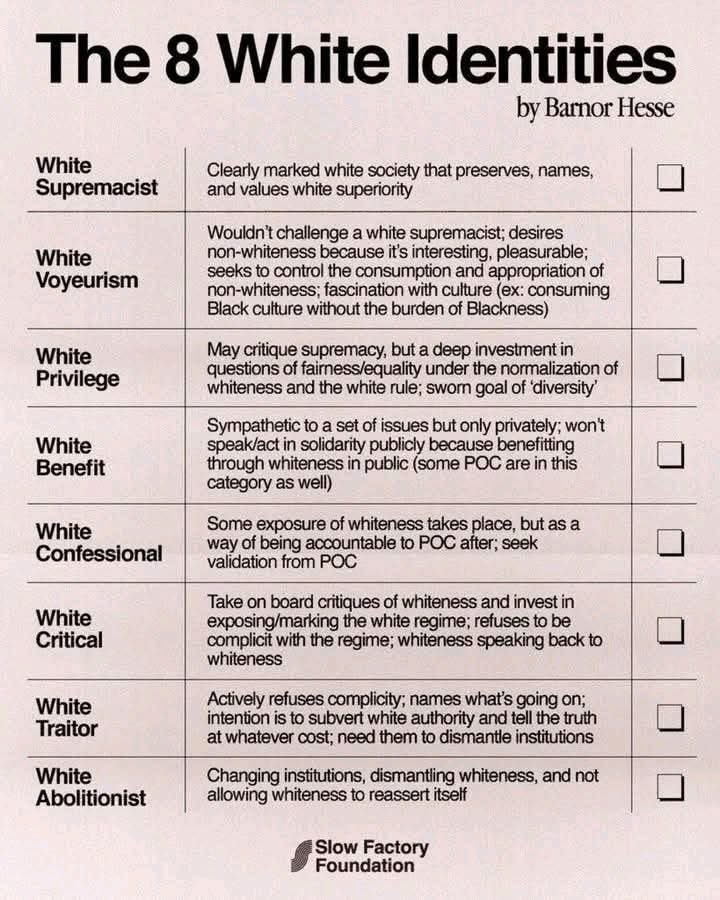
This “8 White Identities” chart (attributed to Barnor Hesse) looks like education, but it functions like a moral sorting machine. It offers eight labels that appear descriptive while quietly guiding you to one approved destination: “traitor/abolitionist,” meaning active participation in dismantling institutions so “whiteness” cannot “reassert itself.” That isn’t neutral analysis; it’s a disciplinary ladder. The key tell is the structure: most categories are not stable identities but staged accusations: if you don’t end at abolition, you’re still “benefiting,” “confessing,” “complicit,” or “voyeur.” It’s less “here are ways people relate to race” and more “here is your moral rank, move upward.”
Where does this method come from? In plain terms, it’s downstream of critical theory which is a family of approaches associated with the Frankfurt School, including Max Horkheimer, which treats social life as saturated with power and aims not merely to interpret society but to critique and transform it. Suspicion becomes the starting posture: norms, institutions, and “common sense” are read as mechanisms that reproduce domination. That posture can be illuminating when it identifies genuine structural incentives or hidden rules. The problem is what happens when the posture hardens into a closed moral cosmology: every institution is presumed guilty, every norm is presumed cover, and disagreement is presumed self-interest.
This particular pop-form is best described as CRT-style reasoning (even when it’s outside law schools): “whiteness” treated as an institutionalized advantage; disparities treated as presumptive evidence of systemic bias; “neutrality” treated as camouflage; and moral legitimacy tied to “anti-racist” alignment rather than truth-tracking. The flaw isn’t “not caring about racism.” The flaw is an a-historical compression: it collapses different eras, actors, and institutions into one continuous regime (“whiteness”) and treats complex tradeoffs as one moral story with one villain. You stop seeing plural motives, competing goods, and reformable failures; you see only complicity versus resistance.
The chart also relies on social coercion, not argument. It invites “accountability,” but what it means in practice is public performance under threat of moral demotion. Ask for evidence and you’re “centering yourself.” Disagree and you’re “invested.” Stay quiet and you’re “benefiting.” Even agreement becomes suspect if it’s the “wrong” kind (confessional, validation-seeking). That’s the unfalsifiable core: the framework is built so that any response can be converted into proof of guilt or complicity. A theory that cannot lose contact with counterevidence doesn’t guide understanding; it guides conformity.
If you actually want a model that helps rather than coerces, start with falsifiable claims and reformable mechanisms: identify specific policies, incentives, or gatekeeping practices; compare outcomes across institutions; test interventions; keep individual dignity intact; and treat moral status as something earned by conduct, not assigned by category. You can still talk about bias and history without turning identity into original sin. The danger of charts like this isn’t that they “teach empathy.” It’s that they train people to swap evidence for ritual, and dialogue for denunciation—and that trade makes every institution worse, not better.
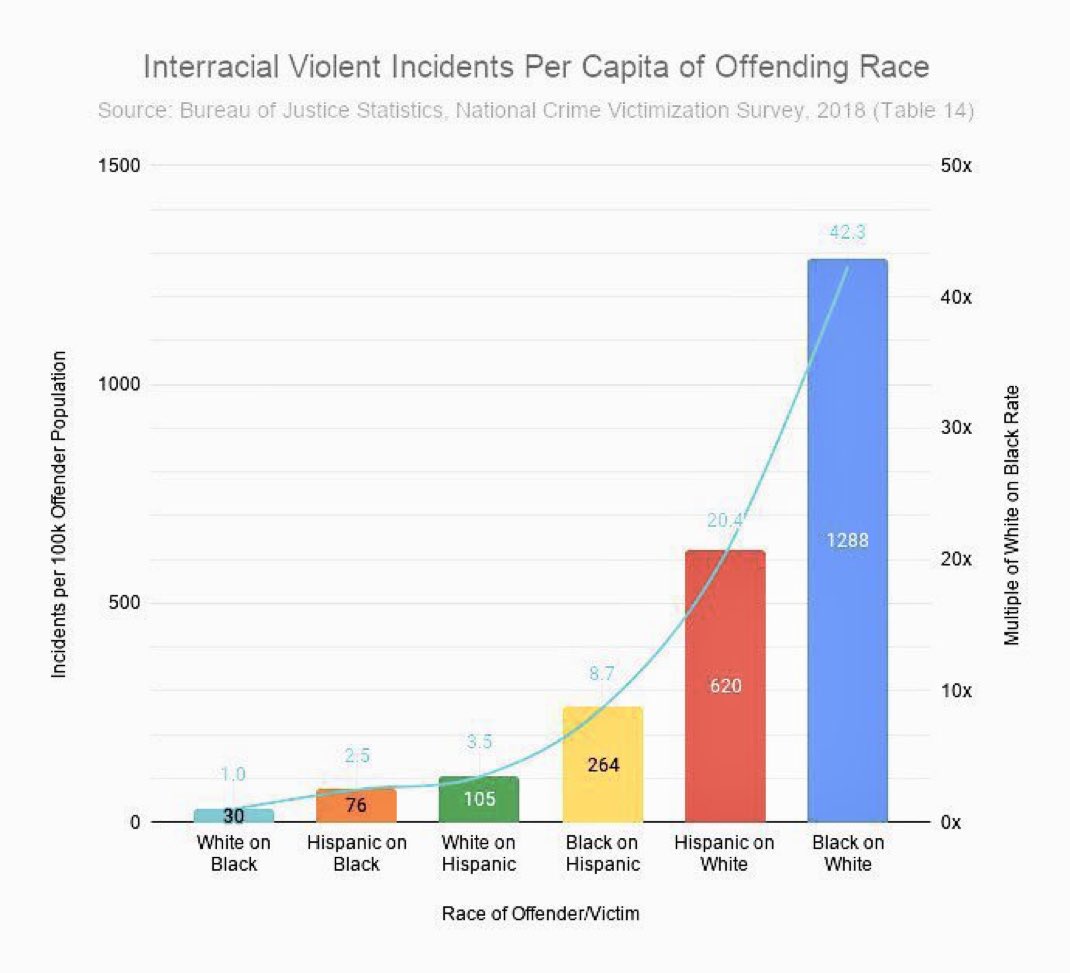
A widely circulated graph derived from the 2018 National Crime Victimization Survey (NCVS) reveals a stark asymmetry in interracial violent crime: Black offenders were perceived by victims to commit violence against Whites at a per capita rate dramatically higher than the reverse. Adjusted for population sizes—Blacks comprising roughly 13% of the U.S. population and Whites about 60%—the offending rate shows Black-on-White violence occurring at approximately 40 times the rate of White-on-Black violence per 100,000 offenders in each group.
This raw per capita disparity explodes the “woke” narrative that portrays racial dynamics in crime as symmetric or driven primarily by White aggression toward minorities. Instead, victim reports indicate that interracial violence flows overwhelmingly in one direction, undermining claims of equivalent racial bias or systemic White-on-Black targeting in everyday criminal acts.Critics often attempt to downplay this by noting that most violent crime is intraracial and that random opportunity—Whites being far more numerous—should lead to more Black-on-White incidents even without disproportionate offending. Adjusting for the larger White victim pool reduces the ratio to around 7:1, which still represents a significant elevation beyond what pure chance would predict.
This adjusted figure accounts for contact opportunities but does not erase the evidence of disproportionate involvement; it simply contextualizes it. The NCVS, based on direct victim perceptions rather than police reports, bypasses potential biases in arrests and provides a clearer picture of actual experiences, further challenging narratives that attribute disparities solely to law enforcement racism.
Ultimately, these statistics dismantle the oversimplified “woke” framing of crime as a tool of White supremacy oppressing minorities. While socioeconomic factors, segregation, and historical inequities contribute to crime patterns, the data show no equivalence in interracial harm—Whites are disproportionately victimized in cross-racial incidents relative to their offending rates. Ignoring per capita realities or dismissing them as misleading sustains a politicized myth that distorts public understanding and policy. Honest engagement with victim-survey evidence demands rejecting narratives that equate vastly unequal patterns, focusing instead on addressing root causes without excusing directional disparities.
For context, a related BJS report comparing NCVS offender data to arrests is here: https://bjs.ojp.gov/library/publications/race-and-ethnicity-violent-crime-offenders-and-arrestees-2018 (and its PDF: https://bjs.ojp.gov/content/pub/pdf/revcoa18.pdf).
Across Canada, we are witnessing a subtle yet sweeping shift: ideology increasingly outweighs empirical judgment, and institutions once grounded in caution are now pressing ahead with conviction. When belief eclipses observation, society risks felling its own future. This essay explores how the parable of A Short History of Progress becomes a cautionary mirror for our age, when economic vitality, civic trust, and long-term health hang, in effect, on that final swing of the axe.

“The Last Tree” draws a sharp line from the collapse of Easter Island’s ecosystem to three modern Canadian crises—net-zero policy, selective law-enforcement in protest, and rapid-onset gender-affirming care—to ask: when ideology becomes our arbiter rather than evidence, what are we willing to sacrifice?
The Last Tree: When Ideology Fells the Future
In Ronald Wright’s A Short History of Progress, the tale of Easter Island stands as a stark parable of human folly. Isolated in the vast Pacific, the Rapa Nui people arrived around 800 AD and transformed a forested paradise into a monument to their ingenuity and hubris. Over centuries, they felled the island’s palm groves to haul colossal moai statues across the terrain, using timber for sledges, ropes from bark, and fuel for fires. What began as a display of ancestral piety and clan prestige spiraled into ecological catastrophe. Soil eroded, fertility plummeted, bird populations vanished, and the once-vibrant ecosystem crumbled. By the 17th century, the population had crashed from perhaps 15,000 to a few thousand, amid famine, warfare, and cannibalism. Wright captures the inexorable logic: progress, unchecked, devours its own foundations.
Yet it is the final act that lingers—a moment of crystalline horror. The people who felled the last tree could see it was the last, could know with complete certainty that there would never be another. Imagine that islander, axe in hand, gazing at the solitary palm swaying against the horizon. The wind carries the salt of an empty sea, the ground beneath him scarred and barren. What raced through his mind? Not ignorance, for the warnings were etched in the dust: topsoil washing into the ocean, rats devouring every seed, canoes rotting on barren shores. No, it was something fiercer—a conviction forged in ritual and rivalry.
This tree, he might have reasoned, honours the ancestors; to spare it is to dishonour them, to invite the gods’ wrath. The rival clan cannot be allowed supremacy in statue-toppling; one more moai secures our lineage’s glory. Tradition demands it, the priests decree it, and in the face of clan elders’ unyielding stares, doubt withers like the fronds around him. Survival? A coward’s calculus, subordinate to the sacred narrative of progress through monument. With a swing, ideology claims its victory over reality, sealing the island’s doom.
This scene, Wright implies, is not ancient history but a mirror to our own susceptibilities. Ideological blindness is not partisan—it afflicts any society where belief eclipses observation. We stand at analogous thresholds today, where cherished convictions compel us to strike the final blow.
Consider our pursuit of net-zero emissions, pursued with a fervour that borders on the messianic. The federal government’s 2030 targets, however well-intentioned, risk undermining the very prosperity they claim to safeguard. The rhetoric of existential apocalypse—tipping points invoked like divine judgments—drowns out the data: Canada’s emissions constitute roughly 1.5 percent of the global total, and even full compliance would yield negligible climatic impact while rivals like China and India accelerate coal-fired expansion. Policymakers, axe raised, justify the cut: it honours the intergenerational covenant, shames the sceptic as a heretic. Yet the last “tree” here is economic vitality itself, felled in service to a narrative that confuses virtue with viability.
No less alarming is the selective blindness in enforcing the rule of law, particularly amid the surge of “Free Palestine” protests since October 7, 2023. These demonstrations, while not all hateful, have coincided with a documented explosion of antisemitism: synagogues vandalised, Jewish students harassed, and public chants equating Zionism with Nazism increasingly tolerated under the banner of free expression. Authorities often cite the need to avoid escalation or protect equity rights—but to apply the law unevenly corrodes the Charter’s promise of equal protection. The justification echoes the islander’s: equity demands deference to the aggrieved, lest we be branded oppressors. Thus, the final tree of civic trust is hacked away under the banner of performative solidarity.
Perhaps most viscerally, our medical institutions’ embrace of gender-affirming care reveals ideology’s grip on empirical mercy. Provincial guidelines expedite hormones and surgeries for minors, often with scant longitudinal scrutiny, despite emerging evidence of regret and harm. Critics—including those echoing the UK’s Cass Review—argue that compassion has been recast as affirmation, turning clinics into ideological fortresses where dissent is pathologised. This is not to deny the reality of gender dysphoria or the dignity of trans adults seeking relief; it is to insist that true compassion must rest on evidence, not dogma. The clinician, scalpel poised, rationalises: empathy compels affirmation; to probe deeper risks transphobia’s charge. Reality—the patient’s lifelong body, the data’s gaps—yields to the doctrine, mutilating futures in the name of inclusion.
These Canadian vignettes, like Easter Island’s denouement, expose ideology’s seductive tyranny: a narrative so totalising it renders the evident obsolete. Friedrich Nietzsche foresaw this abyss in his dissection of nihilism, that devaluation where “the highest values are losing their value.” Like Wright’s islanders, we mistake self-destruction for virtue—a form of nihilism Nietzsche saw as civilisation’s end-game. Cloaked in Marxist activist garb—equity as the new god, progress as its prophet—these policies dissolve society’s sinews not through malice but through a will to power masquerading as justice. Nietzsche warned that such illusions prolong torment, for “hope in reality is the worst of all evils because it prolongs the torments of man.”
To reclaim our ground, we must confront the axe in our hand: interrogate the story, honour the verifiable, and plant anew before the last tree falls. The islanders could not. We still can.
References
- Wright, Ronald. A Short History of Progress. Anansi, 2004.
- Fraser Institute, “Measuring the Cost of Canada’s Net-Zero Climate Policy,” 2024.
- B’nai Brith Canada, Annual Audit of Antisemitic Incidents, 2024.
- Government of Canada, 2030 Emissions Reduction Plan, 2022.
- Cass, Hilary. Independent Review of Gender Identity Services for Children and Young People (The Cass Review). UK NHS, 2024.
- For Canada-specific studies on gender-affirming care outcomes:
- Jackman, Liam et al., “Patient-reported outcomes, provider-reported outcomes, and physiologic parameters after gender-affirming hormone treatment in Canada: a systematic review” (2025). (SpringerLink)
- Lawson, M.L. et al., “A Cross-Sectional Analysis from the Trans Youth CAN! Study” (2024). (Jah Online)
- “At-a-glance – Gender identity and sexual attraction among Canadian youth: findings from the 2019 Canadian Health Survey on Children and Youth” (2023). (canada.ca)
Found on X here.
Intersectionality in the Classroom: From Empathy to Indoctrination
Intersectionality, a framework coined by legal scholar Kimberlé Crenshaw in 1989, purports to illuminate how overlapping social categories such as race, gender, class, and sexuality compound experiences of discrimination or privilege. Emerging from Crenshaw’s analysis of Black women’s marginalization within both feminist and civil rights discourses, the term has since evolved into a pervasive lens for examining interlocking systems of power.
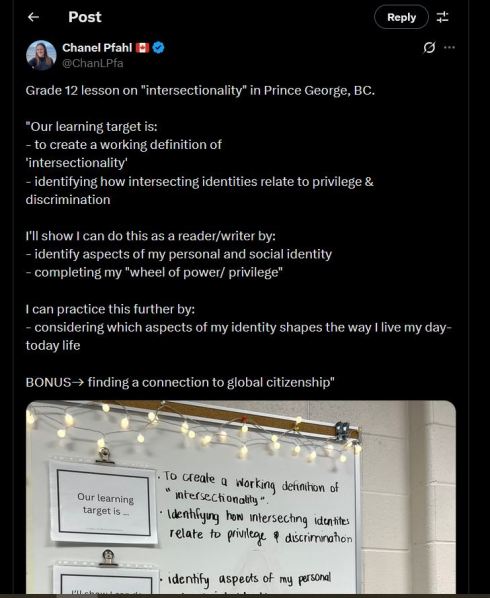
In a recent Grade 12 lesson plan from Prince George, British Columbia, students are tasked with crafting personal definitions of intersectionality, mapping their identities onto a “wheel of power/privilege,” and connecting these to daily life and global citizenship. This exercise, ostensibly designed to foster empathy, exemplifies how the theory infiltrates education—reducing multifaceted human experience to a grid of predetermined oppressions and advantages. Yet beneath its academic veneer lies a mechanism for sowing division, one that demands scrutiny for its role in perpetuating grievance over growth.
At its core, intersectionality falters by collapsing the rich tapestry of individual lives into rigid identity matrices, sidelining agency, character, and shared humanity in favor of immutable traits assigned at birth. By framing privilege as an unearned inheritance tied to one’s position on the proverbial wheel, the framework risks breeding resentment among students, who learn to view peers not as collaborators but as bearers of systemic guilt. Empirical observations from social movements underscore this fragmentation: alliances crumble when identity eclipses common purpose, as seen in fractured coalitions where tactical solidarity yields to performative purity tests.
Even within leftist traditions, critics decry how intersectionality dilutes rigorous economic analysis into cultural essentialism, obscuring material inequities under a haze of subjective hierarchies. Far from empowering, this lesson in Prince George transforms the classroom into a theater of suspicion—where adolescents dissect their “intersecting identities” not to build resilience but to catalog wounds, fostering a generation primed for perpetual victimhood rather than principled action.
This pedagogical sleight of hand reveals intersectionality’s deeper allegiance to identity politics, a doctrine that elevates collective affiliation above individual merit and moral accountability. In the lesson’s directive to “identify aspects of my personal and social identity” relative to privilege, students are subtly coerced into prioritizing group-based narratives over personal narratives, echoing a broader cultural shift where loyalty to tribe trumps universal ethics. Such politics, by design, atomizes society into silos of grievance, undermining the Enlightenment ideal of judgment by deeds rather than descent.
The result is not enlightenment but alienation: white students branded as inherent oppressors, marginalized peers cast as eternal victims, all while the lesson’s “bonus” nod to global citizenship rings hollow amid the induced tribalism. Verifiable accounts from educators and observers confirm this corrosive effect, with classrooms devolving into echo chambers of accusation rather than forums for frank exchange.
Worse still, intersectionality’s Marxist undercurrents betray its origins in class warfare, merely repackaging economic antagonism as identitarian strife to sustain endless conflict without resolution. Drawing from dialectical materialism’s emphasis on oppositional forces, the theory substitutes proletariat–bourgeois divides with fluid yet perpetually clashing identity classes—oppressors versus oppressed—fueling a zero-sum battle that mirrors historical agitprop but swaps factories for feelings. Critics within the Marxist canon itself lament this dilution, arguing it retreats from revolutionary class consciousness into liberal fragmentation, where cultural skirmishes supplant systemic overhaul.
In the Prince George curriculum, this manifests as students pondering how their “wheel” positions them in global hierarchies, unwittingly internalizing a narrative of inevitable clash that excuses inaction while justifying radicalism. By promoting such identitarian discord, intersectionality does not liberate; it entrenches a spectral class war, audible in its echoes from the Frankfurt School to contemporary campus upheavals.
In place of this divisive doctrine, educators should pivot to a lesson grounded in universal human rights, drawing from the Enlightenment’s timeless assertion of equality before the law irrespective of ascribed identities. Students might begin by studying the Universal Declaration of Human Rights (1948)—articulating core tenets like dignity and non-discrimination—and then apply them to case studies that transcend identity silos. Group debates could explore how these rights galvanize cooperation in pluralistic societies, extending into civic duties such as community service that bridge divides through shared endeavor.
This alternative, far from ignoring inequities, confronts them through aspirational universality, fostering citizens equipped for concord rather than combat. By centering verifiable principles over subjective grids, such a curriculum honors truth’s pursuit, arming youth against narrative warfare with the unyielding shield of human solidarity.
References
- Crenshaw, Kimberlé. “Demarginalizing the Intersection of Race and Sex.” University of Chicago Legal Forum 1989(1): 139–167.
— Foundational essay introducing intersectionality in the context of Black women’s employment discrimination cases. - Crenshaw, Kimberlé. “Mapping the Margins: Intersectionality, Identity Politics, and Violence against Women of Color.” Stanford Law Review 43, no. 6 (1991): 1241–1299.
— Expanded articulation of intersectional theory applied to social and legal contexts. - Bell, Daniel. The Cultural Contradictions of Capitalism. New York: Basic Books, 1976.
— Influential analysis of how ideological movements replace class analysis with cultural moralism. - Fraser, Nancy. “From Redistribution to Recognition? Dilemmas of Justice in a ‘Post-Socialist’ Age.” New Left Review 212 (1995): 68–93.
— A left-wing critique of intersectionality’s turn toward identity over material class structures. - Marcuse, Herbert. One-Dimensional Man. Boston: Beacon Press, 1964.
— Core Frankfurt School text examining how ideology replaces substantive rationality; relevant to intersectionality’s theoretical lineage. - United Nations. Universal Declaration of Human Rights. Adopted December 10, 1948.
— Primary document grounding an alternative civic and moral education in universalism rather than identity determinism. - Lilla, Mark. The Once and Future Liberal: After Identity Politics. New York: Harper, 2017.
— Liberal critique of identity politics and its corrosive impact on civic cohesion.
Hannah Arendt’s portrait of Adolf Eichmann as a thoughtless bureaucrat lingers as a caution against evil’s mundane guise. Christopher Browning’s Ordinary Men extends this indictment, trading Eichmann’s desk for the blood-soaked forests of Poland, where Reserve Police Battalion 101—500 Hamburg ‘everymen’—executed 39,000 Jews and deported 44,000 more to Treblinka in 1942-43. These were no zealots: middle-aged draftees, family men untouched by Nazi fervor, yet they pulled triggers with grim efficiency. Browning’s forensic reconstruction from postwar trials complements Arendt, illuminating how conformity, not conviction, forges complicity. In an age of ideological silos, their story warns that thoughtlessness scales from individual abdication to collective carnage.
Arendt diagnosed Eichmann’s evil as a failure to think—to judge actions against universal humanity—yielding obedience’s autopilot. Browning operationalizes this in RPB 101’s crucible. On July 13, 1942, in Józefów, Major Trapp’s order to slaughter 1,800 innocents included an opt-out: a dozen stepped forward, fathers haunted by their own children’s faces. The rest? They fired, vomited, and fired again, bound not by hatred but by the group’s inexorable pull. Peer pressure proved the deadliest weapon: to demur meant isolation, whispers of cowardice, or worse—standing alone amid the splatter of brains and pleas. As Browning dissects, “binding factors” like deference to authority and aversion to shame radicalized the reluctant. Initial nausea faded into routine; Jews devolved from neighbors to “bandits,” their deaths logged as quotas met. This mirrors Arendt’s “banality”: not demonic intent, but the quiet erosion of moral agency, where thinking cedes to fitting in.
Browning’s men prefigure Arendt’s broader fear—that totalitarianism thrives on unreflective masses. Unlike Eichmann’s abstracted ledgers, these policemen confronted the visceral: a mother’s wail, a child’s gaze. Yet empathy atrophied through diffusion—blame smeared across the chain of command—and progressive desensitization. A few resisted, sabotaging hunts or feigning illness, their conscience a fragile bulwark against the tide. Most drifted, careerism and alcohol dulling the sting. Browning invokes social experiments like Milgram’s obedience studies, positing such dynamics as human universals, not German pathologies—a riposte to claims of cultural exceptionalism.
This convergence sharpens lessons for our fractured present, where critical constructivism and woke Marxism summon conformity’s specter. Critical constructivism, an epistemological framework that treats knowledge as socially mediated and entwined with power—rejecting empirical objectivity for interpretive lenses shaped by culture and positionality—echoes RPB 101’s euphemisms, recasting dissent as dominance while evidence bows to constructed narratives. Proponents propagate without pause, their deference to “lived experience” a peer-enforced gag on Socratic probe. Woke Marxism, a repackaged Marxism applying class struggle to identity oppressions—framing queer theory as “gender Marxism” and intersectionality as “identity Marxism”—amplifies this through performative allegiance. Its rituals—DEI oaths, cancellation tribunals—demand uncritical adherence, sidelining judgment for allegiance, much as Trapp’s men traded qualms for camaraderie. Ordinary adherents comply, not from malice, but inertia: promotions hinge on nods, ostracism on silence.
Arendt and Browning converge on the antidote: reclaim thinking as defiant praxis. In algorithm-curated echo chambers, where ideologies brook no fracture, epistemic humility—questioning, pluralizing, judging—arrests the slide. Thoughtlessness is choice, not fate; conformity’s shadow lifts only through vigilant reflection. Honor the dead of Józefów not with memorials alone, but by fortifying the ordinary against atrocity’s call. Goodness demands depth; evil preys on the shallow. In choosing to think, we dismantle the battalion within.

References
Arendt, H. (1963). Eichmann in Jerusalem: A Report on the Banality of Evil. New York: Viking Press. (Primary source for the concept of the banality of evil and its philosophical underpinnings.)
Browning, C. R. (1992). Ordinary Men: Reserve Police Battalion 101 and the Final Solution in Poland. New York: HarperCollins. (Core historical analysis based on postwar judicial testimonies, detailing the battalion’s actions and psychological dynamics.)
Dead Wild Roses. (2025, August 25). “Unraveling the Roots—How ‘Woke’ Emerges from Social Construction.” https://deadwildroses.com/2025/08/25/unraveling-the-roots-how-woke-emerges-from-social-construction/. (Defines critical constructivism via Kincheloe’s assumptions, linking it to woke epistemology and power-mediated knowledge.)
Dead Wild Roses. (2022, April 6). “Queer Theory is Gender Marxism – James Lindsay.” https://deadwildroses.com/2022/04/06/20651/. (Critiques woke Marxism as repackaged identity-based Marxism, drawing on Lindsay’s analysis of queer theory and intersectionality.)
Goldhagen, D. J. (1996). Hitler’s Willing Executioners: Ordinary Germans and the Holocaust. New York: Alfred A. Knopf. (Contrasting thesis on German antisemitism, referenced by Browning to highlight universal rather than cultural explanations.)
Hilberg, R. (1961). The Destruction of the European Jews. Chicago: Quadrangle Books. (Foundational Holocaust scholarship on the “short, intense wave of mass murder” in 1942, informing Browning’s timeline.)
Milgram, S. (1963). “Behavioral Study of Obedience.” Journal of Abnormal and Social Psychology, 67(4), 371–378. https://doi.org/10.1037/h0040525. (Seminal experiment on authority compliance, invoked by Browning to explain diffusion of responsibility in RPB 101.)
Trunk, I. (1972). Judenrat: The Jewish Councils in Eastern Europe Under Nazi Occupation. New York: Macmillan. (Contextual background on Jewish councils’ coerced roles, paralleling themes of complicity under duress.)
[Editor’s Note: A previous version of this essay included citations that did not support the specific claims attached to them. I reviewed the sources, corrected reference details, and revised the text to align with what the evidence can bear.]
Gender ideology, with its audacious claim that biological sex bows to subjective whim, is a wrecking ball smashing through truth, family, and society. It peddles a fiction: that large numbers of individuals are born in the “wrong” bodies, requiring major medical interventions to “fix” what evolution perfected over millennia. When parents of dependent children are egged on to “transition,” the fallout can be severe, not just personal, but societal. This isn’t a debate. It is a destabilizing moral and political project demanding fierce, unflinching resistance
Shattering Children’s Worlds
Children, fragile and tethered to parental stability, are shaken when a parent’s identity shift reorders their world. Hormones, surgeries, or social reinventions don’t just alter a parent. They can fracture a child’s sense of security. Clinical psychologist Dr. Erica Anderson, herself transgender, has warned that we are running something like a “social experiment,” with uncertain long-term outcomes for young people caught up in this cultural moment (Jarvie, 2022).
On the narrower question of children raised by a transgender parent, the available research is limited and mixed. Some studies report generally good child adjustment in their samples while also emphasizing how little broad, long-term evidence exists (Imrie et al., 2020). None of this supports breezy certainty, institutional mandates, or the pretense that complex family changes are automatically cost-free. Prioritizing an adult’s self-actualization over a child’s emotional bedrock isn’t progress. It is a risk we keep rebranding as compassion.
Demolishing Family Bonds
Families, the crucible of human connection, can disintegrate under this ideology’s corrosive weight. A parent’s transition can place marriages under severe strain, forcing spouses and children into abrupt renegotiations of roles, expectations, and loyalties. The empirical literature on romantic relationship satisfaction and stability in transgender contexts is still developing, but systematic review work suggests relationship outcomes are heterogeneous and shaped by multiple stressors, not a simple morality play where affirmation guarantees flourishing (Marshall et al., 2020). The ideology’s fetish for individual affirmation over collective duty can rip apart interdependence, leaving children caught in loyalty conflicts and spouses facing unrecognizable partners. This isn’t liberation. It is a familial debacle, a slow-motion implosion of the bonds that sustain us.
Corroding Institutions
Society’s institutions, schools, hospitals, public health bodies, buckle as gender ideology colonizes them. The Cass Review (2024), a major UK review of pediatric gender services, concluded that parts of the evidence base for medical pathways are weak and that clinical practice had developed without the level of rigor, consistency, and safeguarding expected in other areas of pediatric healthcare (Cass Review, 2024). When medicine and education forsake skepticism and evidence for dogma and compliance rituals, public trust corrodes. This isn’t inclusion. It is an institutional betrayal of the empirical foundations that anchor civilization.
Defying Biological Reality
Biologically, gender ideology is utter bollocks. Human sexual dimorphism is a core feature of our species. Claims of mass “body mismatches” are not supported by the basic reality of sex. Even intersex conditions are rare, and prevalence estimates vary sharply depending on definitions. Sax (2002), using a strict definition, argues for a very low prevalence, far below the inflated figures often implied in popular debate (Sax, 2002). If pervasive dysphoria were a simple, innate biological fate on the scale now suggested, humanity would have joined Neanderthals and Denisovans in the evolutionary dustbin. Yet, we’re told the most advanced species can’t navigate puberty without turning healthy bodies into medical projects. Absurd. This ideology spits on evolutionary resilience, peddling a delusion that demands invasive fixes for psychological distress. The stakes are civilizational: either we reclaim material reality, or we watch society unravel, child by child, family by family, institution by institution.

References
- Cass Review. (2024). Independent Review of Gender Identity Services for Children and Young People: Final Report.
https://cass.independent-review.uk/home/publications/final-report/ - Imrie, S., et al. (2020). Children with Trans Parents: Parent–Child Relationship Quality and Psychological Well-being. (Open access)
https://pmc.ncbi.nlm.nih.gov/articles/PMC8372299/ - Jarvie, J. (2022, April 12). A transgender psychologist has helped hundreds of teens transition. But rising numbers have her concerned. Los Angeles Times.
https://www.latimes.com/world-nation/story/2022-04-12/a-transgender-psychologist-reckons-with-how-to-support-a-new-generation-of-trans-teens - Marshall, E., et al. (2020). The quality and satisfaction of romantic relationships in transgender people: A systematic review. (Open access)
https://pmc.ncbi.nlm.nih.gov/articles/PMC8726697/ - Sax, L. (2002). How common is intersex? A response to Anne Fausto-Sterling. The Journal of Sex Research, 39(3), 174–178. (PubMed record)
https://pubmed.ncbi.nlm.nih.gov/12476264/
Arendt exposed ideological conformity, Gramsci revealed cultural capture, and Orwell diagnosed linguistic decay. Now, John Stuart Mill’s On Liberty (1859) offers a moral and philosophical counter to critical social constructivism’s (CSC) hostility toward open inquiry and individual conscience. Mill’s insistence that liberty of thought, speech, and character fuels social and moral progress stands as a principled rebuke to CSC’s attempts to bind individuality to collective dogma. Together, these thinkers—Arendt, Gramsci, Orwell, and Mill—equip us to resist CSC’s illiberal advance.
Mill argues that silencing expression harms not only the speaker but society as a whole, which is deprived of truth’s refinement through open contest (Mill, 1859, Ch. II). Even false opinions, he writes, may contain a kernel of truth; and true ones grow weak without opposition. CSC, meanwhile, appeals by promising equity through collective identity. Yet it treats dissent as a moral failure. Disagreement with DEI orthodoxy or critical race theory is labeled “harmful” or dismissed as “white fragility,” producing what Mill called “the tyranny of the prevailing opinion.” In 2024, University of Washington faculty guidelines equated merely questioning anti-racism initiatives with creating a “hostile environment,” thereby chilling discussion.
CSC’s moral coercion inverts Mill’s epistemic humility—his belief that all ideas deserve scrutiny, no matter how widely accepted. Mandatory DEI trainings, such as a 2024 policy at a major tech firm requiring employees to affirm “lived experience” as a primary form of knowledge, preclude rational dissent. In K–12 education, 2024 California curriculum guidance redefined “authenticity” as alignment with racial or gender identity groups, effectively suppressing individual thought. These tactics substitute ritual affirmation for genuine intellectual contest—exactly what Mill warned against.
Mill’s defense of individuality as a moral ideal—his celebration of “originality” and “nonconformity” (Ch. III)—clashes with CSC’s group-based scripts. By prioritizing identity categories over self-authorship, CSC undermines human flourishing. Mill does not reject social justice, but insists that no ideal justifies silencing dissent. His Enlightenment liberalism calls us to restore a culture of contestation and protect the individual as a source of moral insight.
Where Orwell showed how language is manipulated to close debate, Mill reveals why debate must remain open—because liberty depends on it. This series—Arendt’s pluralism, Gramsci’s cultural strategy, Orwell’s linguistic clarity, and Mill’s defense of liberty—forms a unified resistance to CSC’s totalizing ambitions.
Read Mill. Restore the contest of ideas. Reclaim individuality in classrooms, workplaces, and public life as the cornerstone of a free society.
Three Salient Points for Arguments Against Critical Social Constructivism
- Silencing Dissent Erodes Truth: CSC’s labeling of CRT critiques as “hostile,” as in 2024 campus policies, violates Mill’s warning that suppressing dissent impoverishes collective understanding.
- Moral Coercion Replaces Rational Persuasion: CSC’s mandates—like 2024 DEI affirmations in workplaces—replace Mill’s marketplace of ideas with conformity. Challenging these in policy debates restores reasoned inquiry.
- Individuality Is Suppressed by Group Identity: CSC’s identity scripts, seen in 2024 K–12 curricula, undermine Mill’s ideal of self-authorship. Promoting merit-based and pluralistic policies can counter this trend.
Reference
Mill, J. S. (1859). On Liberty. London: John W. Parker and Son.











 bleatmop
 Mystro


 Dead Wild Roses
Your opinions…