
You are currently browsing the category archive for the ‘Social Science’ category.
Category Archive
Critical Race Theory (CRT) – What it is.
April 4, 2022 in Education, Social Science | Tags: CRT Defintions, New Discourses | by The Arbourist | 2 comments
One hears about the battle going on in the US to keep Critical Race Theory out of public institutions. Rather than relying media soundbites of what CRT is, I figured it was time to go searching for the definition myself.
As with most academic literature sorting through the palavers is a time consuming and often arduous chore, but I’ve found that James Lindsay has done a fair job of contextualizing and explaining what CRT (theory) is and how it operates in society (praxis).
This definition is taken from James Lindsay’s website – New Discourses.
“Critical race Theory is a Critical Theory of race. It distinguishes itself explicitly from previous approaches to race and racism, such as the liberal ones characterizing the Civil Rights Movement of the 1960s (but not the Black Power movement—see also, black liberationism). For example, in the introduction to the textbook Critical Race Theory: An Introduction, critical race Theory is characterized explicitly in these terms:
The critical race theory (CRT) movement is a collection of activists and scholars engaged in studying and transforming the relationship among race, racism, and power. The movement considers many of the same issues that conventional civil rights and ethnic studies discourses take up but places them in a broader perspective that includes economics, history, setting, group and self-interest, and emotions and the unconscious. Unlike traditional civil rights discourse, which stresses incrementalism and step-by-step progress, critical race theory questions the very foundations of the liberal order, including equality theory, legal reasoning, Enlightenment rationalism, and neutral principles of constitutional law. (p. 3, emphasis added)
A few salient points stand out in this paragraph. First, critical race Theory is centrally concerned with power, which it holds in higher regard than truth (indeed, it holds the postmodernist position that claims to truth are assertions of power by specific means). Second, it distinguishes itself from “traditional” civil rights and instead favors identity politics (in the radical sense). Third, it is not interested in progress but revolution. Fourth, it calls into question “the very foundations of the liberal order, including equality theory, legal reasoning, Enlightenment rationalism, and neutral principles of constitutional law.” That positions critical race Theory as explicitly anti-Western and, in the narrower context in which it arose and mostly applies, anti-American. Critical race Theory favors equity over equality, where equity specifically refers to a particular understanding of social equity theory and not a more generalist notion of fairness. Indeed, it explicitly characterizes the idea of (racial) equality as a kind of conspiracy theory that leads people, especially people of color (double especially BIPOC), to accept the status quo and their systemically oppressed state of affairs (see also, internalized dominance, internalized oppression, and internalized racism, i.e., false consciousness).
Critical race Theory began in critical legal studies in frustration that the legal wins over institutional racism in the 1960s did not more quickly succeed in ending racism (see also, cultural racism and new racism) or repairing disparate outcomes by race (see also, equity). It draws significant input from black scholars of the 19th and 20th centuries, ranging from Frederick Douglass to W. E. B. Du Bois as well as black feminists from the latter part of the 20th century, including bell hooks, Patricia Collins, and, most notably, Kimberlé Crenshaw, who coined the term together with her mentor, Derrick Bell of Harvard Law. The postcolonial French psychoanalyst Frantz Fanon was also a significant influence. There are, of course, many kernels of truth within critical race Theory, or that critical race Theory is built upon, but there is little reason to accept that its analysis is serious or rigorous and less reason to believe that its recommended solutions can ameliorate rather than inflame racial issues in society.
As can be observed in the examples (above and below), critical race Theory begins with a cynical view that race is the predominant structural element of American (and other) societies, and that all analyses of race must incorporate systemic power, which is to say systemic racism. This, it insists, is everywhere, ordinary, permanent, and mostly (and badly) hidden, a kind of racism that is just beneath the surface (see also, code, mask, internalized dominance, internalized oppression, and internalized racism). Indeed, it tends to proceed from Derrick Bell’s assumption that racism has a permanence to it (or, sometimes, is permanent) and thus is not overcome and does not end but instead changes forms to something more subtle and harder to find. A consequence of this belief is that racism does not improve in society or stay the same but actually gets worse by virtue of staying roughly the same while becoming more insidious. One duty of the critical race Theorist is to expose this hidden racism wherever it can be found.
Critical race Theory begins with core presumptions such as that racism is ubiquitous in (American) society and its ordinary state of affairs (rather than an aberration from them). It therefore believes that all interactions across racial difference must account for the influences of structural racism. Under the first core presumption of critical race Theory, the question is not “did racism take place?” but “how did racism manifest in that situation?” for all social phenomena. That is, the racism is presumed to be present and in need of a critical race Theorist to find it and point it out. Critical race Theory does not just presume that society is fundamentally racist in its very structure, but also that it is intrinsically organized upon “anti-Blackness” in particular, leading to seemingly peculiar concepts like “brown privilege,” “brown complicity,” and “brown fragility” alongside the more obvious “white privilege,” “white complicity,” and “white fragility” upon which they are modeled. These posit that white and brown people have a vested interest in anti-Blackness because it affords them privilege, which makes them complicit in white supremacy and too emotionally fragile to cope with challenges to that social order. In other words, it is a conspiracy theory that everyone and, indeed, all of society (independently of the people in it, in a systemic sense) is organized against black people.
As a result of this line of thinking, all people within these systems must be aware of and engage their positionality relative to Theorized racial power dynamics intentionally and at all times (see also, intersectionality). As such, critical race Theory advocates increasing the social significance of racial categories in order to engage in identity politics (see also, identity-first and racism). An example of this assumption being put into action is the Black Lives Matter movement, which springs from the assumption that our police and criminal justice systems are wholly corrupted by systemic racism. Another would be the wide array of nominally “anti-racist” programs and trainings on offer (and mandate) throughout much of our society.
Critical race Theory stands apart from other kinds of Theory in that it is usually written quite clearly and has simple tenets. These include the central theme that racism is ordinary and permeates everything. It therefore needs to be uncovered and addressed using critical methods (see also, critical theory and mask). This is done in the form of Theory being applied to historical texts, societal representation, or current discourses. An example of the first includes Derrick Bell’s Interest-Convergence Thesis, in which he argues that advances have only been made for black people when it has been in white people’s interests to allow them. This is, in fact, listed among the core presuppositions of the Theory. This causes Bell to argue that progress of race relations is largely a myth. This is a radical and empirical (although interpreted with a specific ideological bias) approach to critical race Theory. The critical study of whiteness (see also, whiteness studies) is, in this sense, under the broad umbrella of critical race Theory.
One consequence of this view is that critical race Theory explicitly endorses historical revisionism, as it proceeds from the assumption that history was written by dominant (white) people who have, as a result of their privilege and its influences, not represented it accurately. A contemporary example of this effort is the 1619 Project, which was promoted by the New York Times starting in August 2019, with the explicit agenda of reframing the founding of the United States as a project in maintaining and exploiting slavery (see also, post-traumatic slavery syndrome).
A strongly postmodern approach to critical race Theory also exists, is currently dominant, and owes much to black feminists like bell hooks and Patricia Collins. These scholars sought to understand racism and its connection to gender by taking a “multi-layered” approach, which included some postmodern concepts about experiential knowledge(s) and multiple consciousness (see also, Matrix of Domination). The black feminist legal scholar Kimberlé Crenshaw was hugely influential as well (and is recognized along with Derrick Bell as the originator of critical race Theory).
Crenshaw is best known for her concept of “intersectionality,” which she describes as “a provisional concept linking contemporary politics with postmodern theory.” Under intersectionality, race, gender, sexuality, and other matters of identity are seen as cultural constructs in keeping with postmodern cultural constructivism, but, in deviation from the radical deconstruction of earlier forms of postmodern thought, oppression on those grounds is seen as objectively real.
Because of its postmodern influence, “discourse analysis” is also strong within critical race Theory. This involves a highly interpretive approach to interactions between a white person and a person of color that begins with the assumption that a power imbalance will exist and racism will be present and the person of color will be more able to detect it (see also, position, standpoint epistemology, and close reading).
Another central tenet of critical race theory is the critique of liberalism. This comes as a shock to most American readers who mistakenly identify critical race Theory as something associated with liberals and liberalism, but CRT is openly an anti-liberal theoretical and political project. The liberal approach to anti-racism is to divest race categories of social significance and treat everyone equally. That is, race is to become largely irrelevant and we, as a society, come to see skin color as having no more significance to a person’s worth or abilities than their hair color. This is referred to by critical race Theorists as “colorblindness” and is deemed highly problematic (see also, racism-blindness). A liberal society aims to make sure that everybody is treated equally by ensuring that race, gender, or sexuality does not prevent anyone from accessing any opportunity and then evaluates each individual on their abilities. This is known as “meritocracy,” which is viewed as a highly problematic ideology white people use to maintain their cultural dominance and justify their own white supremacy.
Critical race Theorists reject colorblindness and meritocracy as myths and illusions that allow white people to perpetuate their own privilege by failing to see racism operating beneath the surface of systems (see also, white ignorance). Essentially, they see liberalism as the belief that equality, colorblindness, and meritocracy have already been achieved or enable white people to pretend it has or to be satisfied with a painfully slow incremental change, which is inadequate, while misleading people of color by hiding from them the realities of their oppression (see also, false consciousness).
Critical race Theorists therefore advocate not being colorblind or meritocratic. Instead, they recommend that we all focus on race and racism specifically at all times and prioritize diversity, equity, and inclusion in hiring and other opportunities. In practice, this often means to run mandatory implicit bias tests and training in workplaces and ensure that more people of racial minorities are represented in any (prestigious) workplace that lacks them.”
Share this:
The Nine Most Common Cognitive Distortions
March 12, 2022 in Culture, Psychology, Social Science | Tags: Cognitive Behaviour Therapy, Cognitive Distortions, Psychology, Sociology, The Coddling of the American Mind | by The Arbourist | 2 comments
Reading a new book called the Coddling of the American Mind by Gregg Lukainoff and Jonathan Haidt. Just started, but it has been very interesting so far as describes some of the less than ideal strategies we have have for making our way through society. Some of the maladaptive strategies can be countered through consciously acknowledging the mental track being taken and making conscious effort to change said track. Of course, it is easier to diagnose these problems in other people (because we are all-good amiright?), but being able to see and react to these tracks in yourself is the end goal (aka cognitive behaviour therapy, CBT).
1. Emotional Reasoning: Letting your feelings guide your interpretation of reality. “I feel depressed; therefore my marriage is not working out.”
2. Catastrophizing: Focusing on the worst possible outcome and seeing it as most likely. “It would be terrible if I failed.”
3. Overgeneralizing: Perceiving a global pattern of negatives on the basis of a single incident. “This generally happens to me. I seem to fail at a lot of things.”
4. Dichotomous Thinking: Viewing events or people in all-or-nothing terms. “I get rejected by everyone,” or “It was a complete waste of time.”
5. Mindreading: Assuming that you know what people think without having sufficient evidence of their thoughts: “He thinks I’m a loser.”
6. Labeling: Assigning global negative traits to yourself or others. “I’m undesirable,” or “He’s a rotten person.”
7. Negative Filtering: You focus almost exclusively on the negatives and seldom notice the positives. “Look at all the people who don’t like me.”
8. Discounting Positives: Claiming that the positive things you or others do are trivial, so that you can maintain a negative judgement. “That’s what wives are supposed to do – so it doesn’t count when she’s nice to me,” or “Those successes were easy, so they don’t matter.”
9. Blaming: Focusing on the other person as a source of your negative feelings; you refuse to take responsibility for changing yourself. “She’s to blame for the way I feel now,” or “My parents caused all of my problems.”
“[…] It’s easy to see how somebody who habitually things in such ways would develop schemas that revolve around maladaptive core beliefs, which interfere with realistic and adaptive interpretations of social situations.”
-The Coddling of the American Mind. p.38
It has been a good read so far, will keep you updated. :)
Share this:
The Rule of Law – Alfred de Zayas
January 15, 2022 in Social Science | Tags: foundations of society, human dignity, Law | by The Arbourist | 1 comment
Making laws is never easy and Alfred de Zayas prescribes a mix that places human rights and dignity at the forefront. Our laws need to have simple and complex versions readily available to the public to improve our understanding of how the society we exist in works.
“We also have humanistic “values” that should guide diplomacy and peace-making – including the principle “pacta sunt servanda” (treaties must be implemented, art. 26 of the Vienna Convention on the law of treaties). Let us not forget the general principles of law, including good faith (bona fide), the prohibition of abusing rights (sic utere tuo ut alienum non laedas), and the principle of estoppel (ex injuria non oritur jus) – you can’t have your cake and eat it. Alas, both in domestic and international law there is a high level of bad faith and the tendency to apply double-standards. Major powers make agreements and then break them with impunity. Major powers undermine diplomacy by brazenly lying, by making promises and not keeping then. This subverts the credibility of the entire system of norms and mechanisms. Politicians often forget that keeping one’s word is not only a matter of personal honour – it is an indispensable element of trust in the conduct of public affairs. Among other crucial values that we should promote are Christian values such as compassion, empathy, forgiveness, solidarity.
It is axiomatic that the rule of law functions as a pillar of stability, predictability and the democratic ethos in modern society. Its object and purpose is to serve the human person and progressively achieve human dignity in the larger context of freedom.
Because law reflects power imbalances, we must ensure that the ideal of the rule of law is not instrumentalized simply to enforce the status quo, maintain privilege, and the exploitation of one group over another. The rule of law must be a rule that allows flexibility and welcomes continuous democratic dialogue to devise and implement those reforms required by an evolving society. It must be a rule of conscience, of listening.
Throughout history law has all too frequently been manipulated by political power, becoming a kind of dictatorship through law, where people are robbed of their individual and collective rights, while the law itself becomes the main instrument of their disenfranchisement. Experience has taught us that law is not coterminous with justice and that laws can be adopted and enforced to perpetuate abuse and cement injustice. Accordingly, any appeal to the rule of law should be contextualized within a human-rights-based framework.”
Share this:
Excerpt from Gender Transition by Ellyn Kaschak, Ph.D
September 22, 2021 in Gender Issues, Radical Feminism, Social Science | Tags: Academia, Ellyn Kaschak, Psychology, Transgender capture of institutions | by The Arbourist | 1 comment
Ellyn Kaschak, Ph.D. is Professor Emerita of Psychology, San Jose State University
Watch out for Dr.Kaschak as she’s violated the first rule of Trans Club – You don’t talk about Trans Club…
“The diagnostic of “gender dysphoria” actually came into existence as “gender identity disorder” and replaced the pathologizing of homosexuality (eliminated in 1973) in the DSM, the psychiatric bible. These diagnoses are adopted by popular vote of the American Psychiatric Association members, democratic rather than scientific. They have the strongest investment in construing psychology in terms of health and pathology. The association members had been convinced by lobbying groups and research, to vote to “normalize” homosexuality. In doing so, they wanted to leave a diagnostic possibility for those who remained conflicted about their sexual orientation. Diagnosis permits treatment via the official approval of the insurance companies, who today control the professions to a frightening extent. Thus was born “gender identity,” seemingly a harmless and even generous compromise.
Proponents of the transgender movement actually hijacked this diagnosis, along with the 50 years of feminist theory, practice and discoveries about the social construction and contextual nature of gender and spun them into a human rights movement, but not one for women. In fact, this movement actually infringes on many of the hard-won rights of women, including not only the right to assemble as a sex-based group but the right to call ourselves women, mothers and daughters. It even attempts to destroy the very concept of sex by conflating sex and gender, but make no mistake, lifetimes of research support unequivocally the difference between sex and gender. They may influence each other, but they are not the same thing. And sex can not be changed. It is a biological reality.
Perhaps the cruelest cut of all is to use our own half-century of feminist research and writing against us. These ideas are not an extension, but a perversion of feminist thought. The most radical goal of gender research, which has been only partially successful, has been to eliminate gendered categories and strictures rather than to multiply them. Feminists tend for obvious reasons to be social constructionists. But physical constructionists never. Feminists tend to respect and live in accord and peace, not try to dominate Mother Nature, not to outdo her or destroy her. We come in peace.
Here are some more important questions. If psychologists and psychiatrists are going to pathologize and diagnose, a questionable practice at best, then shouldn’t they diagnose carefully, as lives depend upon it? Are they then considering and eliminating such diagnoses as narcissism or sociopathic disorders, sexual fetishes, dissociative disorders or even delusional disorders? Is transitioning more like self-cutting or eating disorders than like homosexuality? Increasingly many patients are self-diagnosing, a practice not offered by the professions to any other group.”
Share this:
Derrick Jensen – No, Your Feelings are NOT valid
December 30, 2020 in Culture, Debate, Education, Gender Issues, Philosophy, Social Science | Tags: Derrick Jenson, Post Modern Discourse, Valid | by The Arbourist | Comments closed
An important tonic to anti material discourse. Plus, a cute cat in the video.
“If your feelings are not based in fact, then they are not valid.”
First 6 minutes are great. Kinda rambles in the middle though.
Share this:
The Latent Racism in the Better Homes in America Program
March 3, 2020 in Economy, History, Social Science | Tags: JSTOR, The Latent Racism of The Better Homes in America Program | by The Arbourist | 2 comments
An interesting article over at JSTOR by Manisha Claire It reminds me that that the reality we live today were conscious choices that were made by people in the past. Part of the American zeitgeist is a strong emphasis on personal responsibility and ‘rugged individualism’. These qualities did not mysteriously poof out of the ether, they were constructed and promoted for a reason. It is interesting see how the the historical seeds planted in society have come to fruition.
” instead of addressing housing inequality or the shortage of affordable units, political leaders were presenting home ownership as an attainable choice for all Americans, implying that an inability to live the BHA way was a matter of personal, rather than institutional, failing.”
“The ideology behind BHA ultimately privileged a white, middle-class version of home ownership. In 1922, The Delineator began to devote multiple pages to BHA and its mission, including suggestions for home furnishing and contributions from the organizers. In the October 1922 issue, Herbert Hoover wrote an article called “The Home as an Investment,” declaring that urban overcrowding and poverty “means a large increase in rents, a throw-back in human efficiency, and that unrest which inevitably results from inhibition of the primal instinct in us all for home ownership.”
In Agricultural History, Hutchison writes:
The homes put forth by the national leaders varied somewhat in design but included new household technology that stressed convenience and room layouts that emphasized both family interaction and privacy… In front of the ideal house lay a green, well-tended yard, while behind it might be a small garden. In short, the prescription endorsed by the Better Homes leaders at the national level was that of a suburban dwelling replete with new technological amenities and private space.
Meloney ran “The Ideal Small House,” a column by the architect Donn Barber, which stressed modernity, thrift, and American design for the entire home. There was also a “Rooms for Boys and Girls” column by Mrs. Charles Brady Sanders, dictating “dainty, bright and frivolous” furnishings for girls’ rooms. In boys’ rooms, “masculinity must be foremost.” These columns reinforced the ideals of BHA and made it clear that, despite any structural or financial barriers, readers could and should pursue them.
However, while this ideal was encouraged in literature disseminated to Americans across class and race lines, the realities of achieving this goal were not addressed. Segregationist housing policies, discrimination by banks, and poverty among racialized Americans prevented many people from buying and maintaining homes the BHA way. But BHA rhetoric made it clear that, instead of addressing housing inequality or the shortage of affordable units, political leaders were presenting home ownership as an attainable choice for all Americans, implying that an inability to live the BHA way was a matter of personal, rather than institutional, failing.”
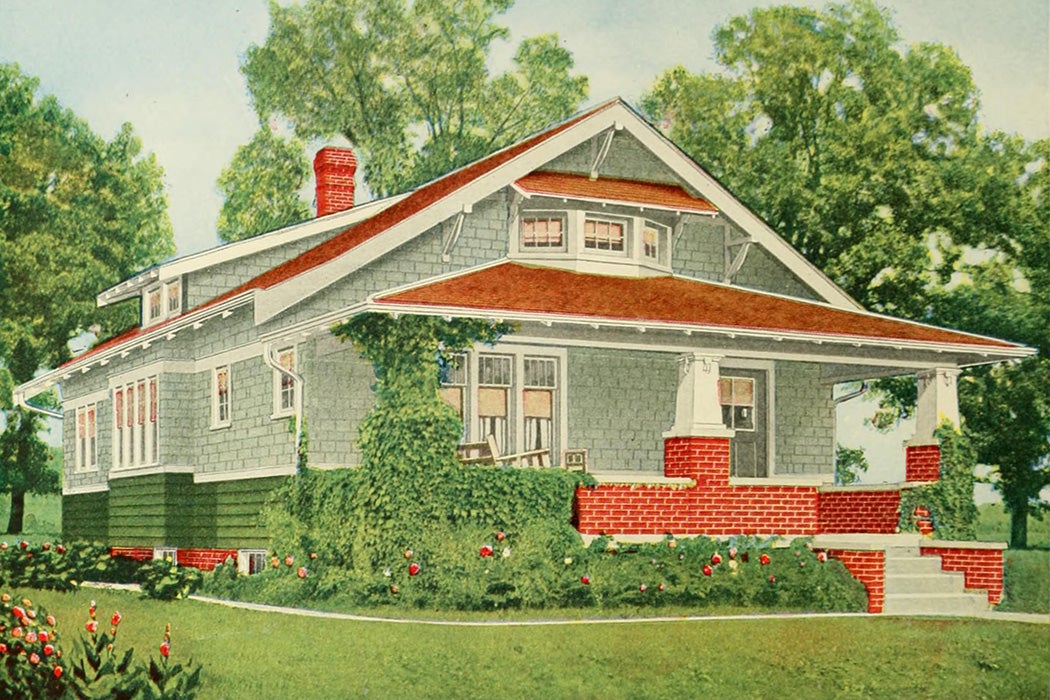
“On display at the national exhibition in D.C., the National Better Home included modern amenities like indoor plumbing and electricity, reflecting an attempt to encourage homeowners to purchase new appliances and embrace scientific thinking at home. Hutchison writes that the living spaces in the house were designed to “evoke sentimental images of family unity” while “the kitchen conveyed efficiency and cleanliness.” That approach to home design was emulated in cities and towns around the country, as local communities vied for the title of Best American Home. These exhibitions were written up in newspapers across the country, and the movement’s leaders emphasized thrift and sensibility over “commercialism.”
For Black and immigrant homeowners (or would-be homeowners), BHA offered a kind of aspirational modeling that decried their current living conditions, but offered no substantial way out of their circumstances.”
Share this:
The Infectious Nature of Beliefs – Excerpt from Bence Nanay’s Essay
July 1, 2019 in Culture, Psychology, Social Science | Tags: Adveritsing, Aeon Magazine, Bence Nanay, Catching Desires, Social Psychology | by The Arbourist | 2 comments
I do love readinng Aeon Magazine. This essay by Bence Nanay questions how much control we have over our desires in society. It is a fascinating question as I think the commonly held belief we all have is that we, as individuals, are ever-present and mostly unchanging over time as we interact with society. It isn’t really the case as we are far from the immutable social islands that we think we are and more like a slowly flowing stream that is in a gradual state of constant change.
Unfortunately advertisers have latched onto this very human tendency and try to exploit our quasi-fluid state of desiring things by shaping advertising messages to foment desires with us, to get us to buy their particular product. Quite insidious, really. But then again, most of capitalism is.
“But what would be the screening mechanism for direct desire infection? Beliefs form a coherent network, but desires don’t. We can, and very often do, have conflicting desires. Just because a desire I acquired by means of desire infection contradicts some other desire of mine, I will not normally reject it. Contradictions between beliefs are easier to spot than contradictions between desires.
Cigarette or beverage commercials are very efficient ways of infecting you with desires. They are not trying to communicate a message. If they did, they would probably choose a more efficient message than Real men smoke a certain brand of cigarette. Such commercials are trying to trigger desires in you, bypassing your screening mechanism, which is probably against smoking and consuming sugary beverages. And they do so very efficiently: even though you think that a certain brand of sugary beverage is very unhealthy and bad for you, if the commercial is well-done, it will nonetheless trigger a desire in you.
Is there no screening mechanism against direct desire infection then? Here is one option: we want lots of things, but we want to only want very few things. Wanting to want something is what makes it stand out from the crowd. So this second-order desire (of not just wanting but wanting to want) could be thought of as the screening mechanism for direct desire infection. We screen out desires we do not want to have. And there are desires we do want to have – these are the ones that pass the screening and get to be endorsed.
This would give us a nice parallel with the screening mechanism for beliefs based on testimony. The problem is that it is unlikely to work. Second-order desires are also desires. So given that we can acquire first-order desires by direct desire infection, there is no obvious reason why second-order desires could not be acquired by direct desire infection. But then what would protect us from the infection of our second-order desires? Maybe third-order desires? If we need second-order desires to decide which of our first-order desires are infected, we would then also need third-order desires to decide which of our second-order desires are infected. And so on. As a screening mechanism against infected desires, this won’t work.
The contrast I made between the screening mechanism of beliefs and that of desires is not supposed to be absolute. Our screening of false beliefs often fails. And, as some techniques in psychiatry show, some ‘unwanted’ desires often do get screened out, for example, by making the conflict between them blatantly obvious. But while there is a default mechanism for the screening of beliefs, there is no comparable default screening mechanism for desires. And this has serious potential implications for how we think of the self.
Our desires change. The question is, what changes them? We acquire many of our desires by means of desire infection, and there is no real screening of these desires. But this means that many of our desires are, in some sense, inherited from the people around us.
A radical consequence of this argument concerns the way we should think about the self in light of these considerations. A widespread way of thinking about the self, going at least as far back as the 18th century and David Hume, is that it consists of the set of all our desires (besides some other mental states). But if this is so, then who we are (or the self) is a result, to a large extent, of random desire infection.
We know that we systematically ignore the possibility that our future self could be different from our present self. This is called the ‘end of history illusion’: we have a tendency to consider our self a finished product, but it is blatantly not. And this ‘end of history illusion’ makes it even more likely that we will try to give post-hoc rationalisations for any desires we might acquire by means of direct desire infection.
So the self changes. The question is, how much of this change is under our control? Some of it is: we have pretty good control over what new beliefs we acquire. And we might even have control over really wild, crazy desires. But we have no full control. Direct desire infection can have a real effect on who we are and whom we become – it is a phenomenon we should take very seriously.











 bleatmop
 Mystro
 The Arbourist


 Dead Wild Roses
Your opinions…