
Social constructivism, a theory positing that reality is constructed through social processes and interactions rather than being an objective truth, lies at the core of what is commonly referred to as “woke” ideology. This perspective asserts that knowledge, identity, and societal norms—such as gender, race, and morality—are not rooted in any inherent or natural order but are instead products of human agreement and power dynamics. In the woke framework, this translates into a belief that all structures and hierarchies are arbitrary and must be relentlessly questioned or dismantled, particularly those perceived as oppressive. The emphasis on subjective experience and collective narrative over empirical evidence or universal principles defines woke ideology as a direct descendant of social constructivism, where truth becomes malleable and contingent upon the dominant social discourse.
This worldview inherently encourages coercive attitudes because it rejects the possibility of a shared, objective reality that can be appealed to in resolving disputes. If reality is socially constructed, then those who control the narrative wield ultimate power, and dissent becomes not just a disagreement but a threat to the constructed order. Woke adherents often demand conformity to their reimagined norms—such as language policing, mandatory ideological training, or the silencing of opposing views—under the guise of protecting marginalized groups or advancing justice. This coercion stems from the belief that alternative perspectives perpetuate harmful constructs, leaving no room for dialogue or compromise. The result is a moral absolutism that justifies silencing or punishing those who deviate from the prescribed narrative, as their very existence challenges the fragile consensus of the constructed reality.
The totalitarian tendencies of this approach emerge from its insistence on universal adherence to a singular interpretive framework. Social constructivism, as embraced by woke ideology, does not tolerate competing claims to truth; it seeks to monopolize the social construction process itself. Institutions—be they educational, corporate, or governmental—are repurposed as tools to enforce this orthodoxy, often through mechanisms like cancel culture, deplatforming, or the rewriting of history to align with the approved narrative. Dissenters are not merely wrong but dangerous, necessitating their exclusion or reeducation. This mirrors historical totalitarian regimes, where control over perception and belief was paramount, except here it is cloaked in the language of progress and equity rather than overt authoritarianism.
Fundamentally, social constructivism within woke ideology constitutes an anti-real ontology—an explicit rejection of an independent, knowable reality. By denying that there are facts or truths outside human interpretation, it undermines the foundations of science, reason, and even basic human experience. For instance, biological realities like sex differences are reframed as oppressive constructs to be transcended, while historical events are judged not by evidence but by their alignment with contemporary moral sensibilities. This anti-real stance dismisses the possibility of a world that exists beyond our perceptions, reducing everything to a power struggle over who gets to define the “truth.” In doing so, it sacrifices the pursuit of understanding for the imposition of ideology, leaving no anchor for objective inquiry or mutual coexistence.
In conclusion, social constructivism serves as the intellectual bedrock of woke ideology, driving its coercive and totalitarian impulses while cementing its status as an anti-real ontology. It transforms society into a battleground of competing narratives where power, not truth, determines legitimacy. The resulting culture of enforced conformity stifles dissent and erodes the possibility of a shared reality, replacing it with a fragmented, subjective landscape that demands constant vigilance and control. Far from liberating, this framework traps individuals in a cycle of perpetual reconstruction, where no truth is final and no freedom is secure. Ultimately, it reveals a paradox: a philosophy claiming to deconstruct oppression constructs its own rigid, unyielding system in its place.
 A few houses down, there’s this neighbour who’s basically declared his yard a no-maintenance zone, and it’s got the whole block groaning. Every winter, we’re all out shoveling to keep the sidewalks clear, but his place? A snow-drift disaster that forces people to shuffle into the street. Come summer, his lawn’s a chaotic sprawl of overgrown grass and invasive weeds that look ready to invade the rest of the neighborhood. Like, come on—how hard is it to just run a mower over your lawn once a week-ish? It’s not like we’re begging for a botanical masterpiece, just some basic effort.
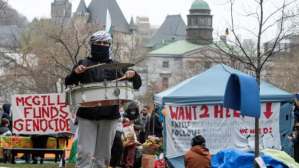 The protests at McGill University in April 2025 and the Trucker Convoy of 2022, while distinct in their scale, context, and authority, offer a compelling lens through which to examine accountability and lawbreaking in Canada. The McGill protests, driven by anti-Israel activists, involved physically blocking lecture halls and disrupting classes, as reported by B’nai Brith Canada, thereby denying students their right to education. In contrast, the Trucker Convoy, a nationwide movement against COVID-19 mandates, paralyzed critical infrastructure like the Ambassador Bridge, causing billions in economic losses and prompting the federal government to invoke the Emergencies Act. The scale of the Trucker Convoy’s impact was far greater, affecting national and international trade, while McGill’s disruptions were localized to a university campus. Additionally, the authority responding differed—McGill’s administration, a private institution, managed the campus protests, whereas the federal government, with its broader legal powers, tackled the Trucker Convoy. These differences in scope and jurisdiction naturally shaped the responses, but they also highlight a shared challenge: ensuring accountability when laws or rules are broken.
 The disparity in official responses to these events reveals a troubling inconsistency in addressing lawbreaking in Canada, fueling perceptions of a two-tier justice system. The Trucker Convoy faced severe consequences—hundreds of arrests, vehicle seizures, and frozen bank accounts under the Emergencies Act, as reported by Globalnews.ca—reflecting the government’s prioritization of economic and public safety. In contrast, McGill’s response was tepid, with the university implementing ID-based access controls only after days of disruption, and no immediate legal consequences like arrests or suspensions for the protesters, despite calls from advocacy groups for decisive action. While the federal government’s authority and the national stakes justified a stronger response to the Trucker Convoy, McGill’s leniency raises questions about institutional accountability on Canadian campuses. This inconsistency—where one group faces significant repercussions while another does not—erodes public confidence in the rule of law, suggesting that the consequences of lawbreaking may depend on the cause, context, or authority involved. Canada must strive for a balanced approach, ensuring that all acts of lawbreaking, regardless of scale or motivation, are met with fair and proportionate accountability to uphold the principles of justice and equality that define the nation.
 These protests not only disrupted academic life but also created an environment of fear, particularly for Jewish students, who felt targeted by what advocacy groups described as antisemitic behavior. The McGill demonstrations reflect a worldview that rejects Canada’s commitment to pluralism and freedom of expression, instead embracing a form of radicalism that seeks to impose its agenda through force. Historical insights, such as those from McGill’s Institute of Islamic Studies, highlight that radical Islam often merges religious ideology with political and social demands, as noted in a House of Commons report on the “clash of civilizations” thesis. This fusion can lead to a confrontational stance that clashes with Canadian culture, which values negotiation and inclusivity over exclusionary tactics that silence others.











 bleatmop
 Mystro
 The Arbourist


 Dead Wild Roses
Your opinions…