
You are currently browsing the tag archive for the ‘A Short History of Progress’ tag.
Across Canada, we are witnessing a subtle yet sweeping shift: ideology increasingly outweighs empirical judgment, and institutions once grounded in caution are now pressing ahead with conviction. When belief eclipses observation, society risks felling its own future. This essay explores how the parable of A Short History of Progress becomes a cautionary mirror for our age, when economic vitality, civic trust, and long-term health hang, in effect, on that final swing of the axe.
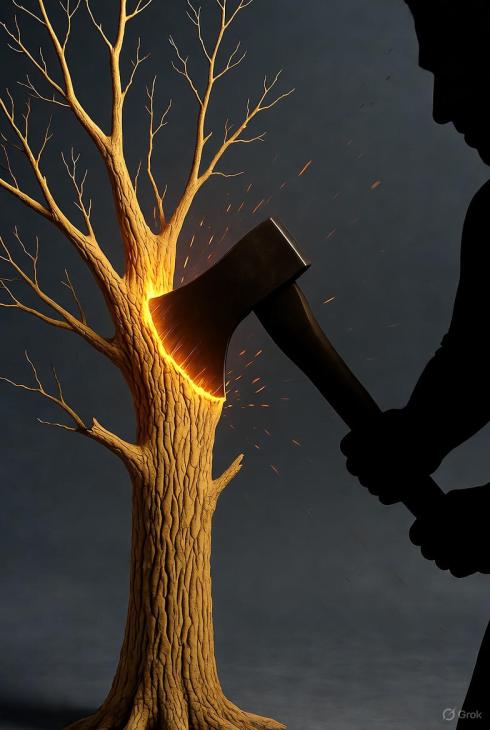
“The Last Tree” draws a sharp line from the collapse of Easter Island’s ecosystem to three modern Canadian crises—net-zero policy, selective law-enforcement in protest, and rapid-onset gender-affirming care—to ask: when ideology becomes our arbiter rather than evidence, what are we willing to sacrifice?
The Last Tree: When Ideology Fells the Future
In Ronald Wright’s A Short History of Progress, the tale of Easter Island stands as a stark parable of human folly. Isolated in the vast Pacific, the Rapa Nui people arrived around 800 AD and transformed a forested paradise into a monument to their ingenuity and hubris. Over centuries, they felled the island’s palm groves to haul colossal moai statues across the terrain, using timber for sledges, ropes from bark, and fuel for fires. What began as a display of ancestral piety and clan prestige spiraled into ecological catastrophe. Soil eroded, fertility plummeted, bird populations vanished, and the once-vibrant ecosystem crumbled. By the 17th century, the population had crashed from perhaps 15,000 to a few thousand, amid famine, warfare, and cannibalism. Wright captures the inexorable logic: progress, unchecked, devours its own foundations.
Yet it is the final act that lingers—a moment of crystalline horror. The people who felled the last tree could see it was the last, could know with complete certainty that there would never be another. Imagine that islander, axe in hand, gazing at the solitary palm swaying against the horizon. The wind carries the salt of an empty sea, the ground beneath him scarred and barren. What raced through his mind? Not ignorance, for the warnings were etched in the dust: topsoil washing into the ocean, rats devouring every seed, canoes rotting on barren shores. No, it was something fiercer—a conviction forged in ritual and rivalry.
This tree, he might have reasoned, honours the ancestors; to spare it is to dishonour them, to invite the gods’ wrath. The rival clan cannot be allowed supremacy in statue-toppling; one more moai secures our lineage’s glory. Tradition demands it, the priests decree it, and in the face of clan elders’ unyielding stares, doubt withers like the fronds around him. Survival? A coward’s calculus, subordinate to the sacred narrative of progress through monument. With a swing, ideology claims its victory over reality, sealing the island’s doom.
This scene, Wright implies, is not ancient history but a mirror to our own susceptibilities. Ideological blindness is not partisan—it afflicts any society where belief eclipses observation. We stand at analogous thresholds today, where cherished convictions compel us to strike the final blow.
Consider our pursuit of net-zero emissions, pursued with a fervour that borders on the messianic. The federal government’s 2030 targets, however well-intentioned, risk undermining the very prosperity they claim to safeguard. The rhetoric of existential apocalypse—tipping points invoked like divine judgments—drowns out the data: Canada’s emissions constitute roughly 1.5 percent of the global total, and even full compliance would yield negligible climatic impact while rivals like China and India accelerate coal-fired expansion. Policymakers, axe raised, justify the cut: it honours the intergenerational covenant, shames the sceptic as a heretic. Yet the last “tree” here is economic vitality itself, felled in service to a narrative that confuses virtue with viability.
No less alarming is the selective blindness in enforcing the rule of law, particularly amid the surge of “Free Palestine” protests since October 7, 2023. These demonstrations, while not all hateful, have coincided with a documented explosion of antisemitism: synagogues vandalised, Jewish students harassed, and public chants equating Zionism with Nazism increasingly tolerated under the banner of free expression. Authorities often cite the need to avoid escalation or protect equity rights—but to apply the law unevenly corrodes the Charter’s promise of equal protection. The justification echoes the islander’s: equity demands deference to the aggrieved, lest we be branded oppressors. Thus, the final tree of civic trust is hacked away under the banner of performative solidarity.
Perhaps most viscerally, our medical institutions’ embrace of gender-affirming care reveals ideology’s grip on empirical mercy. Provincial guidelines expedite hormones and surgeries for minors, often with scant longitudinal scrutiny, despite emerging evidence of regret and harm. Critics—including those echoing the UK’s Cass Review—argue that compassion has been recast as affirmation, turning clinics into ideological fortresses where dissent is pathologised. This is not to deny the reality of gender dysphoria or the dignity of trans adults seeking relief; it is to insist that true compassion must rest on evidence, not dogma. The clinician, scalpel poised, rationalises: empathy compels affirmation; to probe deeper risks transphobia’s charge. Reality—the patient’s lifelong body, the data’s gaps—yields to the doctrine, mutilating futures in the name of inclusion.
These Canadian vignettes, like Easter Island’s denouement, expose ideology’s seductive tyranny: a narrative so totalising it renders the evident obsolete. Friedrich Nietzsche foresaw this abyss in his dissection of nihilism, that devaluation where “the highest values are losing their value.” Like Wright’s islanders, we mistake self-destruction for virtue—a form of nihilism Nietzsche saw as civilisation’s end-game. Cloaked in Marxist activist garb—equity as the new god, progress as its prophet—these policies dissolve society’s sinews not through malice but through a will to power masquerading as justice. Nietzsche warned that such illusions prolong torment, for “hope in reality is the worst of all evils because it prolongs the torments of man.”
To reclaim our ground, we must confront the axe in our hand: interrogate the story, honour the verifiable, and plant anew before the last tree falls. The islanders could not. We still can.
References
- Wright, Ronald. A Short History of Progress. Anansi, 2004.
- Fraser Institute, “Measuring the Cost of Canada’s Net-Zero Climate Policy,” 2024.
- B’nai Brith Canada, Annual Audit of Antisemitic Incidents, 2024.
- Government of Canada, 2030 Emissions Reduction Plan, 2022.
- Cass, Hilary. Independent Review of Gender Identity Services for Children and Young People (The Cass Review). UK NHS, 2024.
- For Canada-specific studies on gender-affirming care outcomes:
- Jackman, Liam et al., “Patient-reported outcomes, provider-reported outcomes, and physiologic parameters after gender-affirming hormone treatment in Canada: a systematic review” (2025). (SpringerLink)
- Lawson, M.L. et al., “A Cross-Sectional Analysis from the Trans Youth CAN! Study” (2024). (Jah Online)
- “At-a-glance – Gender identity and sexual attraction among Canadian youth: findings from the 2019 Canadian Health Survey on Children and Youth” (2023). (canada.ca)
This lecture, which I attended at the University of Alberta, and later read the book was one of the cornerstones of the awakening of my intellectual curiosity about the world and how human societies work.
Each time history repeats itself, so it’s said, the price goes up. The 20th century was a time of runaway growth in human population, consumption, and technology, placing a colossal load on all natural systems, especially earth, air, and water — the very elements of life.

The most urgent questions of the 21st century are: where will this growth lead? Can it be consolidated or sustained? And what kind of world is our present bequeathing to our future?
In A Short History of Progress Ronald Wright argues that our modern predicament is as old as civilization, a 10,000-year experiment we have participated in but seldom controlled. Only by understanding the patterns of triumph and disaster that humanity has repeated around the world since the Stone Age, can we recognize the experiment’s inherent dangers, and, with luck and wisdom, shape its outcome.
Ronald Wright was born in England, educated at Cambridge, and now lives in British Columbia. A novelist, historian, and essayist, he has won prizes in all three genres, and is published in ten languages. His nonfiction includes the number one bestseller Stolen Continents, winner of the Gordon Montador Award and chosen as a book of the year by the Independent and the Sunday Times.
His first novel, A Scientific Romance, won the 1997 David Higham Prize for Fiction and was chosen a book of the year by the Globe and Mail, the Sunday Times, and the New York Times. His latest book is the novel Henderson’s Spear. Ronald Wright is also a frequent contributor to the Times Literary Supplement, and has written and presented documentaries for radio and television on both sides of the Atlantic.
Found the whole lecture on youtube and will link to the CBC archive as well.
 I’m glad I’ll be dead when humanity’s collective shit hits the fan. I used to get all wrapped up in debates about Capitalism and the slow motion Seppuku we’re committing. I was genuinely flummoxed when my arguments were characterized as hopelessly naive and that my positions were unfounded vis-a-vis economic reality (a.k.a the dominant capitalist consumption paradigm).
Bollocks to that noise.
I’m out of fucks to give about important economic arguments and how super-fucking-awesome capitalism is. I will not be around when glitz comes off of our over-consumption and enough of humanity realizes how hard they’ve been screwed over by our benevolent job creating, all-boats-raising, [insert mendacious free-market dogmatic sentiment here], elite whose only goal is to keep their particular party going on the backs of every else. I, if consciousness exists after corporeal death, will be bathing in tears of the elite, relishing every savoury nanosecond of schadenfreude, as their hard “earned” lifestyle and material wealth crumbles to ash in a fiery pyre with the rest humanity.
Our human tendency to stratify our societies is our downfall. The inequalities that capitalism creates blinds those with power and privilege to the destruction of the very means of survival. Ronald Wright wrote this about the importance of the biosphere and the resources it supplies. To0 tree-huggy for you? Tough darts friend, the historical record is littered with the wrecks of societies that did not learn this fundamental lesson.
The lesson I read in the past is this: that the health of land and water – and of woods, which are the keepers of water – can be the only lasting basis for any civilization’s survival and success.
—A Short History of Progress, p 105
Don’t believe me? Well fuckmesideways bro, you don’t have too, it might be easier if you don’t see this one coming. The good scientists over at NASA have published a neat study on the merry death-spiral we happen to be inhabiting, The Guardian has an article summarizing said paper, thus we’ll peruse the highlights here.
This paragraph’s prescience is chilling:
“Noting that warnings of ‘collapse’ are often seen to be fringe or controversial, the study attempts to make sense of compelling historical data showing that “the process of rise-and-collapse is actually a recurrent cycle found throughout history.” Cases of severe civilisational disruption due to “precipitous collapse – often lasting centuries – have been quite common.”
Useful thought experiment time. Imagine when you were a teenager. Remember how thoroughly self absorbed, shallow, and brain-dead you were? That same myopic narcissism is reflected in intellectual, political and social stands that typify the attitudes of the elite. This NASA study is a smackdown of all of what our cherished elites hold dear.
Will a peer reviewed article suddenly change minds and ingrained attitudes? Considerthe prevalence and persistence of religious belief despite the wealth of knowledge that contradicts said venerated mythology. The sheer number of people that haplessly cling to religious delusion is a testament to the doggerel stupidity our species is infected with. The peoples minds we need to change have the influence and the inclination not to listen to reason. So let’s not get all lathered up about the ramifications of this report, even if does purportedly deal in fact.
“It finds that according to the historical record even advanced, complex civilisations are susceptible to collapse, raising questions about the sustainability of modern civilisation:
“The fall of the Roman Empire, and the equally (if not more) advanced Han, Mauryan, and Gupta Empires, as well as so many advanced Mesopotamian Empires, are all testimony to the fact that advanced, sophisticated, complex, and creative civilizations can be both fragile and impermanent.
Mmm. Sounds nothing at all like our society. But let’s not learn from the past because the ignoble fate suffered by those societies couldn’t possibly happen today.
Because hubris.
(I could have stopped the post here, but sadly, my sanguine nature runs both wide and deep, thus we continue, hoping a difference might be made)
But what are the causes of the downfall of human civilizations?
“[…]lead to collapse when they converge to generate two crucial social features: “the stretching of resources due to the strain placed on the ecological carrying capacity”; and “the economic stratification of society into Elites [rich] and Masses (or “Commoners”) [poor]” These social phenomena have played “a central role in the character or in the process of the collapse,” in all such cases over “the last five thousand years.”
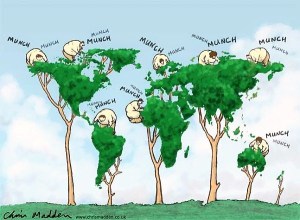 Wow. You mean the rich worry only about getting richer and fucking everyone else over is an actual historical(now supported with SCIENCE!!!)fact? Thank you brave scientists heads for nailing that conclusion that has been obvious to anyone who studies history and has more than two fucking neurons to rub together. So one could say that a system that creates stratification – CAPITALISM – isn’t a really a good system to blindly, balls-to-the-wall-style, endorse. Who would have figured that shit out (hint: rhymes with ‘parks’).
“Currently, high levels of economic stratification are linked directly to overconsumption of resources, with “Elites” based largely in industrialised countries responsible for both:
“… accumulated surplus is not evenly distributed throughout society, but rather has been controlled by an elite. The mass of the population, while producing the wealth, is only allocated a small portion of it by elites, usually at or just above subsistence levels.”
Are you enjoying your peon status? I know I certainly am. But hey, you could make it rich someday too and live just like the fat cats – not that the elites would propagate popular myths (thank you corporate media) to keep the drones in line. But why listen to bitter ole Arbourist? Ronald Wright has done the dirty work and comes to a similar (paraphrased)conclusion:
“Wright sees needed reforms being blocked by vested interests who reject multi-lateral organisations, and support laissez-faire economics and transfers of power to corporations as leading to the social and environmental degradations that led to the collapse of previous civilisations. Necessary reforms are, in Wright’s view, being blocked by vested interests who are hostile to change, including American market extremists. Wright concludes that “our present behaviour is typical of failed societies at the zenith of their greed and arrogance” and calls for a shift towards long-term thinking:”
 Yep, and the Elites and their libertarian teenager mentality are going to resolutely deny this until they are standing in the warm rich glow of their freshly razed gated communities and mansions. Only then does this sort of message sink in.
“Modelling a range of different scenarios, Motesharri and his colleagues conclude that under conditions “closely reflecting the reality of the world today… we find that collapse is difficult to avoid.” In the first of these scenarios, civilisation:
“…. appears to be on a sustainable path for quite a long time, but even using an optimal depletion rate and starting with a very small number of Elites, the Elites eventually consume too much, resulting in a famine among Commoners that eventually causes the collapse of society. It is important to note that this Type-L collapse is due to an inequality-induced famine that causes a loss of workers, rather than a collapse of Nature.”
So many options, how about option #2?
“Another scenario focuses on the role of continued resource exploitation, finding that “with a larger depletion rate, the decline of the Commoners occurs faster, while the Elites are still thriving, but eventually the Commoners collapse completely, followed by the Elites.”
Oh this sounds all gloomy and pretty shitty overall, do we have some sciency facts on this? Of course we do…
“In both scenarios, Elite wealth monopolies mean that they are buffered from the most “detrimental effects of the environmental collapse until much later than the Commoners”, allowing them to “continue ‘business as usual’ despite the impending catastrophe.” The same mechanism, they argue, could explain how “historical collapses were allowed to occur by elites who appear to be oblivious to the catastrophic trajectory (most clearly apparent in the Roman and Mayan cases).”
Pretty good argument for a more egalitarian society no? Because the status quo means most of us die and the remainder to to live life Hobbsian style: “Nasty, Brutish  and short.” Did statement that just send up a dog whistle for our dear friends of capitalism?? Sharing wealth, income redistribution.. the soon to be named spectre of unfuckingwashed Socialism?
Damn straight, son.
Oh were you contemplating bringing some apologia for capitalism to the comments section to set me straight on how fucking wonderful it is and how really if we just keep innovating it will be a panacea for all? (Tell that to third world parents whose kids(21 a minute if you have statistical fetish) are still dying of preventable diseases). Change this shitty system now or get used to the happy-funtime reality that Hobbes and Malthus intimately describe.
“Applying this lesson to our contemporary predicament, the study warns that:
“While some members of society might raise the alarm that the system is moving towards an impending collapse and therefore advocate structural changes to society in order to avoid it, Elites and their supporters, who opposed making these changes, could point to the long sustainable trajectory ‘so far’ in support of doing nothing.”
It won’t change, not by our hand. I get that – keep the orgy going kids; I expect nothing less.
But as I said earlier I won’t be around to stew when things go sideways (well maybe as a wizened old soul on a rocking chair with a shotgun and cats), so enjoy your mess assholes. I’m frackking done with this.
Let’s close with a non swear word laden summary from Ronald Wright of many of my thoughts on humanities majestic progress and the challenges we face:
“Things are moving so fast that inaction itself is one of the biggest mistakes. The 10,000-year experiment of the settled life will stand or fall by what we
do, and don’t do, now. The reform that is needed is not anti-capitalist, anti-American, or even deep environmentalist; it is simply the transition from short-term to long-term thinking. From recklessness and excess to moderation and the precautionary principle.
The great advantage we have, our best chance for avoiding the fate of past societies, is that we know about those past societies. We can see how and why they went wrong. Homo sapiens has the information to know itself for what it is: an Ice Age hunter only half-evolved towards intelligence; clever but seldom wise.
We are now at the stage when the Easter Islanders could still have halted the senseless cutting and carving, could have gathered the last trees’ seeds to plant out of reach of the rats. We have the tools and the means to share resources, clean up pollution, dispense basic health care and birth control, set economic limits in line with natural ones. If we don’t do these things now, while we prosper, we will never be able to do them when times get hard. Our fate will twist out of our hands.”
—A Short History of Progress, p 131–2
Short History of Progress Wikipedia.
Short History of Progress Review on Quill and Quire
Surviving Progress: Documentary Film featuring Ronald Wright.
The Massey Lecture Series: A Short History of Progress produced by the CBC on youtube-











 bleatmop
 Mystro


 Dead Wild Roses
Your opinions…