
You are currently browsing the tag archive for the ‘Alberta’ tag.
Paul Brandt is not a fringe troll with a microphone. He’s a mainstream Canadian artist with a public record of philanthropy, and he’s closely associated with “Not In My City,” a project focused on combating sexual exploitation and trafficking. So when he was slated to appear as a keynote speaker at Alberta’s North Central Teachers’ Convention and then disappeared from the final program, the obvious question is not “what did he tweet?” It’s simpler:
Who made that decision, and why won’t they say so plainly?
The reporting to date suggests Brandt was initially scheduled, then “not included in the final schedule,” with no substantive explanation offered beyond that. That’s not a scheduling explanation. That’s a refusal to explain.
And refusals matter, because when institutions won’t tell the truth in normal language, people assume the worst—and sometimes they’re right.
The Mechanism: Institutional Silence Creates Political Meaning
If you remove a speaker at the last minute and provide no reason, you create a vacuum. That vacuum fills with the most plausible theory available.
In this case, the most widely circulated theory is that Brandt’s public comments touching Alberta independence politics annoyed someone. Is that proven? No. It remains inference. But it is an inference made easier by the ATA ecosystem’s habits: highly political instincts, high message discipline, low transparency.
If the truth is mundane—contract issue, travel issue, logistical conflict—then say it. If the truth is “we didn’t want this topic,” then say that, too. Adults can handle disagreements. What they can’t handle is managerial fog deployed as reputational control.
Precision: Who Is “The ATA” Here?
One important correction: teachers’ conventions are not simply “the ATA” as a monolith. Convention programming is organized by convention associations and boards; the ATA is part of the structure, but local governance and planning matter.
That distinction doesn’t let anyone off the hook. It just tells us where accountability should point: the convention organizers and the ATA officials involved need to identify the decision-maker.
Not “we didn’t include him.”
Not “the schedule changed.”
Not “it was complicated.”
Name the person or committee. Publish the rationale. Own it.
The Drag Bingo Contrast (What We Can Prove, and What We Can’t)
Let’s also clean up another point, because credibility matters more than vibes.
There is evidence that at least one ATA local (Calgary Public Teachers, ATA Local 38) has promoted drag bingo events for teachers—adult social programming and fundraising, including a “Drag Bingo 2.0” event advertised for February 28, 2026 at Hudsons Canada’s Pub. Other posts and recaps indicate this has been a recurring event.
What that does not prove is “drag queen programming for children in classrooms.” If you want to make that claim, you need separate documentation. This piece doesn’t need it.
The point is narrower and stronger:
ATA-affiliated organizations are willing to put their name to drag entertainment for adults, as part of educator culture—and yet they won’t clearly explain why a speaker connected to anti-exploitation advocacy was removed from a major professional gathering.
That mismatch doesn’t prove bad intent. It proves something else: selective transparency. When the programming is ideologically safe, the institution is loud. When the programming might trigger internal conflict, the institution becomes a ghost.
The Real Issue Isn’t Paul Brandt. It’s Institutional Governance.
If you are a teacher paying dues, you should be furious—not necessarily because Brandt is the perfect keynote, but because your professional association is behaving like a risk-management shop instead of a member-serving institution.
Here are the questions that require answers:
- Who made the call to remove him from the program?
- What criterion was used—professional relevance, conduct, political sensitivity, “safety,” reputation risk?
- When was the decision made?
- Was Brandt given a reason, and is that reason publishable?
- Will the organizers commit to a transparency standard going forward?
If those questions can’t be answered, the institution has a bigger problem than one cancelled keynote. It has a legitimacy problem.
Because once you normalize silent removals, you don’t just manage controversy. You teach your own members that power flows upward, speech gets filtered, and you’re expected to smile.
Verdict
You can disagree about Alberta independence. You can dislike country music. You can even decide a trafficking-focused keynote doesn’t fit your convention theme. Fine. That’s politics.
But if you can’t say it openly—if your default mode is bland non-answers and managerial evasion—then you’re not leading educators. You’re managing a brand.
And Alberta parents are right to notice. When the people tasked with protecting children won’t speak plainly about their own choices, they don’t look principled. They look captured.
Albertans deserve better than that. And teachers do too.

Some children are genuinely vulnerable, atypical, or distressed, and they deserve careful support.
That should be easy to say. It should also be the beginning of the conversation, not the end of it.
The problem starts when a narrow duty of care is expanded into a broad teaching mandate. Support for a small number of children becomes a reason to saturate schools, children’s media, and online spaces with contested identity frameworks. What begins as accommodation becomes doctrine. What begins as care becomes a general lens for everyone.
That is the central move.
It is usually framed in soft language: inclusion, visibility, affirmation, making room. Sometimes that language is fair. But it can also hide a scope change. A real minority need is used to justify population-level exposure. The existence of some children who need unusual support does not, by itself, justify turning child-facing institutions into delivery systems for anti-normative identity scripts many children are not developmentally ready to evaluate.
Put simply: support is not the same thing as saturation.
A useful heuristic is the inoculation model. The implicit argument often sounds like this: expose everyone early and often to the framework so harm is prevented later. But that assumes the framework is age-appropriate, conceptually clear, and socially harmless when applied at scale. Those assumptions are usually asserted, not argued.
You can see the pattern in school frameworks like SOGI 123. SOGI 123 describes itself as an initiative to help educators make schools safer and more inclusive for students of all sexual orientations and gender identities, with tools spanning policy, school culture, and teaching resources. In British Columbia, SOGI 123 has been broadly integrated through educator networks and district participation structures. In Alberta, similar SOGI 123 resources and supports exist and are used, but public acceptance and implementation have been more contested and uneven. (Your local framing here is fine; if you want, we can add a specific Alberta anchor in the next pass.)
The point is not that every teacher using these materials has radical intentions. Most likely do not. The point is structural. A framework introduced in the name of protecting a minority of vulnerable students can become a general lens for shaping the environment of all students. That is exactly where support turns into saturation.
None of this requires pretending there are no benefits. Anti-bullying frameworks and school supports can reduce harassment and improve school climate for vulnerable students, and in some cases for other students as well. Recent SOGI 123 evaluation reporting in B.C. has explicitly claimed reductions in some forms of bullying and sexual-orientation discrimination, including effects observed for heterosexual students in studied schools. But that is a different question from whether a framework is well-bounded, developmentally fitted, and appropriate as a general lens for all children. A program can produce some good outcomes and still be overextended in scope.
This is also where ordinary parents often feel morally cornered. They are told the framework is simply about kindness and safety. Then they discover it also carries contested claims about identity, norms, and development. When they raise questions about age, fit, or timing, the objection is treated as hostility rather than prudence.
That rhetorical move matters. It is how debate gets shut down.
Some activist frameworks are not just asking for tolerance or non-harassment. They are more ambitious. They treat ordinary social norms as presumptively suspect—or as things to be actively challenged—rather than mostly inherited and refined. Adults can debate that in adult spaces. The problem is when those frameworks are translated into child guidance and presented as common sense before children are developmentally ready to sort through the concepts.
You do not need a graduate seminar to see the issue. Children imitate. Children seek belonging. Children absorb prestige cues. Children are shaped by what trusted adults celebrate. That is not bigotry. That is basic reality.
This is why developmental fit matters. Children do not process abstract identity questions the way adults do. Identity formation is gradual. Social context matters. Timing matters. Adult authority matters. Age appropriateness is not a slogan; it shifts across developmental stages, and what may be discussable at 16 is not automatically suitable at 6. When institutions present contested frameworks in a celebratory register first and a cautionary register later (or never), adults should worry.
The usual public binary is false. The choice is not between cruelty and total affirmation. It is not between neglect and ideological immersion. A sane society can do both things at once: provide targeted support for the children who truly need it, while refusing to reorganize the symbolic environment of all children around contested anti-normative frameworks.
That is not repression. It is proportion.
And proportion is exactly what gets lost when every concern is moralized and every request for limits is treated as harm.
We should be able to say, plainly, that some children need exceptional care without turning exceptional cases into the template for everyone else. We should be able to protect the vulnerable few without swamping the many. We should be able to teach kindness without requiring ideological inoculation.
If we cannot make those distinctions, then we are not practicing compassion. We are practicing scope creep with moral language.
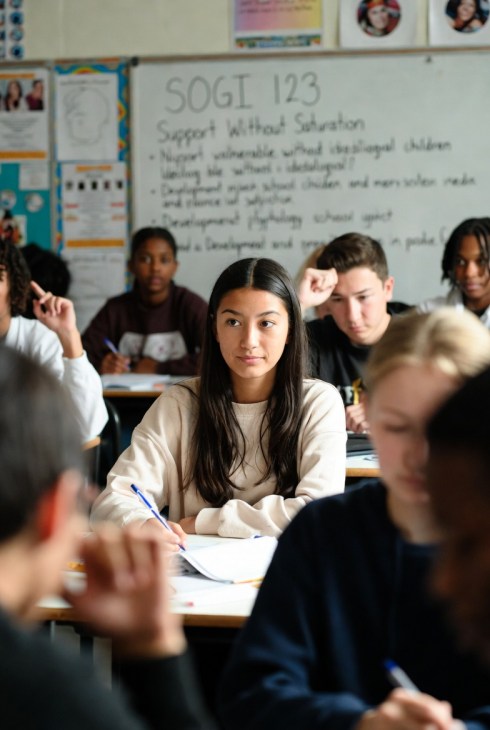
Support for vulnerable students is necessary. But targeted care is not the same as saturating schools with contested identity frameworks for all children.
References
- SOGI 123 / SOGI Education. “SOGI 123 | Making Schools Safer and More Inclusive for All Students.”
https://www.sogieducation.org/ (SOGI 123) - SOGI Education. “What Is SOGI 123?”
https://www.sogieducation.org/question/what-is-sogi-123/
(official explainer page) - SOGI Education. “British Columbia.”
https://www.sogieducation.org/our-work/where-we-support/british-columbia/
(B.C. implementation / network context) - ARC Foundation. “UBC Evaluation of SOGI 123 (October 2024).”
https://www.arcfoundation.ca/ubc-evaluation-sogi-123-october-2024
(evaluation / outcomes framing from SOGI-supportive side) - Alberta Teachers’ Association. “What is SOGI 123?”
https://teachers.ab.ca/news/what-sogi-123 (teachers.ab.ca) - Keenan, H., and Lil Miss Hot Mess. “Drag Pedagogy: The Playful Practice of Queer Imagination in Early Childhood.” Curriculum Inquiry 51, no. 5 (2021): 578–594.
https://doi.org/10.1080/03626784.2020.1864621 - Gender Report (opinion/critical perspective). “We need to take ideological gender rhetoric out of education.” (Jan. 28, 2021).
https://genderreport.ca/sogi-gender-curriculum-queer-theory/ (CANADIAN GENDER REPORT) - Global News. “Duelling protests held in Edmonton over sexual orientation and gender identity policies in schools” (Sept. 20, 2024).
https://globalnews.ca/news/10766483/edmonton-gender-identity-sexual-orientation-alberta-schools/ (Global News)
If “process legitimacy” is the immune system of pluralist democracy, then institutional behaviour on gender policy is a stress test. The question isn’t whether an organization “supports trans kids.” Most Canadians want distressed kids treated with compassion. The real question is whether a major institution preserves the rules that let citizens disagree without declaring each other enemies: transparent standards, viewpoint tolerance, due process, and consistent safeguarding norms.
On gender issues in Alberta schools, the Alberta Teachers’ Association (ATA) has repeatedly positioned itself against provincial policies that increase parental consent/notification requirements (for under-16 name/pronoun changes) and opt-in consent for certain explicit instruction around gender identity and sexuality. (Reuters) (Those positions are not obscure; they are central to ATA’s public posture around the province’s direction of travel.)
More important than the slogans is the procedural stance that shows up in teacher guidance: ATA-affiliated materials have explicitly cautioned educators against disclosing a student’s sexual orientation or gender identity to parents or colleagues without the student’s consent. (Office of Population Affairs) That is a high-stakes choice about where authority sits—between child, family, and school. You can argue for it. You can argue against it. But you can’t pretend it’s neutral. It quietly rewrites safeguarding defaults: the family becomes, at minimum, a conditional partner rather than the presumption.
Now add the evidence environment. Over the last two years the confidence level around pediatric medical interventions has become more openly disputed—not only in Europe but in the Anglosphere generally. A major American federal review published under HHS/OPA in late 2025 frames the evidence base for pediatric gender-dysphoria treatments as weak/low-certainty and calls for greater caution and higher standards of evidence. (Office of Population Affairs) Separately, a 2025 systematic review and meta-analysis focused on puberty blockers for youth with gender dysphoria rated the certainty of evidence as very low for many outcomes and called for higher-quality studies. (PMC)
None of that automatically tells Alberta what to do. But it does tell you what institutions shouldn’t do: treat a contested landscape as settled; treat caution as moral failure; treat parental involvement as presumptive danger; or treat dissent as “misinformation” rather than as disagreement about evidence thresholds and child-protection tradeoffs.
Because once an institution behaves that way, it teaches a poisonous lesson: the process is legitimate only when it produces the “right” outcomes. That’s outcome legitimacy wearing a procedural costume. And it’s exactly how you get an arms race in which every faction concludes it must “capture” the institution before the other faction does.
To be clear: there are serious researchers and clinicians who report short-term mental-health improvements in cohorts receiving gender-affirming medical interventions, and there are studies reporting low regret among youth who accessed puberty blockers/hormones in particular samples. (PubMed) That’s precisely why process legitimacy matters: when evidence is mixed, partial, or uncertain, the only adult stance is procedural humility—clear standards, honest uncertainty, room for argument, and policies that can survive being applied by your opponents next year.
Verdict (process-first, not tribe-first)
If an institution wants to avoid the “friend/enemy” trap on this file, it should stop acting like moral certainty is a substitute for good procedure. In practice that means:
- publish the evidence threshold being used (and why),
- separate student support from ideological doctrine,
- adopt viewpoint-neutral professional norms (no loyalty tests),
- and set safeguarding rules that can be defended symmetrically—not only when your side holds the pen.
That’s how you reduce ideological capture risk without replacing it with counter-capture. 🧯
Glossary 📌
Process legitimacy — Accepting an institution’s decision as binding even when you dislike the outcome, because rules were lawful, fair, transparent, and consistently applied.
Outcome legitimacy — Treating a process as legitimate mainly when it produces your preferred outcome.
Ideological capture — A condition where a contested worldview becomes so dominant in an institution’s norms and incentives that dissent is chilled and policy becomes insulated from evidence contestation and pluralism. (Best treated as an inference from mechanisms, not a slogan.)
Safeguarding — Child-protection norms and practices: role clarity, duty of care, appropriate parental involvement, documentation, escalation pathways, and risk management.
Low certainty evidence — A systematic-review judgment (often using GRADE) indicating limited confidence that an observed effect is real and durable; future studies may change the conclusion materially.
Puberty blockers (in this context) — Medications used to pause pubertal development; the debate concerns indications, outcomes, and risk–benefit in youth with gender dysphoria.
Citations 🧾
ATA / Alberta schooling context
- ATA-affiliated guidance on confidentiality around students’ sexual orientation/gender identity (GSA/QSA guide). (Office of Population Affairs)
American evidence review
- HHS/OPA report PDF: Treatment for Pediatric Gender Dysphoria: Review of Evidence and Best Practices (Nov 19, 2025). (Office of Population Affairs)
- HHS press release summarizing the report (Nov 19, 2025). (HHS.gov)
- Scholarly critique/response to the HHS report (J Adolesc Health, 2025). (JAH Online)
Systematic review on puberty blockers
- Miroshnychenko et al. 2025 systematic review/meta-analysis (PubMed + full text). (PubMed)
Evidence suggesting benefit / satisfaction in some cohorts (for balance and accuracy)
- Tordoff et al. 2022 (JAMA Network Open): association with lower depression/suicidality over 12 months. (JAMA Network)
- Olson et al. 2024 (JAMA Pediatrics): satisfaction/regret findings in youth accessing blockers/hormones (regret rare in that sample). (JAMA Network)
Alberta’s Bill 13, the Regulated Professions Neutrality Act, marks one of the most significant free-expression protections introduced in Canada in a generation. In a political climate where professional regulators increasingly police personal beliefs, Alberta has drawn a constitutional line: no regulator has the right to punish lawful off-duty expression or enforce ideological conformity.
For a country grappling with expanding limits on acceptable speech, Bill 13 is a clear statement that cognitive liberty still matters — and must be defended.
Protecting the Mind from Institutional Overreach
The bill’s core principle is simple:
regulated professionals — doctors, nurses, teachers, lawyers, engineers — do not surrender their freedom of thought or expression when they obtain a license.
Bill 13 therefore prohibits regulatory bodies from disciplining professionals for their lawful off-duty expressive conduct. The definition is broad by design:
any communication or symbolic act that expresses meaning is protected, unless it involves real harm such as violence, criminal acts, abuse of professional power, or sexual misconduct.
This is precisely the line a free society should defend. Regulators must ensure competence — not enforce an ideological worldview.
The “Peterson Law”: A Necessary Rebalance
Bill 13 responds directly to cases like that of Jordan Peterson, whose regulator attempted to discipline him for personal political commentary made outside his clinical practice. Whatever one thinks of Peterson, the precedent was dangerous: it implied that professionals serve at the pleasure of ideological censors.
Bill 13 rejects this entirely.
It enshrines a foundational principle:
Your license does not give the state ownership of your mind.
In a country where social and professional pressures increasingly enforce narrow orthodoxies, this is an overdue correction.
Ending Ideological Compulsion in Professional Licensing
The bill also prohibits mandatory ideological training unless it directly relates to professional competence or ethics. This includes DEI, unconscious-bias modules, or cultural-competency courses whose content extends beyond verifiable job requirements.
This is not a rejection of diversity or ethics. It is a rejection of the assumption that the state can compel belief — or force professionals to internalize political frameworks as a condition of employment.
Canada has drifted toward a model where ideological education is treated as neutral truth. Bill 13 restores the older liberal idea:
the state regulates conduct, not thought.
Reaffirming Charter Principles the Rest of Canada Left Behind
Bill 13 strengthens the role of the Charter of Rights and Freedoms and Alberta’s Bill of Rights in appeals. Regulators must now justify any intrusion on expression using a correctness standard, not deferential rubber-stamping.
In effect, Alberta is telling professional bodies:
If you are going to infringe expression, you must prove it is justified — and most ideological policing won’t survive that scrutiny.
This is how constitutional societies are supposed to operate.
A Model for a Canada That Has Lost Confidence in Its Own Freedoms
Critics warn of dangers. But these warnings always elide the key truth:
Bill 13 does not protect threats, criminality, hate-motivated harassment, or abuse of professional power.
It protects speech — not harm.
It protects thought — not misconduct.
It protects dissent — not danger.
And this is urgently needed. Across Canada, cognitive liberty is narrowing. Professionals face whispered threats, social pressure, licensing consequences, reputational ruin, and ideological gatekeeping for expressing legitimate political or social views. The boundary between professional standards and ideological enforcement has blurred.
Bill 13 restores that boundary with clarity and force.

Verdict: Alberta Is Right — and Other Provinces Should Follow
Alberta’s bill is a principled pushback against a creeping culture of compelled ideology. It marks a return to classical liberalism, where the right to think and speak freely is not contingent on political fashion.
By affirming that professionals retain sovereignty over their own minds, Bill 13 sets a vital precedent for the rest of Canada.
At a time when our freedoms feel increasingly conditional, Alberta has chosen to defend them.
For those who still believe in free speech, open debate, and the inviolability of conscience should celebrate when this bill is passed.
Alberta’s education system is at a breaking point. As more than 51,000 teachers strike across the province over oversized classrooms, the battle over class-size caps, staffing levels, and funding formulas has erupted into a full-blown crisis. With reports of classes swelling into the 30s and even 40s—and with the province no longer publishing detailed class-size data—the dispute between the Alberta Teachers’ Association (ATA) and the Government of Alberta has become a referendum on whether quality learning can survive without clearer metrics, stricter rules, and targeted investments. This analysis examines the facts, details each side’s proposals, and steelmans both perspectives so readers can decide where the truth lies.
A Classroom Crisis or Budgetary Reality?
On October 6, 2025, teachers across Alberta walked out, declaring that the province’s classrooms have become “untenable.” The ATA’s strike action followed a decisive 89.5% rejection of the government’s offer—a signal of deep discontent.
(Source: Shootin’ the Breeze)
The core issues are class size, student complexity, and resource allocation. Teachers report classes of 30–40 students, rising numbers of high-needs children, and too few educational assistants or supports.
(Source: Learning Success Blog)
The government, meanwhile, stresses budget restraint, local flexibility, and warns that province-wide class caps would impose unsustainable costs.
What Do the Facts Reveal?
Data Transparency:
Until 2019, the province published annual class-size data for schools. In 2019, the current government ended that practice—making it difficult to establish accurate, province-wide numbers.
(Source: Braceworks)
Reported Trends:
An ATA survey found that 72% of Albertans believe class sizes are “too big,” while only 20% think they are “about right.”
(Source: ATA News)
Nearly 40% of teachers say their largest class has between 30 and 40 students; some exceed 40.
Funding and Growth:
In 2020, Alberta shifted to a three-year weighted moving average (WMA) for per-student funding. This was meant to stabilize budgets, but schools in fast-growing regions argue it made it harder to keep pace with enrollment increases.
(Source: Braceworks)
Together, these factors—rising enrollment, slower hiring, and more complex student needs—created the “classroom crisis” the ATA describes.
The ATA’s Position (Steelmanned)
- Binding Class-Size Caps:
The ATA calls for enforceable limits—especially smaller classes in early grades and high-needs classrooms. Oversized classes, they argue, reduce individualized feedback and classroom management capacity. - Staffing and Support for Complexity:
The ATA emphasizes that class composition matters as much as headcount. Classrooms with several students requiring individualized plans or behavioural supports demand additional staffing. - Funding to Hire 5,000+ Teachers:
To meet the province’s 2003 class-size recommendations, Alberta would need over 5,000 more teachers.
(Source: Swift News) - Quality of Learning:
The ATA contends this is not about wages—it’s about ensuring conditions where teachers can teach and students can learn.
In summary:
The ATA’s strongest case is that Alberta’s classrooms are objectively too large and complex for effective instruction, and only binding standards—backed by resources—can restore educational quality.
The Government’s Position (Steelmanned)
- Fiscal Responsibility:
The government argues that rigid caps would cost billions and force trade-offs with other priorities such as facilities and technology. - Local Flexibility:
Because school boards face different realities—urban crowding versus rural under-enrollment—the government says decisions should remain local, not imposed from Edmonton. - Targeted Investments, Not Blanket Caps:
The province has proposed hiring 3,000 teachers and 1,500 educational assistants over three years to focus on high-need areas, calling this a “strategic” alternative to universal caps.
(Source: CityNews Edmonton) - Continuity of Schooling:
The government invoked back-to-work legislation, arguing that prolonged strikes risk irreparable harm to students.
In summary:
The government’s steelmanned position is that it’s acting responsibly—preserving local flexibility, fiscal discipline, and stability while still targeting the worst pressure points.
What the Evidence Suggests
The educational research is nuanced:
- Smaller classes, especially in early grades, improve academic outcomes and behavioural management. (See: Project STAR, Krueger 2002)
- Benefits decline as grades rise or when teacher quality is not addressed simultaneously.
- Blanket reductions are expensive; targeted reductions often deliver higher returns per dollar.
Applied to Alberta:
The province may achieve the best results by targeting early-years and complex-needs classrooms, rather than imposing uniform caps across all grades. The evidence supports smaller classes where they matter most, not necessarily everywhere.
Where the Facts Should Lead Public Judgment
- Demand Transparency:
Reinstate province-wide class-size reporting so both government and ATA claims can be verified. - Target Early Grades and Complex Classes:
Evidence shows these investments yield the highest payoff. - Acknowledge Trade-offs:
Caps and hiring increases require billions in funding—citizens deserve clear accounting of costs and benefits. - Negotiate in Good Faith:
Both sides have legitimate claims: teachers on workload, government on fiscal prudence. A transparent mediation process focused on data—not ideology—would best serve students.
Final Thoughts
This strike is not just about teacher pay. It’s about the structure of public education itself—what class sizes are acceptable, how complexity is managed, and how Alberta balances fiscal discipline with classroom realities.
If your priority is student-centered learning and teacher retention, the ATA’s demand for enforceable caps has merit. If your focus is fiscal sustainability and flexibility, the government’s caution makes sense.
Either way, the solution must begin with facts: transparent class-size data, verifiable outcomes, and evidence-based reforms that put students first.

References
- Alberta Teachers’ Association – Class size issues top of mind for Albertans
- Learning Success Blog – Alberta’s 51,000 Teachers Strike Over Classroom Crisis as Class Sizes Hit 40 Students
- Braceworks – Alberta stopped tracking class sizes. Then it changed its funding formula. Now, it’s a teachers’ strike issue.
- Shootin’ the Breeze – Alberta teachers vote 95% for strike over wages and class sizes
- CityNews Calgary – Overcrowding in spotlight ahead of possible Alberta teachers strike
- Swift News – ATA Wants More Than 5,000 New Teachers To Meet Class-Size Recommendations
Alberta’s first province-wide teachers’ strike has drawn national attention, exposing deep tensions between educators’ demands for fair compensation and the government’s drive for fiscal restraint. With more than 51,000 teachers on strike, classrooms across the province remain closed, and Premier Danielle Smith’s government prepares back-to-work legislation. Here’s what’s really at stake—and where both sides stand.
The Dispute at a Glance
The Alberta Teachers’ Association (ATA), representing over 51,000 public, Catholic, and francophone teachers, initiated a province-wide strike on October 6, 2025—the first full withdrawal of services in its history. Collective bargaining began more than 18 months ago, but talks broke down after the ATA tabled a comprehensive proposal on October 14, which the government rejected as unaffordable, estimating an added cost of nearly $2 billion beyond current budget projections.
As of October 26, no new bargaining sessions are scheduled. Premier Danielle Smith has pledged to introduce back-to-work legislation on October 27 if no deal is reached, and her government has signaled readiness to invoke the notwithstanding clause to preempt legal challenges.
Core Issues and Divergent Positions
The ATA argues that chronic underfunding, rising classroom complexity, and stagnant wages threaten teacher retention and student outcomes. The government counters that its funding model already reflects enrollment growth, claiming the union’s proposal exceeds fiscal limits without introducing new revenue sources, such as a provincial sales tax.
Both sides cite inflation and federal immigration policy as aggravating factors but assign responsibility differently.
Key Positions Compared
| Issue | ATA Position and Demands | Government Position and Offers |
|---|---|---|
| Salary Increases | 15% compounded over three years to offset inflation (20–25% since the last agreement) and keep wages competitive. | 12% over four years (3% annually), plus a $4,000 one-time retention bonus; claims this would make Alberta teachers the second-highest paid in Canada. |
| Class Sizes and Complexity | Enforceable class caps (20–23 students max, K–9) and 200 minutes of guaranteed weekly prep time for high school teachers. | No mandatory caps; promises to hire 3,000 new teachers and 1,500 educational assistants, citing federal immigration policies as the main driver of class complexity. |
| Educational Supports and Funding | $2.6 billion in stable, dedicated funding for mental health, professional development, and special needs support. | $2.6 billion in base funding tied to enrollment, alongside over 130 new schools; focuses on infrastructure and hiring without raising taxes. |
| Negotiation Process and Strike | Rejects mediation as overly restrictive; frames strike as a lawful escalation after failed talks. Will adopt “work-to-rule” if legislated back. | Labels union demands as inflexible; offers enhanced mediation if the strike ends immediately. Proceeding with back-to-work legislation to “protect students.” |
Escalation and Public Response
What began as rotating regional walkouts has now become a province-wide shutdown, impacting hundreds of thousands of students and families. Public sentiment remains split—polls show strong support for smaller class sizes but growing concern about prolonged disruptions to schooling.
The ATA has twice rejected the government’s 12% wage proposal, calling it insufficient given inflationary pressures. Finance Minister Nate Horner maintains the offer exceeds adjustments made under the previous NDP government and aligns with broader public-sector restraint measures.
What Comes Next
With back-to-work legislation imminent, Alberta faces a pivotal test of both fiscal discipline and labor relations. The proposed bill would compel a return to work while imposing fines for defiance. ATA leadership warns that if the law passes, teachers will respond through work-to-rule actions and broader public advocacy campaigns.
Observers note that this standoff could galvanize other public-sector unions, creating a wave of coordinated opposition to legislative back-to-work measures across Canada. Whether a negotiated settlement or legal confrontation emerges first may determine the tone of public-sector labor relations for years to come.

References and Data Sources
- Alberta Teachers’ Association. “Moving forward with bargaining.” October 15, 2025.
https://teachers.ab.ca/news/moving-forward-bargaining - Alberta Teachers’ Association. “ATA rejects government’s biased mediation proposal.” October 17, 2025.
https://teachers.ab.ca/news/ata-rejects-governments-biased-mediation-proposal - Alberta Teachers’ Association. “Bill 2 won’t fix the crisis in Alberta classrooms.” October 24, 2025.
https://teachers.ab.ca/news/bill-2-wont-fix-crisis-alberta-classrooms - CBC News. “Province will consider back-to-work legislation for Alberta teachers if no deal.” October 15, 2025.
https://www.cbc.ca/news/canada/edmonton/nate-horner-alberta-teachers-strike-talks-legislation-9.6939589 - CBC News. “Back-to-work legislation to end Alberta teachers’ strike coming Monday, says premier.” October 23, 2025.
https://www.cbc.ca/news/canada/edmonton/back-to-work-legislation-to-end-alberta-teachers-strike-coming-monday-says-premier-9.6949884 - Calgary Herald. “Alberta teachers’ union has proposal for province amidst strike.” October 15, 2025.
https://calgaryherald.com/news/teachers-union-contract-proposal-alberta-teachers-strike - Edmonton Journal. “ATA angered by back-to-work legislation, but still considering options.” October 24, 2025.
https://edmontonjournal.com/news/local-news/edmonton-teachers-have-harsh-words-for-the-upc - Nate Horner (@NateHornerAB) on X (Twitter), October 2025 posts detailing government offer.
https://x.com/natehornerab - Red FM Calgary. “ATA President Jason Schilling calls for smaller class sizes and fair wages as teacher strike talks continue.” October 16, 2025.
https://calgary.redfm.ca/ata-president-jason-schilling-calls-for-smaller-class-sizes-and-fair-wages-as-teacher-strike-talks-continue/
As Alberta’s teachers’ strike enters its fourth week, the Alberta Teachers’ Association (ATA) continues to frame its demands as a crusade for student welfare. Yet the claim that “more money equals better outcomes” collapses under scrutiny. From OECD comparisons to provincial spending data, the evidence shows that educational achievement depends far more on teaching quality, curriculum, and social factors than raw dollars. The strike, for all its moral packaging, reveals a deeper struggle over power, perception, and the limits of evidence-based policy.

The Alberta Teachers’ Association claims more funding will improve student outcomes—but decades of Canadian and international data show little correlation between spending and achievement. Here’s what the evidence actually says.
The Illusion of “Funding Equals Outcomes”
The ATA has justified its province-wide strike—launched on October 6, 2025—as a moral stand for students, demanding over $2.6 billion in new funding, along with wage hikes and class-size caps. This narrative, however, fails the empirical test. International and domestic data demonstrate no consistent correlation between per-student spending and academic performance in either Canada or the United States.
By invoking student welfare while halting instruction for hundreds of thousands of children, the ATA’s rhetoric converts a standard labor dispute into a manipulative moral appeal. The union’s campaign, in effect, weaponizes classrooms to secure greater compensation—substituting sentiment for substantiation.12
International Comparisons: Money Doesn’t Buy Results
Cross-national data dispels the myth outright. In 2021–22, the United States spent an inflation-adjusted $15,500 per K–12 student, compared to $12,229 in Canada.3 Yet on the 2022 PISA assessments, Canadian students outperformed Americans across all domains—mathematics (497 vs. 465), reading (507 vs. 504), and science (515 vs. 499).4
Within Canada, spending disparities tell the same story. Quebec, investing roughly $11,000 per pupil, consistently ranks among the top performers in PISA literacy and numeracy, while Saskatchewan, despite a 14.8% real spending increase from 2018–2022, has seen no corresponding gains in outcomes.56 As the Fraser Institute concludes: “Higher levels of per-student spending do not achieve higher student scores on standardized tests.”7
U.S. Evidence: The Plateau Effect
American data reinforces this pattern. Brookings Institution research on state-level NAEP scores finds that per-pupil expenditure is “only weakly related” to student performance, with intrastate differences far outweighing funding gaps between states.8 The Mountain States Policy Center adds that even after controlling for demographics, “little if any positive correlation” remains.9
Despite record K–12 spending of $857 billion in 2022, U.S. achievement continues to slide: 8th-grade reading scores fell three points since 2022, even after adjusting for inflation.10 Meta-analyses from the National Bureau of Economic Research (NBER) quantify these effects precisely—every 10% increase in spending yields only a 0.05–0.09 standard deviation improvement in test performance, with benefits plateauing beyond basic adequacy.1112 In short: money matters, but only up to the point where systems are competently run.
Alberta’s Context: Selective Honesty and Strategic Obfuscation
ATA President Jason Schilling claims “chronic underfunding” drives poor outcomes. Yet Alberta’s per-student funding already aligns with or exceeds most provincial benchmarks when enrollment growth is accounted for.13 The union’s October 14 proposal advances structural demands unsupported by the evidence it cites, while rejecting a 12% wage offer that would make Alberta’s teachers the second-highest paid in Canada.14
This contradiction reveals intent. The ATA’s approach—threatening continued disruption and “work-to-rule” resistance post-legislation—shows the strike is less about pedagogy than about extracting concessions under moral camouflage.15 Polling confirms this miscalculation: while Albertans sympathize with smaller class sizes, they oppose protracted strikes that harm students.16
What the Evidence Actually Shows
Decades of research converge on one conclusion: achievement is driven not by spending, but by teaching quality, curriculum coherence, and socioeconomic stability.17 The global example is Estonia, which spends less than half the U.S. per pupil yet consistently ranks among the top five PISA performers due to its rigorous national curriculum and teacher accountability systems.18
The ATA’s position, by contrast, exemplifies a form of narrative warfare—a strategic fusion of moral rhetoric and material self-interest. Its funding narrative exploits public empathy while sidestepping empirical accountability. Policymakers should reject this coercive model and instead target resources toward proven reforms: effective instruction, rigorous content, and genuine equity—not symbolic spending.
Footnotes
- Alberta Teachers’ Association, “Moving forward with bargaining,” October 15, 2025, https://teachers.ab.ca/news/moving-forward-bargaining ↩
- CBC News, “Back-to-work legislation to end Alberta teachers’ strike coming Monday,” October 23, 2025, https://www.cbc.ca/news/canada/edmonton/back-to-work-legislation-to-end-alberta-teachers-strike-coming-monday-says-premier-9.6949884 ↩
- OECD, Education at a Glance 2024, Table B1.1, https://www.oecd.org/education/education-at-a-glance/ ↩
- OECD, PISA 2022 Results (Volume I), 2023, https://www.oecd.org/pisa/publications/pisa-2022-results.htm ↩
- Statistics Canada, “Elementary-Secondary Education Expenditure,” 2023, https://www150.statcan.gc.ca/n1/pub/81-582-x/81-582-x2023001-eng.htm ↩
- Fraser Institute, “Comparing the Provinces on Education Spending and Student Performance,” 2024, https://www.fraserinstitute.org/studies/comparing-provinces-education-spending-student-performance ↩
- Ibid. ↩
- Brookings Institution, “The Geography of Education Inequality,” 2023, https://www.brookings.edu/research/geography-education-inequality/ ↩
- Mountain States Policy Center, “Education Spending and Student Outcomes,” 2024, https://mountainstatespolicy.org/education-spending-outcomes ↩
- NCES, Digest of Education Statistics 2023, Table 236.10, https://nces.ed.gov/programs/digest/d23/tables/dt23_236.10.asp ↩
- NBER, “The Effects of School Spending on Educational and Economic Outcomes,” Working Paper 24649, 2022, https://www.nber.org/papers/w24649 ↩
- Ibid. ↩
- Alberta Education, “Funding Manual 2024/25,” https://www.alberta.ca/funding-manual ↩
- Nate Horner (@NateHornerAB), X posts, October 2025, https://x.com/natehornerab ↩
- Alberta Teachers’ Association, “Bill 2 won’t fix the crisis,” October 24, 2025, https://teachers.ab.ca/news/bill-2-wont-fix-crisis-alberta-classrooms ↩
- Angus Reid Institute, “Alberta Teachers’ Strike Poll,” October 2025 (summary via media) ↩
- Hanushek, E., “The Impact of Differential Expenditures on School Performance,” Educational Researcher, 1989. ↩
- OECD, PISA 2022 Results, Country Notes: Estonia. ↩











 bleatmop
 Mystro


 Dead Wild Roses
Your opinions…