
You are currently browsing the tag archive for the ‘Canada’ tag.
1/ The current controversy in Saskatchewan shows how the gender debate has become the perfect storm for loss of confidence in the Charter. The Charter has never commanded universal respect among Canadians but in recent years these doubts have increased.
2/ The Charter was introduced by Pierre Trudeau over opposition from the provinces. The notwithstanding clause was one of a series of compromises which won the grudging support of 9 provinces. Quebec did not agree and has used the notwithstanding clause regularly.
3/ Public support for the Charter has grown because it was believed to secure broadly shared values of equality between individuals and limitations on state authority. It was seen as reinforcing democratic government by protecting the fundamental conditions for democracy.
4/ More recently academic and now judicial thinking has adopted a new concept of human rights based on ameliorating the condition of oppressed groups, even at the expense of traditional values of liberty and equality.
5/ This new concept of rights has pushed the courts further into the realm of policy making for which the judicial process is not designed. Bad decisions will happen and as they become more frequent the need for a political safety valve has increased.
6/ A basic problem is that court procedures are intended to resolve a clear conflict between two parties. There are often many different perspectives to a Charter issue and all of these perspectives are seldom adequately represented in court.
7/ The rules of evidence make it difficult to present a full picture of the complexity of an issue like pediatric gender transition. The scientific background has to be presented through expert witnesses who submit written reports. This is a costly process.
8/ The high costs of bringing a Charter case mean that many cases are brought by groups receiving government funding. The government is using the Charter litigation to advance the interests of favoured groups in a way that bypasses the legislative and public debate.
9/ Judges of course follow the media and in most cases they can rely on their own general knowledge to aid in understanding the evidence presented in court. However, on the issue of gender medicine Canadian media coverage has been hopelessly biased.
10/ A judge who reads the Globe and Mail and listens to the CBC will have heard nothing about the international controversy over gender medicine. There has been no coverage of the closure of the Tavistock gender clinic of the policy changes in Sweden, Finland and Norway.
11/ Strict rules of evidence exist because court cases are intended to provide a final resolution to a dispute. There are provisions to re-open a criminal conviction where new evidence is discovered after trial in other types of cases the decision is final after the final appeal.
12/ Public policy, on the other hand, should be constantly revised as new and better evidence emerges. New evidence on pediatric gender transition is emerging rapidly but it is being ignored by Canadian media and policy makers.
13/ There is a risk that when Canada finally realizes how harmful the current approach to pediatric transition has become, the ability to change course will be hindered by Charter judgments made on the basis of faulty and limited evidence.
14/ In these circumstances, use of the notwithstanding clause may be a necessity but it is worth considering that we would not be in this mess if our major institutions did not show such disregard for the Charter’s protection of freedom of expression.
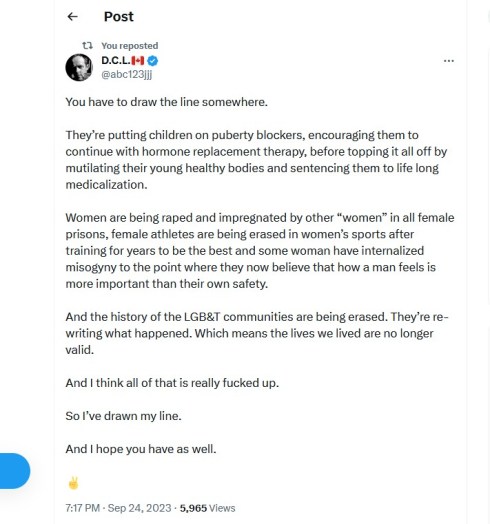
People are waking up and appraising the damage being done by gender ideology. This from D.C.L. on twitter.
Jonathan Kay writes on Canadians finally waking up to the harms of gender ideology and how it is in our institutions. It is a quick necessary read, go to the Quillette and read the whole thing.
“The most obvious answer is that this movement does real, observable harm, by forcing women to share prisons, rape-crisis centres, athletic leagues, locker rooms, and other vulnerable spaces with men. It also encourages children, many of them gay, autistic, or psychologically fragile due to bullying and underlying mental-health challenges, to indulge the gothic horror-movie delusion that they were “born in the wrong body,” and to embark on a lifetime regime of (dangerous and untested) drug treatments and body-disfiguring surgeries.
But there’s another factor at play, too: I don’t want to live in a society that gaslights its own citizens. The oft-repeated slogan that “trans women are women” simply isn’t true. Furthermore, everyone knows it isn’t true—including those who shout it the loudest. Like other slogans of this type, it’s an officially sanctioned lie. And once it becomes a matter of settled precedent that we can all be forced to submit to this kind of lie, many more of them are guaranteed to follow.”
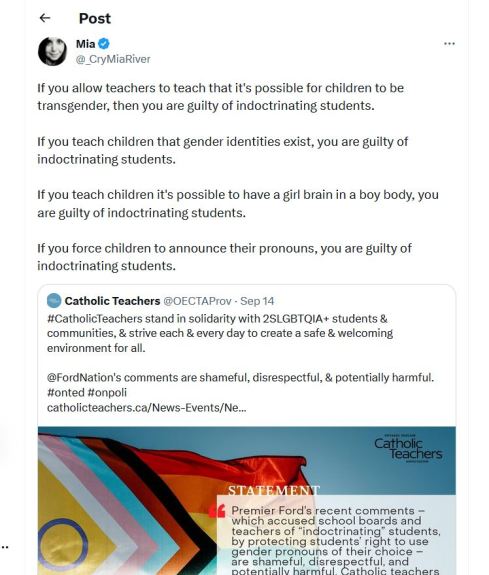
This is such an important step in regaining female rights and boundaries in Canada. I hope the CPC actually does something with this and gives female voters a home within the Canadian polity.
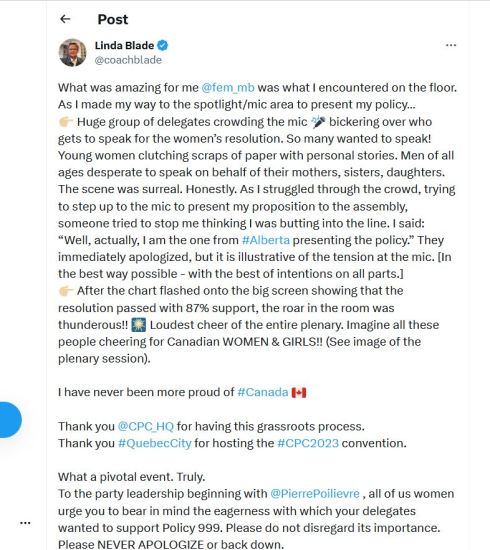
This is from a resource aimed at children and teachers to ‘educate’ them on the finer points of gender-woo. It is here the notion of the unfalsifiable gender-soul is born. This woo, because of Bill C-16 is a category. In the same list as “sex” in our Charter.
See the problem yet? Sex is based on physical observable reality. Gender Identity is nebulous at very best. I’m sure nothing can go wrong with these two aspects sharing the same priority in our Nations Charter or Rights and Freedoms…











 bleatmop
 Mystro


 Dead Wild Roses
Your opinions…