
You are currently browsing the tag archive for the ‘Child development’ tag.
Tag Archive
Protect the Few Without Swamping the Many – Inclusive Education (SOGI 123)
February 26, 2026 in Alberta, Canada, Education, Gender Issues, Media, Public Policy | Tags: Alberta, British Columbia, Canada, Child development, Culture, Education, Gender Ideology, Media Literacy, Parenting, Schools, Social Policy, SOGI 123 | by The Arbourist | 1 comment
Some children are genuinely vulnerable, atypical, or distressed, and they deserve careful support.
That should be easy to say. It should also be the beginning of the conversation, not the end of it.
The problem starts when a narrow duty of care is expanded into a broad teaching mandate. Support for a small number of children becomes a reason to saturate schools, children’s media, and online spaces with contested identity frameworks. What begins as accommodation becomes doctrine. What begins as care becomes a general lens for everyone.
That is the central move.
It is usually framed in soft language: inclusion, visibility, affirmation, making room. Sometimes that language is fair. But it can also hide a scope change. A real minority need is used to justify population-level exposure. The existence of some children who need unusual support does not, by itself, justify turning child-facing institutions into delivery systems for anti-normative identity scripts many children are not developmentally ready to evaluate.
Put simply: support is not the same thing as saturation.
A useful heuristic is the inoculation model. The implicit argument often sounds like this: expose everyone early and often to the framework so harm is prevented later. But that assumes the framework is age-appropriate, conceptually clear, and socially harmless when applied at scale. Those assumptions are usually asserted, not argued.
You can see the pattern in school frameworks like SOGI 123. SOGI 123 describes itself as an initiative to help educators make schools safer and more inclusive for students of all sexual orientations and gender identities, with tools spanning policy, school culture, and teaching resources. In British Columbia, SOGI 123 has been broadly integrated through educator networks and district participation structures. In Alberta, similar SOGI 123 resources and supports exist and are used, but public acceptance and implementation have been more contested and uneven. (Your local framing here is fine; if you want, we can add a specific Alberta anchor in the next pass.)
The point is not that every teacher using these materials has radical intentions. Most likely do not. The point is structural. A framework introduced in the name of protecting a minority of vulnerable students can become a general lens for shaping the environment of all students. That is exactly where support turns into saturation.
None of this requires pretending there are no benefits. Anti-bullying frameworks and school supports can reduce harassment and improve school climate for vulnerable students, and in some cases for other students as well. Recent SOGI 123 evaluation reporting in B.C. has explicitly claimed reductions in some forms of bullying and sexual-orientation discrimination, including effects observed for heterosexual students in studied schools. But that is a different question from whether a framework is well-bounded, developmentally fitted, and appropriate as a general lens for all children. A program can produce some good outcomes and still be overextended in scope.
This is also where ordinary parents often feel morally cornered. They are told the framework is simply about kindness and safety. Then they discover it also carries contested claims about identity, norms, and development. When they raise questions about age, fit, or timing, the objection is treated as hostility rather than prudence.
That rhetorical move matters. It is how debate gets shut down.
Some activist frameworks are not just asking for tolerance or non-harassment. They are more ambitious. They treat ordinary social norms as presumptively suspect—or as things to be actively challenged—rather than mostly inherited and refined. Adults can debate that in adult spaces. The problem is when those frameworks are translated into child guidance and presented as common sense before children are developmentally ready to sort through the concepts.
You do not need a graduate seminar to see the issue. Children imitate. Children seek belonging. Children absorb prestige cues. Children are shaped by what trusted adults celebrate. That is not bigotry. That is basic reality.
This is why developmental fit matters. Children do not process abstract identity questions the way adults do. Identity formation is gradual. Social context matters. Timing matters. Adult authority matters. Age appropriateness is not a slogan; it shifts across developmental stages, and what may be discussable at 16 is not automatically suitable at 6. When institutions present contested frameworks in a celebratory register first and a cautionary register later (or never), adults should worry.
The usual public binary is false. The choice is not between cruelty and total affirmation. It is not between neglect and ideological immersion. A sane society can do both things at once: provide targeted support for the children who truly need it, while refusing to reorganize the symbolic environment of all children around contested anti-normative frameworks.
That is not repression. It is proportion.
And proportion is exactly what gets lost when every concern is moralized and every request for limits is treated as harm.
We should be able to say, plainly, that some children need exceptional care without turning exceptional cases into the template for everyone else. We should be able to protect the vulnerable few without swamping the many. We should be able to teach kindness without requiring ideological inoculation.
If we cannot make those distinctions, then we are not practicing compassion. We are practicing scope creep with moral language.
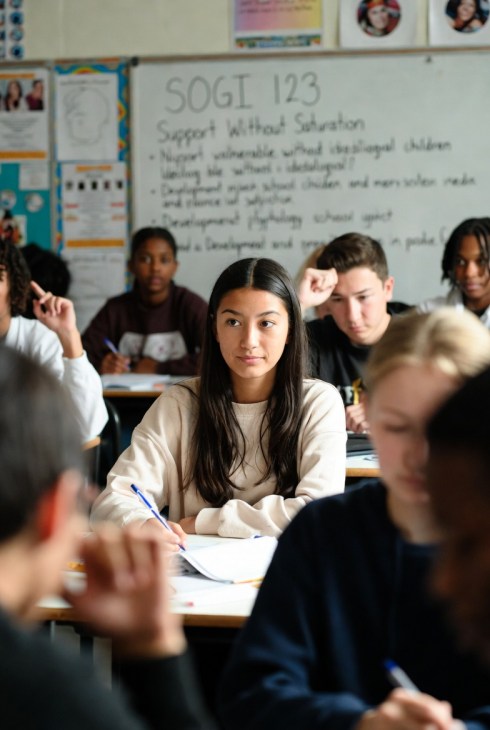
Support for vulnerable students is necessary. But targeted care is not the same as saturating schools with contested identity frameworks for all children.
References
- SOGI 123 / SOGI Education. “SOGI 123 | Making Schools Safer and More Inclusive for All Students.”
https://www.sogieducation.org/ (SOGI 123) - SOGI Education. “What Is SOGI 123?”
https://www.sogieducation.org/question/what-is-sogi-123/
(official explainer page) - SOGI Education. “British Columbia.”
https://www.sogieducation.org/our-work/where-we-support/british-columbia/
(B.C. implementation / network context) - ARC Foundation. “UBC Evaluation of SOGI 123 (October 2024).”
https://www.arcfoundation.ca/ubc-evaluation-sogi-123-october-2024
(evaluation / outcomes framing from SOGI-supportive side) - Alberta Teachers’ Association. “What is SOGI 123?”
https://teachers.ab.ca/news/what-sogi-123 (teachers.ab.ca) - Keenan, H., and Lil Miss Hot Mess. “Drag Pedagogy: The Playful Practice of Queer Imagination in Early Childhood.” Curriculum Inquiry 51, no. 5 (2021): 578–594.
https://doi.org/10.1080/03626784.2020.1864621 - Gender Report (opinion/critical perspective). “We need to take ideological gender rhetoric out of education.” (Jan. 28, 2021).
https://genderreport.ca/sogi-gender-curriculum-queer-theory/ (CANADIAN GENDER REPORT) - Global News. “Duelling protests held in Edmonton over sexual orientation and gender identity policies in schools” (Sept. 20, 2024).
https://globalnews.ca/news/10766483/edmonton-gender-identity-sexual-orientation-alberta-schools/ (Global News)
Share this:
Gender Identity – Profoundly Dangerous Concepts For Children.
December 9, 2025 in Gender Issues, International Affairs, Medicine, Queer Bullshit, Science | Tags: Child development, Pernicious Transgender Ideology, Piaget, Science | by The Arbourist | Leave a comment
“Piaget viewed children as “little scientists” who actively construct knowledge by testing and refining mental schemas, most often through play. Through assimilation (fitting new experiences into existing schemas) and accommodation (adjusting schemas when they do not fit), driven by equilibration (resolving confusion), children progress through four stages: sensorimotor, preoperational, concrete operational, and formal operational.Development is a self-motivated process of making sense of the world. Adults naturally introduce their own schemas to children; most are well-meaning and beneficial. However, it is hard to imagine a more destructive schema for young children than that of ‘gender identity.’ Piaget’s theory explains how and why children adopt this adult shortcut to achieve equilibration.Simply it provides easy answers to difficult questions.What transgender ideology offers these playful child scientists is a highly self-destructive, adult schema (construct) wholly unsuitable for their developing, vulnerable minds. This schema, if pushed by significant adults, can easily be assimilated into a child’s learning patterns, providing ready made answers (equilibration) to questions the child would be years away from naturally asking; along with terrible, self-destructive answers to natural self-doubts. Thus, for a toddler girl: “Why do I prefer to play with boys’ things, etc.?” The inserted adult schema answers, “Because you are really a boy.” Of course the correct answer would be, “Because that is who you are” backed up with, “And you are perfect as you are – so carry on playing”.However transgenderism is not interested in children growing into well balanced adults. It targets vulnerable, especially autistic children, with undeveloped schemas who can be convinced that the way to achieve equilibration is to perform “being transgender”. It needs these (trans) children to provide cover for adult autogynephiles.This brilliant application of Piaget’s theory highlights why imposing adult “gender identity” concepts on children short-circuits their natural cognitive development—and why it’s especially harmful for vulnerable groups like autistic kids.”
Evidence backs this up: A 2023 systematic review and meta-analysis found a clear overlap between autism spectrum disorder (ASD) and gender dysphoria/incongruence, with autistic youth far more likely to experience it, likely due to challenges with flexible schemas and social understanding.”
https://pubmed.ncbi.nlm.nih.gov/35596023/The UK’s independent Cass Review (2024) went further: after rigorous systematic evidence reviews, it concluded the evidence for puberty blockers and hormones in minors is weak, with risks (e.g., bone density loss, fertility impacts) outweighing unproven benefits. It recommends extreme caution and holistic care over rapid affirmation.
Full report: https://cass.independent-review.uk/final-report/We must protect children’s natural exploration through play and affirm their bodies as they are. Imposing ideology that locks in confusion isn’t kindness—it’s harm. Prioritize evidence-based therapy and watchful waiting.

Share this:
On Social Transitioning – Dr. P on X
October 7, 2024 in Psychology | Tags: Child development, Psychology, Social Transitioning, Trans, Transgender ideology | by The Arbourist | 1 comment
[Reformatted for Readability]
As a clinical psychologist I believe that no child should ever be allowed to socially transition, because this action simply concretises the lie that sex is mutable. Furthermore, social transitioning does not address the underlying psycho-social problems that might be leading a child to believe themselves to be of the wrong ‘gender’. Shockingly, this practice is widespread and has rapidly and with no oversight, embedded itself in schools across the West. But what does this mean for those caught up in it?
Here I mainly consider and question some impacts of socially transitioning a child who is attending primary or secondary school. I suggest that it is not a consequence-free, benign opportunity to offer a child time to think about their ‘gender identity’.
The perils principally arise because the nature of the word ‘social’ is being dangerously misunderstood and, perhaps, deliberately misrepresented.
In the Trans Upside Down, ‘social’ is seen as simply meaning ‘non-invasive’ and/or non-medical, involving only a change of name; change of uniform; change of pronouns; ‘packing’ or ‘binding’; use of opposite sex toilets and changing rooms; and involvement in the opposite sex’s sporting and other activities. However this approach only considers the narrow perspective of the child who is supposedly ‘transitioning’. The more important issue and question is how does the socially transitioning child in school affect those around them? I suggest that this practice also has a deeply negative and destabilising effect on the mood, behaviour and interpersonal relationships of everyone in the socially transitioning child’s orbit.
What impact on the child?
As the Cass Review points out, social transitioning has the effect of locking the child into their assumed ‘gender identity’. Puberty is a time of rapid neurobiological change during which executive functioning (ie the ability to plan and to understand the consequences of one’s actions) starts to develop.
At a time when the brain is literally re-wiring itself, when it is like a veritable bowl of porridge, a child’s naïve and youthful experimentation with their identity (in its old-fashioned meaning) should not be taken as an article of faith. Particularly not by those who are charged with the responsibility of teaching children to think clearly!
So, instead of adults firmly saying “no” and placing appropriate boundaries around the child and/or investigating what may be the underlying causes of wanting to ‘transition’, youngsters (encouraged by adults) are being speedily and unquestioningly inducted into the cult of gender, from which it is very difficult to escape.(See here for a wider discussion on the ‘transitioning’ from a neurobiological perspective).https://x.com/Psychgirl211/status/1830280563908894828
Because socially transitioning children is unsupervised and unregulated, we don’t know its intra-psychic and functional impact. We just take the child’s unevidenced word that they have found their “authentic selves” and are thereby happier. However, ideally (if social transition must happen, which it should not), a child’s depression, anxiety, social functioning, and strengths and difficulties should be regularly assessed and monitored for the duration of their ‘transitioning’. This could easily be done by school psychologists and counsellors.
Impact of ‘secret’ transitioning
Even more damaging than openly transitioning a child is the practice of secret transitioning, where the school actively hides the child’s new ‘gender identity’ from parents. In school the child uses a new name and different pronouns and wears the uniform and uses the facilities of the opposite sex. However, in correspondence and in any contact with parents, the child’s birth sex is recognised. I can hardly think of anything more damaging to a child’s psyche, especially given that trans identification is typically the manifestation of underlying dysfunction:
How is the child to manage the constant shifts in male and female, (and God help us), ‘non-binary’ identity, between home and school?
What are the stresses of maintaining such a blatant lie?
How does the child process having to constantly lie to their parents?
Are the child’s friends party to the deception?
Must siblings lie to their parents in order to maintain the relationship with their brothers/sisters, or do they tell their parents what’s happening in school, and thereby damage the sibling relationship?
Secretly transitioned children (and their siblings and friends) are placed in an invidious position, which must be unbearably stressful and emotionally damaging. Nonetheless, this dangerous practice is pervasive and is justified by schools under the mantra of “protecting” the ‘Trans Kid’.
What impact on other children?
Also to be considered is the effect the socially transitioned child has on their peers. Social transitioning is contagious. Learning Theory tells us that the more a behaviour is reinforced and rewarded, the more frequent that behaviour becomes. As the socially transitioning child is treated by schools like a cross between conquering hero and sacred vessel, the actions of one such child inevitably ‘infects’ others, until in some cases, up to a quarter of a year group identifies as ‘trans’ or ‘non-binary’. This is evidently nonsensical, but it is being accepted by schools as reality and is not only permitted but lauded and welcomed.
Thus, apart from the gross impact of imitation, we should be asking:
-Does socially transitioning one child in a class impact the levels of depression or anxiety of the other children?
-Does it interfere with their learning?
-Does it affect behaviour?
-Does it affect the quality of the relationships with their own parents and/or siblings outside of school?
-In what other ways does social transitioning affect the non-transitioning peer(s)?
These are all questions that psychologists and school counsellors should be investigating. But we don’t know the answers because nobody is even asking these or other related questions. There is no research data whatsoever on the impact of social transitioning to the child and the school community. What is now occurring in thousands of schools across the West is the equivalent of putting a new drug on the market without having run any clinical trials, but simply stating that it is safe to use.
Impact on moral development
There is also a wider danger of socially transitioning a child and in forcing their peers to go along with the lie that Susan is now ‘Simon’, when they can clearly see she isn’t. Moral development is the process by which people develop the distinction between right and wrong. There are many theories on how morality develops, but in general they describe a stepwise process wherein children move from being moral absolutists with ‘black and white thinking’, to a point where ‘goodness’ is gradually replaced by a more subtle understanding of ‘truth/justice’. This process lasts from about age five to mid/late twenties when the most mature form of moral understanding and reasoning is achieved. The later form of moral thinking is not however always reached. Psychopaths, for example, never develop this facility.
Into this stepwise process enters the ‘socially transitioning’ child. The child itself is a living lie and, equally damaging, other children are then being forced into the acceptance of this lie by the very people from whom, at this critical stage in their lives, they should be learning and modelling appropriate morality. But now, because of gender ideology and its sequalae of social transitioning, children are being sanctioned for not acquiescing to the obvious and blatant falsehood that someone has changed sex.
Children cannot develop proper moral reasoning if they are compelled to believe untruths, or if they are suspended from school, isolated from their friends, or told to “undertake reflection” (this sounds particularly sinister!) for merely holding their ground.
Schools which socially transition children are carrying out an in-vivo, unsupervised behavioural experiment and nobody has any idea of the broader consequences that may result from this enforced disruption to children’s moral development. The full picture may take years to unfold and we may yet all pay the price for it. (Generally, it is by such means of lax or non-existent moral rules placed by adults that sociopathy develops.)
Things are worse for children with learning disabilities or social-communication disorders such as Autism. Such children see and describe the world as it is. Dissembling is difficult, or even impossible for them. I believe that making an Autistic or learning-disabled child use wrong-sex pronouns, (or otherwise forcing them accede to the lie that a classmate has changed sex), is tantamount to psychological torture.
Impact on safety
As ever, the impact of socially transitioning falls heavier on females than it does on males. Girls have lost the privacy of their school toilets and their changing rooms. They are being sexually assaulted or worse, raped by boys ‘identifying’ as girls. They are developing urinary tract infections because they are scared to use the toilets. They are staying at home during their periods because boys are spying on them and making them feel embarrased. They are losing at sports and being deprived of scholarships because of the actions of boys who identify as girls.
As a result of the invention of ‘Gender Dysphoria’ in 2013, adults who should know better and who should be safeguarding children have instead entered a state of ‘Learned Madness’. They have developed a mindset where enforcing and protecting a child’s supposed ‘gender identity’ now supersedes all considerations of safety, fairness, morality, or common sense.
Teachers have seemingly forgotten they have a duty of care to all students, not just those who think themselves to be ‘trans’. It is truly an incredible and appalling state of affairs. (See here for a wider discussion on ‘Gender Dysphoria’.
https://x.com/Psychgirl211/status/1808825717204922755
Conclusion
Social transitioning is akin to taking an already disturbed and unhappy child to the top of a very tall building, pushing them off, then forcing all their friends and classmates to not only watch, but to help with the clean up. It is an unregulated, uncontrolled and incredibly powerful psycho-social intervention being carried out by gender ideologues and/or unqualified, uncritical or, perhaps pressured, teaching staff.
Nobody, except the ‘transitioning’ child (who is likely themselves suffering from psychological problems) has ‘agreed’ to be part of this social experiment and therefore this practice is also highly unethical. But, sadly as with all gender related madness, my profession of psychology has been deafeningly silent in calling this out.
TL:DR: Socially transitioning is an unethical and dangerous practice that schools should be having nothing to do with and whose long-term consequences are unknown.


Your opinions…


