
You are currently browsing the tag archive for the ‘Economics’ tag.
The ‘Broken Window’ parable has lasted because the mistake it identifies is permanent. People keep confusing motion with wealth.
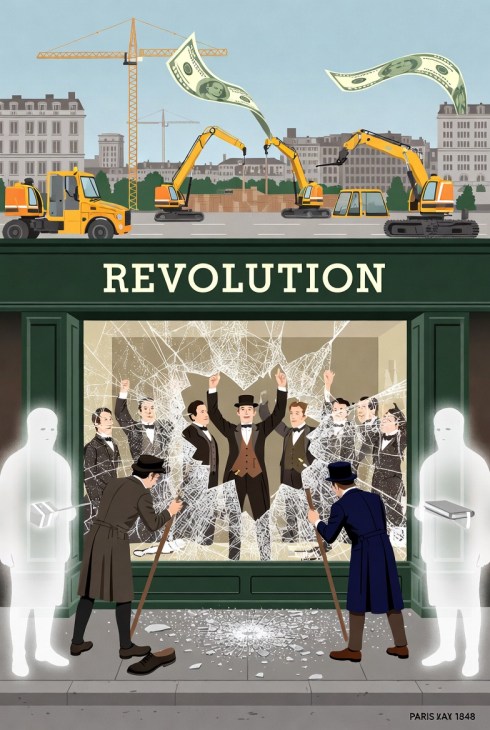
A shop window gets smashed. The glazier benefits. He is paid to replace it. Money changes hands. Work is created. Onlookers reassure themselves that the damage at least “helped somebody.” Bastiat’s point is that this is where bad economic reasoning begins. The shopkeeper must now spend money restoring what he already had instead of buying something new, improving his business, saving, or investing. The glazier gains work. The shopkeeper loses options. Society ends up with a replaced window instead of a replaced window plus whatever else might have been created. That is not growth. It is recovery from loss.
In That Which Is Seen, and That Which Is Not Seen, published in 1850, Bastiat gave this simple error its enduring form. The visible effect is easy to grasp: the glazier gets income, then spends it elsewhere, and activity ripples outward. But the visible beneficiary is only half the story. What disappears from view are the unrealized alternatives: the suit never bought, the tool never purchased, the apprentice never hired, the expansion never attempted. The fallacy survives because the gain is concrete and public while the loss is dispersed and hypothetical. One can be pointed to. The other must be reasoned out.
“People keep confusing motion with wealth. Visible activity is easy to celebrate. The wealth that never came into being is harder to see, and easier to ignore.”
That is why the broken window is not really about vandalism. It is about how easily public argument stops at the first visible effect and calls the matter settled. Once you see that, a great deal of modern economic rhetoric starts to look less like analysis than stagecraft.
The pattern is familiar in debates over stimulus spending. Governments announce major spending packages. The public is shown crews on worksites, contracts being signed, jobs being counted, funds “flowing into the economy.” The imagery is always immediate and flattering. Something is happening. Therefore something good must be happening.
But visible activity is not the same thing as net wealth creation. Government does not create resources from nothing. It taxes them away, borrows them away, or inflates them away. In each case, resources are redirected from other possible uses. The serious question is not whether public spending produces measurable effects. Of course it does. The serious question is whether those resources would have created more value had they remained in private hands, guided by price signals, local knowledge, and voluntary choice rather than political allocation.
That is where the unseen side of the ledger matters. We see the bridge. We do not see the private investment that never happened because capital was drawn elsewhere. We see the subsidized payroll. We do not see the household purchasing power weakened by inflation. We see the grant recipient. We do not see the startup that never secured financing, or the consumer demand that was blunted by higher taxes or debt service. Public spending can make its beneficiaries highly visible while leaving its displaced alternatives diffuse and mostly invisible. That is politically useful, but analytically weak.
The usual reply is that recessions change the equation. When labour is idle, capital is underused, and private demand collapses, government spending may mobilize resources that would otherwise sit dormant. That is the strongest counterargument, and it should be taken seriously. A deep recession is not the same as a fully employed economy. Slack matters. Timing matters. Liquidity panics matter. A blanket denial of all countercyclical policy is cruder than Bastiat’s actual insight deserves.
But this does not rescue the broken window logic from criticism because it does not actually answer it. Even in a downturn, the central question remains comparative: compared to what? If the claim is that temporary public spending can stabilize demand under exceptional conditions, that is at least a serious argument. But it is not the same argument as saying that destruction creates prosperity, or that politically directed spending is wealth in itself. It still matters what is being funded, how efficiently it is administered, what incentives it creates, and whether the spending is genuinely using idle resources or merely displacing better uses that are harder to measure in real time.
“Replacement is not creation. Redirection is not prosperity. A society does not become richer by repairing destruction and calling the bustle growth.”
That distinction matters because bad arguments often smuggle themselves in under good intentions. A narrow case for emergency stabilization can turn into a permanent political habit of treating state spending as inherently productive. Once that shift happens, Bastiat’s warning reasserts itself in full. Replacement is still not creation. Redirection is still not spontaneous enrichment. Measured output can rise while underlying wealth formation weakens.
The same mistake appears after natural disasters and during wartime booms. After a hurricane, people say rebuilding will “boost the economy.” During war, people point to full factories and rising production figures. But rebuilding what was destroyed is not the same as becoming richer. Producing goods for destruction is not the same as expanding civilian prosperity. These events may generate employment, contracts, and output. They do not erase the prior loss. The relevant comparison is not between disaster and inactivity. It is between the world after destruction and the world in which the destruction never occurred.
That is what makes Bastiat’s lesson both obvious and routinely ignored. Visible motion is emotionally persuasive. A ribbon-cutting is easier to celebrate than an opportunity cost. A government announcement is easier to narrate than a private investment that never happened. Political systems are structurally biased toward what can be displayed, counted, branded, and claimed. The unseen has no ceremony attached to it. It leaves no plaque.
So the broken window fallacy endures not because the logic is hard, but because the discipline is hard. It requires people to keep asking the next question after the applause line. Jobs doing what? Spending on what? At whose expense? Relative to which forgone alternative? In a free economy, resources are scarce and choices are real. To pretend otherwise because spending is visible is to confuse accounting entries with prosperity.
Bastiat’s point remains devastating because it cuts through so much noise. Destruction does not enrich. Replacement does not add net wealth. Spending is not identical with prosperity. A society becomes richer when it creates new value, lowers costs, improves production, expands choice, and allows people to direct resources toward ends they actually value. It becomes poorer when it burns wealth, redirects capital by force, and congratulates itself for the bustle that follows.
That was true in Bastiat’s time. It is true now. The forms get larger, the numbers get bigger, and the rhetoric gets smoother, but the underlying mistake does not change. The glazier is still real. So is the window. So is everything we never got because we mistook repair, diversion, and visible activity for growth.
References
Bastiat, Frédéric. “What Is Seen and What Is Not Seen.” Online Library of Liberty.
https://oll.libertyfund.org/pages/wswns
Bastiat, Frédéric. “That Which Is Seen, and That Which Is Not Seen.”
https://bastiat.org/en/twisatwins.html
Bastiat, Frédéric. “Chapter 1: What Is Seen and What Is Not Seen.” Econlib.
Encyclopaedia Britannica. “Frédéric Bastiat.”
https://www.britannica.com/money/Frederic-Bastiat
Cullen, Joseph A., and Roger H. Gordon. “Taxes and Wartime Mobilization in the U.S. Economy: World War II as a Natural Experiment.” NBER Working Paper 12801.
Garin, Andy. “The Wartime Origins of Industry Location and Economic Mobility in the United States.” NBER Working Paper 33418.
An Alternate Theory Worker Exploitation under Capitalism.
Karl Marx argued that capitalists exploit workers by appropriating the surplus value generated by labor, framing profit as the result of systemic theft within the production process. In Marx’s view, capitalists accumulate wealth by paying workers less than the value their labor produces, perpetuating class conflict and portraying profit as inherently unjust. This perspective casts capitalists as parasitic, extracting wealth without contributing equivalent value to the economic system.
Eugen Böhm-Bawerk, a prominent Austrian economist, countered this narrative with his theory of time preference, articulated in works like Capital and Interest (1884). He posited that individuals naturally prefer present goods over future goods, meaning workers value immediate wages over delayed returns. Capitalists, by contrast, provide those wages upfront, investing capital and bearing the uncertainty of future profits. This exchange is not exploitative but a mutually beneficial arrangement where workers receive immediate income, while capitalists assume the risk and delay gratification, hoping their investments yield returns over time.
Böhm-Bawerk’s framework refutes Marx by redefining profit as compensation for time, risk, and strategic planning, rather than exploitation. Capitalists undertake the burden of forgoing present consumption, managing resources, and navigating market uncertainties. Their profit, when realized, reflects the value of their foresight and willingness to wait, not the theft of labor’s output. This perspective shifts the economic narrative from class struggle to a cooperative process where both workers and capitalists fulfill distinct, voluntary roles based on their preferences and economic realities.

Our dear government’s stalwart obsession with fossil fuel is again jeopardizing the economic well-being of the Province of Alberta. Kenny is investing heavily in a project that may evaporate with the stroke of the Presidential pen.
The company said Alberta has agreed to invest approximately $1.1 billion US as equity in the project, which substantially covers planned construction costs through the end of 2020.
The remaining $6.9 billion US is expected to be funded through a combination of a $4.2-billion project-level credit facility to be fully guaranteed by the Alberta government and a $2.7-billion investment by TC Energy.
“TC Energy is essentially saying, ‘We don’t want to take that risk’ … Alberta is essentially saying, ‘OK, we’ll take that risk, we’ll put in $1.5 billion Canadian, and if it ends up that no one pulls the presidential permit, then we’re all going to work on getting the rest built over 2021 and ’22.”‘
We need jobs, we need economic advancement, but most importantly, we need to stop running hail-Mary plays based on the fossil fuel industry with public money. The government of Alberta should represent all of its constituents and refocus on diversifying our economic contribution instead of playing this dreadfully expensive and foolish shell game with Alberta’s future.
Our tarsands oil just isn’t environmentally or economically sound anymore.
“He said what’s also worrisome for the industry is the political signal this sends internationally — especially on the heels of a major Norwegian investment fund blacklisting four Canadian oilsands producers.
“In terms of the bellwether of the political appetite for support for the oilsands south of the border, I think it’s obviously problematic,” Johnston said.”
I sincerely hope that we can elect the NDP as our government again in Alberta, as their dirty oil plan focused much more on economic diversification and benefits for the people of Alberta. The Federal government of Canada is standing lukewarmly with Alberta for the moment, but with a Democratic win down south it looks like the Keystone pipeline will go back into limbo once again.
“Biden strongly opposed the Keystone pipeline in the last administration, stood alongside President Obama and Secretary [of State John] Kerry to reject it in 2015, and will proudly stand in the Roosevelt Room [of the White House] again as president and stop it for good by rescinding the Keystone XL pipeline permit.”
A spokesperson for Canada’s deputy prime minister, Chrystia Freeland, responded by saying the Canadian government supports Keystone XL: “It is a good project that will create jobs for Canadians and it fits within our climate plan.”
Fossil fuels need to pave the way to Alberta’s new economic future, maintaining them and the industries that sway our government, cannot be the way.

Quoted news stores from cbc.ca.
It seems like William Greider was frighteningly correct with the thesis of his book from 1997. This snippet from Counterpunch has raised my curiousity enough to make it point to borrow or buy the book.
“Back in 1997, Greider wrote a book, One World, Ready or Not: The Manic Logic of Global Capitalism, which warned that competition from the developing world would put downward pressure on the wages of manufacturing workers and that large trade deficits could lead to serious shortfalls in aggregate demand, meaning weak growth and high unemployment. The book was widely trashed by economists, including the leading liberals of the day. In particular, they ridiculed the idea that trade deficits could lead to unemployment, after all, the Fed could just lower interest rates to make up any shortfall in demand.
Two decades later, most of the mainstream of the profession accepts the idea of “secular stagnation,” meaning a sustained shortfall in demand that leaves the economy operating well below its potential level of output. With interest rates having bottomed out at zero following the Great Recession, most economists would concede that the Fed does not have the ability to boost the economy back to full employment, or at least not with its traditional tool of lowering the federal funds rate.
While economists generally do not like to talk about the trade deficit as a cause of secular stagnation, fans of logic and arithmetic point out that if we had balanced trade rather than a deficit of 3.0 percent of GDP, it would provide the same boost to the economy as an increase in government spending of 3.0 percent of GDP or roughly $650 billion a year in today’s economy. There is little doubt that would be a huge boost to demand and would have gone far towards ending the problem of secular stagnation. (There is no magic to balanced trade. I only use it as a point of reference.)
There were certainly things that Greider got wrong in One World, Ready or Not, as he did in his other economic writings. He was a journalist not an economist. Still, as one great economist commented, it is better to be approximately right than exactly wrong, a position that described many of his economist critics.”
The book, read now, will probably read like a fairly large “I told you so”, but I think it would be interesting to see what evidence he used to make the assertion.
A thick meaty discussion of the western political economy and the checkered history that has led us to the current financial mess we happen to be in. Great viewing, get some popcorn!
 Sometimes, it seems, my fellow Albertans can be quite the confused lot. Actually no, that is wrong; we are not confused, just bi-polar. In Alberta have this curious duality the runs the course of our electoral politics. We want to be rugged, independent, self-made individuals with no interference from any level of government – private industry and unchecked capitalism is how we roll.
In the boom times…
The other identity like we like to periodically break out (and inflict on the rest of Canada) is the simple, hardworking Albertan who just can’t make ends meet and if the Government only understood our hardship and not alienate us with its ivory tower elitist policies and just HELP us (‘help’ is usually bailing out Big Business at the bottom of the business cycle). We also have to feel persecuted and neglected at this time as the response from the people we’ve just been telling to f*ck off and leave us alone (during the boom years) are not jumping up and saving us as quickly as we’d like.
“Here it’s a very partisan response to a specific government that western conservatives really, really don’t like.” Smith said.”
[…]
“Smith said the movement in Canada targets the federal Liberal party and its actions toward the oil industry.
“No matter what they do in that sector, the Liberals seem to be criticized for not doing enough,” he said.
“It’s a pretty big stretch to suggest that a government that just bought a pipeline and is now passing over a billion dollars in support for oil or the oil sector is somehow anti-oil, but that’s the rhetoric that comes out of the conservative protests in Canada.”
So, we have these rugged small government loving individualists protesting to get more government intervention into the economy, not on their own behalf, but on the behalf of the oil companies. The very same oil comapanies that continue to make generous profits and pay substantial dividends to shareholders:
“Lead author Ian Hussey said Suncor, CNRL, Cenovus, Imperial and Husky have remained “incredibly profitable corporations,” banking and paying out to shareholders $13.5 billion last year.
“There’s no question that the price crash had a major impact on the industry in Alberta, most importantly on the almost 20,000 workers who lost their jobs in 2015, but the Big Five are doing just fine,” Hussey said.
“As highly integrated multinationals — all with significant assets in the U.S. — they’ve been able to shift their operations in response to market conditions to ensure they remain profitable despite the issues that have been dominating the headlines in recent months.”
So, as usual, false populism renews its roots in Western Canada. As our ruggedly bold individualist trek eastward to demand more government intervention favourable to the business elite in our society.
Of course no false populist movement is complete without xenophobia and racism.
“People who attended the rally in Regina on Saturday said they were against Trudeau, the carbon tax and Canada’s plan to endorse the United Nations’ migration pact — which outlines objectives for treating global migrants humanely and efficiently.
Victor Teece, a self-identified nationalist against globalization, said the migration agreement is “destructive to Canada as a nation.” Teece said he believes Canada’s identity is centred around European, Judeo-Christian values.
Smith said there is a concerning, “very loud” and “very disturbing message around anti-immigration” emerging within the Canadian rallies.”
Yeah. If you didn’t know it, Canada has a huge immigration problem. According to these people, not enough of the ‘right’ types of people are moving to Canada. Quite disgusted with the whole rhetorical judeo-christian bullshit narrative. The cultural mosaic that is Canada thrives on the diversity that people bring with them from across the world.
We are a multicultural nation. The embarrassment that is this ‘Convoy Movement’ is a gift that inspires the nativist-nationalist right to creep out from the woodwork. Given the example of the untrammelled false populism down south, this is a direction Canada should definitely avoid.











 bleatmop
 Mystro
 The Arbourist


 Dead Wild Roses
Your opinions…