
You are currently browsing the tag archive for the ‘Economy’ tag.
If a government’s job is to steward the conditions for ordinary people to build, trade, invest, and plan a life, then our federal leadership has been doing that job badly.
Not because Canadians are lazy. Not because the world is easy. But because the governing reflex is wrong: when something breaks, Ottawa reaches for a new program, a new credit, a new rebate, a new subsidy, a new “strategy.” It treats the economy like a patient that can be stabilized indefinitely with IV drips.
That approach can buy headlines. It cannot buy prosperity.
The best indicator is per-person performance. We can argue about which yardstick matters most, but the story is consistent: Canadians are producing less per person than we should be, relative to peers and especially relative to the United States. When per-capita output stagnates, everything gets harder at once: housing feels unaffordable, healthcare feels strained, wages feel thin, and every problem becomes a fight over slices instead of a discussion about baking more bread.
The policy style matters because it shapes incentives. When governments patch symptoms with cash transfers while leaving the cost structure and the approval structure untouched, they teach the country the wrong lesson: don’t fix the machine; keep bribing the machine not to squeal.
The mechanism: why “more programs” keeps failing
Here’s the basic mechanism, stripped of moral drama:
- High costs and slow approvals choke supply.
Housing, energy, infrastructure, major projects, even small-business expansions: Canada is a country that says “no” and “later” far more often than it says “yes” and “go.” Every delay is a tax. Every duplicated review is a tax. Every veto point is a tax. - Government then tries to “help” people pay the tax it created.
Rebates, credits, subsidies, targeted relief. It’s a strange kind of compassion that insists on first inflating the cost of living and then offering a coupon to survive it. - Those programs don’t increase productivity.
They redistribute purchasing power. Sometimes that’s justified in emergencies. But as a governing model it becomes a treadmill: you need ever-larger transfers to offset the same underlying frictions. - Meanwhile investment goes elsewhere.
Capital avoids uncertainty, delays, and politicized approvals. If the return on effort is higher across the border, it doesn’t matter how many committees we convene about “competitiveness.” The money leaves. So do the high-productivity jobs.
That’s the loop.
Steelman: “But the government is trying to protect people”
Yes. There are real hardships and real shocks: pandemic aftershocks, energy volatility, inflation waves. A modern state can’t pretend none of that exists.
But a serious government distinguishes relief from policy habit.
Relief is temporary and humble. It treats symptoms while it removes the causes.
Policy habit is permanent and proud. It treats symptoms and declares victory.
Canada’s problem is not that government ever helps. It’s that government too often helps in a way that replaces fixing the constraints. Then it wonders why the constraints keep biting.
The verdict
If your economic model is “make life expensive, then subsidize the expense,” you don’t get abundance. You get dependency, resentment, and a widening gap with jurisdictions that still know how to build.
You also get a politics where every election becomes a bidding war over who will mail the bigger cheque, because structural reform has been quietly taken off the table.
That’s not leadership. It’s managed decline with better graphics.
Three solutions that trust Canadians
These aren’t “one weird trick” fixes. They’re principles that put choice back in the hands of households and entrepreneurs rather than bureaucracies.
1) Let people keep more of what they earn, especially on essentials
If Ottawa wants to help with affordability, it should stop pretending price pressures are solved by “targeted” programs. The cleanest help is broad, simple tax relief that lets people choose.
- Cut taxes that hit basics hardest (and stop layering cost-pushers into the production chain).
- Prefer lower rates and fewer carve-outs over boutique credits that require a rulebook and a caseworker to access.
- If a policy goal requires a price signal, keep it simple and transparent, not buried across permits, compliance, and pass-through.
This trusts Canadians because it doesn’t tell them what to buy. It stops taking their money and then re-selling it back to them with a government logo.
2) Slash approval times and regulatory duplication so builders can build
Canada does not have a “housing feelings” problem. It has a permission structure problem.
- Set hard timelines for approvals and treat missed deadlines as automatic escalation or approval, not “we’ll get back to you.”
- Collapse overlapping reviews and require agencies to coordinate rather than serially veto.
- Align incentives so provinces and municipalities that approve homes and infrastructure fast aren’t punished for growth.
This trusts Canadians because it assumes the default answer to a lawful project is “yes,” and it lets builders, trades, and communities respond to demand without waiting years for permission.
3) Open the country internally: real competition, real mobility, real choice
A country shouldn’t feel like 10 small markets with paperwork toll booths between them.
- Remove internal trade barriers so goods, services, and workers can move freely across provinces.
- Make credential recognition faster for skilled trades and professionals so talent isn’t trapped behind provincial gatekeeping.
- Reduce the habit of picking “future sectors” by subsidy and instead create conditions where any sector can win if it serves customers.
This trusts Canadians because it relies on competition and mobility, not bureaucratic selection. It lets consumers choose, lets workers move, and lets businesses scale without needing a lobbyist.
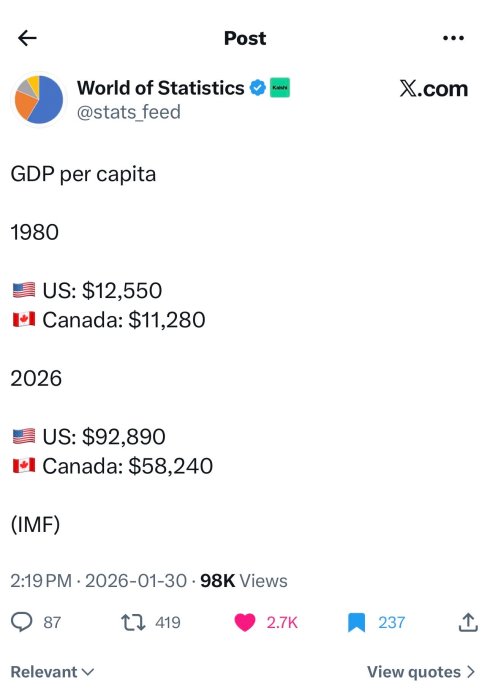
If Ottawa keeps governing by bandage, the next few years will look like the last: higher spending, louder announcements, thinner per-person results, and a country that feels like it’s working harder for less. The gap won’t close by intention. It will close only when we stop confusing “more government activity” with “more national competence.”
Canada is in the middle of a familiar temptation: the Americans are difficult, therefore the Chinese offer must be sane.
The immediate backdrop is concrete. On January 16, 2026, Canada announced a reset in economic ties with China that includes lowering barriers for a set number of Chinese EVs, while China reduces tariffs on key Canadian exports like canola. (Reuters) Washington responded with open irritation, warning Canada it may regret the move and stressing Chinese EVs will face U.S. barriers. (Reuters)
If you want a simple, pasteable bromide for people losing their minds online, it’s this: the U.S. and China both do bad things, but they do bad things in different ways, at different scales, with different “escape hatches.” One is a democracy with adversarial institutions that sometimes work. The other is a one-party state that treats accountability as a threat.
To make that visible, here are five egregious “hits” from each—then the contrast that actually matters.
Five things the United States does that Canadians have reason to resent
1) Protectionist trade punishment against allies
Steel/aluminum tariffs and recurring lumber duties are the classic pattern: national-interest rhetoric, domestic political payoff, allied collateral damage. Canada has repeatedly challenged U.S. measures on steel/aluminum and softwood lumber. (Global Affairs Canada)
Takeaway: the U.S. will squeeze Canada when it’s convenient—sometimes loudly, sometimes as a bureaucratic grind.
2) Energy and infrastructure whiplash
Keystone XL is the poster child of U.S. policy reversals that impose real costs north of the border and then move on. The project’s termination is documented by the company and Canadian/Alberta sources. (TC Energy)
Takeaway: the U.S. can treat Canadian capital as disposable when U.S. domestic politics flips.
3) Extraterritorial reach into Canadians’ private financial lives
FATCA and related information-sharing arrangements are widely experienced as a sovereignty irritant (and have been litigated in Canada). The Supreme Court of Canada ultimately declined to hear a constitutional challenge in 2023. (STEP)
Takeaway: the U.S. often assumes its laws get to follow people across borders.
4) A surveillance state that had to be restrained after the fact
Bulk telephone metadata collection under Patriot Act authorities became politically toxic and was later reformed/ended under the USA Freedom Act’s structure. (Default)
Takeaway: democracies can drift into overreach; the difference is that overreach can become a scandal, a law change, and a court fight.
5) The post-9/11 stain: indefinite detention and coercive interrogation
Guantánamo’s long-running controversy and the Senate Intelligence Committee’s reporting on the CIA program remain enduring examples of U.S. moral failure. (Senate Select Committee on Intelligence)
Takeaway: the U.S. is capable of serious rights abuses—then also capable of documenting them publicly, litigating them, and partially reversing course.
Five things the People’s Republic of China does that are categorically different
1) Mass rights violations against Uyghurs and other Muslim minorities in Xinjiang
The UN human rights office assessed serious human rights concerns in Xinjiang and noted that the scale of certain detention practices may constitute international crimes, including crimes against humanity. Canada has publicly echoed those concerns in multilateral statements. (OHCHR)
Takeaway: this is not “policy disagreement.” It’s a regime-scale human rights problem.
2) Hong Kong: the model of “one country, one party”
The ongoing use of the national security framework to prosecute prominent pro-democracy figures is a live, observable indicator of how Beijing treats dissent when it has full jurisdiction. (Reuters)
Takeaway: when Beijing says “stability,” it means obedience.
3) Foreign interference and transnational pressure tactics
Canadian public safety materials and parliamentary reporting describe investigations into transnational repression activity and concerns around “overseas police stations” and foreign influence. (Public Safety Canada)
Takeaway: the Chinese state’s threat model can extend into diaspora communities abroad.
4) Systematic acquisition—licit and illicit—of sensitive technology and IP
The U.S. intelligence community’s public threat assessment explicitly describes China’s efforts to accelerate S&T progress through licit and illicit means, including IP acquisition/theft and cyber operations. (Director of National Intelligence)
Takeaway: your “market partner” may also be running an extraction strategy against your innovation base.
5) Environmental and maritime predation at scale
China remains a dominant player in coal buildout even while expanding renewables, a dual-track strategy with global climate implications. (Financial Times)
On the oceans, multiple research and advocacy reports emphasize the size and global footprint of China’s distant-water fishing and associated IUU concerns. (Brookings)
Takeaway: when the state backs extraction, the externalities get exported.
Compare and contrast: the difference is accountability
If you read those lists and conclude “both sides are bad,” you’ve missed the key variable.
The U.S. does bad things in a system with adversarial leak paths:
investigative journalism, courts, opposition parties, congressional reports, and leadership turnover. That doesn’t prevent abuses. It does make abuses contestable—and sometimes reversible. (Senate Select Committee on Intelligence)
China does bad things in a system designed to prevent contestation:
one-party rule, censorship, legal instruments aimed at “subversion,” and a governance style that treats independent scrutiny as hostile action. The problem isn’t “China is foreign.” The problem is that the regime’s incentives run against transparency by design. (Reuters)
So when someone says, “Maybe we should pivot away from the Americans,” the adult response is:
- Yes, diversify.
- No, don’t pretend dependency on an authoritarian state is merely a swap of suppliers.
A quick media-literacy rule for your feed
If a post uses a checklist like “America did X, therefore China is fine,” it’s usually laundering a conclusion.
A better frame is risk profile:
- In a democracy, policy risk is high but visible—and the country can change its mind in public.
- In a one-party state, policy risk is lower until it isn’t—and then you discover the rules were never meant to protect you.
Canada can do business with anyone. But it should not confuse trade with trust, or frustration with Washington with safety in Beijing.
If Canada wants autonomy, the answer isn’t romanticizing China. It’s building a broader portfolio across countries where the rule of law is not a slogan in a press release.
References
- Canada–China trade reset (EV tariffs/canola): Reuters; Guardian. (Reuters)
- U.S. criticism of Canada opening to Chinese EVs: Reuters. (Reuters)
- U.S. tariffs/lumber disputes: Global Affairs Canada; Reuters. (Global Affairs Canada)
- Keystone XL termination: TC Energy; Government of Alberta. (TC Energy)
- FATCA Canadian challenge result: STEP (re Supreme Court dismissal). (STEP)
- USA Freedom Act / end of bulk metadata: Lawfare; Just Security. (Default)
- CIA detention/interrogation report: U.S. Senate Intelligence Committee report PDF. (Senate Select Committee on Intelligence)
- Guantánamo context: Reuters; Amnesty. (Reuters)
- Xinjiang assessment: OHCHR report + Canada multilateral statement. (OHCHR)
- Hong Kong NSL crackdown example: Reuters (Jimmy Lai). (Reuters)
- Transnational repression / overseas police station concerns: Public Safety Canada; House of Commons report PDF. (Public Safety Canada)
- China tech acquisition / IP theft framing: ODNI Annual Threat Assessment PDF. (Director of National Intelligence)
- Coal buildout: Financial Times; Reuters analysis. (Financial Times)
- Distant-water fishing footprint / IUU concerns: Brookings; EJF; Oceana. (Brookings)
Poland’s ascent to a $1 trillion economy in September 2025 marks a remarkable transformation. Emerging from the wreckage of Soviet control, Poland has become one of Europe’s fastest-growing economies over the past three decades. With GDP growth projected at 3.2 percent for 2025, unemployment near 3 percent (harmonized), and inflation moderating to 2.8 percent in August, it demonstrates resilience and steady progress.
Canada, with a nominal GDP of roughly $2.39 trillion, is richer in absolute terms but faces weaker dynamics: growth forecasts of just 1.2 percent, unemployment climbing to 7.1 percent in August, and persistent concerns over productivity and rising public debt. The contrast raises an important question: which elements of Poland’s success can Canada responsibly adapt to its own very different circumstances?
1. Manufacturing Capacity and Industrial Resilience
Poland’s economy has benefited from retaining a strong industrial base, especially in automotive, machinery, and technology supply chains closely integrated with Germany. This foundation has provided steady export growth and employment, while limiting excessive reliance on fragile overseas supply chains.
Canada, by contrast, has seen its manufacturing share of GDP shrink over decades as industries relocated or hollowed out. While Canada cannot replicate Poland’s role as a mid-cost hub inside the EU, it could adapt the principle: incentivize the repatriation or expansion of high-value sectors (e.g., EV manufacturing, critical minerals processing, aerospace). Strategic tax credits, infrastructure investment, and streamlined permitting could restore resilience and provide middle-class employment.
Lesson for Canada: industrial renewal need not mean autarky, but building domestic capacity in key sectors reduces vulnerability to shocks — as Poland’s stability during recent European crises shows.
2. Immigration Policy and Integration Capacity
Poland has pursued a relatively selective immigration system, prioritizing labor market fit and manageable inflows. While Poland remains relatively homogeneous (Eurostat estimates about 98% ethnic Polish in 2022), its policy has focused on ensuring newcomers integrate into economic and cultural life. The result has been high employment among migrants and limited social disruption compared with some Western European peers.
Canada, by contrast, accepts large inflows — even after scaling back targets to 395,000 permanent residents in 2025 — and faces housing pressures and uneven integration outcomes. Canada’s homicide rate (2.27 per 100,000 in 2022) is higher than Poland’s (0.68), though crime is shaped by many factors beyond immigration. Still, rapid population growth without infrastructure, housing, and language capacity has heightened social strains.
Lesson for Canada: immigration policy should balance humanitarian goals with absorptive capacity. Emphasizing labor alignment, regional settlement, and language proficiency — as Poland has done — would help ensure inflows strengthen productivity while minimizing stress on housing and services.
3. Cultural Continuity and Heritage as Assets
Poland has paired modernization with deliberate protection of its cultural identity. The restoration of Kraków and Warsaw not only preserves heritage but fuels a thriving tourism sector. National traditions, rooted in Catholicism for many Poles, have also informed family policy (e.g., child benefits) and provided a sense of cohesion during rapid economic change.
Canada’s pluralism differs fundamentally, and it cannot — and should not — mimic Poland’s religious or cultural model. Yet Canada can still learn from the broader principle: treating heritage and shared narratives as economic and social assets rather than obstacles. Investments in Indigenous landmarks, Francophone culture, and historic architecture could enrich tourism, foster pride, and strengthen cohesion. Likewise, family-supportive policies (parental leave, child benefits, flexible work arrangements) are essential as Canada faces declining fertility and an aging workforce.
Lesson for Canada: cultural preservation and demographic support are not nostalgic luxuries — they can reinforce economic stability and social cohesion.
4. Fiscal Prudence and Monetary Autonomy
Poland’s choice to retain the zloty rather than adopt the euro preserved monetary flexibility. Combined with relatively conservative fiscal policies (public debt at about 49% of GDP in 2024, well below EU ceilings), this has allowed Poland to respond to crises with agility while maintaining competitiveness.
Canada already benefits from its own currency, but fiscal expansion has pushed federal debt above 65% of GDP. While Canada’s wealth affords greater borrowing room, long-term sustainability requires discipline. Poland’s experience suggests that debt caps, counter-cyclical saving, and careful monetary coordination can preserve resilience without stifling growth.
Lesson for Canada: fiscal credibility is itself an economic asset. Setting clearer debt-to-GDP targets and enforcing discipline would strengthen Canada’s ability to weather global volatility.
Conclusion
Poland’s trajectory is not without challenges. It faces demographic decline, reliance on EU subsidies, and governance controversies that Canada would not wish to replicate. But its achievements underscore a vital truth: prosperity need not mean sacrificing resilience, identity, or cohesion.
For Canada, the actionable lessons are clear:
-
rebuild key industries,
-
align immigration with integration capacity,
-
invest in heritage and families,
-
and re-anchor fiscal policy in prudence.
Adapted to Canadian realities, these reforms could help lift growth closer to 3 percent, reduce unemployment, and restore a sense of national momentum.

References
-
International Monetary Fund (IMF). World Economic Outlook Database, October 2025.
-
Statistics Canada. Labour Force Survey, August 2025.
-
Eurostat. Population Structure and Migration Statistics, 2022–2025.
-
OECD. Economic Outlook: Poland and Canada, 2025.
-
World Bank. World Development Indicators, 2024–2025.
-
UN Office on Drugs and Crime (UNODC). Global Homicide Statistics, 2022.
-
National Bank of Poland. Annual Report, 2024.
-
Government of Canada. Immigration Levels Plan 2025–2027.
Inflation is the steady climb in prices for goods and services, shrinking what your money can buy over time. It arises when too much money chases too few goods, a dynamic fueled by policy missteps and economic shocks. This essay examines inflation’s primary drivers, emphasizing government spending and money printing, with a focus on Canadian examples, including recent actions, grounded in hard evidence. The stakes are high: inflation corrodes savings, disrupts planning, and frays societal unity, demanding a clear-eyed look at its causes.
Government spending, especially when deficit-financed, is a key inflationary culprit. Large-scale fiscal interventions—like Canada’s $500 billion in COVID-19 relief programs in 2020–2021, including the Canada Emergency Response Benefit (CERB)—flooded the economy with cash, spiking demand. This surge, coupled with supply constraints, drove Canada’s inflation to 8.1% in June 2022, a 40-year high. A 2022 Scotiabank analysis estimated these programs added 0.45 percentage points to core inflation by widening the output gap. Historically, Canada’s 1970s deficit spending, which fueled double-digit inflation, mirrors this pattern. Recent policies, such as 2025 provincial and federal inflation-relief transfers, risk further stoking demand, with Scotiabank projecting they could necessitate a 38% share of the Bank of Canada’s rate hikes to counteract their inflationary impulse.
Money printing, through central bank policies like quantitative easing, devalues currency by expanding the money supply. In Canada, the Bank of Canada’s purchase of $400 billion in government bonds during 2020–2021 lowered interest rates to 0.25%, encouraging spending but devaluing the Canadian dollar. This imported inflation, as a weaker dollar raised import costs, contributing over 50% to inflation in final domestic demand by late 2022. Zimbabwe’s hyperinflation in the 2000s, peaking at 79.6 billion percent monthly, offers an extreme parallel, driven by unchecked money creation. In 2024, the Bank of Canada’s continued quantitative tightening, alongside a 2025 policy rate hold at 4.5%, reflects efforts to curb these pressures, though global factors like U.S. inflation still amplify Canada’s import-driven price hikes.
Supply shocks and wage-price spirals further aggravate inflation. Canada’s 2022 supply chain disruptions, exacerbated by global port delays and China’s COVID-zero policy, spiked food and energy prices—food alone contributed 1.02 percentage points to inflation. The 1973 OPEC embargo, which quadrupled oil prices, offers a historical parallel, as does Canada’s 2022 experience with Russia’s invasion of Ukraine, which drove gasoline prices to $2 per liter. Wage-price spirals, fueled by 4.5% wage growth in advanced economies in 2021, also played a role, with Canada’s labor shortages post-reopening pushing service prices up 5% by mid-2022. Current U.S. tariffs on Canadian goods, as of January 2025, threaten to raise import costs further, with uncertain pass-through to consumers, potentially sustaining inflationary pressure.
Inflation’s corrosive grip—evident in Canada’s 2022 peak and lingering 2.6% rate in February 2025—demands accountability. Government spending and money printing, as seen in Canada’s pandemic policies and bond purchases, are potent drivers, amplified by supply shocks and wage dynamics. Historical and recent evidence, from 1970s deficits to 2025 tariff risks, underscores the need for disciplined fiscal and monetary policy. Citizens must demand restraint to protect purchasing power and preserve economic stability before inflation’s tide engulfs us all.

Bibliography
- Congressional Budget Office. (1980). The Economic Effects of Federal Deficits. https://www.cbo.gov/publication/21925
- Energy Information Administration. (1974). Historical Overview of the 1973 Oil Crisis. https://www.eia.gov/history/
- European Central Bank. (2019). Asset Purchase Programmes. https://www.ecb.europa.eu/mopo/implement/omt/html/index.en.html
- Federal Reserve Bank of San Francisco. (2021). Fiscal Policy and Excess Inflation During the Pandemic. https://www.frbsf.org/economic-research/publications/economic-letter/2021/may/fiscal-policy-and-excess-inflation-during-pandemic/
- International Monetary Fund. (2009). Zimbabwe: Hyperinflation. https://www.imf.org/en/Publications/WP/Issues/2016/12/31/Zimbabwe-Hyperinflation-22603
- OECD. (2022). Employment Outlook 2022. https://www.oecd.org/economy/employment-outlook/
- Scotiabank. (2022). Canadian Inflation: Mostly Temporary and Foreign, But Pandemic Programs Have a Major Impact on Policy Rates. https://www.scotiabank.com
- Statistics Canada. (2024). High Inflation in 2022 in Canada: Demand–Pull or Supply–Push?. https://www150.statcan.gc.ca
- The Globe and Mail. (2022). The Most Important Source of Canada’s Inflation: The Government Borrowed More Than $700-Billion. https://www.theglobeandmail.com

 Is a sub gig worth the health of your family?
That main question that has been going through my head as of late, since school has started. I’ve been very lucky to be able to attend schools I know that also happen to have very stringent health protocols. But I won’t go somewhere new, where I don’t know the people or the lay of the land. Even with the familiarity and risk reduction, the chance to be infected isn’t zero.
The other side of the coin is, of course, I’m a big fan of eating and keeping up on the bills that, through some dark magic, continue to arrive and require my fiscal involvement even when deep into a world pandemic.
Being Canadian, I had access to the CERB, which while available provided income to keep the home-fires going and remain safely at home with minimal exposure. I haven’t been more proud of a Canadian Federal government for taking such bold steps to keep its population safe.
Yet, as the second wave comes, the fiscal reality of the government’s finances may dictate that there will be no relief available. It is very possible that the schools, and thus my employment, may become unavailable for an undetermined length of time.
So then given the uncertainty of future work should I take more risks and work now because no work may be the only option open in the future – but if I catch the virus now I may be out for months recuperating with added negative of possibly killing my vulnerable family members.
This sort of risk drenched future is hell on risk averse individuals such as myself.
I’ll do my best and hope that it is enough for whatever scenario we happen to fall into.
*sigh*
The Pandemic is debunking cherished capitalism mythos one weary chestnut at time.











 bleatmop
 Mystro


 Dead Wild Roses
Your opinions…