
You are currently browsing the tag archive for the ‘ethics’ tag.
Distribute freely my pretties! Spread the word. :)
It amazes me how sometimes, when I criticize something in religion, the defence that theists supply are just as bad or worse than my original criticism. For instance, I have often said that the sermon on the mount promotes the idea of thought crime. Thinking hateful things is the same as murder and thinking sexy things is the same as adultery. If anything could show Christian dogma to be one of totalitarian fascism rather than of love, its the idea that you can be guilty just by thinking something.
When I point this out, I often get told that the message that I OUGHT to be getting from that passage is that, in the eyes of god, a sin is a sin. Sins are all equal under god’s divine judgment.
The first time I heard this, I did a double take. Even someone who’s had their intelligence ebbed by the retarding forces of religion should be able to see the horrible consequences of that little gem. Alas, once again, my optimism and charity were quickly deflated. That person was serious. So were the great number of believers who have told me the same thing since.
So, for them, and any who happen to think along the same lines, I would like to explain why it is so horrible. By saying a sin is a sin is a sin, and they are all morally equivalent in the eyes of god, the theist is equating the suffering a shop owner feels when someone steals a piece of gum from his store to the suffering felt by a rape victim. Indeed, if two people each steal a piece of gum, the shop owner has suffered from twice as many sins against him than the rape victim, so the shopkeeper has, by Christian math, been wronged more.
While I could go on at length why this is horrendous in the worst kind of way, I think if you can’t figure it for yourself, you are beyond any help that my postings can ever hope to give. But, to my amazement, the believers aren’t stumped by this. They say ‘oh, of course, to us humans one is much worse than the other, but I’m talking about in GOD’S eyes, not ours’.
They don’t seem to realize that their answer still doesn’t make anything better. They say that their god is perfectly good and just. If that is so, any difference between humans perception and that of their god would mean a deficiency on our part. That means, according to this abhorrent little bit Christian philosophy, rape victims are WRONG when they feel worse than the robbed shopkeeper. And our justice system is WRONG to treat the rapist more severely than it treats the gum thief. For if they were a bit more like Jesus, they would see that a sin is a sin and the right thing to do is to treat them equally.

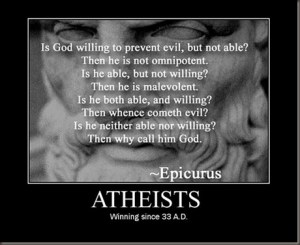
If it’s morally reprehensible that a human take a certain view (like candy burglary is as bad as rape) then it would be just as revolting if a sky faerie took that view. So, not only does this sermon on the mount establish the ground rules for thought crime, it also, thanks to the defence posited by Christians, shows their god to be a despicable and morally bankrupt entity that belittles the suffering those who have endured the worst of crimes.
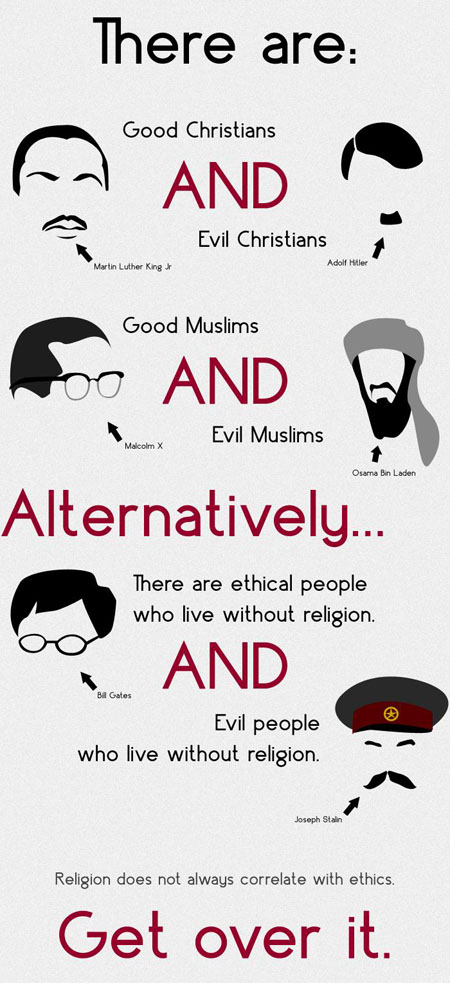
 I am continually astounded by Christian claims to moral supremacy, that they somehow have access to a pinnacle of ethics that non-believers just don’t share.
When I point out that non-believers do a great deal of good in the world, I find myself mostly ignored by theists. Apparently atheist acts of love and charity don’t count. So I tried another angle. If the good-deed doing Christians were to suddenly give up their faith, would they cease their acts of good will? Not a chance. If they actually cared about their fellow humans (which, in most cases, I believe they do) then the belief in some external sky faerie would have no bearing on their desire to help out their brothers and sisters. Again, my point is most frequently met with avoidance. And so, as I cannot get anywhere by promoting the morality of the faithless, I will now try lighting the candle of enlightenment from the other end. In this post I intend to debunk the validity of Christianity’s cornerstone of ‘ethics’: the ten commandments.
When defending the morality of their faith, Christians claim that all a society needs is wholesome and is found in the commandments. Further (as discussed above) the Bible is the only place to find these teachings. The most often cited are commandments five through nine, so I will start with those. Honour your parents, don’t murder, don’t commit adultery, don’t steal, and don’t lie. Christians will go on and on about how good these rules are and to how bad things get when they are not obeyed. Surely, they must be divinely ordained and we ought to worship the supernatural being that delivered these rules to us. You catch that? Attribute an obvious truth to your deity and suddenly its THE god. That just doesn’t work.
Let me explain.
Don’t murder and don’t steal are not revelations in morality. Indeed, these have been laws for every human society for as long as there have been laws (and in case you’re not sure, the existence of laws does in fact predate Christianity). Further, these same laws have been observed in societies within the animal kingdom. Same with honouring parents. It’s an evolutionary strength found in a multitude of species. The young simply have a better chance at survival if they are close to their parents. What about that adultery one? Animals don’t get married, so that commandment is homo-sapien specific. Right? Oh wait. Marriage is just an extension of the ‘mate for life’ behaviour which IS displayed by a number of animal species (most at higher rates than us) including pigeons and termites. That’s right. Commandment number seven has been mastered by termites. Not really your typical image of absolute moral authority, is it? Not lying is a similar case. No society has every promoted duplicity between its members. These rules just aren’t that difficult for people to come up with on their own, and they certainly do not require some god to teach them.
So far the commandments are irrelevant to societal morality, as any society is perfectly capable of deriving these rules themselves. I will call this irrelevance “best case scenario”. To see how the commandments can fall short of this, we must look to the ones not yet mentioned. The first three are basically the same while the fourth is an extension of those three.











 bleatmop
 Mystro


 Dead Wild Roses
Your opinions…