
You are currently browsing the tag archive for the ‘Feminism’ tag.
Discussing our society is difficult at the best of times. Getting a handle on some of the basics can never hurt as we struggle to make our civilization more progressive and humane. Toward that end a look at some of the salient features of how we have organized our society is in order. I’m borrowing from FinallyaFeminism101, a blog that helps set the stage and create the tools for discussions on how society has been structured.
**update** – A big thanks to Rob F from the Words on What for bring to my attention to a specific listing of male privilege on the blog, Alas a blog.
The first installment is about privilege or white male privilege (WMP) and how it affects all aspects of our society.
Privilege is: About how society accommodates you. It’s about advantages you have that you think are normal. It’s about you being normal, and others being the deviation from normal. It’s about fate dealing from the bottom of the deck on your behalf.
[Betty, A primer on privilege.]
Since social status is conferred in many different ways — everything from race to geography to class — all people are both privileged and non-privileged in certain aspects of their life. Furthermore, since dynamics of social status are highly dependent on situation, a person can benefit from privilege in one situation while not benefiting from it in another. It is also possible to have a situation in which a person simultaneously is the beneficiary of privilege while also being the recipient of discrimination in an area which they do not benefit from privilege.
Male privilege is a set of privileges that are given to men as a class due to their institutional power in relation to women as a class. While every man experiences privilege differently due to his own individual position in the social hierarchy, every man, by virtue of being read as male by society, benefits from male privilege.
When first dealing with the concept it might be easier to approach it from a systematic, rather than personal, approach. Consider what Lucy says here:
[T]rue gender equality is actually perceived as inequality. A group that is made up of 50% women is perceived as being mostly women. A situation that is perfectly equal between men and women is perceived as being biased in favor of women.
And if you don’t believe me, you’ve never been a married woman who kept her family name. I have had students hold that up as proof of my “sexism.” My own brother told me that he could never marry a woman who kept her name because “everyone would know who ruled that relationship.” Perfect equality – my husband keeps his name and I keep mine – is held as a statement of superiority on my part.
In this case the inequality is perceived, in part, because taking one’s husband’s name is considered “normal” for a woman, whereas choosing to keep one’s own name deviates from that. Popular culture often labels this behavior as “emasculating” to a man, but never bothers to question how a woman might feel being asked to give up something that has been part of her since her birth. This is an example of a culture of male privilege — where a man’s position and feelings are placed above that of the woman’s in a way that is seen as normal, natural, and traditional.
Going back to Lucy’s article, this is what she said in the paragraph directly preceding the one quoted above:
Male privilege may be more obvious in other cultures, but in so-called Western culture it’s still ubiquitous. In fact, it’s so ubiquitous that it’s invisible. It is so pervasive as to be normalized, and so normalized as to be visible only in its absence. The vast, vast, vast majority of institutions, spaces, and subcultures privilege male interests, but because male is the default in this culture, such interests are very often considered ungendered. As a result, we only really notice when something privileges female interests.
Most people do not think twice about a woman who shares the same name as her husband; they simply assume that the shared name is his family name. This is an illustration about how male privilege operates in stealth. When a wife does not share the same name as the husband, however, it often leads to confusion and even anger — as Lucy’s example illustrated. This is because the male-oriented option (wife taking husband’s name) is seen as default, and the neutral option (both parties keeping their original names) is a deviation from that norm and therefore comes across as privileging the woman because it doesn’t privilege the man.
It is important to keep in mind that the above example is not an outside incident; male privilege is an institutional problem that has a long history associated with it. In addition to her anecdote above, Lucy discusses how male privilege interacts with fandom; in “Occasionally Conversations with my Man Are Instructive” Ilyka talks about the impact of it in terms of male commenters on feminist blogs; and in her “Privilege in Action” series tekanji takes instances of privilege that she’s witnessed in various aspects of her life (both online and off) and deconstructs them, looking specifically at why they are problematic. All of which points to one thing: it’s not about one person saying or doing one thing, it’s about a whole lot of people saying and doing things that, collectively, end up giving men an overall advantage.
Sociological Images also comes through with some data about women and the workforce and the precentage of money they make in relation to a man doing the same job.


 Approaching contentious topics in conversation is always a touchy proposition considering my stance on most issues. The War in Afghanistan, Prison Policy, Educational Policy and Patriarchy are all minefields that are necessarily carefully navigated through as disagreeing too much with the dominant point of view only leads to consternation and frustration on both sides of the conversation.
Sadly, we end up talking about ‘other’ topics and any sort of give or take is eliminated because of the calcified nature of conservatism in Alberta. Take for instance the Oilsands, a blight in Northern Alberta that is poisoning the environment and the people who live near them. The counter argument, jobs and the economy of course. We are making money and that takes precedence over all. Once the Athabasca river is thoroughly contaminated and the people living near it have moved away or died, things will be fine I imagine.
Similarly in Afghanistan, I’m sure once we kill enough of the Taliban peace and prosperity will firmly take hold and we can make a gracious exit and commend ourselves on a job well done. The alternate picture, perpetual war against a embittered, radicalized population does not to have much traction, although it is a narrative much closer to the reality of the situation in Afghanistan at present. I imagine though that we’ll eventually end up blaming the Afghan people for being too backward, too corrupt and too sectarian for our benevolent efforts (bombing the crap out of everything) and disengage while calling it mendaciously, a victory for our side. Consider the magic woven in Vietnam where America came out of the war eventually demanding reparations from the Vietnamese for their actions… Imperial hubris is wonderful.
Hubris aside, the mentality of some conservatives can be somewhat trying, especially with regards to crime and prisons. The verdict is in, and the evidence points to one clear concept. Punishing people does not ‘fix’ them. More punishment is not the solution. Here is where I get accused of being “soft” on crime. Quite bluntly, dealing with the precursors to crime and criminality – poverty, discrimination, and inequality- is a much more efficient and effective way to deal with crime in a society. I assert with certainty we will still need prisons because necessarily, there exists in any population a percentage of people who simply do not fit in and need to be segregated from the general population. The focus though needs to be on the precursors and getting people the skills they need to become a member of society that does not need to commit crime.
Educational policy dovetails into the discussion of the justice system as it has been noted that in punishment heavy modes of operation, educational policy can act as a feeder system for the criminal justice system. Again, the idea that we can punish (people) children into becoming what we want is deleteriously wrong notion that needs to be dispelled from the schools. The fear of punishment works for many, but not all children. For those who do not have the skills to behave correctly punishing them more only pushes them further away from our goal of nurturing and educating people to become contributing members of our society.
Like the unreality of the punishment point of view the view that Feminism is over and women have achieved equality in our society is a persistent meme that needs to be corrected. The Patriarchy is not dead, our culture is a rape culture and women are still second class citizens at their very best. Is the work of eradicating the massive inequality built into our culture even close to being done, heck no. Not acknowledging that the work needs to be done retards progress significantly, as again, the case must be made, defended and writ large so the proper context can be established and the idea that feminism is not “over” can be vanquished (again).
The theme of this post has been pretty much “waaaa! it sucks having to constatantly contradict the dominant cultural and historical narrative, look how much work it is!!!!”. I realize that, but I write to educate those who wonder why when they talk about certain topics with their progressive friends they all of a sudden get that tired 1000 kilometer stare.
Women judged on their looks? Objectification? It just does not happen in our society. Really.
*sigh*
Thank you to Sociological Images for the find.
One of the most frustrating parts of attempting to discuss White Male Privilege (WMP) with oh say white males is the  denial of the fact that it exists and it is an intrinsic characteristic woven into the fabric of our society. It is nice when another study is done (adding to the large body of work) to show its existence and how thoroughly embedded it is in our culture. A big hat-tip to Sociological Images for the leg work (which I am reposting it its entirety) in condensing the study originally found on Fairness and Accuracy in Reporting.
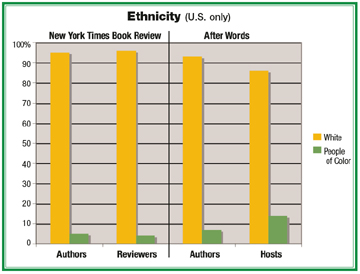
In a post at Fairness and Accuracy in Reporting, Steve Rendall and Zachary Tomanelli investigated the racial breakdown of the book reviewers and authors in two important book review venues, the New York Times Book Review and C-SPAN’s After Words. They found that the vast majority of both reviewers and authors were white males.
“Overall, 95% of the authors and 96% of the reviewers were non-Latino white (compared to 65% of the population).
Women accounted for between 13 and 31% of the authors and reviewers:
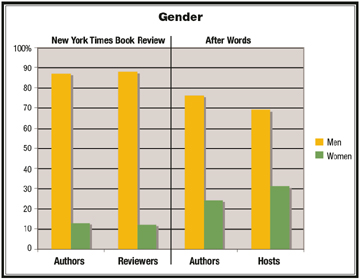
This is some hard data showing that white men’s ideas are made more accessible than the ideas of others, likely translating into greater influence on social discourse and public policy. These individuals certainly don’t all say the same thing, nor do they necessarily articulate ideas that benefit white men, but a greater diversity of perspectives would certainly enrich our discourse.”
It is really hard to argue against the substantive data collected about the influence of WMP on our culture and how it conditions us to think and act. As the quoted material says, just imagine if more people were able to influence our culture how much more rich and diverse our culture would be.
Sociological Images always has something disturbing or depressing. Today is a little of both.
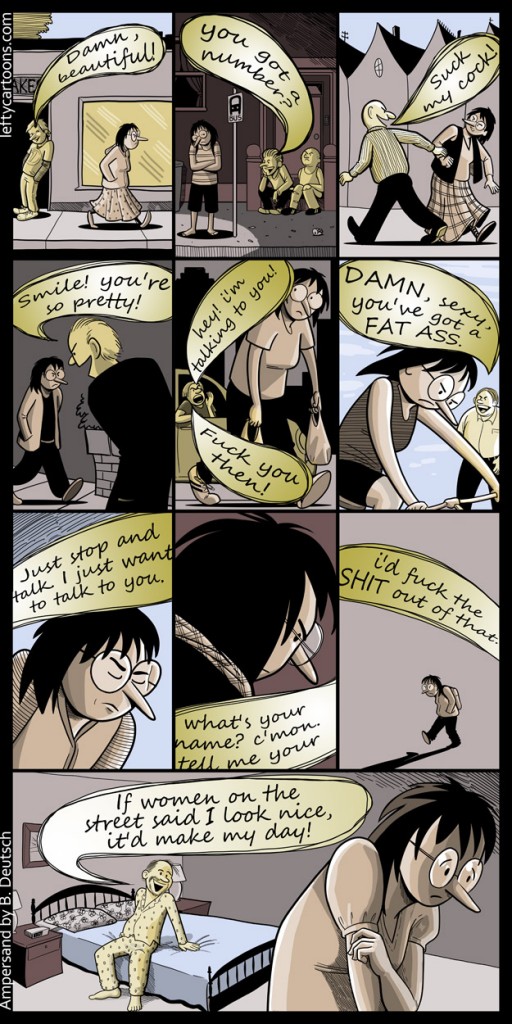
“This also nicely illustrates male privilege in the last panel, and how the worst problems with street harassment often don’t come from the men on the street harassing you – but rather from the prevailing attitudes among society/other men that it’s something you should welcome.”
*sigh*
Part of the problem when dealing with the issues of Rape and Rape Culture are the implicit messages that are built into our patriarchal culture. Full marks to Scotland for starting to tease out one of the threads that holds us back from seeing women as people instead of members of the sex class.
One of the neat features of a model is that it allows you to strip down the gloss and inessential features that can sometimes clutter arguments and details about a particular topic; in the case of this post the prevalence of the Patriarchy. I am certainly not part of the Blamatariat yet, but I feel that I am moving across the spectrum toward a more informed, knowledgeable state of affiars.
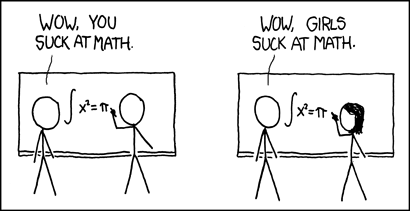 There has been a furour on the Intertoobz as of late over the decision (now repealed) by Blizzard, the makers of World of War Craft, to attach players real names to their characters in game and while posting in the game related forum. The frantic typing and posting resounded across the Net, there are threads about this topic everywhere from Pharyngula to Shakesville.
The questions and concerns raised range from harassment on forums to IRL stalking and worse. A jumping off point in one of the threads took me here to a brilliant post by Nattie on a thread from MetaFilter. I suggest you go read the entire post with the idea in mind that this could be viewed as a primer for understanding Patriarchy 101. To the uninitiated the patriarchy can seem a little bit of a fuzzy concept due to the implicit and ingrained nature of how the P functions. In light of potential learning from this piece I have added hyperlinks to the Shakesville Feminism 101 section for those seeking more illumination than the limited scope provided here.
Nattie says [italics, underlining and links, mine]:
“* If you do post a picture (I never did) people either go nuts over how hot you are and won’t leave you alone –– and the guys that perv on you treat you in a condescending way because hot=stupid; having to hear that shit addressed to other girls on Vent was really infuriating and uncomfortable — OR they make a point of constantly telling you how ugly you are and won’t leave you alone. There is no middle ground. They either want to fuck you or deride you. And it actually doesn’t matter how hot or how ugly you are, either; the hottest girls will get called ugly (and FAT, ALWAYS FAT), and the ugliest girls still have to deal with lonely guys who aren’t superficial. Any time the girl posts something thereafter, people will comment on her appearance, even though it has nothing to do with whatever is being discussed.”
The italicized statements are nothing new to the advanced Blamer, but to the uninitiated parsing them out can be

No objectification going on here. We are most definitly not appealing to the male gaze.
very illuminating. For instance, the options faced in the the statement A)”oh I you’re sooo hot I want to frak you” or B)”oh you’re so ugly, you are not soooo not”frakkable”. Both “choices” revolve around the idea that the primary feature of a female is her beauty as viewed by how attractive she is to the male gaze. Not the content of her character, not her opinions, not her factual claims, but just how she looks. So female worth is judged by how good of a sexual object they appear to be.
This ugly fact has a one to one correspondence to the real meatspace world. Women deal with this 24/7,all the time, on all stations full on assault on their identity as human beings.
“* If you ask someone to leave you alone, you’re a stuck up bitch. That means you always have to be nice to everyone. This was both unfair and character-building, because now I’m really good at talking to and disengaging from socially ill-adjusted people without hurting their feelings.”
Again, the social expectations of women are quite explicit and when you go against them you get flayed to the bone because you are not properly performing your sanctioned role. Since when should a person have to ‘be nice’ or be anything all the time or be labelled a ‘stuck up bitch’ (insert your gendered insult here)? As a woman you get to deal with this as well, just because you happen to possess a double X chromosome. There are severe repercussions when Patriarchally sanctioned behaviour expectations are not followed.
* Some people think anything you do or say is attention-whoring, even if you never wanted the attention. If a guy makes a joke in a forum post, he’s a funny guy. If a girl makes a joke in a forum post, she’s an attention whore. If a guy makes a good argument in a forum post, he’s a smart guy. If a girl makes a good argument in a forum post, she’s doing it for attention. She’s ESPECIALLY an attention whore if people like her or agree with her.
* Similarly, people assume that the only reason anyone likes you is because they’re one of your fanboys. So people don’t genuinely think women or funny or make good arguments, they’re just fanboys. If other girls like you, then it’s because women form cliques — even if in the previous breath they were saying that women are all catty and hate each other.
Do you notice the pattern of choices that is become prevalent? Women are presented with two choices both equally shitty that do nothing to further her own autonomy or identity. You can choose either one patriarchally approved stereotype or the other, both damage you as a person.
“A sizable portion of [the population in general]gamers are racist. (Sexism, racism, and homophobia are what make me most uncomfortable about the gaming community; in a serious way I feel more connection to gamers than any other group, so this pains me. Plenty of gamers are none of these things and I love them to death, but I think those same gamers realize what a huge problem it is in the community in general.) An even bigger portion of gamers are just not very racially sensitive — they’ll use “nigger” or “Jew” a lot, for example, even if they don’t think they actively feel anything against those groups, because they think it’s funny. In the same way that saying stuff is “gay” is especially pronounced in the gamer community, even the people that say slurs ironically or by force of habit inadvertently make actual bigots in the gaming community feel empowered because they don’t realize other people don’t mean those things like they do. It is much more common and acceptable to express racist opinions in the gaming community than society at large.”
The quote really speak for itself, but the tacit acceptance of gendered insults and racist putdowns only reinforces the negative stereotypes that have such corrosive effects in our culture.
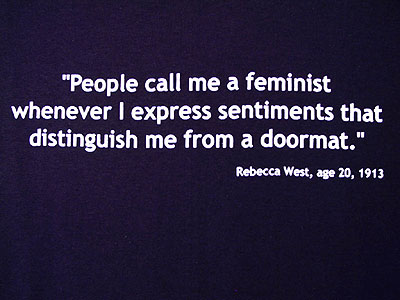 I have barely scratched the surface of all the issues that could be covered, just with the quoted materials. Frighteningly there is almost a 1:1 correspondence to what happens in the gaming world vs. what goes on in the real world, it is just a little easier to see in the gaming world because people are less constrained by social norms and morality in the mostly anonymous world of gaming. (or shorter the vile sexism and batshite crazy stupidity is easily observed)
A big thank you to Shakesville for having such a comprehensive FAQ for dealing with the multitudinous issues that this particular world of warcraft blip brought up.











 bleatmop
 Mystro
 The Arbourist


 Dead Wild Roses
Your opinions…