
You are currently browsing the tag archive for the ‘Ideology’ tag.
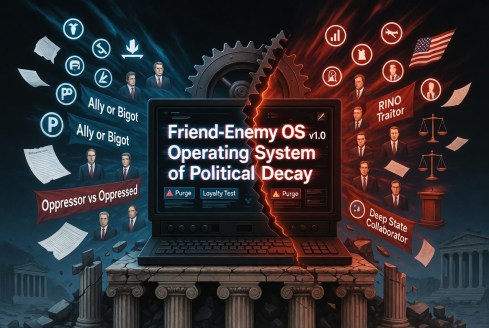
One of the most destructive temptations in politics is the urge to turn disagreement into moralized tribal war. Not argument. Not persuasion. Not the hard, frustrating work of governing a society full of competing interests and imperfect people. War. Friends and enemies. Allies and traitors. The pure and the contaminated. Once that frame takes hold, politics stops being about order, restraint, and judgment. It becomes a loyalty machine. Carl Schmitt gave this instinct its most famous formulation in The Concept of the Political, where he argued that the essence of politics lies in the distinction between public friend and public enemy. He was right to see that real political life can descend to existential conflict. He was wrong to treat that descent as the essence of politics rather than one of the permanent dangers civilized politics is supposed to contain. The friend-enemy distinction is not the foundation of healthy politics. It is the logic of political decay.
The danger is not only that the framework is harsh. Politics can be harsh. The danger is that it installs enmity at the center of public life and pushes everything else to the margins. Institutions, laws, debate, compromise, constitutional limits, due process, even ordinary factual disagreement all become secondary. What matters is identifying the enemy, consolidating the team, and punishing hesitation. That is why this logic travels so easily across ideologies. It can appear in revolutionary Marxism, in Maoist “enemies of the people,” in Islamist loyalty-and-disavowal frameworks, in activist binaries like ally versus bigot or oppressor versus oppressed, and in right-wing scripts about traitors, regime collaborators, and weak conservatives who supposedly enable the left. The vocabulary changes. The mechanism does not. A public enemy is named, and then a moral test is imposed: how fully will you align against him?
“The ratchet always turns one way: toward greater fanaticism, greater purification, greater moral ugliness. Truth is subordinated to solidarity. Principle is subordinated to faction.”
What makes this logic totalitarian is that it abolishes the space for dissent. Once the enemy has been declared, neutrality is no longer allowed. You either join the mobilization or you are suspected of serving the enemy’s cause. Hesitation becomes complicity. Refusal becomes betrayal. Moderation becomes guilt. That is how political movements become purge machines. You can either be anti-racist or you are helping racism. You can either be a trans ally or you are enabling bigotry. You can either fight the deep state, resist the regime, and oppose the left without reservation, or you are a RINO, a coward, a collaborator. This is the structure that matters. Not the tribe wearing it. Once politics is moralized into friend and enemy, the pressure falls hardest not only on official opponents, but on the insufficiently zealous within one’s own camp.
That is why factions organized around “no enemies to the left” or “no enemies to the right” almost always radicalize inward. The outer edge of the movement becomes untouchable because criticizing it risks helping the enemy. So the only safe targets are moderates, doubters, and fellow travelers who fail the loyalty test. The left protects its most extreme activists and attacks liberals who cannot keep up. The right protects its own hardliners and attacks conservatives who still think prudence, constitutional restraint, or factual discipline matter. In both cases, the center is hollowed out first. The ratchet always turns one way: toward greater fanaticism, greater purification, greater moral ugliness. Truth is subordinated to solidarity. Principle is subordinated to faction. Politics ceases to be the art of living together under conditions of disagreement and becomes a permanent sorting mechanism for friends, enemies, and suspects.
A civilized society cannot survive on those terms. That does not mean pretending enemies never exist. They do. Free societies are not obliged to indulge movements openly hostile to liberty, law, and peaceful coexistence. But the achievement of constitutional civilization is precisely that it refuses to make enmity the organizing principle of normal public life. It channels conflict through law, opposition, procedure, restraint, and rights. It leaves room for disagreement without turning every disagreement into proof of treason. That is the line Schmitt blurred and totalitarian movements erase completely. The mistake is not in noticing that politics can become existential. The mistake is in treating that possibility as the deepest truth of politics and then building public life around it. Once you do that, purges are no longer an accident. They are the destination. Friend-enemy politics is not realism. It is the operating system of political decay.
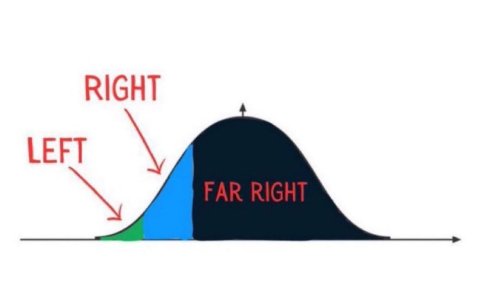
One of the most corrosive habits in current political discourse is the way plain factual claims get assigned a partisan label. Not arguments. Not policies. Facts. Or, more precisely, statements that point back to material reality, institutional limits, or ordinary human constraints. In theory, facts are supposed to discipline ideology. In practice, they are often treated as ideological aggression when they obstruct a preferred moral script.
That is what people are reaching for when they say facts are now treated as right-wing. The phrase is blunt, but it points to something real. In a growing number of disputes, especially around sex, gender, speech, and institutional policy, a person can say something materially true and be treated not as a participant in debate but as a moral suspect. The point is not answered on its merits. It is recoded as a signal of contamination. The speaker is no longer heard as describing reality. He is heard as choosing a tribe.
That shift matters because it changes the structure of argument. Once a factual claim is socially coded as “right-wing,” the burden quietly moves. The question is no longer whether the claim is true. The question becomes why you said it, what kind of person says such things, and who might feel endangered by hearing it. Motive replaces mechanism. Stigma replaces rebuttal. The claim is not refuted so much as quarantined.
You can see this clearly in disputes over sex and pronouns. For many people, saying that sex is real, binary in the ordinary human sense, and not altered by self-declaration is not an act of hostility. It is a claim about reality and a claim about language. “He” and “she” historically track male and female persons. Refusing to detach those words from sex is not, on its face, a partisan performance. It is an attempt to keep public language tethered to the material world rather than to inward identity claims.
“The disagreement is not mainly about politeness. It is about which reality gets public authority.”
That is exactly why the issue generates so much heat. The disagreement is not mainly about politeness. It is about which reality gets public authority. Does language track bodies, or does it track self-declared identity? Does a school treat sex as a stable feature of the world, or does it treat identity assertion as the governing fact? Those are not small etiquette disputes inflated by the internet. They are conflicts about ontology, law, and institutional power.
Canada now offers several live examples. Alberta’s Education Amendment Act requires parental notification when a student requests a gender identity-related preferred name or pronouns, and parental consent for students under 16 before staff may use them. The province says these changes are part of supporting families and setting clear school rules, with the remaining education amendments anticipated to take effect on September 1, 2025. Then, in late 2025, Alberta escalated further. Bill 9 invoked the notwithstanding clause to shield not only this school policy but other contested sex-and-gender measures from being struck down by the courts. That bundling matters. It shows this is no longer being treated as a narrow administrative disagreement, but as a foundational conflict over parental authority, child development, and the public meaning of sex.
Quebec presents the same fracture from the opposite direction, and it is ongoing now. Current reporting says a Montreal teacher is challenging the provincial policy that allows students 14 and older to change the name and pronouns used at school without parental consent. The teacher alleges she was required to use male pronouns at school while using female pronouns with the student’s parents. A preliminary hearing on anonymity and confidentiality was held on March 6, 2026, with the broader merits challenge still to come. Strip away the activist packaging and the conflict becomes plain: can institutional professionals be required to maintain two vocabularies of reality depending on the audience, and if they object, are they making an ethical argument or committing a moral offense?
The Barry Neufeld case in British Columbia shows the institutional end point of this logic. On February 18, 2026, the B.C. Human Rights Tribunal issued its decision and ordered substantial damages after finding that multiple publications were discriminatory, while some crossed the threshold into hate speech. That does not prove that every factual objection to gender ideology is punishable. It does show how readily dissent can be processed through systems that move from moral condemnation to formal classification. Once that line is crossed, everyone watching understands the lesson. The risk is no longer simply that you will be called wrong. The risk is that you will be treated as a public contaminant.
This is why the familiar “both sides are just choosing different facts” formula goes soft in exactly the wrong place. The conflict is not symmetrical. One side is generally making claims about bodies, language, legal authority, and institutional procedure. The other is often demanding that those things yield to identity-based recognition norms. Dignity is real and relevant. But dignity does not erase biological category, dissolve observable sex, or transmute factual disagreement into literal violence.
So when people say facts are treated as right-wing, the point is not that truth literally belongs to one side of the spectrum. The point is that in a culture saturated with moral performance, inconvenient facts are often recoded as partisan because it is easier to stigmatize them than to answer them. A factual claim that disrupts the script is no longer processed as description. It is processed as dissent. And dissent, under current conditions, is increasingly treated as a character defect.
Facts do not have a party. But when facts obstruct an ideological narrative, that narrative will often brand them right-wing and move straight to motive-policing. That is not a sign that the facts have changed. It is a sign that too much of public discourse has become allergic to reality when reality refuses to flatter the creed.
References
Government of Alberta. “Supporting Alberta students and families.”
https://www.alberta.ca/supporting-alberta-students-and-families
Government of Alberta. “Protecting youth, supporting parents, and safeguarding female sport.”
https://www.alberta.ca/protecting-youth-supporting-parents-and-safeguarding-female-sport
Global News. “Montreal teacher challenges policy for trans students to hide identity from parents.” March 6, 2026.
https://globalnews.ca/news/11719392/montreal-teacher-trans-students-challenge/
British Columbia Human Rights Tribunal. Chilliwack Teachers’ Association v. Neufeld (No. 10), 2026 BCHRT 49. February 18, 2026.
https://www.bctf.ca/docs/default-source/for-news-and-stories/49_chilliwack_teachers-_association_v_neufeld_no_10_2026_bchrt_49.pdf?sfvrsn=2d847803_1
Collin May has published a long, ambitious essay in the C2C journal (Hearts of Darkness: How the Left Uses Hate to Fuel its 21st Century Universal Imperium) on cancel culture, “hate” rhetoric, and the modern left’s moral posture. It is broader than I would write, more philosophical than most readers will tolerate, and occasionally overbuilt. But it names a pattern that matters, and one I return to often here: once “hate” becomes a universal accusation, institutions stop persuading and start policing.
May’s most useful contribution is not just the complaint (“cancel culture exists”) but the mechanism: “hate” stops being a moral description and becomes a category that pre-sorts who may be argued with and who may simply be managed.
That is the issue.
Not whether hatred exists. It does. Not whether some speech is vicious. It is. The issue is what happens when “hate” becomes the default label for disagreement, skepticism, refusal, dissent, or plain moral and factual judgments that cut against elite narratives.
At that point, the term stops describing and starts doing administrative work.
You can watch this happen across the institutions that shape public life: media, HR departments, professional bodies, universities, bureaucracies, and the expanding quasi-legal space around speech regulation. The sequence is familiar. Someone raises a concern about policy, ideology, language rules, school programming, medical ethics, public safety, immigration, religion, or sex-based rights. Instead of answering the argument, the institution reframes the speaker. Not wrong—harmful. Not questioning—spreading hate. Not participating in democratic friction—a threat to social order.
That move changes the rules of engagement. A wrong claim can be debated. A “hateful” claim can be quarantined. Once a claim is reclassified as harm rather than argument, the institutional response changes with it: less rebuttal, more restriction.
This language matters because it is not only moral language. It is managerial language. It justifies deplatforming, censorship, professional discipline, reputational destruction, and exclusion from ordinary civic legitimacy. It creates a class of people whose arguments no longer need to be answered on the merits. It also trains bystanders to confuse moral panic with moral seriousness.
May explains this through a large historical and philosophical genealogy. Fair enough. I am less interested in the full genealogy than in the practical result in front of us. In plain terms: the rhetoric of “hate” is often used to centralize authority in institutions that no longer trust the public and no longer feel obliged to reason with them.
That is one reason trust keeps collapsing.
People can live with disagreement. They can even live with policies they dislike. What they do not tolerate for long is being handled—being told their questions are illegitimate before they are heard. Once citizens conclude that institutions are using moral language as a shield against scrutiny, every future statement gets discounted. Even true statements are heard as spin.
And then the damage compounds. If “hate” is defined so broadly that it includes dissent, genuinely hateful speech becomes harder to identify and confront. The category gets inflated, politicized, and cheapened. Meanwhile, ordinary democratic disagreement becomes harder to conduct without professional or social risk.
That is not a confident free society. It is a managerial one.
Canada is not exempt. We have our own versions of this habit: speech debates reframed as safety debates, policy criticism recoded as identity harm, and public disputes (including over schools, sex-based rights, and even routine civic rituals like land acknowledgements) routed through tribunals, regulators, HR offices, and media scripts instead of open argument. The details vary by case. The mechanism does not. This tactic is not unique to one political tribe, but it is now especially entrenched in progressive-managerial institutions, which is precisely why it has so much reach.
The answer is not to deny hatred exists, or to become casual about cruelty. The answer is to recover civic discipline.
Name actual incitement when it occurs. Enforce existing laws where there are real threats, harassment, or violence. But stop using “hate” as a catch-all for disfavoured views. Stop treating condemnation as a substitute for evidence. Stop teaching institutions that the way to win an argument is to disqualify the speaker.
May quotes Pope Francis on cancel culture as something that “leaves no room.” Whether or not one follows his full historical argument, that phrase captures the operational problem.
A liberal society cannot function if citizens are only permitted to disagree inside moral boundaries drawn in advance by bureaucrats, activists, and legacy media.
The test is simple: can a claim be examined without first being moralized into silence?
If the answer is no, that is not moral confidence. It is institutional insecurity backed by power.
That is the pattern worth naming. And that is why essays like May’s, even when they overshoot, remain worth reading.

References
Collin May, “Hearts of Darkness: How the Left Uses Hate to Fuel its 21st Century Universal Imperium,” C2C Journal (February 16, 2026), https://c2cjournal.ca/2026/02/hearts-of-darkness-how-the-left-uses-hate-to-fuel-its-21st-century-universal-imperium/. (C2C Journal)
This post is inspired by the writing of James Lindsay on X.
The Mechanics of Woke Sociognosticism: A Persuasive Analysis
Contemporary “woke” ideology—focused on systemic injustice, identity-based power dynamics, and cultural transformation—has morphed into a quasi-religious framework that claims exclusive access to sociological truth. Its adherents, wielding an implacable certainty, cast dissent as ignorance or complicity, undermining the pluralism essential to liberal societies. This essay argues that woke ideology operates as sociognosticism: a fusion of critical social theory with gnostic epistemology, where salvation lies in “awakening” to hidden structures of oppression. While its moral aim to address inequities is undeniable, its totalizing worldview risks authoritarianism, stifling dialogue and fracturing society.
I. Defining Sociognosticism
Sociognosticism marries sociological critique with a gnostic belief in hidden, redemptive knowledge. Historically, gnosticism posits that gnosis—secret knowledge—unlocks salvation by revealing a dualistic reality of light versus darkness (Voegelin, 1952). Political theorist Eric Voegelin applied this to ideologies like Marxism, which claim to expose a veiled truth behind social structures. In woke sociognosticism, society is a prison crafted by hegemonic groups (e.g., white, male, capitalist), who maintain power through a “false consciousness” internalized by the masses (Gramsci, 1971). Activists position themselves as enlightened guides, dismantling this illusion. Yet, their framework is often presented not as one perspective but as the sole legitimate lens, dismissing alternative views as inherently flawed.
II. The Elect and the Awakened: Epistemic Elitism
Woke ideology fosters an “elect” class—those “awakened” to systemic oppression—who view their insight as both morally and intellectually unassailable (Lindsay, 2025). This mirrors Herbert Marcuse’s argument in Repressive Tolerance, where dissenting views are deemed intolerable if they perpetuate systemic harm (Marcuse, 1965). Disagreement is recast as evidence of false consciousness, as seen in online campaigns on platforms like X, where critics of woke orthodoxy face accusations of racism or transphobia (e.g., high-profile cancellations of public figures for questioning prevailing narratives, X, 2024–2025). Such epistemic elitism conditions dialogue on ideological conformity, punishing dissent with social ostracism or demands for public “self-education,” effectively silencing pluralistic debate.
III. Struggle, Awakening, and the Maoist Echo
Woke sociognosticism employs rituals of struggle and awakening, echoing Maoist techniques of “self-criticism” and “struggle sessions” (Mao, 1967). Originating during the Chinese Cultural Revolution, these were public rituals of ideological repentance in which individuals were forced to confess alleged wrongthink to reinforce social conformity. Contemporary analogues include institutional diversity training programs that require participants to acknowledge privilege or complicity in systemic bias. For example, several corporate and university DEI (Diversity, Equity, and Inclusion) initiatives between 2023 and 2025 have included exercises in which employees or students must complete “privilege checklists” or write statements of commitment to anti-racism. Refusal to comply is often interpreted as regression or resistance to enlightenment.
The concept of “allyship” reinforces this structure, demanding continuous affirmation of anti-oppression principles, with failure interpreted as betrayal. This creates a narrative of inevitability: crises—social, economic, or personal—are seen as catalysts for “waking up” to the truth. While rooted in a desire to address inequities, these tactics prioritize conformity over dialectic, substituting performative repentance for genuine inquiry.
IV. A Closed Epistemology
The woke worldview is self-sealing, absorbing contradictions into its narrative. Karl Popper’s critique of unfalsifiable theories applies here: counter-evidence is reinterpreted as proof of the system’s pervasive influence (Popper, 1963). For instance, when a woman denies experiencing gender-based oppression, she may be accused of internalized misogyny; when a Black individual critiques critical race theory, they are often labeled as “anti-Black” or as supporting white supremacy. Notably, prominent Black academics who voice heterodox views—such as critiques of DEI bureaucracy—have been targeted with denunciations on platforms like X (2025), reinforcing the idea that dissent is heresy. This totalizing simplicity reduces complex realities to a binary of oppressors versus oppressed, rendering the ideology immune to challenge and hostile to nuance, even when confronting legitimate inequities.
V. The Political Danger
While woke ideology seeks justice—a noble aim—its sociognostic structure threatens pluralism. Hannah Arendt warned that ideologies reducing reality to a single explanatory framework erode judgment and shared political life (Arendt, 1951). Woke influence in institutions like academia and media, where speech codes and DEI policies increasingly frame dissent as harm, raises concerns about encroaching authoritarianism. For example, university speech guidelines updated in 2024 at several U.S. campuses have redefined “harmful speech” to include disagreement with concepts such as gender self-identification or systemic racism, chilling open discourse.
If silence, speech, or disagreement can be deemed oppressive, liberal norms—due process, open debate, individual conscience—are subordinated to a dogmatic moral code. Acknowledging the validity of addressing systemic inequities does not negate the danger: a worldview that pathologizes dissent risks fracturing the very society it aims to redeem.
Conclusion
Woke sociognosticism, while driven by a moral impulse to rectify injustice, operates as a closed belief system that stifles dissent and undermines pluralism. Its adherents’ certainty—rooted in a gnostic claim to hidden truth—casts disagreement as ignorance or sin, fostering division over dialogue. For a liberal society reliant on free inquiry and epistemic humility, this poses a profound challenge. Justice is essential, but it must not sacrifice the principles—open debate, mutual respect—that make justice possible.

References
Arendt, H. (1951). The Origins of Totalitarianism. New York: Harcourt, Brace.
Gramsci, A. (1971). Selections from the Prison Notebooks. New York: International Publishers.
Lindsay, J. (2025). X Post, July 5, 2025. Retrieved from https://x.com/ConceptualJames/status/1941564050707501548
Mao, Z. (1967). Quotations from Chairman Mao Tse-Tung. Peking: Foreign Languages Press.
Marcuse, H. (1965). Repressive Tolerance. In R. P. Wolff, B. Moore Jr., & H. Marcuse, A Critique of Pure Tolerance (pp. 81–123). Boston: Beacon Press.
Popper, K. (1963). Conjectures and Refutations: The Growth of Scientific Knowledge. London: Routledge.
Voegelin, E. (1952). The New Science of Politics: An Introduction. Chicago: University of Chicago Press
While reading Richer Morrison’s essay called Self-Defeating Environmental Activism this particular paragraph caught my eye ( I recommend reading the entire essay).
“I call this unconstrained in part as a reference to the distinction the economist Thomas Sowell advanced, of a constrained vs. unconstrained view of society and government. The constrained view—broadly consistent with the ideas of our Founding Fathers—suggests that human beings are by nature given to abusing and fighting over political power, and thus governing structures have to be limited and divided. The constrained view also acknowledges that our most important societal problems are not amenable to permanent solutions but are simply a matter of competing interests and values and thus can only be balanced toward a least bad resolution. The unconstrained vision—more amenable to Progressive theorists—holds that governments should be empowered to require good outcomes and eradicate bad outcomes, and obviously then assign behaviors to one of those categories.”
The constrained and unconstrained views of society are important theoretical and ideological origins for understanding how our views are shaped and reinforced. With the recent seismic changes to the body politic on the Left(the move toward a totalizing activist identitatarian ideology) I’ve had to reevaluate many of the positions I’ve taken in the past and come up with new ones, or at least different stances on the issues.
I’d like to say the process is finished, but much work remains in order to rationalize and reorder the priorities of one’s world view. Adopting a more constrained view of government’s role in society is part of the ideological framework that I am adapting toward.
I think the distinction Morrison mentions (quoting Sowell) is fertile ground for the recasting the theoretical lens of how society is viewed.
I’m tired of being lied to by the Left and the Right.
It’s been a rough couple of years for me as I’ve been riding a bit of a roller-coaster when it comes to demarcating my political position and adopting a cognitive frame in which to reasonably process the world.

Talk about unintended veracity.
I come from a academic traditional left background. My blog started in 2009 and I published a paper (self-published) which I wrote for one of my sociology classes (sociology of the family). Here is my preface and conclusion from my paper.
“One of the dominant themes of the course was the gendered assumptions our society is based on. Like the Matrix, until you are shown what it is, you really do not understand it. One of the conditions of the paper was that I had to use a pop culture piece to illustrate how heteronormativity works in our culture. I chose the cartoon ‘Family Guy’ because it is a very offensive show and I was sure I would find heteronormative gold when I analyzed a couple of episodes. Sadly, I was correct…
—–
“If “Family Guy” were truly edgy, the so-called deviant vignettes and their radical take on society would be the norm instead of the cutaway gags, but then the show would be unmarketable. Heteronormative assumptions, like media functions of Chomsky’s model, serve the dominant patriarchal interests. Therefore, the authors of the show would either bend to the wishes of the institutional will, or they would be out of a job as producers of a cartoon. In reality “Family Guy” is a safe cartoon from the patriarchal point of view as it amplifies the correct heteronormative assumptions (albeit very crudely) and intensifies the ‘othering’ of competing non-patriarchal based narratives. Similarly, news that is outside of the dominant acceptable paradigm or boundaries of debate is marginalized or simply ignored by the mass media. In both cases, the interests of the powerful institutions are served and alternative views are either marginalized or ignored. Therefore, “Family Guy” as a cartoon may poke fun at heteronormative values, but by its very nature must endorse and propagate an ‘acceptable’ version of the dominant patriarchal norms to continue to be successful in the mass media.”
Oh sweet jebus. Just look at the conflict theory in action – over a popular cartoon no less. I received top grade for this paper – I worked hard on ii – but ‘wow wow wow’ the frame I was using was problematic. Before we get to comparisons, let’s get a few more data points.
Circa 2015 abortion was one of the big topics here at DWR. This from a post titled The Indomitable Nature of Woman’s Courage.
“The war on women and their rights continues to chug along, it can get depressing having to digest all the misogyny that leaks from the anti-choice, anti-woman side.”
—–
“Trust women.
Oh and a big heart-felt fuck you to so called ‘crisis pregnancy centres’ that are always filled to the brim with toxic bullshit. We need you like we need smallpox in the world.”
Did I take the time to really understand the rational behind what Crisis Pregnancy Centres were doing. Absolutely not. They were part of the religious right, and the religious right in my cognitive frame were an irredeemable source of EVIL (and patriarchy, we mustn’t forget patriarchy).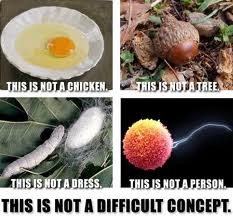
The other big topic was Radial Feminism and it was a well worn path through 2014 – 2018. For instance, my primer on Sex Based Oppression –
[Quoted Material] “As Friedrich Engels made clear, even before feminism’s First Wave, women were historically controlled because we are “a means of production”—without women, there are no heirs, and without heirs, no inherited property and wealth. Women’s reproductive capacity is why we were colonized as property, just as animals, countries, weapons and land was colonized. Otherwise, we wouldn’t have been important at all; any thing we could do (cooking, cleaning, sewing clothes) could have been done as well by men (and in the military, it was). The reason women were oppressed was to control our REPRODUCTIVE ABILITIES. This does not mean all women had these abilities, but women were assumed to have them until proven otherwise. (In many religious traditions, a woman’s “barren” status was the only acceptable reason for divorce.)
There can be no other logical, rational basis for women’s oppression; unless you think men were just being “mean” or something. No, it was for a very real, profit-centered reason. Men without families and heirs could not build empires (or even working farms) and without this centralized, religiously-sanctioned consolidation of the family, the state could not have evolved. The state then effectively empowered men to be women’s keepers until very very recently in human history.
THIS is the origin of women’s oppression.”
Yep. The feminist streak here at DWR runs deep and wide – but then a funny little bit of legislation happened in Canada – Bill C-16. And then the wide feminist river began to narrow into a direct defense of females as a distinct political and social class in society as Bill C-16 codified the unfalsifiable notion of Gender Identity into our Charter of Rights.
“So here we be – enshrining more patriarchal norms into our laws – big surprise right? This legislation potentially represents a large step backwards for women.
“As unpopular as this fact has become, a man or boy who wishes to identify as a woman or girl, perhaps taking on stereotypically feminine body language, hairstyles, and clothing, is still male. He still has male sex organs, which means girls and women will continue to see him as a threat and feel uncomfortable with his presence in, say, change rooms. Is it now the responsibility of women and girls to leave their own spaces if they feel unsafe? Are teenage girls obligated to overcome material reality lest they be accused of bigotry? Is the onus on women to suddenly forget everything they know and have experienced with regard to sexual violence, sexual harassment, and the male gaze simply because one individual wishes to have access to the female change room? Because one boy claims he “feels like a girl on the inside?” And what does that mean, anyway?”
So which is more important male gender feelings or female safety? I would like to advocate here for gender neutral washrooms/changing area as the beginning of a compromise in this area. We still live in a patriarchy and sex segregated facilities are still necessary for the protection and safety of females in our society. The choice whether to co-mingle with men in washrooms or change rooms should be up to all those involved.”
 It was a watershed moment for me. Gender-magic suddenly, was made a part of our Charter of Rights and the resulting bullshit was quite beyond the pale as female rights, boundaries, and safety continue to be curtailed and rolled back up here in Canada. It is 2023 now, and push-back against the tide of regressive gender ideology has a reasonable start, but we still have a long way to go as most of our government institutions are thoroughly captured by this insidious ideology.
I’m sorta fed up with the transgender bullshit. As early as 2021 – this from the post Transgender Ideology Obscures & Enables Male Violence – CTV (Newspeak) News:
“Forget about ‘just wanting to pee’ wedge issue bullshit – this is what we are in for in Canadian society; this is the upside-down, nothing has any meaning, timeline that trans ideology has in store for us.
Do not believe your eyes, but rather what some individual says about who they are. This is where belief in gender-magic takes us, where male violent crime is somehow called ‘female’ violent crime because the violent male has fucking delusions of gender and we need to respect that.
No. The word must get out of what is happening here and the bald-faced misogyny that is transgender ideology must be stopped.”Yeah, the gloves have come off and up till the present it has been a journey that has seen my reject my ideological left leaning beginnings. The argument can be made that since 2015 the Left has hit the crazy button and, in many cases, simply left former supporters and adherents politically homeless. The rise of Radical Activist Leftism (queer theory based gender ideology, the misogyny that is Transactivism, BLM, the so called anti-fascists et al.) has left me so cold toward my former home on the left. So I went looking and much to my chagrin the “Right” isn’t much better. So started to lean into some of the bugbears the Right chases. For example, identity politics –
“Identity politics sow division and strife within society. We need to revisit the idea that we are all Canadians first and foremost. We come in all different shapes, beliefs, and abilities. Those differences and the acceptance of our actual diversity is what makes Canada a wonderful place to live and prosper.
Josh Denaas writes at the Macdonald-Laurier Institute about the change in activism over the years and how it has become less about gaining acceptance in society more about demanding to be accommodated regardless of the validity of the claim.
“I’m pleased that in 2023 LGBT people can be themselves in public, and that there is zero tolerance for bullying in schools and workplaces. That said, I’m starting to worry that some LGBT people are becoming the new bullies.”
“People see what they want to see and hear what they want to hear” – signed *EVERYONE* on twitter. It was late 2018 that I started to lean harder into twitter as a social media outlet., and to be honest, it has had negative effect on my writing here on DWR. Sparing with others, getting the dopamine hit from winning a successful snipe argument, the format of the short tweet all sap the intentionality and nuance of writing and thinking in complete descriptive thought. I was necessary though folks; January 2018 was when my marriage went pear-shaped and what I thought was a partnership for life turned out to be a much more temporary experience. Amiable and all that, but my mental resources available at the time were MUCH more suited to Twitter than the long form essay. Twitter also has a way to weave a quasi-net of acceptance and understanding to your particular points of view and preferred ideologies, it is rather alluring to be perfectly honest.
 The silos present there at first confirmed my left bias, but then led by the likes of James Lindsay and his podcasts from The New Discourses I embarked on a journey to the right, or at least centre-right.
Lindsay, one of the authors of the Grievance Studies Affair, has taken it upon himself to combat the what he describes as the encroachment and capture of our cultural institutions by Cultural Marxist ideologues. Lindsay has topics ranging from grooming in schools to DEI training to the Sustainable Development Goals. The picture he assiduously paints is one of a long subtle Communist march through the Western institutions with the goal of overthrowing Western values and unfurling the new collectivist revolution. He unpacks concepts the Left is based on – and it is an impressive intellectual shortcut, but ultimately a shortcut it is. The picture you take away from him, despite his charitable efforts (sometimes) is fairly negative view of the evolution of Marxist and how it affects society now. There is no shortcut around grappling with the texts and thoughts of thinkers (on the right and the left) that have shaped and are shaping our reality.
You listen to him – he’s at his most persuasive when he’s reading a primary source from the other side – whether it be the record of the Combahee River Collective or the works of Paulo Friere or Herbert Marcuse – the work he’s amassed and digested into a reasonable format is impressive. Impressive enough to build a hollow cognitive frame around… one could say.
On reflection, I think I’ve learned a fair amount about the topics that I had little or vague knowledge about. What I haven’t done is yet is to formulate a coherent cognitive frame that makes sense of my dual experience of being on the Left (and then having being discarded by the current bullshit activist left) and embracing some of the ideas and notions that are ascribed to the Right.
I need answers.
I’ve read Noam Chomsky’s keystone works on media and media production – Manufacturing Consent. The well spring of evidence points to a distinct conservative take in the news media. Yet, the Herbert Marcuse’s thesis of Repressive Tolerance is an artifact in society in which I have witnessed happening. Did you see all the articles in the media about how they are putting males into female prisons and how dangerous that is for the female prisoners? No?
Me either.
Not a fucking peep.

Make it all make sense!
You would think that such a infringement on female rights and safety would have our Left media up in arms… But not a peep. CBC, The Toronto Star, Counterpunch nothing. NOTHING. The bullshit they do run though is the ideological drivel that is being vomited into society by the Activist Left – because somehow male gender feelings outweigh female rights, boundaries, and safety in society (in the name of tolerance, diversity,and inclusion no less).
Where do you find the stories of women fight back and reclaiming their rights, spaces, and sports? News organizations on the RIGHT. Stories about Riley Gaines (who was forced to compete against the male Lia Thomas in swimming) appear on Fox News. The toxicity of gender ideology or really just discussing it has only appeared in the rightward National Post and never in the Left Globe and Mail. What the actual hell is going on – why is the media I was taught to distrust and malign suddenly become the only avenue of reasonable argument and debate that is allowed in mass communications? The whole media situation really cooks my noodle :/.
This post is already too long, stay tuned for part two where I go into how I think I should build my new cognitive frame from the current giggly-piggley state of being.











 bleatmop
 Mystro


 Dead Wild Roses
Your opinions…