
You are currently browsing the tag archive for the ‘Media Bias’ tag.
Well other than the largest presence on the ground since the disaster ocurred in Haiti, nowhere I guess (ghosts?).
“One major international news agency’s list of donor nations credited Cuba with sending over 30 doctors to Haiti, whereas the real figure stands at more than 350, including 280 young Haitian doctors who graduated from Cuba. The final figure accounts for a combined total of 930 health professionals in all Cuban medical teams making it the largest medical contingent on the ground.”
This is not just Haiti, Cuba has a history of being among the first responders to crisis situations worldwide.
“Cuban medical teams played a key role in the wake of the Indian Ocean Tsunami and provided the largest contingent of doctors after the 2005 Pakistan earthquake. They also stayed the longest among international medical teams treating the victims of the 2006 Indonesian earthquake.
In the Pakistan relief operation the US and Europe dispatched medical teams. Each had a base camp with most doctors deployed for a month. The Cubans, however, deployed seven major base camps, operated 32 field hospitals and stayed for six months.”
 Cuba, a nation still in an economic stranglehold enforced the the US, still has the resources to send to other disaster stricken countries around the world. Do they vie for international resources or media time like other NGO’s? Rarely. No, rather they are have been, on many occasions, the first ones on the ground and the last ones to leave stricken areas of the world.
How do they do it? Cuba is a poor island nation, but yet they get it done. There is not glitzy flavour of the day fundraising and the enormous overhead that goes along with such hoopla; they just get there and start helping people to the best of their limited ability.
Do we hear about the outstanding work that Cuban doctors are doing in our filtered and standardized media. Not a peep of course. Being on the official US enemy list makes you magically disappear from positive media coverage.
Cuba sets the gold standard on what effective crisis response should look like. Imagine how much Cuba could achieve if the West were not determined to strangle their nation economically.
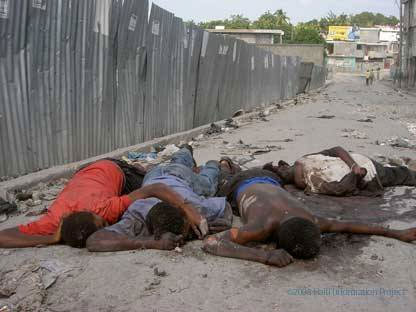 When all is said and done in Haiti will things change? Or will the status quo remain? Media Lens has done a excellent job at giving a short historical primer about Haiti and Western intervention within the small island nation.
“In September 2008, Dan Beeton of the US-based Center for Economic and Policy Research told us:”Media coverage of floods and other natural disasters in Haiti consistently overlooks the human-made contribution to those disasters. In Haiti’s case, this is the endemic poverty, the lack of infrastructure, lack of adequate health care, and lack of social spending that has resulted in so many people living in shacks and make-shift housing, and most of the population in poverty. But Haiti’s poverty is a legacy of impoverishment, a result of centuries of economic looting of the country by France, the U.S., and of odious debt owed to creditors like the Inter-American Development Bank and World Bank. Haiti has never been allowed to pursue an economic development strategy of its own choosing, and recent decades of IMF-mandated policies have left the country more impoverished than ever.” (Email to Media Lens, September 9, 2008)”
The short form is that, we have chosen profit over people in Haiti. The results are obvious, endemic poverty, economic ruin, desperate people.
“Aristide’s balancing of the budget and “trimming of a bloated bureaucracy” led to a “stunning success” that made White House planners “extremely uncomfortable”. The view of a US official “with extensive experience of Haiti” summed up the reality beneath US rhetoric. Aristide, slum priest, grass-roots activist, exponent of Liberation Theology, “represents everything that CIA, DOD and FBI think they have been trying to protect this country against for the past 50 years“. (Quoted, Paul Quinn-Judge, ‘US reported to intercept Aristide calls,’ Boston Globe, September 8, 1994)”
Yet another grim legacy written in unnecessary human suffering. When we are blind to history, when our media institutions promote, rather than banish, lies and approved truth we lose an important part of our character; our empathy and compassion. Our motivations to help others are not activated because the suffering is cloaked in the twin grey falsehoods of nationalistic myth and self-serving rationalizations.
We owe Haiti much more than emergency aid. We owe them their country and their right to self-determination.
 Given the bias of our media, this story should be filed in the official ‘memory hole’ of our imperial consciousnesses.
“Palestinians in the Gaza Strip are marking one year since the start of Israel’s 22-day offensive on the territory, which left hundreds dead and damaged millions of dollars worth of infrastructure.”
Had this happened to an ally, or at least a non official enemy, the network feeds would be all over this. As is, the somber notes are duly recorded by Al Jazeera.
“Ismail Haniya, the deposed Palestinian prime minister, was expected to unveil a plaque commemorating the 1,600 people that Hamas officials say were killed during the war.
Other estimates put the Palestinian death toll closer to 1,400, the majority of whom were civilians, including around 400 children.”
400 hundred children slain. Ho Hum. Why all the carnage in the first place?
“The stated aim behind Israel’s “Operation Cast Lead” was to cripple the ability of Hamas and other Palestinian groups from launching rockets into southern Israel.
Avital Leibovich, an Israeli military spokesperson, told Al Jazeera on Sunday that the operation had been successful.”
Ah, those darn children making rockets. Oh I’m sure it can be all dismissed by calling them collateral damage and the fault of Hamas by intentionally putting innocents in harms way. Was it worth it? Not according to Hamas sources:
“Dr Ahmad Yousuf, a senior Hamas official and former advisor to Haniya, said that the political movement also remained strong despite the devastation caused by the Israeli offensive. “The Israelis failed their objectives on all accounts,” he told Al Jazeera from Gaza City. “Hamas is still there and we try to help our people, but we are still under occupation and suffering from sanctions.”
Hmm. Complete success and complete failure depending on who you ask. For 1400-1600 hundred people it does not really matter anymore. Oh hey, western media look here a story that is reporting from both points of view. You should try it sometime.
Oh and another little tidbit that ‘escapes notice’ in the western media:
“Last week, 16 rights groups including Amnesty International and Oxfam issued a joint statement saying the world has “betrayed” civilians in the Gaza Strip by failing to end the Israeli blockade of the enclave.”
Huh. But of course, they are of the wrong nationality, colour and political leanings. We can safely ignore them and their concerns.
 It is nice to be able to form a common frame of reference while discussing certain issues. The topic of the media and bias almost always comes up and this is a useful framework for analyzing how our Media functions. Medialens has a great summary of Edward Herman and Noam Chomsky’s mass media model. I’ll post the link to the entire work and the introduction here.
“In their 1988 book ‘Manufacturing Consent – The Political Economy of the Mass Media’, Edward Herman and Noam Chomsky introduced their ‘propaganda model’ of the media. The propaganda model argues that there are 5 classes of ‘filters’ in society which determine what is ‘news’; in other words, what gets printed in newspapers or broadcast by radio and television. Herman and Chomsky’s model also explains how dissent from the mainstream is given little, or zero, coverage, while governments and big business gain easy access to the public in order to convey their state-corporate messages – for example, ‘free trade is beneficial, ‘globalisation is unstoppable’ and ‘our policies are tackling poverty’.
We have already touched upon the fact that corporate ownership of the media can – and does – shape editorial content. The sheer size, concentrated ownership, immense owner wealth, and profit-seeking imperative of the dominant media corporations could hardly yield any other result. It was not always thus. In the early nineteenth century, a radical British press had emerged which addressed the concerns of workers. But excessive stamp duties, designed to restrict newspaper ownership to the ‘respectable’ wealthy, began to change the face of the press. Nevertheless there remained a degree of diversity. In postwar Britain, radical or worker-friendly newspapers such as the Daily Herald, News Chronicle, Sunday Citizen (all since failed or absorbed into other publications) and the Daily Mirror (at least until the late 1970s) regularly published articles questioning the capitalist system.”
 One of the most exasperating comments I hear on a fairly regular basis is that the Media has a left wing bias. If you look even a centimeter inside and below official received opinion you can see there is no left wing bias in the mainstream media. If anything, a right wing bias exists. The news we get generally reflects elite opinion on the topic at hand. That is why it is so important to get your news from as many different outlets as possible hopefully with a few of the ‘alternative’ media outlets thrown into the mix. Medialens is an orginization that watches the British press for the veracity of their stories and accuracy of their reporting. As it is with most things, it is better to show than to tell. I have a short blurb to look at illustrating exactly how filtered our ‘independent MSM’ actually is.
On August 26, the Guardian newspaper published an article titled, ‘US takes on Israeli-Palestinian conflict and Iran’s nuclear programme in one massive gamble.’ Julian Borger and Ewen MacAskill told readers:
“The Obama administration’s approach to two of the world’s most intractable and dangerous problems, the Israeli-Palestinian conflict and Iran’s nuclear programme, is to link them together in the search for a solution to both.
“The new US strategy aims to use its Iran policy to gain leverage on Binyamin Netanyahu’s government.”
The “Iran policy” is based on US Secretary of State Hillary Clinton’s threat of “crippling sanctions” against Iran. (BBC online, ‘Israel-US settlement deal “close”’, Analysis by Jeremy Bowen, August 26, 2009; http://news.bbc.co.uk/1/hi/world/middle_east/8221559.stm)
The sanctions threat is to ensure that Iran does “not compromise on uranium enrichment by the end of next month.” The Guardian told its readers that not only are sanctions supposed to pre-empt any Israeli military action against Iran, “they are also a bargaining chip offered in part exchange for a substantial freeze on Jewish settlements in the West Bank.” The paper quoted one official “close to the negotiations”:
“The message is: Iran is an existential threat to Israel; settlements are not.”
So much for Obama’s much-hailed Cairo speech in June 2009 in which he promised a “new beginning between the United States and Muslims around the world.” (‘Obama speech in Cairo’, Huffington Post, June 4, 2009; http://www.huffingtonpost.com/2009/06/04/obama-speech-in-cairo-vid_n_211215.html)
Okay, so we have the original from the Guardian. Now lets look at the objection from David Cromwell at MediaLens which bases its critique of the article on reality instead of received opinion.
The Guardian article presented the US as a valiant peace-seeker:
“The Obama administration is setting out to juggle two potentially explosive global crises, while walking the tightrope of a shaky and nervous global economy. It is not going to be easy, but Washington appears to have decided it has no option but to try.” (Borger and MacAskill, op. cit.)
This is a deeply misleading picture of the US in the Middle East and the wider world, as we have often explained in our books and in media alerts. We are to believe that the world’s number one rogue state is searching for benign solutions to the world’s most “intractable problems”. This fiction is standard in corporate media coverage.
As the independent journalist Jonathan Cook commented to us:
“This analysis in yesterday’s Guardian is almost a masterclass in how the liberal media unthinkingly reflect elite priorities.” (Jonathan Cook, email, August 27, 2009)
Huh. A little different that what you read in the newspapers all the time. It gets better, Cromwell writes a email to the editor of the Guardian for failing to address the issues in the middle east.











 bleatmop
 Mystro


 Dead Wild Roses
Your opinions…