
You are currently browsing the tag archive for the ‘Meghan Murphy’ tag.
Meghan Murphy is one of Canada’s leading Feminists. This quote is from her article – “Thanks to trans activism, 2017 saw a return to old-school, sexist dismissals of women and women’s rights.” Definitely worth your time to go and peruse the entire article. What I would like to focus on is how well this quote highlights one aspect of the feminist struggle against the various incarnations of patriarchy and men’s rights activism.
Feminists (those who struggle for the emancipation of women from patriarchy) are being attacked for merely naming the problem that they face. Gender is a problem, it is a toxic hierarchy that hurts both women and men. The liberal mainstream won’t have any of it though (quelle suprise~!~). Instead, the notion of gender identity is being enshrined in law and shoehorned into society which of course is good for men, but bad for women. Women brave enough to challenge the ideology of ‘gender identity’ are are routinely misconstrued, harassed, and marginalized. Why?
Questioning the dominant patriarchal narrative – and yes the transactivist narrative is inherently patriarchal – is challenging male dominance in society, and will always be vilified and marginalized.
The good news is that the dictates of reality defying ‘gender-identity’ platform, even if just superficially examined, are unpalatable to not only to the so-called ‘mainstream sensibilities’, but also to those who value rational arguments based on material reality and fact.
Feminists have known this pretty much since the beginning and the radical vanguard are now slowly being joined by those who appreciate the strength of radical feminist arguments and analysis.
Let us hope this trend continues and intensifies, because Patriarchy 2.0 is in dire need of a serious blaming.
“The notion that “gender identity” exists at all flies in the face of feminist analysis, which says being born female is what forces women into an oppressed class of people, regardless of whether or not they identify with that position. But this point, as well as the concerns women have expressed around the impact of writing something as vague and as regressive as “gender identity” into legislation, including questions around whether males should be permitted in female prisons, change rooms, and transition houses, go unacknowledged and unaddressed by trans activists and queer theorists like Barker. Instead, she paints challenges to this ideology as nothing more than a hateful, unfounded, irrational attack on trans-identified individuals, writing:
“A moral panic is the process of arousing social concern over an issue. Moral panics often involve scapegoating a particular group as the ‘evil’ responsible for a range of societal ills.”
Indeed, Barker sounds no different than the anti-feminists over at Spiked, who claim the #MeToo campaign is a “harassment panic” that demonizes men unfairly. She claims trans-identified people are vilified by challenges to and questions about transgenderism, trans activism, and policies that allow men to enter into women-only spaces, simply based on self-identification, intentionally declining to acknowledge that what women fear is not an abstract trans-identified person, but men, specifically. No one has argued, as Barker claims, that trans-identified people are specifically dangerous or violent. What has been argued is that males are a threat to females, regardless of how they identify. If this fact is indeed considered a “moral panic” in the eyes of people like Jones and Barker, then they are better suited for the alt-right crowd than they are among progressives.
Barker says that this kind of “moral panic” (commonly known as “feminism”) exists to “enable us to attack a specific group for problems we’re all implicated in”… As though we have no idea who is doing all the raping and beating in this world and as though women are equally as culpable…”
How can one tell when men have well and truly infiltrated 3rd wave feminism? When you invite a dude to speak at your Woman’s March who is advocate for the sex industry while concomitantly blocking feminists who are fighting for female liberation. I can fucking smell the inclusivity a mile away, can’t you? Funny how inclusive only works if you bend a knee to the males in charge. Perhaps this is ‘exclusive inclusivity’ who knows – we should look to a male for guidance in with these trying feminist issues…
How about no?
Let’s look to a feminist who is at the forefront of female liberation in Canada, Meghan Murphy:

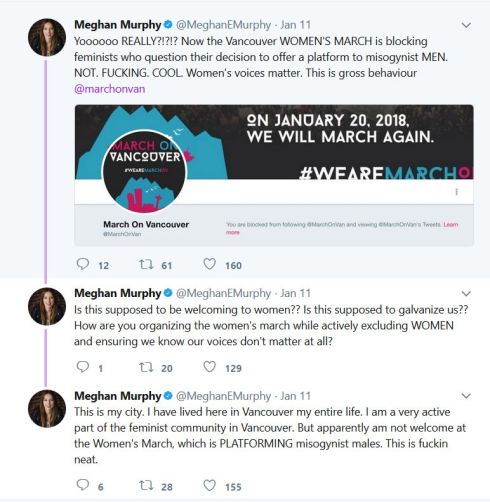
More on the Vancouver ‘Women’s March’ –
And so we march on, indeed.
Oh, and if you are indeed a member of the oppressed female sex class, the Vancouver Women’s March will block you from commenting. Not that mere blocking can stop the female fight for liberation from patriarchy. See the twitter thread here.
Thread highlights :


The last two paragraphs from Meghan Murphy writing on the Feminist Current.
“The fact that the vast majority of those connecting the word “TERF” to threats of violence, death, and genocide are men is notable. The word has been offered up to those who identify as leftists, who have been, on some level, prevented from making misogynistic statements publicly or otherwise advocating violence against women. Their “progressive” credentials meant that they had to maintain a facade of political correctness. But because women labelled “TERF” have been compared to Nazis and bigots, and because trans activism claims to be allied with the interests of the marginalized (despite its overt anti-feminism and individualist ideology), these leftist men have a socially acceptable excuse. Indeed, they seem to revel in it. It’s as if they were given the green light to scream “bitch” (or perhaps “witch” would be more accurate, considering the targeting of specific unruly women to “punch”… or burn…) over and over again, cheered on by their comrades.
If “TERF” were a term that conveyed something purposeful, accurate, or useful, beyond simply smearing, silencing, insulting, discriminating against, or inciting violence, it could perhaps be considered neutral or harmless. But because the term itself is politically dishonest and misrepresentative, and because its intent is to vilify, disparage, and intimidate, as well as to incite and justify violence against women, it is dangerous and indeed qualifies as a form of hate speech. While women have tried to point out that this would be the end result of “TERF” before, they were, as usual, dismissed. We now have undeniable proof that painting women with this brush leads to real, physical violence. If you didn’t believe us before, you now have no excuse.”
Yep. Same script folks – slapping down the uppity women – who dare oppose having the boundaries of their lives dictated by males. Male violence is the scourge of our society, how many canaries are necessary before we fix this problem?
Bill C-16 is problematic for women. Go read the entirety of Megan Murphy’s article on the Feminist Current, I’ve excerpted a key bit here though. :)
Bill C-16 passed at the Senate on Thursday. Under this new Canadian legislation, which follows similar laws in a number of Western countries, a person can determine their gender or sex via self-declaration at any time and for any reason. It’s considered a human rights violation to question it. No criteria, physical markers, or tests have been identified to determine trans status. As an inherently individualistic idea, gender identity isn’t tethered to any external reality and is therefore considered immune from qualification or broader critical analysis.
If an individual’s identity doesn’t impinge on anyone, it’s easy to accept it at face value. But when an individual transitions into a group of people who face different challenges, questions will naturally arise about whether opportunities reserved for those who are marginalized in their own right will be inevitably claimed by these new members, once again making it more difficult for the original members to get ahead. Already, we’ve seen a handful of examples of males who transitioned later in life showered with praise and handed awards reserved for women, who have spent their entire lives enduring patriarchy as females.
Remarkably, troubling philosophical questions remain unaddressed. If gender identities are determined on an individual basis with no parameters around what they mean, it follows that there can be as many genders as there are human beings. If each individual has a purely self-determined identity, then, by definition, these inherently unique identities can’t be shared with anyone else. No one person can experience another person’s thoughts or feelings to verify that they are thinking or feeling the same things. How can males, or anyone for that matter, know that they feel like a woman? Even if, for the sake of argument, we accept the tautology that a woman is a person who identifies as a woman, the logical conclusion is that “woman” can mean anything and therefore means nothing.
And yet women exist.
Despite a lack of clarification and broad consensus on this, women are vilified simply for asking questions. We’re expected to abandon all prior experiences and notions of ourselves, most especially those that relate to our female embodiment and the oppression that stems from it. Sex-based protections have been effectively dissolved. When it comes to female-only facilities, human rights law is clear: a male who claims the identity of “female” or “woman” can’t be turned away. If a woman has concerns or is in a vulnerable position, her options are to somehow get over it or leave. What this tells women and girls who are survivors of male violence is that females’ right to refuge and privacy away from males is negotiable and that they come last. This is an insidious form of grooming that tells women and girls that they are hysterical for recognizing the epidemic of discrimination and violence directed at them and that they must prioritize the feelings of others over their own sense of self-preservation.
Though frequently twisted, the argument here isn’t that trans people in particular pose a threat. The issue is that as long as gender identity rests on self-declaration, it is impossible — and illegal — for females to distinguish between males who simply wish to live as transgender women and other males. This is an unwarranted burden to place on women and girls, who shouldn’t be obligated to have or divulge a history of trauma in order to justify maintaining independent spaces (not that it makes a difference when they do anyway).
Laws based on personally subjective, indescribable feelings are bad news, not only Canadian women, but the rest of society as well.
I’m not sure when the definition of progressive queer activism changed to mean defiling and destroying women’s spaces, but unsurprisingly, the violent men of Queer activism (terrorism) are at it again. And quite honestly, they (GAG) can fuck the hell right off – violent patriarchal repression of women with a shiny coat of queer paint is still male violence and misogyny – and has no place in a society that claims to value women and stand for ‘equality’.
This violent shit doesn’t raise eyebrows or cause a stir in the media because the targets are only women after all. Meghan Murphy and the Guerrilla Feminist Collective are on the case though. Thank heavens.
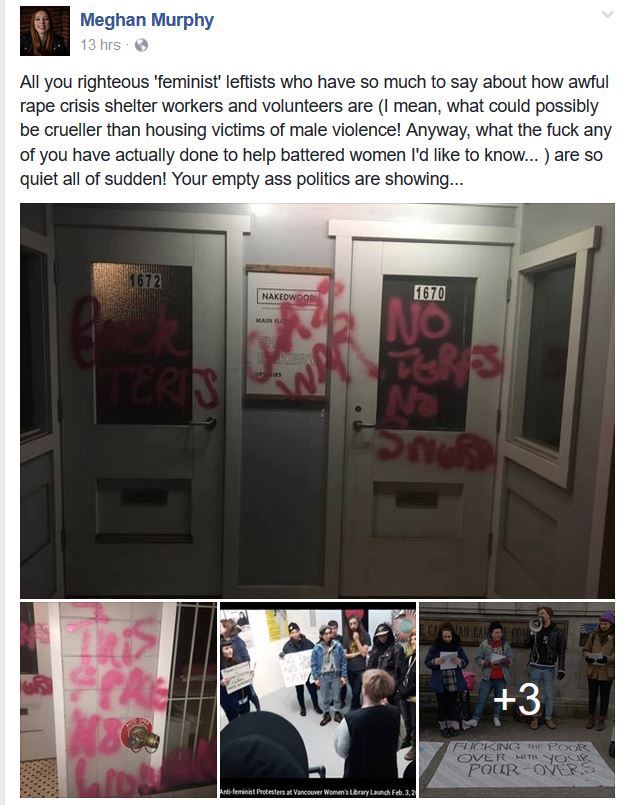
“GAG / Gays Against Gentrification have vandalized the building housing the Vancouver Women’s Library. This latest action is prompting the following comparison of this new alt-white group’s activism.
♂ ♂ ♂ ♂ ♂ ♂ ♂ ♂ ♂ ♂ ♂ ♂ ♂ ♂ ♂ ♂ ♂ ♂ ♂ ♂ ♂ ♂ ♂ ♂ ♂ ♂ ♂ ♂ ♂ ♂ ♂ ♂
Protest methods against for-profit business in Chinatown:
* Stand across the street, 1/2 a block away, sing a nice christmas song with the lyrics changed protesting gentrification & racism (as an all white group)
* Inch closer, but remain outside the business, on the far side of the sidewalk so as not to disrupt customers and business operations
* Smile, sing, display signs neatly and respectfully, either laid on the sidewalk or in their hands
* Abide by all common-sense understandings of legal protest on/near private property
* Take responsibility for and pride in their action
♀♀♀♀♀♀♀♀♀♀♀♀♀♀♀♀♀♀♀♀♀♀♀♀♀♀♀♀♀♀♀♀♀♀♀♀♀♀♀♀♀♀♀♀
Protest methods against volunteer-run, no-profit, free & inclusive women’s library on the night of their launch:
* Shout and scream slurs at library visitors outside
* Enter and take over the space with outraged entitlement
* Jason, a white male, continually asks which women inside are sex workers, and shouts “we don’t want you in our fucking spaces”, referencing the fact that he outed himself as a “trans person involved in sex work” thereby staking a claim to the area (?) which is a well known hunting ground for Johns seeking children and indigenous women specifically. Jason, are you a John? Can you clarify what you meant by “involved in sex work”? This can have so many meanings. TIA
* Destroy and steal library property: ripping artwork, destroying books, stealing wine, pulling the fire alarm
* Physically intimidate and assault library visitors outside
* Scream sexist slurs at women library visitors outside
* Bar library visitors from entering the space, actually turning people away who travelled in the heavy snow to reach the library
* Steal hand-painted sandwich board outside the library
* Vandalize the building that houses the library. A space shared by a diverse group of artists and artisans, jeopardizing the safety, livelihood, and work of many, not just that of the library.
* Discard all common-sense understandings of legal protest inside or on private property
* Deny any responsibility for their actions although almost every member of GAG was present and engaged
* Repeatedly claim to be committed to engaging in learning and discourse, yet reject, shut down, delete any and all criticisms, coming from a wide range of people and groups.”
So, GAG understands what peaceable protest looks like, but they chose not to when it comes to a library for women. This is what happens when women challenge the dominant male narrative in society, and this is why we need a feminist movement that is dedicated to fighting for female emancipation from patriarchy.
Donate to the Vancouver Women’s Library at this link.
“Suzannah Weiss writes, “A large part of feminism is obtaining equal treatment for women, so understandably, a lot of feminist efforts and rhetoric focus on women.”
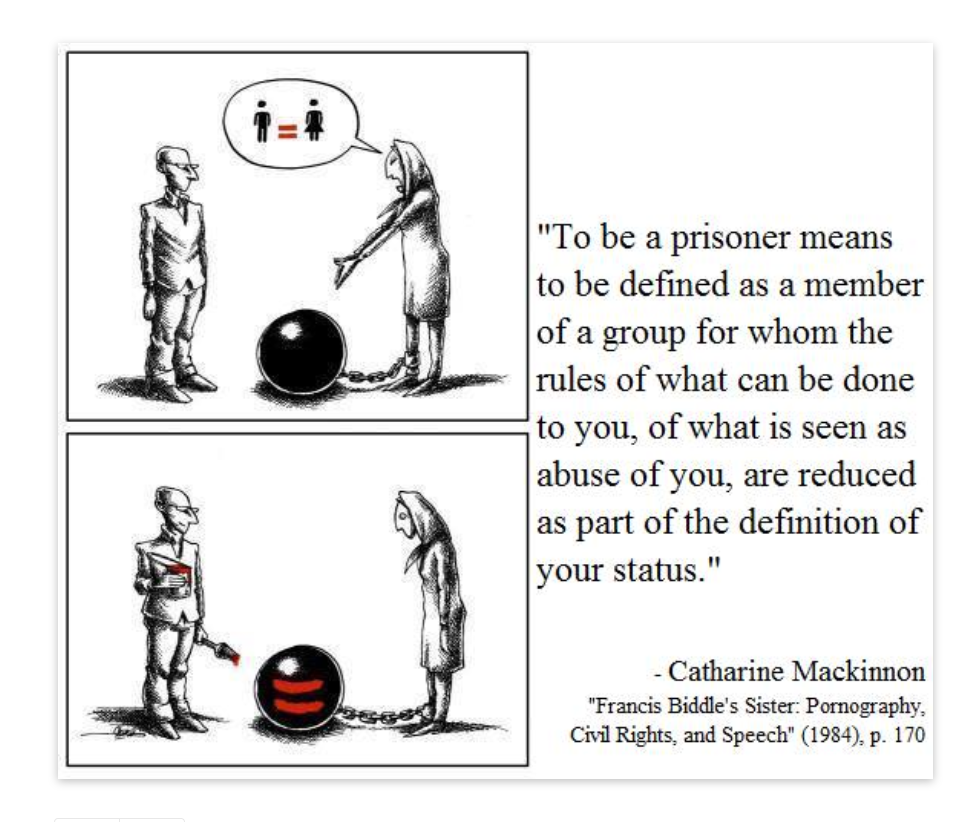
Well, nearly quoted the whole damn article, but so very important. Go to the national observer for the rest.
“In Wednesday’s House of Commons debate on Bill C-16, also known as the Transgender Rights Bill, Justice Minister Jody Wilson-Raybould, who introduced the legislation back in May, explained:
“Gender identity is a person’s internal or individual experience of their gender. It is a deeply felt experience of being a man, a woman, or being somewhere along the gender spectrum. Gender expression is how a person publicly presents their gender. It is an external or outward presentation through aspects such as dress, hair, makeup, body language, or voice.”
But these statements show a deep misunderstanding of what gender is and how it works. Gender is a product of patriarchy. Ideas around masculinity and femininity exist to naturalize men’s domination and women’s subordination. In the past, women were said to be too irrational, emotional, sensitive, and weak to engage in politics and public life. Men were (and often still are) said to be inherently violent, which meant things like marital rape and domestic abuse were accepted as unavoidable facts of life. “Boys will be boys,” is the old saying that continues to be applied to excuse the predatory, violent, or otherwise sexist behaviour of males.
The feminist movement began back in the late 1800s in protest of these ideas, and continues today on that basis. The idea that gender is something internal, innate, or chosen — expressed through superficial and stereotypical means like hairstyles, clothing, or body language — is deeply regressive.
Beyond misguided language there is the fact that we are very quickly pushing through legislation that conflicts with already established rights and protections for women and girls.
Women’s spaces — including homeless shelters, transition houses, washrooms, and change rooms — exist to offer women protection from men. It isn’t men who fear that women might enter their locker rooms and flash, harass, assault, abuse, photograph, or kill them… This reality is often left unaddressed in conversations around gender identity. This reality is sex-based, not identity-based. Men cannot identify their way out of the oppressor class so easily, neither can women simply choose to identify their way out of vulnerability to male violence.”
[…]
As unpopular as this fact has become, a man or boy who wishes to identify as a woman or girl, perhaps taking on stereotypically feminine body language, hairstyles, and clothing, is still male. He still has male sex organs, which means girls and women will continue to see him as a threat and feel uncomfortable with his presence in, say, change rooms. Is it now the responsibility of women and girls to leave their own spaces if they feel unsafe? Are teenage girls obligated to overcome material reality lest they be accused of bigotry? Is the onus on women to suddenly forget everything they know and have experienced with regard to sexual violence, sexual harassment, and the male gaze simply because one individual wishes to have access to the female change room? Because one boy claims he “feels like a girl on the inside?” And what does that mean, anyway?
Generally, the claim that one “feels” like the opposite sex “on the inside” is connected to a list of sexist gender stereotypes: a boy likes dolls and dresses, a girl plays with trucks and cuts her hair short, a man enjoys wearing pantyhose and getting manicures, etc… There is no scientific foundation for the idea that sex is defined by a “feeling” or by superficial choices. One cannot, in fact, “feel” like a man or a woman “on the inside,” because sex is something that simply exists. It is a neutral fact. Aside from having a mental condition like body dysmorphic disorder, the only reason one could claim not to “feel” like the sex they are, biologically, is because they identify with the gender roles assigned to the opposite sex. Key word: assigned.
It is unlikely any of us feel comfortable with the restrictive roles we are socialized into as men or women. Certainly those who step out of those roles are punished viciously, and that includes trans identified people. But that problem is a social one, and the solution is not to reinforce sexist ideas about gender, but to push back against the idea of gender itself – that is to say, the idea that males and females have innate behaviours and preferences they are born with. As feminists and progressives, we should challenge the idea that superficial things like clothing, toys, makeup, or mannerisms define us.
We live in a time when women and girls are killed every day, across the globe, by men. Things like rape, domestic abuse, and the murder of Indigenous women and girls in Canada are still not considered hate crimes. Yet we have managed to push through legislation that may very well equate “misgendering” to hate speech.
Women are protected under the human rights code on the basis that we are, as a group, discriminated against on account of our biology. Employers still choose not to hire women based on the assumption that they will become pregnant. Women are still fighting to have access to women-only spaces (including washrooms and locker rooms) in male-dominated workplaces like fire departments, in order to escape sexual harassment and assault.
Legislation and policies that protect “gender identity and expression” unfortunately set up a clash between women’s rights and those who identify as transgender. There are solutions. It was not always the norm, for example, that public buildings had to be accessible for people with disabilities. It is perfectly reasonable to expect public buildings to install private gender-neutral washrooms and change rooms for people who don’t wish to use either the women’s or the men’s room. We can effect change and ensure people have access to the services and support they need without imposing on already established and still very much needed rights of women and girls.
Women are socialized, from the time they are born, to prioritize the feelings and comfort of everyone else but themselves. We learn that our boundaries will not be respected by men, as we are talked over, leered at, cat called, groped, and raped. Girls’ images are constantly being shared electronically by boys and men alike, against their will. There is a real fear that images of our bodies will be put online in order to exploit and degrade us.
Our fears of men are justified, proven over and over again to be (sadly) rational, not irrational. That is something that needs to be respected, not treated as bigoted or hysterical. Society has disregarded women’s feelings, concerns, and safety for long enough.











 bleatmop
 Mystro


 Dead Wild Roses
Your opinions…