
You are currently browsing the tag archive for the ‘Meritocracy’ tag.
A University of Toronto Scarborough posting for an Assistant Professor in Computational Biology and Data Science looks like a standard academic hire. It isn’t. It is a restricted competition tied to a Canada Research Chair (CRC) nomination.
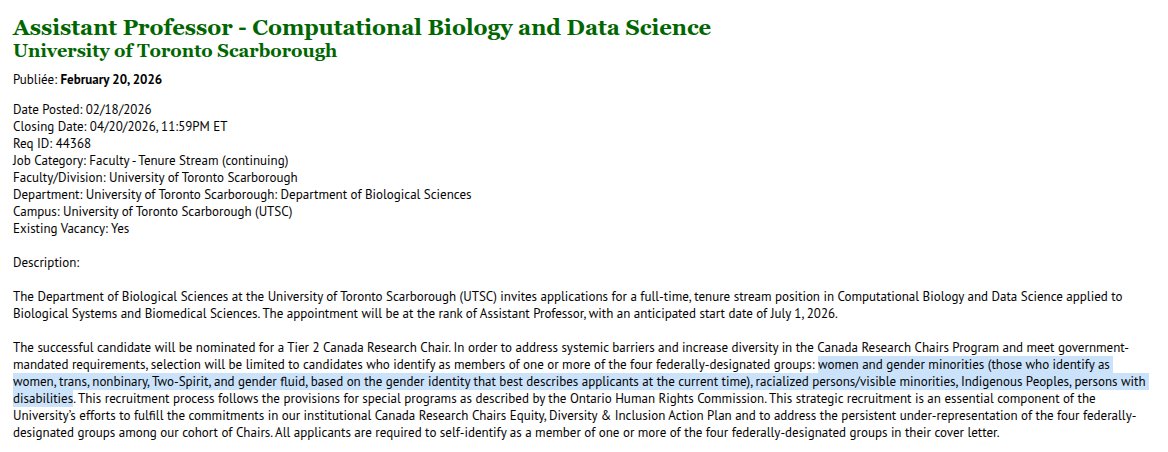 The posting requires applicants to self-identify as a member of one or more “designated groups” in their cover letter, namely women or gender minorities, racialized persons, Indigenous Peoples, or persons with disabilities. If you do not fit one of those categories, you are not eligible to apply. That is not an inference. It is in the posting.
That one detail captures the reality of modern equity administration in Canadian universities: what is framed as “removing barriers” often functions, in practice, as category-based exclusion.
This is not a rogue department. It is a federal program mechanism.
The university did not invent this framework on its own. The hiring restriction is attached to the Canada Research Chairs program, a federal initiative that allocates prestige and funding to institutions under defined rules. One major rule-set is the CRC equity framework, which includes population-based targets for the four designated groups. The program’s stated targets to be reached by the end of 2029 are: 50.9% women and gender equity-seeking groups, 22% racialized persons, 4.9% Indigenous Peoples, and 7.5% persons with disabilities.
Again, these are not vibes. They are published benchmarks tied to institutional plans and program governance.
The key point is the enforcement logic. Under the CRC’s settlement and enforcement framework, institutions that miss interim targets can face consequences that shape nominations and recruitment practices. In plain terms: the program can push institutions toward restricted competitions where eligibility is limited to designated groups.
So when you see a posting that excludes broad classes of Canadians from applying, it is not a one-off. It is a downstream product of rules that tie federal research prestige to demographic targets.
The problem is the normalization of identity gates
Defenders will say this is equity. They will argue that special measures are justified to counter historical bias and structural disadvantage. That is the argument, and it deserves to be stated fairly.
But there is a moral and civic cost to the method. When eligibility is restricted by identity categories, the institution is no longer selecting among all qualified candidates. It is selecting among those who clear an identity threshold first. That is not “equal opportunity.” It is a gate that sorts people before their work is even evaluated.
If you want a simple test for whether this is principled, reverse the identity labels. A posting that said “whites only” or “men only” would be condemned instantly, for good reason. You do not escape discrimination by flipping who benefits. You normalize discrimination by making it administratively routine.
A better standard
If Canada wants fairness in academic hiring, the standard should be straightforward: open eligibility, transparent criteria, and selection based on demonstrated excellence. If there are pipeline problems, fix the pipeline. Broaden recruitment, strengthen mentorship, reduce opaque networking advantages, and enforce accountable evaluation.
Do not solve bias by writing exclusions into job postings, then congratulating yourself for it. That approach trains young researchers to see institutions as political allocation machines rather than merit-seeking communities. And once that belief sets in, you do not get trust back easily.

References
1) U of T Scarborough job posting (Assistant Professor – Computational Biology and Data Science)
https://jobs.utoronto.ca/job/Scarborough-Assistant-Professor-Computational-Biology-and-Data-Science-ON/599939517/
2) Canada Research Chairs: “Establishing equity targets for 2021 to 2029”
https://www.chairs-chaires.gc.ca/program-programme/equity-equite/targets-cibles-eng.aspx
3) CRC Program representation statistics (lists the population-based targets and deadline)
https://www.chairs-chaires.gc.ca/about_us-a_notre_sujet/statistics-statistiques-eng.aspx
4) CRC: Equity, Diversity and Inclusion requirements and practices (overview, settlement context)
https://www.chairs-chaires.gc.ca/program-programme/equity-equite/index-eng.aspx
5) CRC: 2021 Canadian Human Rights Settlement Agreement page (program framing and enforcement context)
https://www.chairs-chaires.gc.ca/program-programme/equity-equite/2021_settlement-reglement-eng.aspx
6) House of Commons Standing Committee on Science and Research, Meeting No. 2 (witness panel includes Steven Pinker and Azim Shariff)
https://www.ourcommons.ca/documentviewer/en/45-1/SRSR/meeting-2/evidence
“And his analysis of “meritocracy” reveals the crude and misleading assumptions about creativity and intelligence upon which it rests. Instead of the comforting rationale that merit breeds success and that the successful have merit, Chomsky suggests, a more rational approach would be to speculate that in our society “wealth and power tend to accrue to those who are ruthless, cunning, avaricious, self-seeking, lacking in sympathy and compassion, subservient to authority ans willing to abandon principle for material gain, and so on.”
-James Peck – From the Introduction of the Chomsky Reader p.10
The quote may be suggesting a sort of ‘what they teach you in school’ versus what actually is type of situation. There is no doubt for me that creativity and intelligence are rewarded in our society, but rather the extent to which they are actually lauded in society is the issue being raised.
The fascinating bit here is how easy it is for us to fool ourselves into thinking we’re doing “x”, when in reality we are doing “y”. In this study, all that was required to mirror the bias in our society against women was for a company to have a policy of meritocracy in place. Under the aegis of this policy people in the study tuned out their thoughts and considerations for actual fairness and stopped appraising their actions.
“When it came time to divvy up $1,000 in bonus money, there was a stark divide between participants in the meritocracy and non-meritocracy conditions. When the fictional company stressed fairness and individual performance, subjects gave men about 12 percent more than equally qualified women on average. When it didn’t mention a focus on merit, there was no significant difference between the bonus for men and women.
Though the experiment didn’t provide specific insights into the reasons for the different results, based on previous academic work, Castilla and Benard suggest that the variance might have to do with the participants’ confidence in their own judgement. In agreeing with the company’s meritocratic principles, they might have bolstered their sense of their own objectivity or felt they had established their “moral credentials” as non-prejudiced people.
“An organizational culture that prides itself on meritocracy may encourage bias by convincing managers that they themselves are unbiased, which in turn may discourage them from closely examining their own behaviors for signs of prejudice,” Castilla and Benard write.”
And there be the one of the problems with existing within a society that has normalized patriarchal standards. It is so very easy to forget that the very societal air we breathe comes with a implicit set of normative attitudes that, when not consciously opposed, take over. This is why not conforming to patriarchal expectations is tiring because feminists know that the ‘autopilot’ is complete trash and must always be on manual control.











 bleatmop
 Mystro


 Dead Wild Roses
Your opinions…