
You are currently browsing the tag archive for the ‘Net Zero’ tag.
Across Canada, we are witnessing a subtle yet sweeping shift: ideology increasingly outweighs empirical judgment, and institutions once grounded in caution are now pressing ahead with conviction. When belief eclipses observation, society risks felling its own future. This essay explores how the parable of A Short History of Progress becomes a cautionary mirror for our age, when economic vitality, civic trust, and long-term health hang, in effect, on that final swing of the axe.
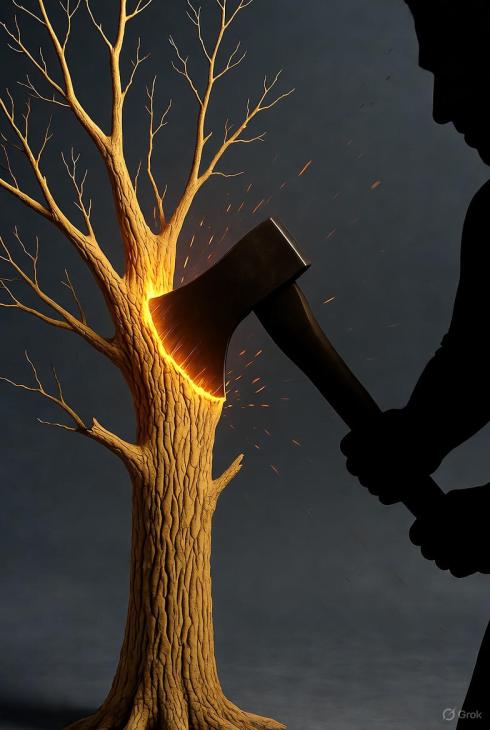
“The Last Tree” draws a sharp line from the collapse of Easter Island’s ecosystem to three modern Canadian crises—net-zero policy, selective law-enforcement in protest, and rapid-onset gender-affirming care—to ask: when ideology becomes our arbiter rather than evidence, what are we willing to sacrifice?
The Last Tree: When Ideology Fells the Future
In Ronald Wright’s A Short History of Progress, the tale of Easter Island stands as a stark parable of human folly. Isolated in the vast Pacific, the Rapa Nui people arrived around 800 AD and transformed a forested paradise into a monument to their ingenuity and hubris. Over centuries, they felled the island’s palm groves to haul colossal moai statues across the terrain, using timber for sledges, ropes from bark, and fuel for fires. What began as a display of ancestral piety and clan prestige spiraled into ecological catastrophe. Soil eroded, fertility plummeted, bird populations vanished, and the once-vibrant ecosystem crumbled. By the 17th century, the population had crashed from perhaps 15,000 to a few thousand, amid famine, warfare, and cannibalism. Wright captures the inexorable logic: progress, unchecked, devours its own foundations.
Yet it is the final act that lingers—a moment of crystalline horror. The people who felled the last tree could see it was the last, could know with complete certainty that there would never be another. Imagine that islander, axe in hand, gazing at the solitary palm swaying against the horizon. The wind carries the salt of an empty sea, the ground beneath him scarred and barren. What raced through his mind? Not ignorance, for the warnings were etched in the dust: topsoil washing into the ocean, rats devouring every seed, canoes rotting on barren shores. No, it was something fiercer—a conviction forged in ritual and rivalry.
This tree, he might have reasoned, honours the ancestors; to spare it is to dishonour them, to invite the gods’ wrath. The rival clan cannot be allowed supremacy in statue-toppling; one more moai secures our lineage’s glory. Tradition demands it, the priests decree it, and in the face of clan elders’ unyielding stares, doubt withers like the fronds around him. Survival? A coward’s calculus, subordinate to the sacred narrative of progress through monument. With a swing, ideology claims its victory over reality, sealing the island’s doom.
This scene, Wright implies, is not ancient history but a mirror to our own susceptibilities. Ideological blindness is not partisan—it afflicts any society where belief eclipses observation. We stand at analogous thresholds today, where cherished convictions compel us to strike the final blow.
Consider our pursuit of net-zero emissions, pursued with a fervour that borders on the messianic. The federal government’s 2030 targets, however well-intentioned, risk undermining the very prosperity they claim to safeguard. The rhetoric of existential apocalypse—tipping points invoked like divine judgments—drowns out the data: Canada’s emissions constitute roughly 1.5 percent of the global total, and even full compliance would yield negligible climatic impact while rivals like China and India accelerate coal-fired expansion. Policymakers, axe raised, justify the cut: it honours the intergenerational covenant, shames the sceptic as a heretic. Yet the last “tree” here is economic vitality itself, felled in service to a narrative that confuses virtue with viability.
No less alarming is the selective blindness in enforcing the rule of law, particularly amid the surge of “Free Palestine” protests since October 7, 2023. These demonstrations, while not all hateful, have coincided with a documented explosion of antisemitism: synagogues vandalised, Jewish students harassed, and public chants equating Zionism with Nazism increasingly tolerated under the banner of free expression. Authorities often cite the need to avoid escalation or protect equity rights—but to apply the law unevenly corrodes the Charter’s promise of equal protection. The justification echoes the islander’s: equity demands deference to the aggrieved, lest we be branded oppressors. Thus, the final tree of civic trust is hacked away under the banner of performative solidarity.
Perhaps most viscerally, our medical institutions’ embrace of gender-affirming care reveals ideology’s grip on empirical mercy. Provincial guidelines expedite hormones and surgeries for minors, often with scant longitudinal scrutiny, despite emerging evidence of regret and harm. Critics—including those echoing the UK’s Cass Review—argue that compassion has been recast as affirmation, turning clinics into ideological fortresses where dissent is pathologised. This is not to deny the reality of gender dysphoria or the dignity of trans adults seeking relief; it is to insist that true compassion must rest on evidence, not dogma. The clinician, scalpel poised, rationalises: empathy compels affirmation; to probe deeper risks transphobia’s charge. Reality—the patient’s lifelong body, the data’s gaps—yields to the doctrine, mutilating futures in the name of inclusion.
These Canadian vignettes, like Easter Island’s denouement, expose ideology’s seductive tyranny: a narrative so totalising it renders the evident obsolete. Friedrich Nietzsche foresaw this abyss in his dissection of nihilism, that devaluation where “the highest values are losing their value.” Like Wright’s islanders, we mistake self-destruction for virtue—a form of nihilism Nietzsche saw as civilisation’s end-game. Cloaked in Marxist activist garb—equity as the new god, progress as its prophet—these policies dissolve society’s sinews not through malice but through a will to power masquerading as justice. Nietzsche warned that such illusions prolong torment, for “hope in reality is the worst of all evils because it prolongs the torments of man.”
To reclaim our ground, we must confront the axe in our hand: interrogate the story, honour the verifiable, and plant anew before the last tree falls. The islanders could not. We still can.
References
- Wright, Ronald. A Short History of Progress. Anansi, 2004.
- Fraser Institute, “Measuring the Cost of Canada’s Net-Zero Climate Policy,” 2024.
- B’nai Brith Canada, Annual Audit of Antisemitic Incidents, 2024.
- Government of Canada, 2030 Emissions Reduction Plan, 2022.
- Cass, Hilary. Independent Review of Gender Identity Services for Children and Young People (The Cass Review). UK NHS, 2024.
- For Canada-specific studies on gender-affirming care outcomes:
- Jackman, Liam et al., “Patient-reported outcomes, provider-reported outcomes, and physiologic parameters after gender-affirming hormone treatment in Canada: a systematic review” (2025). (SpringerLink)
- Lawson, M.L. et al., “A Cross-Sectional Analysis from the Trans Youth CAN! Study” (2024). (Jah Online)
- “At-a-glance – Gender identity and sexual attraction among Canadian youth: findings from the 2019 Canadian Health Survey on Children and Youth” (2023). (canada.ca)











 bleatmop
 Mystro


 Dead Wild Roses
Your opinions…